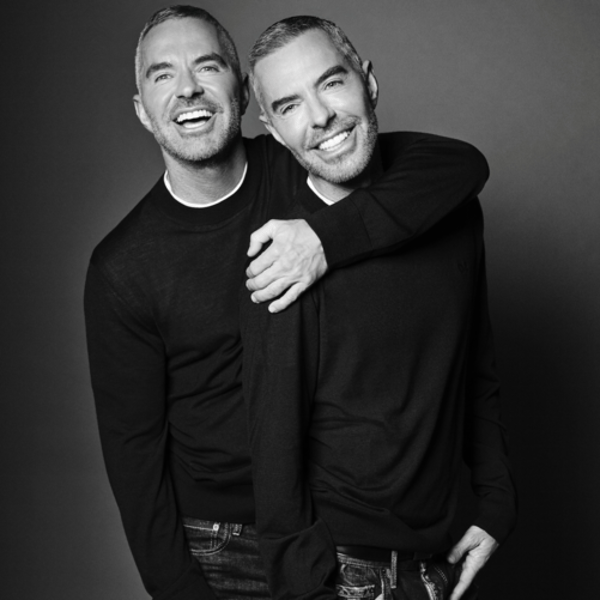
Dsquared2 and OTB Group’s Staff International operation have renewed their licensing agreement, “extending a long-standing collaboration that has underpinned the brand’s ready-to-wear business for more than 20 years”.
DSquared2’s Dean and Dan caten
It’s a “long-term deal” that we’re told “follows a period of reflection and realignment between the parties and cements their shared vision and values. Specifically, the renewal marks a new phase in the partnership, defined by a more focused, strategic, and coordinated approach”.
That’s perhaps an understatement given the sensational news headlines around the deal last year as DSquared2 took the decision to interrupt their licensing deal with Staff insisting it would enforce the agreement.
There were accusations of contractual breaches on both sides of the deal that was originally signed in 2002, extended in 2010, and not due to end until 2027.
But it’s been resolved now with DSquared2 saying the new “agreement comes at a pivotal moment” for it as it “embarks on a new brand chapter, accompanied by new internal leadership”.
The long-term license extension “allows Dsquared2 to focus on brand evolution and creative development, while drawing on Staff International’s infrastructure to deliver operational stability, product excellence, and global distribution”.
OTB and Staff’s Ubaldo Minelli
DSquared2’s founders and creative directors Dean and Dan Caten said: “This renewal underscores the strength of a partnership built over time and our confidence in its future. As we redefine [our] brand strategy, the continued support of a long-term partner who understands our creative vision is essential”.
And Ubaldo Minelli, OTB Group and Staff International CEO, added: “We are pleased to continue working alongside Dsquared2 and Dean and Dan. The extension of this license allows us to build on our shared achievements and contribute to the success of the brand.”
We’re told that further details on the brand’s strategic direction and upcoming initiatives will be announced in the coming months.
Maintaining consistency and not over-reacting on pricing is key for retailers as customers seek stability, the CEO of the biggest global IKEA franchisee told Reuters on Monday.
Deputy CEO and CFO of Ingka Group Juvencio Maeztu, visits an IKEA store in London, Britain November 28, 2023 – REUTERS/Maja Smiejkowska/File Photo
After hiking prices during the Covid-19 pandemic due to supply chain disruptions, the world’s biggest furniture retailer has cut prices over the past two years as high inflation and weak housing markets dented consumer demand.
“Companies want to have predictability and stability, but consumers also want to have stability in prices,” Ingka Group CEO Juvencio Maeztu said on the side-lines of the World Economic Forum annual meeting in Davos, Switzerland. “You have to secure stability as much as possible in the low prices,” he told the Reuters Global Markets Forum.
IKEA has been forced to increase prices again on some products in the United States, where it depends more on imports than elsewhere, to offset the impact of tariffs. Importers are braced for a Supreme Court ruling on the legality of President Donald Trump‘s sweeping global tariffs.
Asked about the ruling Maeztu, who became CEO in November last year, said he did not want to speculate. “What we are learning is we need to take things as they come, one by one,” he said.
“We cannot over-react, especially in pricing. We need to keep some kind of consistency,” he said, adding it was more important than ever to “zoom out” from short-term disruptions.
Ingka Group, which owns stores in 32 markets and accounts for 87% of IKEA sales, reported its lowest annual sales since 2021 in October, after cutting prices to attract consumers. Consumer sentiment across markets is now a “mix of being cautious and optimistic, both at the same time,” Maeztu said.
Kiton closes FY2025 with revenue up 3% at €230 million, and announces its arrival on Milan’s Via Montenapoleone in September.
Kiton, FW 2026/27
The Neapolitan men’s luxury brand grew “consistently across all regions, with the United States confirming its position as the leading market,” the company’s CEO, Antonio De Matteis, tells FashionNetwork.com.
For 2026, the company “already has a significant order book and we are quite confident. Right now, quality pays. End customers are looking for companies of great quality,” the CEO continues.
Today Kiton has 67 single-brand boutiques, which it aims to increase to 70 this year, including through a major investment in Milan. “In September we will open our second flagship in Milan, on Via Montenapoleone. It will be a very important step for us. We are not relocating; we are doubling up. We already have a 250 square-metre, two-storey space,” De Matteis reveals.
The focus on the wholesale channel has also been renewed. “I call it the training ground for companies, where they can test themselves against their competitors. Today the big department stores are the ones suffering; we hope this phase will pass. We remain convinced that wholesale will never end, because customers always enjoy shopping where they can see a broader selection of items,” says the entrepreneur.
In terms of product range, Kiton has turbocharged its accessories. “My nephew, who oversees the line, is doing an excellent job. The third generation is bringing us great satisfaction. KNT is also doing very well. It remains our great laboratory where we experiment with fabrics, patterns, proportions, and silhouettes. It is a tremendous help to the company. It shows us how far we can push and how far our end customer is willing to go,” De Matteis continues.
Kiton’s number one then downplays the impact of Trump’s tariffs. “The biggest issue this year has been the effect of exchange rates. Tariffs were not a problem, but we suffered a lot from the dollar’s depreciation. It costs us a few million in revenue and margin. Today the euro is too strong; it penalises us. We sell a year in advance, but ultimately we take in less,” notes the CEO.
In Milan, the brand presented its latest collection inside a “cinema” that shone a light on the behind-the-scenes of the historic tailoring house. “At a time when the supply chain is being called into question, we show how our garments are made. We own 100% of all the companies that make our products. ‘The Truth of Making’ is an expression of our transparency,” says De Matteis, who concludes with an anecdote from the founder, Ciro Paone. “My uncle used to say ‘The customer forgets the price and remembers the quality’.”
This article is an automatic translation. Click here to read the original article.
The opening of a mono-brand boutique in London is approaching for Boglioli, the iconic Italian menswear luxury brand, renowned above all for having made history with the unstructured jacket and making informal elegance its hallmark. “This is a store of just under 100 square metres on New Bond Street, with no fewer than five display windows and a corner site, hence dual frontage, which will afford us exceptional visibility and will sit alongside our boutiques in Milan and New York,” Francesco Russo, CEO of Boglioli- a brand that now offers a complete head-to-toe look for the contemporary man- tells FashionNetwork.com.
Boglioli, Autumn-Winter 2026/27
“We began with the unstructured jacket- often treated and garment-dyed- using exceptional, carefully sourced raw materials, or fabrics created exclusively for us, to achieve distinctive effects in both colour and handle,” says Francesco Russo. “Of course, an unstructured garment must still take on the shape of a jacket. And that is Boglioli’s savoir-faire. In my view, the world is full of unstructured jackets today; however, when it comes to soft tailoring, I consider the Boglioli jacket unrivalled. Building on this expertise, our day-to-day goal has been to develop a brand lifestyle over time through the creation of a complete wardrobe to dress the modern man.”
Today the Brescia-based company (its historic headquarters are in Gambara) offers trousers, shirts, knitwear, and coats, using materials of consistently the highest quality and silhouettes that are elegant, “but at the same time comfortable- so comfortable you forget you’re wearing them,” Russo notes. “What best encapsulates all these elements? The DNA of the first Boglioli jacket. If we can deliver that comfort to our customers, then we’ve hit the jackpot.”
The shop-in-shop strategy introduced a few years ago by the Brescia-based company around the world “is working extremely well,” says the CEO. “This format helps to keep the overall wholesale distribution strategy- now somewhat under pressure- vibrant. It’s a way, in the multi-brand arena, to cut through the jungle, the bazaar of similar propositions, because with a 5-10 square metre footprint, fully branded, you can send people a much clearer message. We have implemented shop-in-shops extensively in recent months,” Russo continues, “for example in Istanbul we did it with Beymen, in Düsseldorf and Cologne with Breuninger, in Zurich and Basel with Globus. In all these cases, Boglioli’s brand visibility and sales have surged. In March we will open another in Munich, at Lodenfrey, one of Germany’s leading menswear stores.”
Boglioli, Autumn-Winter 2026/27
This will be an additional space to the one the menswear brand has long maintained in the German store: a Boglioli pop-up that will be open for three weeks, “which will convey a targeted stylistic message for that market,” according to Russo.
Following the family’s exit and several changes of ownership, Boglioli is now majority-controlled by a Spanish investor, who took over in 2022 from another Spanish fund. A minority stake is owned by CEO Francesco Russo himself, who is modestly satisfied with turnover. “After reaching our all-time high of €19.5 million in turnover in 2024, last year we saw a slight single-digit decline, as we were affected by the slowdown in wholesale, but in 2026 we started well in the first two months of the sales campaign. If we add the London opening, which will definitely give the business a boost, I think we could reach our new record,” he says.
The brand’s largest market- having debuted in India in 2025- is the United States, followed by Italy, which generates 30% of sales. E-commerce has been growing steadily for the past few years, to the point that Russo speaks of record sales in this channel in 2025, at over €1.5 million. Until now it has been managed through an external partner, but from next March Boglioli has invested to bring it in-house, thereby increasing margins. “Above all, this strategy frees up resources for us to invest in content and marketing, which will then drive e-commerce growth further. So less investment in the platform, and more in content, in the message, in broadening the user base,” explains the Boglioli executive, who was impacted only initially by US tariffs.
Boglioli, Autumn-Winter 2026/27
“The negative impact was felt in April and May 2025, after Liberation Day on April 3, 2025,” says Russo. “From that moment, until the President of the United States said exactly what he wanted to do, people kept their money in their pockets, and we recorded two months of declining sales, particularly in our New York mono-brand boutique. Then, once Trump negotiated and clarified which tariffs he wanted to impose on our sector (ultimately very similar to those already in place), business returned to normal.”
For Boglioli’s CEO, the signing of the agreement to protect European excellences and, above all, to progressively eliminate duties on 91% of EU goods (including clothing and footwear), just concluded between the European Union and the Latin American Mercosur bloc, is therefore important. “It could certainly represent an excellent opportunity for us, because countries like Brazil, Chile, or Argentina- or Mexico, where we are already present but with very small distribution- are all penalised by punitive tariffs. Removing them opens up interesting developments for our brand, particularly in summer, but not only,” he confirms.
With its 155 employees in Italy, plus four in the New York store and a further four arriving in London, Boglioli presented four chapters of its Autumn-Winter 2026/27 collection in Milan: Back to Milano, Lunch in Galleria, Autumn in Brera and Bagai Club, in which the city becomes a direct source of inspiration. From the deep blues and greys of the business sphere, to shades of beige, to sage with luminous nuances; moving through the tones typical of the autumn foliage of literary Brera- where Boglioli’s signature green takes centre stage- to the warm hues of leather and camel, and the more exclusive colours of the Bagai Club proposals, where cocoa and mauve define a new idea of quiet luxury. The materials, also integral to the narrative, alternate between reinvented archival fabrics, ultra-fine wools, super-light flannels, regenerated cashmere, and treated corduroy.
Boglioli, Autumn-Winter 2026/27
Among the core jacket offerings, standouts include the Manin, a double-breasted model with a modern cut; the Treves, inspired by travel-ready safari jackets; and the Galleria, a fluid reinterpretation of the historic Gassmann: all designed for an international man who demands functionality, lightness, and versatility. Alongside these, the new technical over-jackets expand the concept of outerwear, integrating water-repellent treatments, lightweight padding, and functional details. All crafted by the in-house design studio led by Marco Re.
This article is an automatic translation. Click here to read the original article.