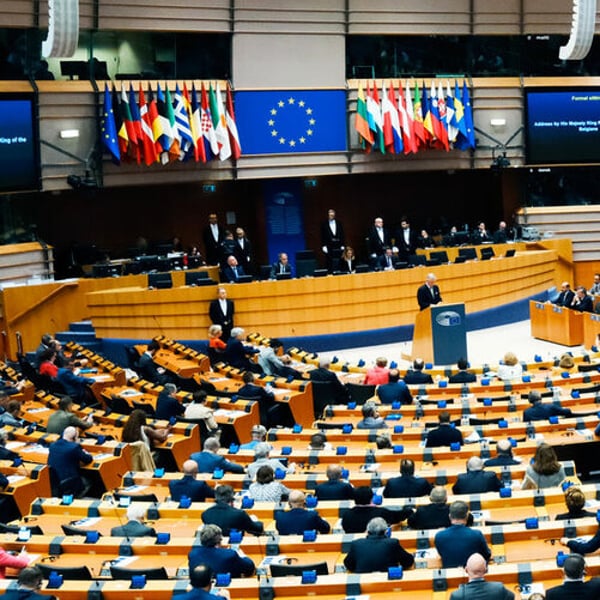
The right and the far right joined forces in the European Parliament on Thursday to unpick a law on major corporations’ social and environmental “due diligence” — a bombshell in Brussels.
Shutterstock
By 382 votes to 249, MEPs approved scaling back the text’s ambitions, limiting the number of companies covered, and removing some obligations. A weakened version of the text had been rejected by MEPs on October 22.
In a break with the traditional “pro-European” majority, an ad hoc alliance between the right (the EPP) and the far right sparked an outcry among the other groups.
The EPP “has torpedoed any moderate compromise,” lamented Social Democrat René Repasi. The vote serves as a warning to the pro-European camp, just as Parliament begins to tackle a series of measures to “simplify” business life.
The far right savoured a “great victory” on Thursday. “Another majority is possible” and “this is just the beginning”, declared the Patriots group, chaired by Jordan Bardella.
Adopted only eighteen months ago, this due diligence law is bearing the brunt of the European Union’s pro-business turn, buffeted by competition from China and tariffs in the US.
Its implementation had already been postponed by a year, from 2027 to 2028. But Brussels wants to go even further to lighten the administrative burden on companies across the continent.
Backed by penalties, the law adopted in 2024 required companies with over 1,000 employees to prevent and remedy human rights violations (child labour, forced labour, safety, etc.) and environmental damage throughout their value chains, including among their suppliers worldwide.
On Thursday, in line with the Member States, the European Parliament raised the thresholds for companies covered to more than 5,000 employees and over €1.5 billion in annual turnover.
Above all, MEPs scrapped the European civil liability regime, which served to harmonise companies’ obligations and their liability before the courts in the event of breaches.
Instead, parliamentarians opted to leave it to national legislation. They also abandoned the climate transition plans that companies were supposed to provide. A move that France, which has long boasted of having created the first national due diligence law, has pushed hard for since the beginning of the year, including through its president, Emmanuel Macron.
“Asphyxiation”
The law is now “completely empty”, laments centrist Pascal Canfin. This vote comes “during COP30” in Brazil and “represents a considerable setback for private-sector climate action”, he believes.
On the right, MEP François-Xavier Bellamy argues, by contrast, that this “simplification” will “save our businesses from regulatory asphyxiation”.
Following this vote, negotiations will begin with the Member States, with a view to the final adoption of the revised law.
“It is still possible to correct course”, says Jurei Yada of the E3G think tank, but the vote shows that “the far right is gaining influence” and that the pro-European majority is “crumbling”.
The absence of European civil liability risks introducing “competition between the 27 Member States to see who has the most lax regime to try to attract companies”, warns Swann Bommier of the NGO Bloom.
In the name of fighting bureaucracy, German Chancellor Friedrich Merz and French President Emmanuel Macron had called for the law to be scrapped altogether.
But even if it is only slashed, the pill is hard to swallow for some of the parliamentarians who had celebrated its “historic” adoption in April 2024 after several years of tug-of-war within the European institutions themselves.
There was no shortage of superlatives at the time, including among Macronists, such as the current president of the centrist Renew group, Valérie Hayer.
However, the political balance has shifted in the chamber since the June 2024 elections, marked by the strengthening of the right and the breakthrough of the far right, which wants to roll back the Green Deal, the package of environmental measures adopted during the previous term.
FashionNetwork.com with AFP.
This article is an automatic translation. Click here to read the original article.
The demerger of Unilever‘s ice cream division, to be named ‘The Magnum Ice Cream Company,’ which had been delayed in recent months by the US government shutdown, will finally go ahead on Saturday, the British group announced.
Reuters
Unilever said in a statement on Friday that the admission of the new entity’s shares to listing and trading in Amsterdam, London, and New York, as well as the commencement of trading… is expected to take place on Monday, December 8.
The longest federal government shutdown in US history, from October 1 to November 12, fully or partially affected many parts of the federal government, including the securities regulator, after weeks without an agreement between Donald Trump‘s Republicans and the Democratic opposition.
Unilever, which had previously aimed to complete the demerger by mid-November, warned in October that the US securities regulator (SEC) was “not in a position to declare effective” the registration of the new company’s shares. However, the group said it was “determined to implement in 2025” the separation of a division that also includes the Ben & Jerry’s and Cornetto brands, and which will have its primary listing in Amsterdam.
“The registration statement” for the shares in the US “became effective on Thursday, December 4,” Unilever said in its statement. Known for Dove soaps, Axe deodorants and Knorr soups, the group reported a slight decline in third-quarter sales at the end of October, but beat market expectations.
Under pressure from investors, including the activist fund Trian of US billionaire Nelson Peltz, to improve performance, the group last year unveiled a strategic plan to focus on 30 power brands. It then announced the demerger of its ice cream division and, to boost margins, launched a cost-saving plan involving 7,500 job cuts, nearly 6% of the workforce. Unilever’s shares on the London Stock Exchange were steady on Friday shortly after the market opened, at 4,429 pence.
This article is an automatic translation. Click here to read the original article.
Burberry has named a new chief operating and supply chain officer as well as a new chief customer officer. They’re both key roles at the recovering luxury giant and both are being promoted from within.
Matteo Calonaci becomes chief operating and supply chain officer, moving from his role as senior vice-president of strategy and transformation at the firm.
In his new role, he’ll be oversee supply chain and planning, strategy and transformation, and data and analytics. He succeeds Klaus Bierbrauer, who’s currently Burberry supply chain and industrial officer. Bierbrauer will be leaving the company following its winter show and a transition period.
Matteo Calonaci – Burberry
Meanwhile, Johnattan Leon steps up as chief customer officer. He’s currently currently Burberry’s senior vice-president of commercial and chief of staff. In his new role he’ll be leading Burberry’s customer, client engagement, customer service and retail excellence teams, while also overseeing its digital, outlet and commercial operations.
Both Calonaci and Leon will join the executive committee, reporting to Company CEO Joshua Schulman.
JohnattanLeon – Burberry
Schulman said of the two execs that the appointments “reflect the exceptional talent and leadership we have at Burberry. Both Matteo and Johnattan have been instrumental in strengthening our focus on executional excellence and elevating our customer experience. Their deep understanding of our business, our people, and our customers gives me full confidence that their leadership will help drive [our strategy] Burberry Forward”.
Traditional and occasion wear designer Puneet Gupta has stepped into the world of fine jewellery with the launch of ‘Deco Luméaura,’ a collection designed to blend heritage and contemporary aesthetics while taking inspiration from the dramatic landscapes of Ladakh.
Hints of Ladakh’s heritage can be seen in this sculptural evening bag – Puneet Gupta
“For me, Deco Luméaura is an exploration of transformation- of material, of story, of self,” said Puneet Gupta in a press release. “True luxury isn’t perfect; it is intentional. Every piece is crafted to be lived with and passed on.”
The jewellery collection features cocktail rings, bangles, chokers, necklaces, and statement evening bags made in recycled brass and finished with 24 carat gold. The stones used have been kept natural to highlight their imperfect and unique forms and each piece in the collection has been hammered, polished, and engraved by hand.
An eclectic mix of jewels from the collection – Puneet Gupta
Designed to function as wearable art pieces, the colourful jewellery echoes the geometry of Art Deco while incorporating distinctly South Asian imagery such as camels, butterflies, and tassels. Gupta divides his time between his stores in Hyderabad and Delhi and aims to bring Indian artistry to a global audience while crafting a dialogue between designer and artisan.