Connect with us

Politics

In Jeffrey Epstein furor, Donald Trump struggles to shake off a controversy his allies once stoked
Published

on


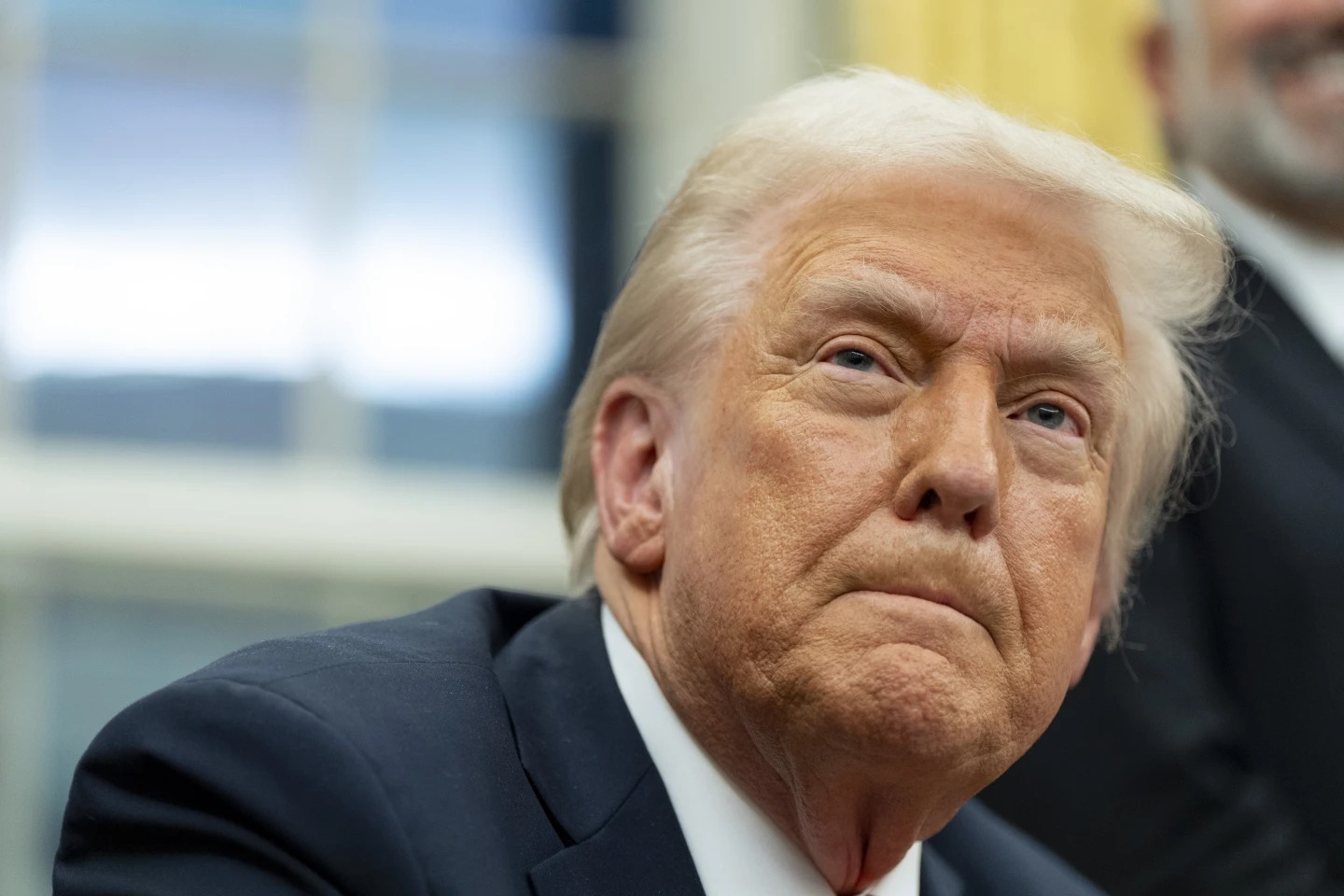
Despite the sun bearing down on him and the sweat beading across his face, President Donald Trump still lingered with reporters lined up outside the White House on Friday. He was leaving on a trip to Scotland, where he would visit his golf courses, and he wanted to talk about how his administration just finished “the best six months ever.”

But over and over, the journalists kept asking Trump about the Jeffrey Epstein case and whether he would pardon the disgraced financier’s imprisoned accomplice, Ghislaine Maxwell.

“People should really focus on how well the country is doing,” Trump insisted. He shut down another question by saying, “I don’t want to talk about that.”

It was another example of how the Epstein saga — and his administration’s disjointed approach to it — has shadowed Trump when he’s otherwise at the height of his influence. He’s enacted a vast legislative agenda, reached trade deals with key countries and tightened his grip across the federal government. Yet he’s struggled to stamp out the embers of a political crisis that could become a full-on conflagration.

Trump faces pressure from his own supporters

The Republican President’s supporters want the government to release secret files about Epstein, who authorities say killed himself in his New York jail cell six years ago while awaiting trial for sex trafficking. They believe him to be the nexus of a dark web of powerful people who abused underage girls. Administration officials who once stoked conspiracy theories now insist there’s nothing more to disclose, a stance that has stirred skepticism because of Trump’s former friendship with Epstein.

Trump has repeatedly denied prior knowledge of Epstein’s crimes and claimed he cut off their relationship long ago. For a President skilled at manipulating the media and controlling the Republican Party, it has been the most challenging test of his ability to shift the conversation in his second term.

“This is a treadmill to nowhere. How do you get off of it?” said Kevin Madden, a Republican strategist. “I genuinely don’t know the answer to that.”

Trump has demanded his supporters drop the matter and urged Republicans to block Democratic requests for documents on Capitol Hill. But he has also directed the Justice Department to divulge some additional information in hopes of satisfying his supporters.

A White House official, who insisted on anonymity to discuss internal strategy, said Trump is trying to stay focused on his agenda while also demonstrating some transparency. After facing countless scandals and investigations, the official said, Trump is on guard against the typical playbook of drip-drip disclosures that have plagued him in the past.

It’s clear Trump sees the Epstein case as a continuation of the “witch hunts” he’s faced over the years, starting with the investigation into Russian interference during his election victory over Democrat Hillary Clinton nearly a decade ago. The sprawling inquiry led to convictions against some top advisers but did not substantiate allegations Trump conspired with Moscow.

Trump’s opponents, he wrote on social media on Thursday, “have gone absolutely CRAZY, and are playing another Russia, Russia, Russia Hoax but, this time, under the guise of what we will call the Jeffrey Epstein SCAM.”

During the Russia investigation, special counsel Robert Mueller and his team of prosecutors were a straightforward foil for Trump to rail against. Ty Cobb, the lawyer who served as the White House’s point person, said the President “never felt exposed” because “he thought he had a legitimate gripe.”

The situation is different this time now that the Justice Department has been stocked with loyalists. “The people that he has to get mad at are basically his people as opposed to his inquisitors and adversaries,” Cobb said.

It was Trump’s allies who excavated the Epstein debacle

In fact, Trump’s own officials are the most responsible for bringing the Epstein case back to the forefront.

FBI Director Kash Patel and his Deputy, Dan Bonginoregularly stoked conspiracy theories about Epstein before assuming their current jobs, floating the idea the government had covered up incriminating and compelling information that needed to be brought to light. “Put on your big boy pants and let us know who the pedophiles are,” Patel said in a 2023 podcast.

Attorney General Pam Bondi played a key role, too. She intimated in a Fox News Channel interview in February that an Epstein “client list” was sitting on her desk for review — she would later say she was referring to the Epstein files more generally — and greeted far-right influencers with binders of records from the case that consisted largely of information already in the public domain.

Tensions spiked earlier this month when the FBI and the Justice Department, in an unsigned two-page letter, said that no client list existed, that the evidence was clear Epstein had killed himself and that no additional records from the case would be released to the public. It was a seeming backtrack on the administration’s stated commitment to transparency. Amid a fierce backlash from Trump’s base and influential conservative personalities, Bongino and Bondi squabbled openly in a tense White House meeting.

Since then, the Trump administration has scrambled to appear transparent, including by seeking the unsealing of grand jury transcripts in the case — though it’s hardly clear that courts would grant that request or that those records include any eye-catching details anyway. Deputy Attorney General Todd Blanche has taken the unusual step of interviewing the imprisoned Maxwell over the course of two days at a courthouse in Tallahassee, Florida, where her lawyer said she would “always testify truthfully.”

All the while, Trump and his allies have resurfaced the Russia investigation as a rallying cry for a political base that has otherwise been frustrated by the Epstein saga.

Trump’s Director of National Intelligence, Tulsi Gabbard, who just weeks ago appeared on the outs with Trump over comments on Iran’s nuclear ambitions, seemed to return to the President’s good graces this week following the declassification and release of years-old documents she hoped would discredit long-settled conclusions about Russian interference in the 2016 election.

The developments allowed Trump to rehash longstanding grievances against President Barack Obama and his Democratic advisers. Trump’s talk of investigations into perceived adversaries from years ago let him, in effect, go back in time to deflect attention from a very current crisis.

“Whether it’s right or wrong,” Trump said, “it’s time to go after people.”

___

Republished with permission of The Associated Press.


Post Views: 0


Source link

Continue Reading

Politics

Ron DeSantis appoints new members to 2 Florida county commissions

Published

on


Patricia ‘Trish’ Petrosky is being added to the Lee County Commission while Charles ‘Wade’ Ellenburg joins the Holmes County Commission.

Two Florida county commissions are getting new members.

Gov. Ron DeSantis appointed two new county commissioners this month. One is taking a seat on the Lee County Board of Commissioners. The other will assume a seat on the Holmes County Commission.

DeSantis appointed Patricia “Trish” Petrosky to the Lee County Commission, home to Fort Myers. Petrosky is replacing Mike Greenwell.

Greenwell served on the District 5 seat of the County Commission since July 2022. That’s when DeSantis appointed Greenwell to that panel. Greenwell would rise to Chairman of the Lee County Commission in 2024 and he was reelected to that post that year. But he passed away Oct. 9 after a battle with cancer and there were memorial services in Lee County. DeSantis also ordered American and Florida flags to fly at half staff on Oct. 21.

Greenwell was with the Boston Red Sox Major League Baseball organization for about a dozen years. That franchise has Spring Training operations in Fort Myers and Greenwell returned to Lee Countyt to raise a family and entered local business.

Petrosky is the Executive Assistant at Evangelical Christian School in Fort Myers. She also was a former realtor with Berkshire Hathaway HomeServices and was a member of the Naples Area Board of Realtors Association.

Meanwhile in Holmes County, DeSantis has appointed Charles “Wade” Ellenburg to that County Commission.

Ellenburg fills the District 2 seat on the Holmes County board after Brandon Newsom was suspended from the panel this year following felony charges. Newsom was involved allegations of violating bail bond laws in the Northwest Florida county that boarders the Georgia state line, according to a report in the Holmes County News.

Ellenburg is a farmer in Holmes County and is a member of the Florida Farm Bureau Holmes County Board of Directors. He also serves on the Fruit and Vegetables State Advisory Board for that bureau. Ellenburg was also elected to the Holmes County Value Adjustment Board this year.


Source link

Continue Reading

Politics

Ben Gibson reappointed General Counsel of Republican National Lawyers Association

Published

on


Gibson was one of Florida’s electors in the presidential election for 2024 in the Electoral Collage.

The General Counsel of the Republican National Lawyers Association (RLNA) is a Florida lawyer who’s getting another crack at the position.

Ben Gibson was reappointed this month to the General Counsel’s job of the RLNA. Gibson was lauded by the Republican Party of Florida for the top legal position in the organization that represents the conservative-leaning legal eagles.

Even Power, Under Chairman of the Republican Party of Florida, said in a news release, Gibson has already been instrumental in building effective legal teams across the U.S. and provided victories for the party regarding Florida’s election laws.

“Ben Gibson is one of the best Republican lawyers in the nation. He has delivered big wins for Florida and the Republican Party. We are proud of his reappointment to the RNLA and proud that Florida continues to lead the nation in election integrity,” Power said.

The RNLA is a networking organization for lawyers who are Republican and the group’s main objectives include advancing professionalism for practicing lawyers and law students. The group provides networking and legal education for political, government and legislative law. It also advocates for open and fair elections while advancing Republican philosophy. Gibson is also on the Board of Governors for the Executive Committee for the RNLA and is the Chapter Chair of the group.

Beyond his RNLA activities, Gibson is the Managing Partner for the law firm Shutts & Bowen in the Tallassee office. Gibson primarily practices political law and has represented statewide political candidates, Republican Party committees, political committees and nonprofit organizations in litigation, compliance and administrative proceedings on the state and national level.

Gibson was one of Florida’s electors in the presidential election for 2024 and cast his ballot for President Donald Trump and Vice President JD Vance in the Electoral College. Gibson’s also been the Chief Legal Counsel for the Republican Party of Florida for the past four election cycles.


Source link

Continue Reading

Politics

Another blue wave? Meet the Democrat trying to make it happen and the Republican trying to stop her

Published

on


Even though Republican Brian Jack is only a first-term congressman, he has become a regular in the Oval Office these days. As the top recruiter for his party’s House campaign team, the Georgia native is often reviewing polling and biographies of potential candidates with President Donald Trump.

Lauren Underwood, an Illinois congresswoman who does similar work for Democrats, has no such West Wing invitation. She is at the other end of Pennsylvania Avenue working the phones to identify and counsel candidates she hopes can erase Republicans’ slim House majority in November’s midterm elections.

Although they have little in common, both lawmakers were forged by the lessons of 2018, when Democrats flipped dozens of Republican-held seats to turn the rest of Trump’s first term into a political crucible. Underwood won her race that year, and Jack became responsible for dealing with the fallout when he became White House political director a few months later.

Underwood wants a repeat in 2026, and Jack is trying to stand in her way.

For Republicans, that means going all-in on Trump and his “Make American Great Again” agenda, gambling that durable enthusiasm from his base will overcome broader dissatisfaction with his leadership.

“You’re seeing a lot of people very inspired by President Trump,” Jack said about his party’s House candidates. “They’re excited to serve in this body alongside him and the White House. That’s been a tool and a motivating factor for so many people who want to run.”

Underwood said she is looking for candidates with community involvement and public service beyond Washington politics. A registered nurse, she was a health care advocate before she ran in 2018, joining a cadre of Democratic newcomers that included military veterans, educators, activists and business owners.

“It’s about having ordinary Americans step up” in a way that “draws a sharp contrast with the actions of these MAGA extremists,” she said.

It’s routine for a president’s party to lose ground in Congress during the first midterms after winning the White House. Trump, however, is in the rare position to test that historical trend with a second, nonconsecutive presidency.

Neither party has released its list of favored candidates in targeted seats. But Jack said Oval Office discussions with Trump focus on who can align with the White House in a way that can win.

Jack highlighted former Maine Gov. Paul LePage as an example. LePage is running in a GOP-leaning district where Democrats face the challenge of replacing Rep. Jared Golden, another member of the party’s 2018 class who recently announced he would not seek reelection.

Trump’s involvement contrasts with 2017, when he was not as tied to House leadership, including then-Speaker Paul Ryan, a Wisconsin Republican, on details of the midterm campaign as he is now. Jack, who got his start with Trump by managing delegate outreach before the 2016 convention, was White House deputy political director during that span. He was promoted to political director after the 2018 losses.

Jack continued advising the president, especially on his endorsements, between Trump’s 2021 departure for the White House and Jack’s own congressional campaign in 2024. He described Trump as intimately involved in recruitment decisions and open to advice on his endorsements since those 2018 defeats.

Trump loyalty will not always be easy to measure, especially in first-time candidates.

But Jack said Republicans have quality options. He pointed to Albuquerque, New Mexico, where Republicans could have a competitive primary that includes Jose Orozco, a former Drug Enforcement Administration contractor, and Greg Cunningham, a former Marine and police officer.

“They both have very inspirational stories,” Jack said.

Orozco has asked voters to “give President Trump an ally in Congress.” Cunningham did not focus on Trump in his campaign launch.

Underwood said Democrats are replicating a district-by-district approach of 2018. Recruiting in the Trump era, she said, is more often about talking with prospective candidates who raised their hands to run than about coaxing them into politics.

The notable numbers of women and combat veterans in her first-term class, Underwood said, was not a top-down strategy but the result of candidates who saw Trump and Republicans as threats to functional government and democracy.

Underwood, who at age 32 became the youngest Black woman ever to serve in Congress after her 2018 election, recalled that Republicans’ efforts to repeal the Affordable Care Act spurred her to run because of her training as a nurse. She shares those experiences with recruits, sharpening how they can connect their ideas and background to the job of a congressperson.

Underwood said she also regularly fields questions about serving in an era of political violence and about the day-to-day balance of being a candidate or congressperson, especially from recruits who have children.

National security is again a draw for Democrats. Former Marine JoAnna Mendoza is running in a largely rural southern Arizona seat and former Rep. Elaine Luria, another Underwood classmate and former naval officer, is running again in Virginia after losing her seat in 2022. Luria was among the lead House investigators of the Jan. 6, 2021, Capitol riot.

Underwood said there are clear parallels to 2018, when successful congressional candidates included Mikie Sherrill, a former Navy helicopter pilot who is now New Jersey governor-elect; Jason Crow, a former Army Ranger who is one of her recruiting co-chairs; and Virginia Gov.-elect Abigail Spanberger, a former CIA case officer.

Democrats also noted the need to find candidates who reflect a district’s cultural sensibilities, meaning a candidate who can withstand Republican accusations that national Democrats are out of touch with many voters.

For instance, in a South Texas district, the top potential Democratic challenger is Tejano music star Bobby Pulido. The five-time Latin Grammy nominee has criticized progressive Rep. Alexandria Ocasio-Cortez of New York for using the term “Latinx” rather than “Latino” or “Latina.”

Mid-decade gerrymandering, mostly in Republican-led states at Trump’s behest, leaves the state of the 435 House districts in flux. Even with the changes, Democrats identify more than three dozen Republican-held seats they believe will be competitive. Republicans counter with about two dozen Democratic-held seats they think can flip.

In the Southwest, Democrats are targeting all three Republican seats in Arizona. The GOP is aiming at three Democratic seats in Nevada. From the Midwest across to the Philadelphia suburbs, Democrats want to flip two Iowa seats, two in Wisconsin three in Michigan, three in Ohio and four in Pennsylvania. Republicans are targeting four Democratic seats in New York.

Nearly all Democratic targets were within a 15-percentage point margin in 2024, many of them much closer than that. Democratic candidates in 2025 special elections typically managed double-digit gains compared with Trump’s margins in 2024, including a recent special House election in Tennessee, when Democrats came within 9 points in a district Trump won by 22 points.

“It’s the same kind of shifts that we saw in 2017 before the 2018 wins,” said Meredith Kelly, a top official at the Democratic Congressional Campaign Committee during Trump’s first presidency. “So, it becomes a mix of that national environment and finding the right candidates who fit a district and can take advantage.”

___

Republished with permission of The Associated Press.


Source link

Continue Reading

Trending

Copyright © Miami Select.