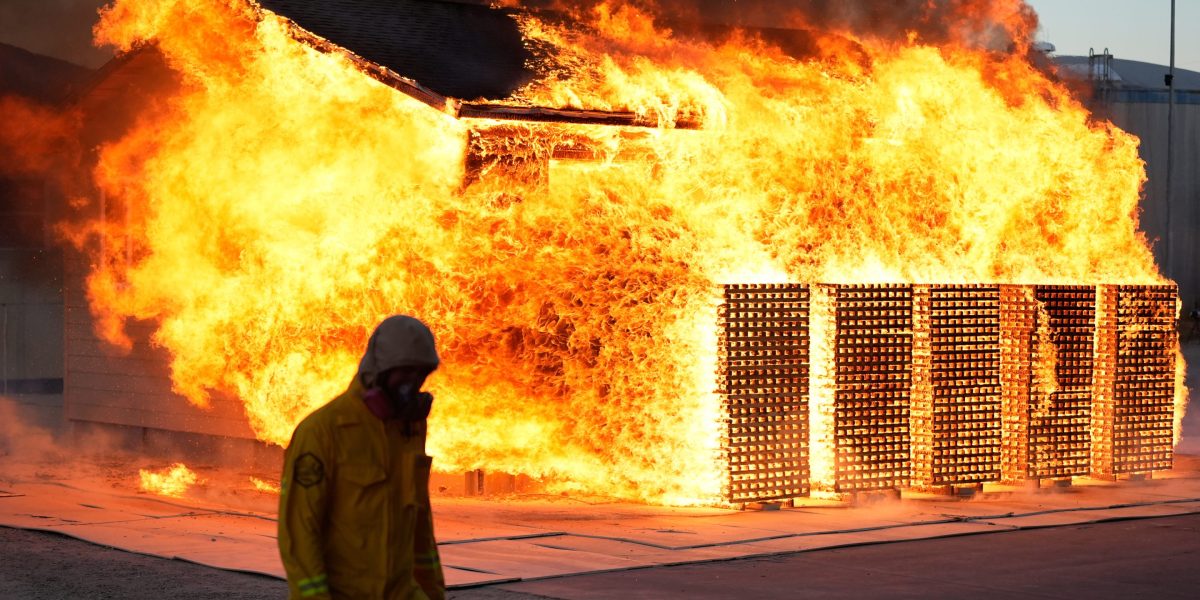
That home went up in flames slower because it was fortified with better materials. Add moving vegetation, mulch, wood fences and hot tubs with their highly flammable insultation several feet away and experts said you can protect houses from the increasing danger of wildfires on a warming planet.
The research is being done by workers at a remote site in South Carolina. They have set fire to 13 houses because scientists need to burn to learn.
Inside the carefully crafted home were sensors and a few cameras the site’s manager said will “give their life for science.” Outside are nearly $1 million of other cameras and instruments in a fireproof building nearby and scattered around.
The Insurance Institute for Business & Home Safety is a nonprofit created by insurers to make houses and other buildings more resilient. The institute’s 100-acre (40-hectare) site in Richburg, South Carolina, started to study hurricanes and heavy wind and rain.
As wildfire danger increased in recent years, they sometimes turn the six-story tall wall of 105 fans stacked on top of each other to blow out of the wind tunnel’s massive doors and spread fire.
“We crash test houses,” said Roy Wright, the president of the institute.
Wildfires are worsening, costing more damage
From 2016 to 2025, wildfires in the United States on average burned an area the size of Massachusetts each year, slightly more than 11,000 square miles (28,500 square kilometers). That’s 2.6 times the average burn area of the 1980s, according to the National Interagency Fire Center. Canada’s land burned on average for the last 10 years is 2.8 times more than during the 1980s, according to the Canadian Interagency Forest Fire Centre.
In the United States, wildfires have caused an average of $17.7 billion a year in damage since 2020, according to statistics kept by the National Oceanic and Atmospheric Administration and the nonprofit Climate Central.
Climate change is intensifying and extending fire seasons across the U.S. and a growing population puts densely packed neighborhoods into fire-threatened areas. In the past three years, massive and devastating wildfires hit California, Maui in Hawaii and the North and South Carolina mountains.
Drought across much of the United States — especially in the West and Southeast — is at record severe levels for this time of year. Add to that record heat and unheard of levels of low moisture in the West for the first three months of 2026 and it looks like this upcoming fire season will be extraordinarily bad, unless late spring or early summer rain somehow bails out the country, said UCLA climate and fire scientist Park Williams.
Test fires lead to building changes
The institute’s research has already led to some conclusions that strengthened California’s fire code. New homes must have ignition-resistant walls, tempered or double paned windows and mesh over vents to prevent fire embers from getting inside.
As important is taking care of the outside. Creating a 5-foot (1.5-meter) buffer where any material that burns easy like pine straw, a hot tub, a wooden fence or overhanging branches is an important line of defense.
The fire testing makes that clear. Researchers at the test site set fire to wooden blocks that look like Jenga towers within the buffer zone. The simulated winds, which in a recent test purposefully fluctuated between 30 and 55 mph (50 to 90 kph), continually pushed the flames toward the home.
Once the windows and walls are breached, all the combustible things inside like couches, furniture, clothes and plastics quickly erupt and begin sending large showers of dangerous burning embers lofted by heavy wind, setting new fires a block or two away.
But fire standards can only help so much. “Under really severe fire conditions, especially those involving very high winds, they probably are of more limited value,” Syracuse University fire researcher Jacob Bendix said.
Home fire prevention becomes a business
Fire prevention tools and techniques are becoming a big business.
After the 2018 Woolsey fire near his home in Ventura County, California, Nicholai Allen watched firefighters use fire retardants and wondered if homeowners could do the same. He became a wildland firefighter and learned that preventing embers from getting into homes’ attics and garages are the key.
Allen now makes and sells Safe Soss (pronounced like sauce), which include carbon filters or guards for attics and vents, fiberglass heat-resistant ember-stopping tape and a spray fire retardant that can work from a garden hose, all of which recently became available at a major hardware chain.
Allen compares it to how people up north get ready for winter.
“It’s kind of like if you live in the snow, you have a snow shovel, you have scrapers, and you know that you have to take certain preventative steps in order to live in an environment that, hey, sometimes snows,” Allen said.
Trial by fire
The test fires by the Insurance Institute for Business & Home Safety are carefully controlled. The homes are made to be as similar to regular houses as possible without electricity or plumbing.
The attention to detail and safety is exacting. The institute likes spring fire testing at its site about halfway between Charlotte, North Carolina and Columbia, South Carolina, because while summer temperatures in the South can nearly match those in the fire-prone West, the swampy humidity in July is a bad approximation to a mountain canyon.
High winds delayed last week’s fire for more than six hours with anxious workers worried they couldn’t wait for the next day because an outdoor burning ban was starting after an unusually dry and hot spring.
Tarps and machines heat the houses to summer levels just before the fires are set on a huge concrete pad just outside the giant hanger where the fans line one wall and the hurricane testing takes place.
Elsewhere at the site, researches have started looking into hail and how it can damage homes. Another part of the campus has dozens of roofs just sticking above the ground as the shingles freeze and bake and are soaked by Mother Nature sometimes for more than a decade for more testing.
___
Borenstein reported from Washington. Associated Press journalist Erik Verduzco contributed from Richburg, South Carolina.
___
The Associated Press’ climate and environmental coverage receives financial support from multiple private foundations. AP is solely responsible for all content. Find AP’s standards for working with philanthropies, a list of supporters and funded coverage areas at AP.org.