Connect with us

Business

Trump’s TACO tariff parade: Here are all the times he talked a big game and didn’t back it up on trade

Published

on


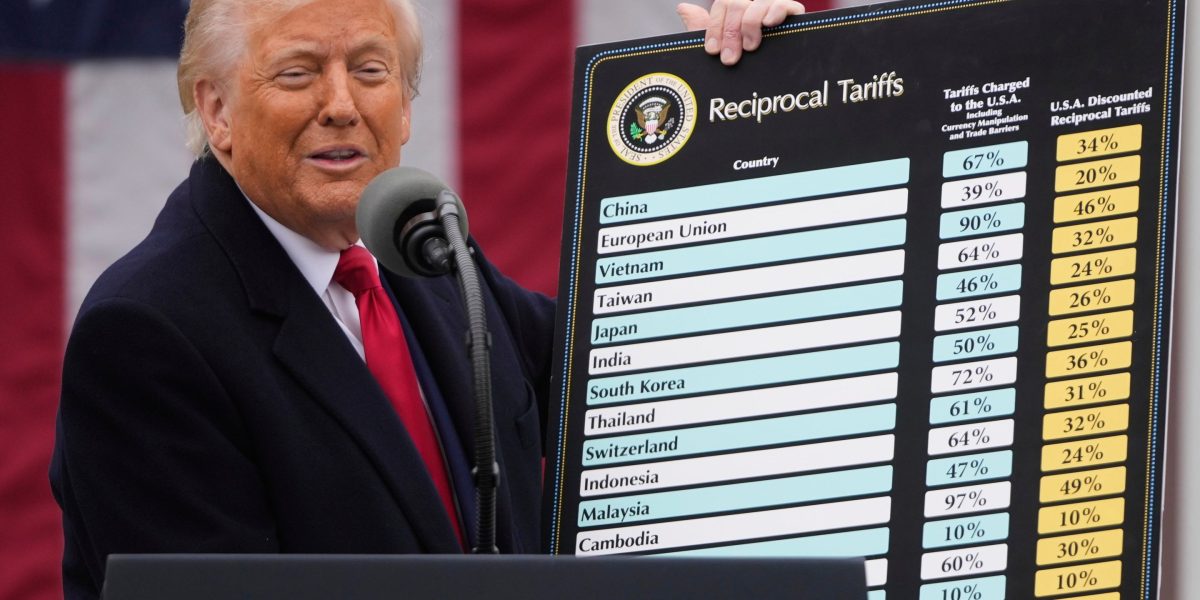
President Donald Trump made a lot of tariff threats and trade promises this year. Many materialized into a barrage of new import taxes that overturned decades of U.S. economic policy — but others have yet to be fulfilled as 2025 comes to a close.

Some of Trump’s unrealized threats reflect a broader approach from a president with a track record of using sky-high levies to pressure other countries into new trade dealsone-up retaliatory measures or even punish political critics. At the same time, they arrived as growing list of tariffs did go into effect — from Trump’s punishing new taxes on imported metals, to tit-for-tat levies with top U.S. trading partners like China — plunging consumers and businesses worldwide into uncertainty.

Here’s what Trump said when announcing some of his biggest (but still unrealized) tariff threats and promises this year, and where things stand today.

External Revenue Service

In his words:

What happened: The External Revenue Service has yet to be established as of the end of December. While administration officials continued to reiterate plans for launching the External Revenue Service during Trump’s first months back in office, the entity does not yet exist.

200% tariff on European wine, Champagne and spirits

In his words:

What happened: The EU’s planned levy on American whiskey — which it unveiled as part of broader retaliation in response to Trump’s new steel and aluminum tariffs — was postponed, with the latest delay reportedly running until at least February.

Trump’s 200% tariff threat on European alcohol never materialized. But spirits were not included in the EU-U.S. trade deal struck over the summer, which set a 15% rate on most European imports.

100% tariff on foreign-made films

In his words:

What happened: Despite Trump’s repeated threats, the U.S. has yet to impose a 100% tariff on foreign films. After his initial May promise to initiate the process, the White House said no final decision had been made. Also still unclear is how the U.S. would tax a movie made overseas.

Tariffs on pharmaceutical drugs

In his words:

What happened: The president did not sign an executive order imposing a 100% tariff on pharma products on Oct. 1 and, as of today, no levy has been put into place. But Trump previously suggested that steep levies on pharmaceutical drugs could arrive further down the road, telling CNBC in August that he would start by charging a “small tariff” and potentially raise the rate as high as 250%. Meanwhile, trade agreements with specific countries set their own rates or exemptions — with the U.K., for example, securing a 0% tariff on all British medicine exported to the U.S. for three years. The administration also announced deals with specific companies with promises of lower drug prices.

100% tariff on computer chips

In his words:

What happened: A sweeping 100% on computer chips has yet to go into effect. When announcing his plans to impose the levy back in August, Trump was not specific about the timing. And other details have remained scarce.

$2,000 tariff dividend

In his words:

What happened: Details about how, when and if a tariff dividend will reach Americans are still scarce. Budget experts have said that the math doesn’t add up. And Treasury Secretary Scott Bessent suggested that it might not mean checks from the government. Instead, Bessent told ABC in November, the rebate might take the form of tax cuts. White House National Economic Council Director Kevin Hassett also told CBS News that it’s up to Congress.


Source link

Continue Reading

Business

Xi touts China’s AI, chip wins in triumphant New Year’s speech

Published

on


President Xi Jinping highlighted China’s achievements in artificial intelligence and the chip industry in a triumphant New Year’s Eve speech as he called for more confidence in the country’s development path in the year ahead.

“China has become one of the world’s fastest-rising economies in terms of innovative capacity,” he declared in a televised address on Wednesday beamed to the nation’s 1.4 billion people, in which he touted China’s achievements in large AI models and breakthroughs in chip research and development.

The Chinese leader underscored the role of innovation in his government’s aim for high-quality economic development and the integration of technology and industry, citing the advancements in humanoid robots and drones. He also touted China’s progress in aerospace and defense, pointing to the country’s latest aircraft carrier, the Fujian, which is equipped with a new electromagnetic catapult launch system.

China had “overcome numerous difficulties and challenges” to meet the targets set out in its 14th Five-Year Plan, Xi said, adding that the country’s gross domestic product is on track to reach 140 trillion yuan ($20 trillion) in 2025. 

“Our economic, technological and national defense capabilities, along with our overall national strength, have risen to new heights,” Xi said.

The speech was Xi’s most upbeat New Year’s Eve address in recent years, coming after his government overcame a multitude of challenges to underscore China’s status as a rising global superpower.

The year opened with a surprise breakthrough when Chinese AI startup DeepSeek defied US chip curbs to release a powerful, low-cost model that stunned Silicon Valley and rattled Wall Street. Chinese chipmakers have rushed to the IPO market, raising funds that are key to the nation’s goal of technological self-reliance and winning the global race on artificial intelligence.

China also stared down US President Donald Trump’s renewed trade war, wielding its dominance over rare earths to extract concessions on tariffs and export controls. Chinese shipments found new homes outside the US, pushing its trade surplus beyond $1 trillion for the first time — a new record in global trade history.

data-srcyload

Ties between the world’s largest economies have stabilized in recent months after Xi and Trump struck a one-year truce in South Korea in October. Trump is scheduled to visit China in April.

In a further sign of Xi’s confidence in handling relations with Washington, the Chinese leader on Wednesday did not highlight “external uncertainties” as a challenge in his outlook for the new year as he had done for 2025. Instead, he noted that 2026 marks the start of the government’s 15th Five-Year Plan and called for a focus on high-quality development.

“We must remain anchored to our objectives, maintain firm confidence, and build on our momentum,” he said.

Anti-Corruption Drive

Xi also stressed the need to push ahead with his anti-corruption campaign, calling for the ruling Communist Party to enforce strict discipline and promote self-reform to “remove decay and grow new flesh.” Xi’s widening purge has ousted scores of military generals and investigated a record number of high-level officials for corruption this year.

Despite the triumphant tone, Xi still faces plenty of challenges at home, including a host of structural vulnerabilities in the world’s second largest economy.

Earlier on Wednesday, Xi declared that China is expected to meet its growth target of “about 5%,” providing an upbeat backdrop to data showing a recovery in the nation’s manufacturing sector. Official data released on Wednesday showed the first expansion in factory activity in nine months, with the manufacturing purchasing managers’ index rising to 50.1 in December from 49.2 in November.

But the economy remains fragile as the year draws to a close. Investment lost further ground in November, consumer spending growth slowed sharply and the property sector deteriorated, reflecting persistent weaknesses in domestic demand.

Xi has previously signaled a tolerance for slower growth in some regions and even said recently that China should crack down on “reckless” projects, highlighting his focus on the quality, rather than pace, of economic growth.

As in previous years, Xi used his speech to reiterate the ruling Communist Party’s stance on Taiwan. “Compatriots on both sides of the Taiwan Strait are connected by blood that is thicker than water. The historical trend toward national reunification is unstoppable,” he said, alluding to Beijing’s longtime vow to bring the self-ruled island under its control, by force if necessary.

Xi’s message to Taiwan came after the People’s Liberation Army’s concluded its most expansive drills around the island democracy in decades. For two days, Chinese warships and aircraft simulated a blockade of the global chip hub with live-fire exercises encircling the main island, while dozens of rockets struck waters near its northern and eastern ends on Tuesday.


Source link

Continue Reading

Business

China buys two-thirds of pledged U.S. soybeans as 2025 closes

Published

on


China has bought at least 8 million tons of US soybeans this year, according to people familiar with the matter, putting the world’s top importer on track to meet a pledge it made two months ago as part of an apparent trade truce with Washington.

State-owned buyers have continued to book US cargoes into late December, the people said, asking not to be named as they are not authorized to discuss the purchases. That extends a buying spree that began in October and maintains a pace that has reassured American exporters, otherwise wary that Beijing’s commitment might slip amid limited visibility and unclear deadlines.

The shipments booked so far are mostly for loading between December and March, the people said.

The White House said immediately after talks between President Donald Trump and Chinese counterpart Xi Jinping that China had pledged to buy at least 12 million tons of US soybeans by the end of this year. US officials later clarified the deadline was in fact the end of February. Beijing has not confirmed the commitment, but the Chinese government has moved to reduce tariffs on the crop and lifted import bans on three American exporters.

The return of Chinese buyers is welcome news for US exporters, and a reminder that buying patterns can change fast — but it is not yet a full reset. Even as Beijing takes US shipments, state-owned firms have bought large quantities of beans from Brazil and Argentina, the people said. Commercial buyers in particular have stayed on the sidelines when it comes to US purchases.

Almost 80% of Brazil’s soy went to China in 2025, with exports through November climbing 16% compared to the previous year. That trade continued in December, even in a period when sales are seasonally weaker, and Brazil’s upcoming harvest is forecast to be a record.

“We cannot confirm from China’s side that anything beyond the 12 million tons has been pledged,” said Ben Buckner, grains and dairy analyst at AgResource Co. The brokerage wrote in a note this week that China was seeking shipments and could reach a “soft target” of 10 million tons in 2025, with an additional 2 million tons in January.

Without a formal deal confirmed by both sides, traders say uncertainty over future sales is reinforcing pressure on soybean prices. Futures in Chicago eased in the year’s final trading session Wednesday, on track to decline about 7% in December, the worst monthly performance since July 2024.

Matt Bennett, an Illinois corn and soy farmer, said many farmers have been “pleasantly surprised” with the steady flow of purchases from China so far, but added there has been frustration with the direction of soybean prices.

“From our vantage point, once you quantify that they’re going to buy 12 million tons, you need something in excess of that to get everyone excited,” Bennett, co-founder of farm advisory AgMarket.Net, said in a phone interview. 

Trump earlier this month announced $12 billion in relief for US farmers, but growers are still waiting for the administration to provide details on how much they will get in payments promised by February.


Source link

Continue Reading

Business

Down Arrow Button Icon

Published

on


It makes little sense, when viewed from early April, that Canadian equities are closing out their second-best year this century. 

Donald Trump had just unleashed the harshest tariffs since The Depression, effectively choking off trade and tearing up a trade agreement he had negotiated. The US president was also openly discussing annexing Canada, stoking unfathomable tensions between the two long-time allies. Political turmoil added to unease up North.

Then Trump backed down from his most punishing tariffs. Technocrat Mark Carney took over as prime minister, easing financial market jitters and cooling tensions with his US counterpart. And, it turned out, Canada’s economy — driven by miners and internationally renowned financial firms —  was perfectly situated for the chaos of Trump’s new world order.

The S&P/TSX soared more than 40% from an April 8 low, putting the gauge on track to end 2025 with a 29% advance, trailing only 2009’s 31% gain for the best ever. The index notched a record 63 new all-time highs along the way, owing to a steady march higher over the year’s final seven months.

Miner and bank stocks have been central to the rally, with the materials subindex doubling on the back of rallies in gold, silver, copper and palladium. The financials group jumped 40%. Tech darlings like Shopify Inc. and Celestica Inc. have also contributed, moving the index by a combined 11% higher during the year. 

“The numbers themselves are somewhat jaw dropping,” said IG Wealth Management chief investment strategist Philip Petursson by phone. “But, I mean, you could sit there and say this is still a well-balanced market that has further upside in 2026.”

The fuel for the rally that powered precious metals to new records may not be spent. Three Federal Reserve rate cuts were a boon to an asset class that doesn’t pay interest. The US central bank is expected to cut twice in 2026. 

Gold and silver also served as a safe haven for traders worried about uncertainty around US trade policies and geopolitical tensions in Europe and the Middle East. Neither of those concerns have been laid fully to rest.

Petursson said he sees further runway for gold prices to continue supporting the S&P/TSX Composite index, but not to the same degree the markets have seen in the past year. 

“It would be foolish to just extrapolate this year’s gains into 2026,” he said, noting though that “the fundamentals are still there” as central banks are expected to continue cutting rates. 

Canada’s Big Six banks, including Toronto-Dominion and Bank of Montreal, posted stronger profits than expected over the year with the annual adjusted earnings coming ahead of Bloomberg consensus expectations by an average of 2 percentage points.

The group financial firms, including insurers and smaller banks, accounts for 33% of the Canadian index. They, too, have enjoyed lower rates in both the US and Canada, along with profits from dealmaking and a better batch of loans that required fewer set-asides. The Canadian group’s advance nearly doubled that of its US counterparts.

There is some concern over the group’s performance heading into 2026. Bank valuations have been elevated at the same time that the Canadian economy may be starting to feel the strain of higher tariffs, said Craig Basinger, Purpose Investments chief market strategist. 

“Gold, energy: those sectors really don’t care about the Canadian economy, but the banks probably should,” Basinger said. “And this just doesn’t feel like the time to be paying a premium valuation for Canadian banks.”

The S&P/TSX Composite banking subindex’s price to earnings ratio reached nearly 15, up from a low of 9.7 in 2022. 

The Canadian index’s record came despite one of the worst years for crude oil prices in recent memory. The problem, though, is the outlook for oil remains muted at best. Basinger said jumping into oil and gas stocks at the beginning of the year would be a very contrarian move given how demand is struggling to keep up with supply. 

The market would also be vulnerable to any troubles in the precious metals markets. Already, silver is sliding into the end of the year, though still on track for a record gain.

Bassinger’s firm took a partial underweight position in S&P/TSX Composite in the fourth quarter, which he said was more about profit-taking after “three consecutive years of oversized gains” rather than any negative view of the index.   

If the new year brings upside surprises to oil, then strategists like Petursson say the S&P/TSX Composite is a great way for foreign investors to leverage the energy play. For Petursson, the answer to the question of whether investors can be successful putting their money outside of the US is “yes”, and there are great options in other markets like Canada, Asia and Europe. 

“When foreign investors are looking for pockets of opportunity, if the TSX was not on their radar, I think it is now,” Petursson said. 


Source link

Continue Reading

Trending

Copyright © Miami Select.