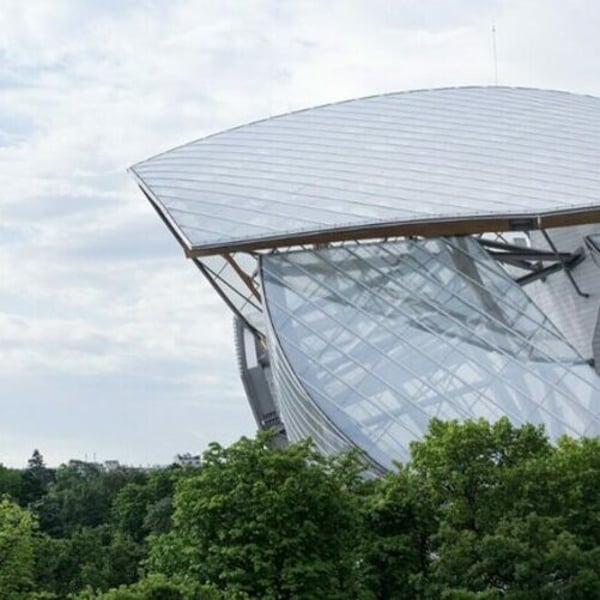
The Fondation Louis Vuitton will stage a novel Alexander Calder centennial retrospective in 2026, the latest in a series by the Paris art institute focused on leading artists of 20th and 21st centuries.
The striking silhouette of the Fondation Louis Vuitton in France – Fondation Louis Vuitton – Facebook
Previous monographic exhibitions at the Fondation Louis Vuitton have included Jean-Michel Basquiat, Joan Mitchell, Charlotte Perriand, Mark Rothko, David Hockney, and Gerhard Richter, its current show.
For Calder, a legendary artist known for his giant mobiles, sprawling mechanical kinetic sculptures moved by power and wind, the foundation will dedicate the entirety of its show space. And also, for the first time, the adjacent lawn, in a dialogue between Calder’s volumes, planes, and movements and those of the foundation’s famous sailboat silhouette.
The announcement by the Fondation Louis Vuitton on Tuesday, comes 11 days after the death of Frank Gehry, the master architect who designed its building. The art show will celebrate the centenary of Alexander Calder’s arrival in France in 1926 and the 50th anniversary of his death with a retrospective covering all aspects of his work. The son and grandson of two sculptors, Calder was born in Philadelphia in 1898 and died in New York in 1976.
Entitled ‘Calder: Rêver en équilibre,’ or ‘Calder: Dreaming in Balance,’ the exhibition covers half a century of creation, from the late 1920s and the first performances of the Calder Circus that captivated the Parisian avant-garde, to his monumental sculptures that redefined the idea of public art in the 1960s and 1970s.
The exhibition, one of the most important to date devoted to Calder, was conceived in close collaboration with the Calder Foundation, which is the main lender. It will also benefit from loans from international institutions and leading private collectors, bringing together nearly 300 works: mobiles and stabiles- to borrow Calder’s terminology for kinetic and static abstractions- as well as wire portraits, wooden sculptures, paintings, drawings, and even jewellery.
Works by his friends Jean Arp, Barbara Hepworth, Jean Hélion, and Piet Mondrian, as well as Paul Klee and Pablo Picasso, help to situate Calder’s radical inventiveness within the avant-garde movement. Thirty-four photographs taken by some of the most important photographers of the 20th century (Henri Cartier-Bresson, André Kertész, Gordon Parks, Man Ray, Irving Penn, and Agnès Varda) show an artist walking the tightrope between art and life.
After studying at the Art Students League in New York, Calder moved to Paris in 1926. In the Montparnasse district, the artist quickly became part of what was then the world’s leading artistic centre. There he presented unique forms, figurative and refined wire sculptures that attracted critical acclaim, and a miniature circus. Thanks to an exceptional loan from the Whitney Museum of American Art, the first in 15 years, Calder’s Circus is returning to Paris, the city where it was created. At the centre of this new kind of show, Calder manipulates acrobats, clowns, and miniature horsemen. Fernand Léger, Jean Hélion, Le Corbusier, Jean Arp, Joan Miró, and Piet Mondrian are among his spectators.
Calder’s visit to Mondrian’s studio in 1930 marked the abstract turning point in his work, first in painting, then in sculpture. Marcel Duchamp proposed the name “Mobiles” for the abstract and kinetic compositions that the artist presented in 1932 at the Galerie Vignon in Paris. Initially driven mechanically, then moved by slight breezes, these mobiles borrowed “their life from the vague life of the atmosphere,” as Jean-Paul Sartre wrote in 1946.
Calder returned to France after WW2 and set up a studio in the hamlet of Saché, in the Loire Valley in 1953. One of his sculptures still stands in the village’s square.
Like his swaying interconnected mobile art, the exhibition is a joint curation that includes input from Suzanne Pagé, artistic director of the Fondation Louis Vuitton; guest curators Dieter Buchhart and Anna Karina Hofbauer, assisted by Valentin Neuroth and Claire Deuticke; and Olivier Michelon, associate curator, assisted by Léna Lévy.
Hugo Boss recently unveiled an ambitious expansion of its growth plan and on Tuesday the German fashion giant said it has secured a revolving credit facility to “ensure the successful execution” of the ‘Claim 5 Touchdown’ growth plan.
Hugo Boss
The €600 million loan (which replaces another loan of the same amount) “was considerably oversubscribed and aims at providing the company with additional financial flexibility”. It’s also linked to the fulfilment of clearly defined sustainability criteria.
“This successful transaction highlights the strong trust our lenders place in our company and its long-term potential,” said CFO/COO Yves Müller.
The loan has a term of five years and includes two options to extend the term by one more year in each case, plus an option to increase the credit amount by up to €300 million.
The company unveiled its strategy in early December, saying its next phase aims to “realign, simplify, and strengthen the business”.
In the short term it’s sacrificing sales and profits as it said that currency-adjusted group sales and profits will both decline next year. But the refreshed strategy aims to “sharpen focus, discipline, and execution across the business”.
It now clearly has the long-term financing to put its plan into operation with the option of even more money on the table if required.
McQueen is aiming to attract attention to its SS26 pre-collection launch with a special installation in its store in the heart of fashion’s capital city, Paris.
McQueen
To celebrate the launch, the label has collaborated with well-known photographer Dafydd Jones, on the installation that features some of his most definitive works, curated by McQueen’s creative director Seán McGirr.
The Rue Saint-Honoré store installation includes 26 of Jones’s original works on public display. The curated selection sits alongside the McQueen pre-collection, “for which these photographs form a core inspiration”.
The installation has just launched and will be in the store until 29 January.
So who is Dafydd Jones? The British photographer is celebrated for his “sharp, satirical depictions of social life, particularly in the 1980s. His career began with prize-winning images of Oxford’s ‘Bright Young Things’, leading to decades of work published in major titles”.
And as well as being in the McQueen store for a limited period, his photos are held in collections including the National Portrait Gallery and the V&A in London.
Francesco Murano, My Style Bags and Acbc were among the winners of the ninth edition of the Young Businesses awards by Italian luxury industry association Altagamma.
The 2025 edition’s winners
Two emerging labels were recognised in the Fashion category. The first was Francesco Murano, founded in 2020 by the eponymous designer, an award winner with CNMI, Altaroma and LVMH. Francesco Murano has been a regular at Milan Fashion Week since February. The second was My Style Bags, a brand founded in 2008 in Milan by Giuseppe Bellora, Lorenza Bellora and Stefano Donadel Campbell, specialised in travel bags and accessories made with fine fabrics.
The award for the Innovation category went to green solutions specialist Acbc, founded in 2017 and now a partner of over 150 international names, including Corneliani, Gucci Watch, Kering Eyewear, Max Mara, Missoni and Versace. Acbc helps them develop green strategies and design sustainable products and environmentally friendly collections.
The other prize-winners were Slalom for object design, Pola Grande Gioielli for jewellery, Portrait Milano for the hotel business, Lávika for wellness and beauty, Ice Yachts for the nautical design and automotive category, and Molino Pasini for food.
The awards, introduced by Altagamma in 2015 in collaboration with Borsa Italiana, Elite-Gruppo Euronext and SDA Bocconi, recognise emerging brands within Italy’s luxury sectors. The winning companies join Altagamma for a year, and will be able to take part in exclusive training and networking sessions, focusing on business strategy and consultancy.
“In the last nine years, Altagamma has created and pursued with dedication this project set up with Franca Sozzani, aimed at spotlighting the stars of the future, the emerging companies that will be the new protagonists of Italian luxury,” said Stefania Lazzaroni, managing director of Altagamma. “These brands have all it takes to become paradigms of Italian excellence in seven different sectors. Since 2015, 64 companies have been recognised by the awards. Many have become established, some have joined Altagamma, and they have all been part of our community for some time,” concluded Lazzaroni.