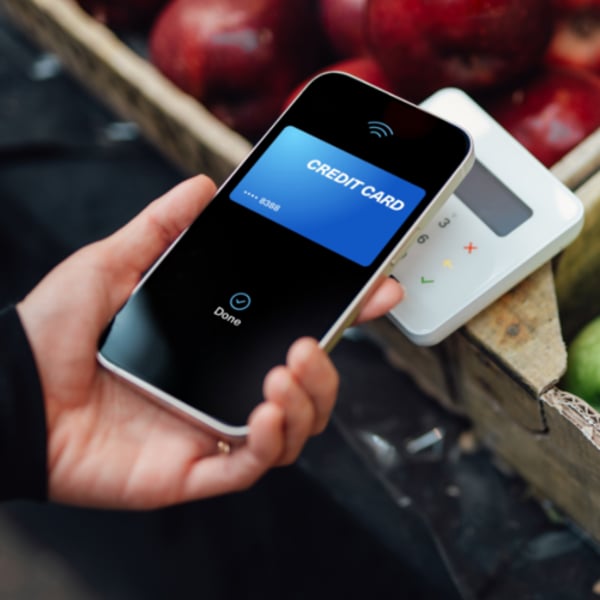
If you want to know how consumers are paying for their purchases, the BRC has just released its latest survey, saying that they swapped credit for debit cards and cash was used in just a fifth of transactions.
Barclays Payments
The BRC’s annual Payment Survey, based on data from last year, reveals a “significant decline” in the use of credit cards, from 14.2% of transactions to 12.6% as consumers turned to debit cards where usage increased from 62% to 64% of transactions.
However, despite their declining popularity, for larger transactions, consumers still preferred using credit cards overall, which offer additional protections for shoppers. Cards also beat cash, which accounted for just 19.2% of transactions.
“As the cost of living crisis eased, some customers returned to old habits. The weekly shop showed signs of a comeback with consumers making fewer but larger transactions”, the report highlighted, with the total number of transactions falling from 20.9 billion to 20.4 billion. Average transaction value rose across all payment types.
More shoppers have also been exploring less traditional payment methods than ever before, particularly for larger transactions. This included the use of gift vouchers, PayPal, and Buy Now Pay Later (BNPL), although no figures were given.
Chris Owen, Payments Policy Advisor at the British Retail Consortium said: “As interest rates peaked in 2024, the use of credit cards fell as customers switched to lower interest forms of payment. However, with cards still accounting for the vast majority of transactions and card fees now more than double the level they were six years ago, only a long-term cap on card fees would bring much needed relief to retailers.
He added: “Looking ahead, as the PSR transitions into the Financial Conduct Authority next year, it is vital that the FCA carries this work forward, delivering fairness and transparency in a market long hampered by competition issues and unjustified fee increases.”
According to the CGT Champagne inter-union, employees in LVMH‘s Champagne division in France are mobilising against the scrapping of a profit-sharing bonus “which has existed since 1967.”
Shutterstock
“The mobilisation is due to the withdrawal this year of profit-sharing at Moët & Chandon. It has been in place since 1967, and this is a first. Employees have also been informed of the cancellation of the value-sharing bonus, on the grounds that the group generated slightly lower profits,” said José Blanco, general secretary of the CGT Champagne inter-union, to AFP on Friday.
Following strikes on December 5 and 8, a rally was held on Thursday outside Moët & Chandon’s head office.
“This strike took place on Thursday in Épernay, outside Moët & Chandon’s head office, with all the group’s Champagne houses: Veuve Clicquot, Krug, Moët & Chandon… and support from other Champagne houses. Around 600 people were present,” said Blanco.
“Originally, it wasn’t supposed to be a demonstration, but an information meeting organised within Moët & Chandon. In the end, the employees gathered on Avenue de Champagne and blocked it,” explained Mr Blanco.
Further actions are being considered, but no date has yet been set. Contacted by AFP, LVMH did not comment.
LVMH’s Wines & Spirits division, which includes Champagnes (Moët & Chandon, Krug, Ruinart…) as well as wines (Château Cheval Blanc, Château d’Yquem, Château d’Esclans…), and Hennessy cognac and Glenmorangie whisky, saw a sharp decline in 2024, with revenue down 11% year-on-year to €5.9 billion.
Over the first nine months of 2025, the division’s revenue fell a further 7%, notably due to customs duties. However, the group estimated that sales returned to growth (at constant exchange rates) in the third quarter, “with an improvement in Champagne, good growth in rosé wines and still weak demand in cognac.”
According to HSBC analysts, Champagne and wine sales accounted for 4% of LVMH’s €84.7 billion revenue in 2024, and cognac and spirits sales for 3%. The bank forecasts an 11% drop in Champagne and wine sales in the fourth quarter of 2025.
The division, which announced in the spring plans to reduce its workforce, has been headed since February by the group’s former chief financial officer, Jean-Jacques Guiony, assisted by Alexandre Arnault, son of billionaire and LVMH CEO Bernard Arnault.
This article is an automatic translation. Click here to read the original article.
On Thursday December 12, the Paris commercial court decided on the future of French premium ready-to-wear retailer IKKS. At the end of a receivership procedure involving several purchasing bids for IKKS, the court has approved the offer by Santiago Cucci, who was named president of the group’s holding company HoldIKKS last year, and Michaël Benabou, co-founder of event sales site Veepee.
Inside an IKKS store – IKKS
The court’s decision has put an end to months of uncertainty for IKKS’s employees. According to figures drawn up by the receivers at the end of August, the group’s staff numbered 1,287 worldwide, 1,094 of them in France. At the time, the group had 473 stores between France and 11 other countries, plus headquarters in the town of Saint-Macaire-en-Mauges and offices in Paris.
IKKS gave a design make-over to its collections in summer, and in September it applied for receivership, after the group’s main shareholders, US investment funds Avenue Capital, CarVal Investors and Marathon Asset Management, expressed their wish to sell the company.
The IKKS group, which operates the eponymous brand as well as One Step and ICode, is still a leading international ready-to-wear retailer in the premium segment, operating several hundred retail outlets (between directly owned and franchised stores, and concessions) in nine countries. The path to new ownership has been complex, since the group was split in several entities, and none of the purchasing bids referred to the group as a whole.
The winning bid’s details
Cucci and Benabou have convinced the court after recently revising their bid upwards. Initially, the bid related to 141 stores, 88 of them directly owned, and 391 company employees.
The deal was clinched after the bid was extended to include 219 stores in France: 92 of them directly owned, 100 franchised, plus 27 Galeries Lafayette concessions. The employees associated to the directly owned stores are 546.
Benabou and Cucci, a former senior executive at Levi’s and a strategic advisor to G-Star, have taken over the IKKS business and are planning to operate a more streamlined store fleet. They will focus on womenswear and menswear, while childrenswear has been put on hold.
The dossiers given to prospective buyers indicated that the IKKS brand accounted for 80% of the group’s revenue, that 64% of its revenue was generated by womenswear, 21% by childrenswear, and 15% by menswear. When the company applied for receivership, direct retail accounted for 77% of revenue, e-commerce (both B2B and B2C) for 20%, and the remaining 3% was generated through the wholesale channel.
Rejected bids
The bid by sustainable fashion brand Faguo, which had been revised to include 15 stores and 30 jobs, was rejected. French group Beaumanoir (which owns womenswear brands Morgan and Caroll) had teamed up with Faguo, offering €1 million to buy the IKKS brand name and some of the stores.
Another rejected bid was put forward by Salih Halassi’s company Amoniss, a shareholder in Pimkie which recently acquired Christine Laure and Chevignon. It initially bid for a minimum of 168 stores and 393 employees.
BCRI Holding, which recently bought Café Coton, initially offered to buy 67 stores with a total of 426 employees. While AA Investments (owner of Smallable, L’Exception and Bonne Gueule) was interested in IKKS’s intangible assets. Verdoso, new owner of The Kooples, withdrew its bid before the November 28 hearing.
Since none of the bids related to the Icode and One Step brands, and to IKKS childrenswear, some of the latter’s stores in France have now closed. The new owners are therefore concentrating on the IKKS brand, out of a group fleet that had 550 stores as of the end of 2024, though streamlining measures started in H1 this year.
The brand’s employees are now hoping IKKS will be able to regain momentum as a recognised name in the premium ready-to-wear segment.
Galeries Lafayette Paris Haussmann welcomes Louis Vuitton‘s latest beauty offering. Under the department store’s famous dome, the house presents, for the first time, a 40 square-metre corner entirely dedicated to its new make-up line, La Beauté Louis Vuitton.
Corner La Beauté Louis Vuitton Galeries Lafayette Paris Haussmann – DR
Louis Vuitton is part of the LVMH group and remains one of the world’s most influential luxury brands, thanks to its expertise in leather goods, fashion, and fragrances. The Galeries Lafayette Haussmann department store, owned by the family-run Galeries Lafayette Group, attracts millions of visitors every year and serves as an important showcase for the world’s leading fashion houses. It is an exceptional setting chosen by Louis Vuitton to present its new beauty proposition.
The house unveils its very first make-up collection, conceived as a new chapter in its vision of the art of travel. The artistic direction of the collection has been entrusted to Dame Pat McGrath, a leading figure in global make-up artistry. She envisions beauty as a means of self-expression and an everyday way of life.
To accompany the launch, Louis Vuitton has created a unique space on the ground floor of Galeries Lafayette. The corner is surrounded by an openwork metal structure featuring the diamond motif associated with the House. The atmosphere blends wood, woven leather and champagne-coloured metal to create a distinctly luxurious setting. The corner offers a personalised experience thanks to a dedicated consultation area, where customers can discover the products, receive advice and enjoy a made-to-measure moment.
The collection comprises three main ranges: LV Rouge with 55 lipstick shades, LV Baume with 10 shades, and LV Ombres with eight eye palettes. Each creation prioritises performance and a powerful sensory experience. The products feature an exclusive olfactory signature created by Louis Vuitton Master Perfumer Jacques Cavallier Belletrud. The refillable cases, designed by Konstantin Grcic, echo the house’s historic codes, marrying elegance and durability.
The space also features an exclusive lipstick trunk that brings together all the shades.
This article is an automatic translation. Click here to read the original article.