Connect with us

Fashion

Spotlight on recent shop openings in France
Published

on


Published


December 9, 2025

As the end of the year approaches, the fashion retail sector is seeing several brands strengthen their bricks-and-mortar presence with new openings. Here is a round-up.

Maison Ola inaugurates first Parisian boutique

Boutique Ola at 33 rue de Grenelle in the 7th arrondissement – DR

Maison Ola, the label founded by Maria de la Orden and Grégory Mizele, known for its hats and hair accessories with a refined, sunlit charm, has set up shop in Paris for the first time. The brand officially opened the doors of its first boutique on 17 November, at 33, rue de Grenelle in the 7th arrondissement.

The 50-square-metre space is located in the heart of Saint-Germain-des-Prés. The boutique brings together all the brand’s collections and has been conceived to showcase its materials and craftsmanship.

This first physical address marks a new milestone for Maison Ola, which continues to expand its network and establish itself in the Parisian market. Maison Ola is available on the Moda Operandi platform, as well as in several outlets located in the Airelles group’s hotels and high-end establishments: Les Airelles Courchevel, Airelles Val d’Isère, Château de la Messardière, Jardin Tropezina, Château d’Estoublon and La Bastide de Gordes.

Phileo brings footwear offering to Boulevard Beaumarchais in Paris

Phileo Beaumarchais store in Paris
Phileo Beaumarchais store in Paris – DR

Founded in 2020 by Philéo Landowski, the independent Parisian footwear brand Phileo opens its first boutique at 37, Boulevard Beaumarchais, in the 3rd arrondissement. The official opening took place on 27 November, and the boutique will be open Tuesday to Saturday, 1pm to 7pm. The retail space spans 62 square metres.

Conceived by Philéo Landowski, who collaborates with several major sports and lifestyle brands, the boutique takes an unconventional approach to retail. With exposed structures and raw surfaces, the space reflects the brand’s interest in the creative process and the tension between materials, and functions as a living space hosting interventions and installations by artists and collaborators.

As an independent label, Phileo is supported by DSMP-BD (Dover Street Market Paris – Brand Development) for distribution. The brand is carried in around thirty points of sale worldwide. It received the 2024 Grand Prix de la Création de la Ville de Paris and was a finalist for the 2025 ANDAM Fashion Award.

Caleb opens first boutique in Le Marais

DR

Founded by Aaron Moyal and Samuel Milgrom, two-year-old brand Caleb continues its expansion with the opening of its first Paris boutique. The store is located at 72, rue Vieille-du-Temple, in the heart of Le Marais, in a 70-square-metre space.

Positioned around a timeless, genderless wardrobe, Caleb offers pieces with fluid cuts and materials selected for their durability. The boutique brings together the full menswear, womenswear and genderless collections, as well as limited editions and a selection of exclusive objects.

This first bricks-and-mortar location strengthens Caleb’s presence in the Paris market. The brand already has several international points of sale: Paris (2 points of sale: 1 Caleb boutique and 1 multi-brand corner at Printemps), St Barth, St-Tropez, Dubai, Kyiv (partner boutique), Italy and Tel Aviv.

Bonne Maison opens first boutique in Annecy

DR

Bonne Maison, the French premium socks brand founded in 2012 and acquired in 2023 by Laure de Gennes, inaugurates its first boutique at 34, rue Sommeiller, in Annecy. The official opening was on 19 November 2025.

The brand, renowned for its graphic, colourful socks made from Egyptian cotton yarn and manufactured in Europe, has unveiled a 30-square-metre space designed as an art gallery.

Bonne Maison, which does not disclose its turnover, generates 90% of its sales internationally (Europe, the United States and Asia) and 20% of its business via digital channels. The brand is distributed in over 700 points of sale worldwide, including Le Bon Marché, Isetan and Printemps New York.

Acanthe inaugurates 15th boutique in France in Levallois-Perret

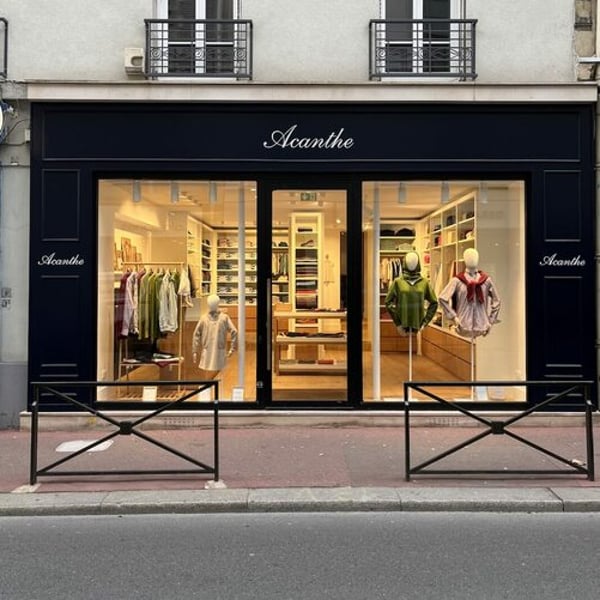
Acanthe boutique at 46 rue du Président Wilson 92300 Levallois Perret
Acanthe boutique at 46 rue du Président Wilson 92300 Levallois Perret – DR

Founded in 1983 by Antoine de Jouffrey, Acanthe aims to offer quality shirts and clothing at accessible prices. Today, the family-run brand is headed by Blanche de Jouffrey, the founder’s daughter, while Aimée de Jouffrey, a womenswear designer, is debuting her Winter 2025 collection.

Acanthe develops timeless, durable collections crafted from natural materials such as cotton, linen, merino wool, lambswool and cashmere. The Cashmere Collection, launched in 2006, illustrates this commitment with modern, long-lasting pieces knitted in two-ply yarn.

In October, Acanthe opened its 15th boutique in France, in Levallois-Perret, a 52-square-metre space. The brand now has 15 points of sale, all standalone boutiques, consolidating its physical presence and direct access to customers.

This article is an automatic translation.
Click here to read the original article.

Copyright © 2025 FashionNetwork.com All rights reserved.


Source link

Continue Reading

Fashion

The personal shopper’s odyssey: From ally of the powerful, to dresser to the stars, to an accessible profession

Published

on


Published


December 9, 2025

The personal shopper is a discreet professional. Their primary role is to help clients define and express their sartorial identity. They advise, analyse and orchestrate a style tailored to each person’s needs, body shape and goals.

In the past, garments were embellished by the fashion merchant to suit her client’s tastes. – DR

In its study “From Luxury to Well-Being: The Personal Stylist’s Journey through Fashion History”, online personal shopper company Lookiero examines how the role has undergone major transformations over the centuries. Initially seen as a luxury reserved for an elite, the profession has gradually been democratised, particularly thanks to digitisation.

Marie-Antoinette and Rose Bertin, a historic fashion duo

The idea of shaping one’s appearance with the help of an expert is not new. As early as the eighteenth century, in Europe’s sumptuous courts, clothing was a powerful marker of status and influence. The emblematic figure of Marie-Antoinette illustrates this perfectly: her ostentatious wardrobe, though provocative for its time, constituted a deliberate political and symbolic strategy.

Portrait of Rose Bertin, Marie-Antoinette's milliner
Portrait of Rose Bertin, Marie-Antoinette’s milliner – Jean-François Janinet via Wikimedia Commons


Her close collaboration with Rose Bertin, her trusted milliner, foreshadowed what would later become the role of the personal stylist. Through her ideas and execution, Bertin translated the queen’s aspirations into a strong, singular visual identity. This notion of “delegated taste” extended into the nineteenth century, when the London and Paris elites were already entrusting specialised assistants with the selection of their finery and accessories.

Hollywood, the fashion image factory

The early twentieth century marked a turning point with the emergence of the fashion press. Publications such as Vogue and Harper’s Bazaar, with visionary editors like Diana Vreeland and Carmel Snow, helped forge an aspirational narrative around feminine aesthetics, positioning fashion as a lever for personal transformation and expression.

June 1920 Vogue cover by American artist Helen Dryden
June 1920 Vogue cover by American artist Helen Dryden – Condé Nast/Domaine Public

At the same time, the Hollywood film industry consolidated beauty archetypes through icons like Audrey Hepburn and Marlene Dietrich. Behind each star, on-set stylists, such as the legendary Edith Head, worked to sculpt these iconic images, professionalising the stylist’s function and gradually making it more visible behind the scenes.

A scientific approach and individual self-assertion

The 1970s saw clothing conceptualised more pragmatically, even as an instrument of persuasion. John T. Molloy’s influential “Dress for Success” (1975) revolutionised approaches to corporate dress. It set out a quasi-scientific methodology linking precise visual codes to professional success. His approach had considerable impact, laying the foundations of image consultancy as a structured discipline and demonstrating that image is a professional asset.

The personal shopper becomes part of Western department stores in the 1980s (Times Square, 1980. Image unmodified)
The personal shopper becomes part of Western department stores in the 1980s (Times Square, 1980. Image unmodified) – Gerd Eichmann/Wikimedia Commons

The 1980s were marked by aesthetic exuberance and a quest for individual self-assertion. Figures such as Ray Petri, creator of the “Buffalo” style, upended convention and fused urban and editorial aesthetics. It was also during this period that exclusive personal shopping services began to emerge in metropolises such as New York, London and Milan, catering to celebrities and executives. Luxury department stores then integrated these services as essential components of the VIP experience.

The media heyday of the personal shopper

The 1990s and 2000s were pivotal for the recognition of the personal shopper as a profession in its own right, thanks to popular programmes such as What Not to Wear, hosted by Stacy London and Clinton Kelly, which argued that style is a skill that can be learnt and mastered. Renowned stylists themselves rose to media prominence via their own reality shows (Rachel Zoe and “The Rachel Zoe Project“, for example), revealing the behind-the-scenes of their craft and popularising a new fashion lexicon.

Stacy London contributed to the rise of the personal shopper (Stacy London, 2008. Image unmodified)
Stacy London contributed to the rise of the personal shopper (Stacy London, 2008. Image unmodified) – Steve from New York City, Baby!, USA/Wikimedia Commons

At the same time, experts such as Nina García, then fashion director at Elle, published reference books that democratised stylistic knowledge, blending fashion culture, the psychology of image and practical advice.

A partly digitised profession

With the advent of the new millennium, the role of the personal stylist has adapted to a more diverse and, above all, more technological environment. Online personal shopper platforms incorporate algorithms and personalised questionnaires, enabling clothing selections to be made remotely, without the client having to leave home. Social networks have given stylists and consultants the opportunity to build their own brands and develop a community, freeing them from traditional media, once dominant in the field.

Today, personal shoppers can work on social networks such as Instagram
Today, personal shoppers can work on social networks such as Instagram – DR

The figure of the influencer often mingles with that of the personal shopper, with these professionals using their profiles to educate, inspire and guide stylistic transformations. Recent concepts such as the “capsule wardrobe” and ethical fashion have thus transformed the personal shopper into a veritable aesthetic coach, far beyond their initial function as a shopping adviser.

“The expansion of digital personal styling companies has democratised this service, making it accessible to a public previously far removed from what was perceived as a luxury reserved for the few,” said the company behind the study.

Today, the personal shopper market is being driven by digital players such as Lookiero, Outfittery and Clic and Fit, in addition to department store services at Le Bon Marché, Printemps, and Galeries Lafayette, as well as professionals active on social networks.

This article is an automatic translation.

Copyright © 2025 FashionNetwork.com All rights reserved.


Source link

Continue Reading

Fashion

Tornatore immortalises Brunello Cucinelli on film

Published

on


Published


December 9, 2025

A wealth of emotion and enchantment marked the world premiere of the documentary film “Brunello, il Visionario Garbato”, directed by Oscar winner Giuseppe Tornatore with a score by fellow Oscar winner Nicola Piovani, presented in Rome on December 4 in the magical setting of Cinecittà.

The poster for the film about Brunello Cucinelli directed by Giuseppe Tornatore

Blending documentary and fiction, the film retraces the places and key moments in the Umbrian entrepreneur’s life journey, from his childhood in the countryside to the village of Solomeo, transformed into the emblem of a distinctive humanistic capitalism. Testimonies, archival footage and personal recollections reveal a man who, from humble beginnings, built a company and an internationally renowned name while always holding fast to the values he cherishes—above all, fairness, dignity and social justice.

“When I was a child we lived in an isolated cottage. Next to us were my uncles, cousins and grandparents, a total of 13 people, all sharecroppers. We had no running water, electricity, heating or even a bathroom, and the farm work was hard. We worked hard and in the evenings, although worn out with fatigue, there was no shortage of smiles and conversation when we gathered for dinner. We children made up games out of nothing and had great fun in our simplicity. I loved being immersed in nature, among the animals, and in the evening I never tired, then as now, of spending hours admiring the stars,” recalled a moved Cucinelli.

Francesco Cannevalle plays child Brunello

“My father taught me from an early age the importance of precision and beauty. When I helped him plough the fields, driving the oxen, he would say, ‘The furrows must be straight, Brunello.’ ‘Why, Dad?’ I would ask. ‘Because straight furrows are beautiful.’ Life in those days, though poor, was happy, healthy, orderly, characterised by strong brotherhood and harmony with the rhythms of nature. And there was faith, of course—indispensable.”

The film, which opens in Italian cinemas between December 9 and 11, goes on to recount the move to Ferro di Cavallo in the 1960s, where Brunello’s father found a job with a steady paycheque as a factory worker, hoping to offer a better life to his family. The arrival in the city is a culture shock: with so many more comforts, Brunello misses the silence; the television seems almost to quash family conversation; and schoolmates mock him because he is a “farm boy”. Then, one evening, overhearing a conversation between his parents, he discovers that his father is unhappy because he is “humiliated in the factory where he is treated like a beast, like a slave”—a pivotal moment for the protagonist. Brunello says to himself, “I do not know what I will do in life, but I would like to try to work and live for human dignity.”

A promise the entrepreneur has certainly kept. A thirst for truth and justice, a desire to do well and to do good, translated into concrete actions in his work, and also drove him to conceive a film about his life.

Nicola Piovani, Brunello Cucinelli, Giuseppe Tornatore

“I’ve seen so many docu-films made after the protagonist’s death and, in my opinion, the protagonist himself must be turning in his grave. I wanted people to have a record of my actions, to hear the facts told in my own voice, while I am alive, for the sake of truth, not for glory. Considering that the film of my life is ‘Nuovo Cinema Paradiso’, who else could I have contacted but Giuseppe Tornatore? So I called him and managed to convince him. And then we thought of Nicola Piovani, for what has become a wonderful, perfectly judged score. They are two masters and also two poets—for me, poets are humanity’s first great figures—and they managed to enter my soul,” Cucinelli explained. “It took us three years to complete the project: filming was spread over two years and one more was devoted to editing. We sought to invest in the great ideals we believe in: family, spirituality, religion, combining them with wisdom, equality and concord, which are for me the great pillars of a decent person.”

Tornatore, who knew little of Cucinelli’s life before embarking on this cinematic adventure with him, said he was gradually drawn in by his stories. The key spark for the Sicilian director was Brunello’s relationship with card games, his great passion since childhood, nurtured in his teenage years and early adulthood, particularly at the bar with friends. A pastime, mind you, not an end in itself nor mere gambling, but one that attained the dignity of a mental exercise, based on logic and strategy, which would later serve him well in business.

“I came up with this idea of telling it all as if it were a card game; it was the spark that led me to say that we could try to shoot,” Tornatore explained.

And he jokes about his protagonist who, although he wanted a film made in his lifetime, actually “was exemplary, because he behaved as if he were dead! He never, in fact, meddled; he did not ask me to remove or add even a single frame. I thank Brunello for allowing me to enter his story and tell it in my own way.”

Brunello Cucinelli
Brunello Cucinelli

Tornatore begins with Brunello’s childhood, portrayed by Francesco Cannevale and Francesco Ferrone, then moves into his youth with Saul Nanni—the only professional actor on a set composed mostly of ordinary people—alongside Brunello himself, who interacts with his own life as though a spectator. There are also contributions from the family in the form of interviews: his wife Federica, his first love and muse; his daughters, Camilla and Carolina; and friends—from those who are not famous to Hollywood superstars such as Patrick Dempsey and Oprah Winfrey—who recount anecdotes and share reflections about him. The film revisits his early entrepreneurial successes, the creation of the company, its growing achievements, and all his work for the benefit of employees and, more generally, the community.

Brunello Cucinelli and family at the premiere of the film in Rome.

Cucinelli is filmed in the places dearest and most emblematic to him: the old rural family home, the countryside around Perugia and Solomeo, his “place of the soul”, the village that pulses at the heart of his life and work. It was there that the woman who would become his wife lived, and among those alleyways and half-ruined walls that the young Brunello conceived the winning venture centred on cashmere and dreamed of restoring the village, the church and the castle—the latter so that it could one day become the headquarters of his company. A dream that became reality thanks to unstoppable determination and undisputed creative genius, but also thanks to Providence. Brunello never forgets his faith, the prayers of the community and his spiritual mentor, Don Alberto, who have always accompanied and supported him.

Tornatore has managed, with his trademark mastery, to fuse moments of powerful pathos with ironic, sardonic and even irreverent elements (some scenes at Bar Gigino or at the Munich trade fair are hilarious), lending the character greater dimensionality and warmth.

Cinecittà
Cinecittà

Nothing was, of course, left to chance. Nor the spectacular Ancient Rome set at Cinecittà chosen by Cucinelli, after the film’s screening inside the Nuovo Teatro 22 (Europe’s largest studio, ed.), to host his guests, including FashionNetwork, at an unforgettable gala dinner.

A long walkway among the ‘ancient ruins’, illuminated by candles and quotations from philosophers dear to Brunello (“Beauty is the splendour of Truth,” Plato; “The language of truth is simple,” Socrates; “Live according to nature,” Marcus Aurelius) led us inside the Basilica Aemilia, where the walls had been decorated with some 130,000 volumes, a nod to the film poster and to the Umbrian entrepreneur’s love of knowledge, philosophy and literature, particularly Greek and Latin.

Brunello Cucinelli certainly did not need a film to become an enduring star in the human and entrepreneurial firmament of our time, but this Tornatore masterpiece will surely also consecrate him to eternal cinematic memory.

This article is an automatic translation.
Click here to read the original article.

Copyright © 2025 FashionNetwork.com All rights reserved.


Source link

Continue Reading

Fashion

Cartier opens new boutique in Palm Beach

Published

on


Published


December 9, 2025

Cartier has opened a permanent boutique in Palm Beach within the Royal Poinciana. 

Cartier opens new boutique in Palm Beach. – Cartier

Located at 70 Royal Poinciana Plaza, the boutique is designed to reflect the brand’s heritage while incorporating Palm Beach’s coastal identity, with an emphasis on architectural preservation and local history. It houses Cartier’s full range of jewelry, fine jewelry, watches, leather goods, fragrance and accessories.

Notably, the boutique occupies part of the former Royal Poinciana Playhouse, originally opened in 1958 and designed by architect John Volk in the Regency Revival style. The store retains the Playhouse façade, including statues depicting the four seasons, preserved under the guidance of the Landmarks Preservation Commission. As a nod to the legacy of the building, interior details feature elements of Regency architecture such as wrought iron accents, stucco façades, classical friezes and arched windows.

Cartier’s interior design also draws on Palm Beach’s natural environment, with 17-foot ceilings, and hand-painted golden wall gradients accented by custom reliefs inspired by native foliage. Wooden flooring references the area’s seafaring heritage, and Murano glass sconces shaped like shells and palm leaves highlight the region’s coastal character and echo themes found in Cartier’s collections.

Cartier has maintained a presence in Palm Beach for over 100 years, having first opened a seasonal boutique in the Beaux Arts Building in 1924.

Copyright © 2025 FashionNetwork.com All rights reserved.


Source link

Continue Reading

Trending

Copyright © Miami Select.