Connect with us

Fashion

Beauty brands target TikTok-generation children

Published

on


Published


December 1, 2025

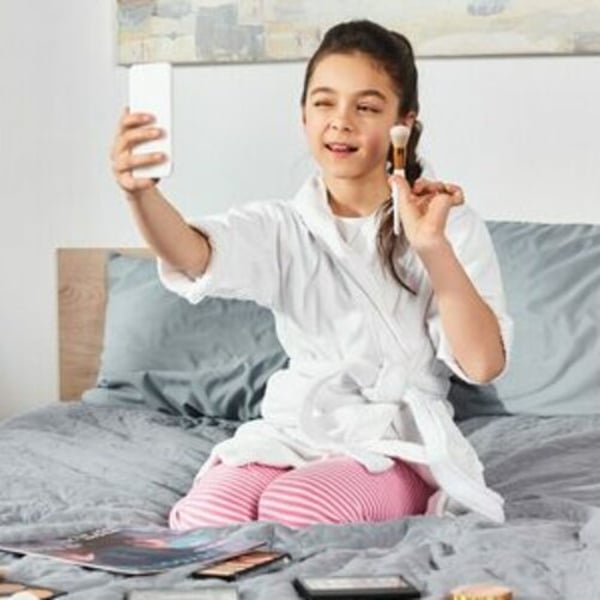
Moisturising masks with panda, unicorn or Barbie designs on the packaging: cosmetics brands are targeting a generation of children raised on social‑media beauty routines, exposing them to unnecessary and potentially harmful products, dermatologists warn.

Shutterstock

Like many celebrities, Canadian actress Shay Mitchell announced in early November that she was launching her cosmetics brand, Rini. Unusually, the range is aimed at children from the age of three.

On its website, the brand offers moisturising, after‑sun or everyday masks featuring a unicorn, a panda or a puppy, at around €5 each.

She is far from alone. Many brands are eyeing what they see as a lucrative market. Founded in 2018, Evereden, another fast‑growing U.S. brand with sales of over $100 million, sells “mists”, toners and moisturisers aimed at pre‑teens.

But “children don’t need cosmetics, apart from hygiene products, of course — toothpaste and shower gel — and sun protection products, when there’s exposure,” Laurence Coiffard, a professor of pharmacy at the Faculty of Nantes specialising in cosmetology, told AFP.

Endocrine disruptors

If social media are any guide, young people in Generation Alpha are trying out skincare and beauty routines at an increasingly early age. Dubbed the “Sephora Kids”, some imitate their favourite influencers from as young as seven, showing off their purchases on YouTube or TikTok.

The Chinese social network says it has attracted a growing number of brands since the launch of TikTok Shop. In France, the number of brands present is said to have risen from 5,000 to 16,500 in the space of six months. And beauty is the leading sector represented, according to its head for France and Southern Europe, Arnaud Cabanis.

But what may look like a game to children is not without risk, professionals insist. Scientific studies have shown that using adult cosmetics packed with chemicals exposes them to endocrine disruptors and phytoestrogens, which can interfere with hormonal development and increase the risk of skin allergies, explains Laurence Coiffard.

To study this phenomenon, Molly Hales and Sarah Rigali, American researchers at Northwestern University in Chicago, spent several months posing as 13‑year‑old girls on TikTok. They then analysed 100 beauty videos posted by 82 profiles of minors — and published their findings in June in the US journal Pediatrics.

In one of the videos, a child developed a rash and burns after applying 14 different products to her face. Another recounted waking at 4.30am to do her beauty “routine” before going to school. “I was shocked by the scale of what I was seeing in these videos, particularly the sheer number of products these girls were using,” Molly Hales told AFP.

‘Distorted self-image’

On average, the videos featured six products, often anti‑ageing creams intended for adults, at a typical cost of €145. In 25 videos analysed in detail, the products contained on average 11 — and up to 21 — substances potentially irritating to children’s skin.

Among the most popular brands are Glow, Drunk Elephant and The Ordinary, which present themselves as healthy, natural alternatives to their chemical‑laden competitors.

“Children are naturally curious,” says Rini co‑founder Shay Mitchell on Instagram, “so we might as well offer gentle, safe products that parents can trust.”

Beyond their potentially harmful effects, these products “perpetuate a certain beauty norm” by normalising the use of a “very expensive and time‑consuming” array of beauty treatments, notes Molly Hales.

On a psychological level, “the risk is to give the child a distorted, even eroticised, self‑image,” warned Pierre Vabres, a member of the French Dermatology Society, at a press conference in Paris in November. “Just as a child is not a miniature adult,” he insisted, “a cosmetic is not a toy.”

(with AFP)

This article is an automatic translation.
Click here to read the original article.

Copyright © 2025 FashionNetwork.com All rights reserved.


Source link

Continue Reading

Fashion

Outdoor brand DryRobe wins trademark case

Published

on


Published


December 5, 2025

Specialist outdoor clothing producer Dryrobe has won a trademark case against a smaller label. The win for the business, which produces waterproof towel-lined robes used by cold water swimmers, means the offending rival must now stop selling items under the D-Robe brand within a week.

Image: Dryrobe

A judge at the high court in London ruled the company was guilty of passing off its D-Robe changing robes and other goods as Dryrobe products and knew it was infringing its bigger rival’s trademark reports, The Guardian newspaper.

The company said it has rigorously defended its brand against being used generically by publications and makers of similar clothing and is expected to seek compensation from D-Robe’s owners for trademark infringement.

Dryrobe was created by the former financier Gideon Bright as an outdoor changing robe for surfers in 2010 and became the signature brand of the wild swimming craze.

Sales increased from £1.3 million in 2017 to £20.3 million in 2021 and it made profits of £8 million. However, by 2023 sales had fallen back to £18 million as the passion for outdoor sports waned and the brand faced more competition.

Bright told the newspaper the legal win was a “great result” for Dryrobe as there were “quite a lot of copycat products and [the owners] immediately try to refer to them using our brand name”.

He said the company was now expanding overseas and moving into a broader range of products, adding that sales were similar to 2023 as “a lot of competition has come in”.

Copyright © 2025 FashionNetwork.com All rights reserved.


Source link

Continue Reading

Fashion

France abandons bid for the total suspension of Shein’s website

Published

on


Published


December 5, 2025

On Friday, France demanded a series of measures from Shein to demonstrate that the products sold on its website comply with the law, but dropped its initial request for a total three-month suspension of the online platform, which had been based on the sale of child-like sex dolls and prohibited weapons.

Shutterstock

At a hearing before the Paris court, a lawyer representing the state said that Shein must implement controls on its website, including age verification and filtering, to ensure that minors cannot access pornographic content. The state asked the court to impose a suspension of Shein’s marketplace until Shein has provided proof to Arcom, the French communications regulator, that these controls have been implemented.

Shein deactivated its marketplace- where third-party sellers offer their products- in France on November 5, after authorities discovered illegal items for sale, but its site selling Shein-branded clothing remains accessible. The state invoked Article 6.3 of France’s Digital Economy Act, which empowers judges to order measures to prevent or halt harm caused by online content.

“We don’t claim to be here to replace the European Commission,” the state’s lawyer said. “We are not here today to regulate; we are here to prevent harm, in the face of things that are unacceptable.” At the time of writing, the hearing is still ongoing.

In a statement issued last week, the Paris public prosecutor’s office said that a three-month suspension could be deemed “disproportionate” in light of European Court of Human Rights case law if Shein could prove that it had ceased all sales of illegal products. However, the public prosecutor’s office said it “fully supported” the government’s request that Shein provide evidence of the measures taken to stop such sales.

France’s decision comes against a backdrop of heightened scrutiny of Chinese giants such as Shein and Temu under the EU’s Digital Services Act, reflecting concerns about consumer safety, the sale of illegal products, and unfair competition. In the US, Texas Attorney General Ken Paxton said on Monday that he was investigating Shein to determine whether the fast-fashion retailer had violated state law relating to unethical labour practices and the sale of dangerous consumer products.

This article is an automatic translation.
Click here to read the original article.
Copyright © 2025 FashionNetwork.com All rights reserved.


Source link

Continue Reading

Fashion

Kappa goes local for football campaign that traces a ‘lifelong love of the game’

Published

on


Published


December 5, 2025

BasicNet’s Kappa turns back the sporting clock for its new AW25 collection, which celebrates “local heroes in football” with a community-focused campaign “honouring the places and people that inspire a lifelong love of the game”.

Image: Kappa

The campaign shines a light on local talent Tyrone Marsh in his hometown of Bedford, revisiting the streets, pitches and community spots “that shaped his football journey”.

Local photographer Simon Gill, who had pictured Marsh during many home and away games, not only “captures the Bedford Town player in the spaces that helped define his skill”, but also highlights the brand’s “rich football heritage with contemporary streetwear energy, creating visuals that pay tribute to community, culture and grassroots football”.

The journey includes Hartwell Drive, the early days of his after-school kickabouts, Hillgrounds Road, synonymous with Bedford football culture, and then onto Faraday Square, locally identified by the concrete pitches and community spirit.

To reflect that journey, the AW25 collection “offers a sense of nostalgia” with Kappa’s long-standing history in fashion and sports “seen through the Omini logo placements and 222 Banda strip”.

The campaign sees Marsh wearing Kappa styles including the Lyman and Uriah Track Tops paired with the Ulrich Track Pants in classic colourways including navy and light blue.

The wider collection includes track tops, track pants, shorts, polos, sweatshirts and T-shirts, available at select retailers across the UK including 80s Casual Classics, Terraces Menswear and RD1 Clothing.

Copyright © 2025 FashionNetwork.com All rights reserved.


Source link

Continue Reading

Trending

Copyright © Miami Select.