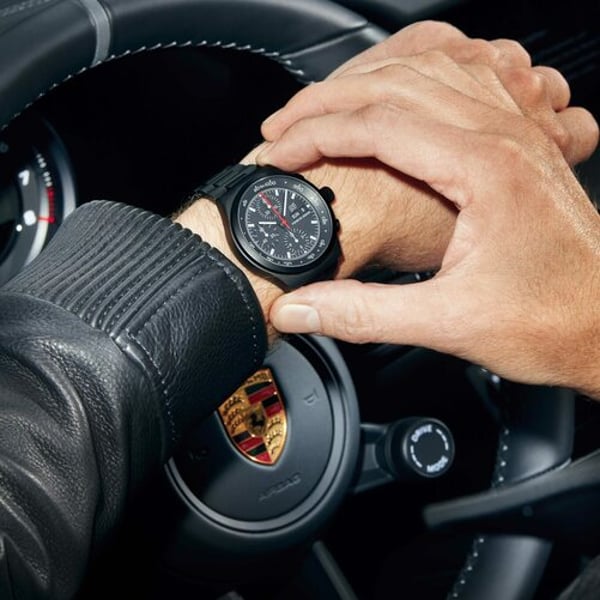
Everyone, maybe even someone living under a rock, has heard the name Porsche. For most, it will conjure images of the famed 911 sports car. Fewer will think of Porsche Design watches, even though they’ve been produced for more than 40 years.
PORSCHE DESIGN
Now the Porsche family is planning to change that. After many years as a separate company, the maker of watches, sunglasses, apparel and other sports gear was brought fully into the fold with the automaker in 2017, when Porsche obtained the final 35% of shares it hadn’t previously controlled. Now, Porsche Design is a part of the broader Porsche Lifestyle Group, which includes departments that make apparel, car accessories, and collaborations on products like eBikes, surfboards, and skis. And all of these categories will be given higher priority by the automaker as it evolves into the future.
Watches, in particular, will be boosted in production numbers and in store presence. “It just made sense,” says Stefan Buescher, chief executive officer of Porsche Lifestyle Group.
A bit of history: It wasn’t too long after the now-famed designer and Porsche scion Ferdinand Alexander “Butzi” Porsche unveiled the 911 in 1963 that he also began designing watches. His motto was “Form over function,” and in 1972 he founded Porsche Design, an independent studio where he created the first Chronograph 1 watch—famously worn by Mario Andretti when he won the Formula One World Championship in 1978. Versions of the Chronograph 1 were also seen in the 1970s on other famous wrists, including Ralph Lauren’s.
Porsche Design designed all these watches in-house, drawing inspiration from the brand’s automotive heritage. But the watches—from the first all-black Chronograph 1 (released in 1972) to the Titan Chronograph (an all-titanium watch unveiled in 1980), Chronotimer and Sport Chrono Collection—were always manufactured through partnerships with companies such as Orfina, IWC Schaffhausen and Eterna (which Porsche Design also later bought and sold).
Then, in 2017, Porsche Design opted to take control of the manufacture of the watches, using a small factory in Solothurn, Switzerland. And now that it’s been fully united with Porsche AG, leadership says it wants to triple its manufacturing capability. The brand is also working with its first multistate retail partner in America, Watches of Switzerland, and has even brought actor Orlando Bloom on as a brand ambassador for all its lifestyle categories, including watches, eyewear (famously worn by Yoko Ono in the 1980s) and luggage. Bloom is also an ambassador for Porsche cars.
Buescher notes that the manufacturing facility could make only about 3,000 watches annually. “To really bring the brand back, we want to build as many as 8,000 to 9,000 watches a year, and so we needed to invest in a larger space.”
In scouting it out, they found the perfect building: the old Eterna watch factory in Grenchen, Switzerland, where F.A. Porsche had once worked. Since purchasing the factory in early 2024, the company has worked to gut the building and equip it with modern technology. The grand opening will be in the fall. The brand will use movements supplied by existing Swiss manufactures and then modify certain elements, but all the design and assembly will take place in-house.
“It’s all about being in the game again in a big way, being seen as a serious brand that does almost everything in-house,” says Ferdi Porsche, nephew of F.A. Porsche. “Like our cars, we need to focus on functionality and quality. Our design ethos for the watches is the core of what my uncle did, and by focusing on icon watches, we are positioning the brand for the future.”
The most recently released watch, unveiled at a Watches of Switzerland party July 23 at its flagship store in the SoHo neighbourhood of New York, is a perfect example of the return to icons. The Porsche Design Chronograph 1 – 1975 Limited Edition watch is created totally in uncoated titanium- a nod to the uncoated stainless steel watch F.A. Porsche designed in 1975. It marks the final series, a limited edition of only 350 pieces, to be made in the Solothurn workshops.
The dial of the watch reflects the dashboard gauges of the 911 with a matte black background, white SuperLumiNova-coated numerals and indexes, and a bold red stop-seconds hand for the chronograph timing. The automatic flyback chronograph is fitted with a modified Swiss movement and is a COSC-certified chronometer, attesting to its accuracy and durability. It features an engraved case back, is numbered and boasts the engraved signature of F.A. Porsch. The watch sells for 9,650 dollars, midrange for the brand whose timepieces sell for 5,350 dollars to 13,000 dollars.
Buescher says that, despite the brand’s large investment in the new manufacture and the costs to tool up for larger production, the Porsche Design watches will remain at the same affordable retail prices. “I think that 13,000 dollar price is a threshold for us that we won’t pass except for the custom-built watches.”
Bloom, the only Porsche brand ambassador, concurs. “Generationally it’s interesting because it’s still the right price for a serious collector and for an aspiring young collector to work towards,” he says. “When you wear the watch, you feel the same proud feeling as owning the car. If you can’t have the car, you buy the watch. And if you can’t afford the watch, you buy the sunglasses.” The first Porsche item he bought himself at the young age of 14 was a pair of vintage original aviator sunglasses, Bloom says.
Coming on board earlier this year to represent all Porsche pillars, Bloom—a watch collector and Porsche car lover—says the fit was synergistic. “It started with my passion for the cars and the brand. I went to great lengths to build a relationship that I felt was authentic to the brand, taking myself to Stuttgart to build a car that I felt reflected my passion. Once I saw the watches, it continued,” he says, indicating that his Porsche Chrono never comes off his wrist.
“There is something so cool about the feeling of driving the car and seeing the watch on your wrist against the dashboard,” the actor says. “It’s so symbiotic. It’s a timeless design that is running all the way through the family and the brand.”