
Fashion
Womenswear catwalks: The ten trends for spring/summer 2026

Published
October 8, 2025
The many debuts at the creative helm of the world’s leading fashion houses mark a transitional season, in which the major trends of recent seasons are asserting themselves. Yet the overall picture is evolving, infused with fresh energy and a breath of optimism, as evidenced by the spring/summer 2026 collections unveiled on the catwalks of New York, London, Milan and Paris from September 11 to October 7.
The working girl silhouette is softening, adopting a more modern, youthful attitude with a dash of audacity in looks where layering, generous volumes, sheerness, shine and fluidity are taking centre stage.
1. The suit
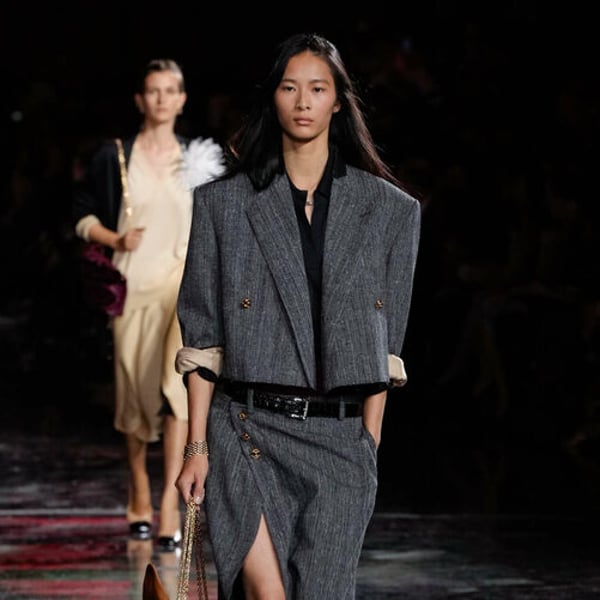
A cornerstone of the women’s wardrobe and a power-dressing staple, the suit is reimagined with a fresher, more relaxed spirit, almost de-dramatised. Chanel, for example, shortened the double-breasted jacket and paired it with a raw-edged wrap skirt. At Dior, the famous Bar jacket was likewise shortened and teamed with a pleated mini skirt. The jacket was also cropped at Max Mara and fastened with an elastic drawstring. The skirt was worn low-slung, often revealing underwear in a totally uninhibited Gen-Z spirit.
2. The hourglass cut

In many collections, jackets, coats and dresses adopted the hourglass line, in a frock-coat vein as at Mugler. The silhouette, nipped at the waist, was perfectly emphasised, while hips and shoulders were accentuated with rounded volumes. Among the many variations, Loewe applied it to leather jackets; while Anrealage even riffed on a giant polo shirt in this shape. With pannier dresses, also seen across several shows, the appetite for the past and for 18th-century period style was confirmed.
3. The godet skirt

The traditional godet skirt, with its undulating movement, is enjoying a new lease of life. It came in several versions, with sweeping swirls of fabric, fitted then flaring into a rippling corolla, or shorter in a skater style. Generally speaking, skirts were everywhere: pencil, ruffled, bubble, slim, slit or panelled. Many appeared in playful prints or vivid colours, sculptural with recycled fringing, as at Bottega Veneta.
4. Maxi & mini

Last season’s maximalist trend, with its XXL details and accessories, continues, now spliced with the opposite tendency: tiny pieces via a cascade of jackets and blouses reduced to boleros and crop tops, or even bras, with strong references to the 1980s and 1990s. Not to mention the ultra-mini skirts and shorts that dominated the catwalks, from Prada to Versace, underscoring a liberated, summery spirit. In the same look, Balenciaga shrunk a T-shirt and ballooned a skirt. The waistline was dropping inexorably to bare the navel in all circumstances.
5. The XXL belt buckle

In the same vein, belt buckles went giant at Zomer, Rabanne and Vaquera. The belt continued to preoccupy designers more than ever. It featured in every look and was worn in full view, ideally sitting very low, while redrawing the silhouette. Designers had fun with it: it bordered a pair of trousers down the legs at Acne Studios, while the belted skirt is on track to become next summer’s must-have.
6. The bra

After focusing on knickers last season, designers are now turning the spotlight on the bra, elevated to a key piece for next summer. It’s paired with bikinis, offered in a lingerie version or as a top in its own right, crafted in every material, including leather or faux fur, as Givenchy dared, while Hermès adorned it with a scarf. In short, it’s omnipresent in the wardrobe.
7. The little jumper over the shoulders

The little jumper (preferably grey) will be next summer’s essential accessory. It’s making a big comeback slung over the shoulders, resurrected from the 1980s with its deliciously old-fashioned preppy feel, as seen at Bottega Veneta. The trick is to subvert the gesture and modernise it. At Loewe, it covered the bust, replacing a top. Acne Studios fixed it at the neck via porthole cut-outs on the sleeves. N°21 reduced it to a pair of sleeves that wrap around the neck like a scarf. At MSGM, it was fastened only at the first button. At Versace, the jumper was tied at the waist, and at Tom Ford, it wrapped around the neck, very chic, tone-on-tone, over a white suit.
8. The “nude”

While an explosion of colour has swept the catwalks, a reassuring neutral palette has made a parallel breakthrough, with nude taking pride of place in next summer’s wardrobe. There wasn’t a single collection without a few looks in beige, powder pink or flesh tones. This soothing shade, inspired as much by cosmetics and the boudoir as by raw materials, has become, with its authentic simplicity, a byword for refinement. Camel is no longer the sole preserve of the trench coat. It now unfolded across every piece, including sumptuous evening gowns, in materials from chiffon to latex.
9 The striped polo shirt

The polo shirt, in fine or bold multicoloured stripes, is the practical little piece that will be all the rage next summer. A playful basic we never tire of, perfect for the beach as well as the city. At Lacoste, the brand’s flagship piece came in an oversized format. Issey Miyake gave it an intriguing puffed, crumpled volume. At Rabanne, it slipped on over a gold metal mini skirt.
10. Recto verso

Couturiers love a surprise. This season, in particular, the back is the focus of obsessive attention. It’s suddenly laid bare, partially revealed, or used to give garments a second identity, as at Vetements, where all the looks appear on the reverse side, most often pared back to their simplest state (underwear and tights). At Niccolò Pasqualetti, a T-shirt morphed into a jacket; at McQueen, the back was revealed with unexpected cut-outs; and at Courrèges, skirts were short at the front and maxi at the back.
This article is an automatic translation.
Click here to read the original article.
Copyright © 2025 FashionNetwork.com All rights reserved.

Published
December 5, 2025
Burberry has named a new chief operating and supply chain officer as well as a new chief customer officer. They’re both key roles at the recovering luxury giant and both are being promoted from within.
Matteo Calonaci becomes chief operating and supply chain officer, moving from his role as senior vice-president of strategy and transformation at the firm.
In his new role, he’ll be oversee supply chain and planning, strategy and transformation, and data and analytics. He succeeds Klaus Bierbrauer, who’s currently Burberry supply chain and industrial officer. Bierbrauer will be leaving the company following its winter show and a transition period.

Meanwhile, Johnattan Leon steps up as chief customer officer. He’s currently currently Burberry’s senior vice-president of commercial and chief of staff. In his new role he’ll be leading Burberry’s customer, client engagement, customer service and retail excellence teams, while also overseeing its digital, outlet and commercial operations.
Both Calonaci and Leon will join the executive committee, reporting to Company CEO Joshua Schulman.

Schulman said of the two execs that the appointments “reflect the exceptional talent and leadership we have at Burberry. Both Matteo and Johnattan have been instrumental in strengthening our focus on executional excellence and elevating our customer experience. Their deep understanding of our business, our people, and our customers gives me full confidence that their leadership will help drive [our strategy] Burberry Forward”.
Copyright © 2025 FashionNetwork.com All rights reserved.
Published
December 5, 2025
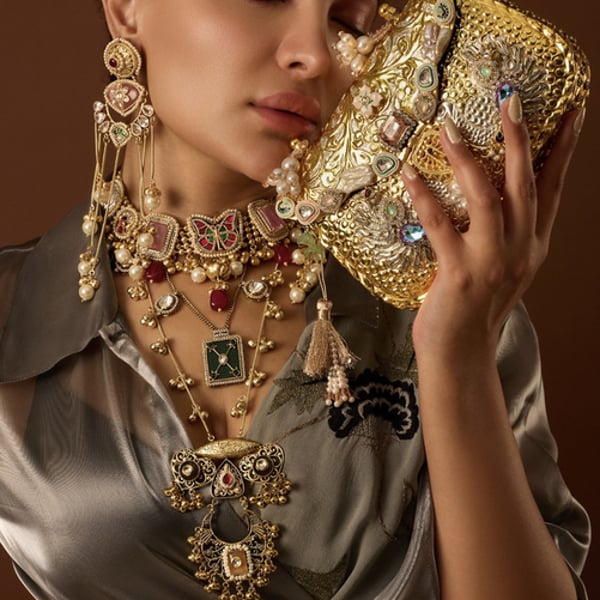
Traditional and occasion wear designer Puneet Gupta has stepped into the world of fine jewellery with the launch of ‘Deco Luméaura,’ a collection designed to blend heritage and contemporary aesthetics while taking inspiration from the dramatic landscapes of Ladakh.
“For me, Deco Luméaura is an exploration of transformation- of material, of story, of self,” said Puneet Gupta in a press release. “True luxury isn’t perfect; it is intentional. Every piece is crafted to be lived with and passed on.”
The jewellery collection features cocktail rings, bangles, chokers, necklaces, and statement evening bags made in recycled brass and finished with 24 carat gold. The stones used have been kept natural to highlight their imperfect and unique forms and each piece in the collection has been hammered, polished, and engraved by hand.

Designed to function as wearable art pieces, the colourful jewellery echoes the geometry of Art Deco while incorporating distinctly South Asian imagery such as camels, butterflies, and tassels. Gupta divides his time between his stores in Hyderabad and Delhi and aims to bring Indian artistry to a global audience while crafting a dialogue between designer and artisan.
Copyright © 2025 FashionNetwork.com All rights reserved.


Tucker Wetmore’s Song ‘Proving Me Right’ is About Model Bryana Ferringer

‘Bachelor’ Winner Cassie Randolph Marries Brighton Reinhardt

Kanye West and Bianca Censori Travel to South Korea Together
-

 Politics8 years ago
Congress rolls out ‘Better Deal,’ new economic agenda
-
Entertainment8 years ago
New Season 8 Walking Dead trailer flashes forward in time
-
Politics8 years ago
Poll: Virginia governor’s race in dead heat
-
Entertainment8 years ago
The final 6 ‘Game of Thrones’ episodes might feel like a full season
-
Entertainment8 years ago
Meet Superman’s grandfather in new trailer for Krypton
-
Politics8 years ago
Illinois’ financial crisis could bring the state to a halt
-
Business8 years ago
6 Stunning new co-working spaces around the globe
-
Tech8 years ago
Hulu hires Google marketing veteran Kelly Campbell as CMO