Connect with us

Business

Wisconsin couple’s ACA health plan soars from $2 a month to $1,600 as subsidies expire

Published

on


For one Wisconsin couple, the loss of government-sponsored health subsidies next year means choosing a lower-quality insurance plan with a higher deductible. For a Michigan family, it means going without insurance altogether.

For a single mom in Nevada, the spiking costs mean fewer Christmas gifts this year. She is stretching her budget already while she waits to see if Congress will act.

Less than three weeks remain until the expiration of COVID-era enhanced tax credits that have helped millions of Americans pay their monthly fees for Affordable Care Act coverage for the past four years.

The Senate on Thursday rejected two proposals to address the problem and an emerging health care package from House Republicans does not include an extension, all but guaranteeing that many Americans will see much higher insurance costs in 2026.

Here are a few of their stories.

From a gold plan to a bronze plan, a couple spends more on less

Chad Bruns comes from a family of savers. That came in handy when the 58-year-old military veteran had to leave his firefighting career early because of arm and back injuries he incurred on the job.

He and his wife, Kelley, 60, both retirees, cut their own firewood to reduce their electricity costs in their home in Sawyer County, Wisconsin. They rarely eat out and hardly ever buy groceries unless they are on sale.

But to the extent that they have always been frugal, they will be forced to be even more so now, Bruns said. That is because their coverage under the health law enacted under former President Barack Obama is getting more expensive -– and for worse coverage.

This year, the Brunses were paying $2 per month for a top-tier gold-level plan with less than a $4,000 deductible. Their income was low enough to help them qualify for a lot of financial assistance.

But in 2026, that same plan is rising to an unattainable $1,600 per month, forcing them to downgrade to a bronze plan with a $15,000 deductible.

Kelley Bruns said she is concerned that if something happens to their health in the next year, they could go bankrupt. While their monthly fees are low at about $25, their new out-of-pocket maximum at $21,000 amounts to nearly half their joint income.

“We have to pray that we don’t have to have surgery or don’t have to have some medical procedure done that we’re not aware of,” she said. “It would be very devastating.”

Family facing higher costs prepares to go without insurance

Dave Roof’s family of four has been on ACA insurance since the program started in 2014. Back then, the accessibility of insurance on the marketplace helped him feel comfortable taking the leap to start a small music production and performance company in his hometown of Grand Blanc, Michigan. His wife, Kristin, is also self-employed as a top seller on Etsy.

The coverage has worked for them so far, even when emergencies come up, such as an ATV accident their 21-year-old daughter had last year.

But now, with the expiration of subsidies that kept their premiums down, the 53-year-old Roof said their $500 per month insurance plan is jumping to at least $700 a month, along with spiking deductibles and out-of-pocket costs.

With their joint income of about $75,000 a year, that increase is not manageable, he said. So, they are planning to go without health insurance next year, paying cash for prescriptions, checkups and anything else that arises.

Roof said his family is already living cheaply and has not taken a vacation together since 2021. As it is, they do not save money or add it to their retirement accounts. So even though forgoing insurance is stressful, it is what they must do.

“The fear and anxiety that it’s going to put on my wife and I is really hard to measure,” Roof said. “But we can’t pay for what we can’t pay for.”

Single mom strains her January budget in hopes Congress acts soon

If you ask Katelin Provost, the American middle class has gone from experiencing a squeeze to a “full suffocation.”

The 37-year-old social worker in Henderson, Nevada, counts herself in that category. As a single mom, she already keeps a tight budget to cover housing, groceries and day care for her 4-year-old daughter.

Next year, that is going to be even tougher.

The monthly fee on her plan is going up from $85 to nearly $750. She decided she is going to pay that higher cost for January and reevaluate afterward, depending on whether lawmakers extends the subsidies, which as of now appears unlikely. She hopes they will.

If Congress does not act, she will drop herself off the health insurance and keep it only for her daughter because she cannot afford the higher fee for the two of them over the long term.

The strain of one month alone is enough to have an impact.

“I’m going to have to reprioritize the next couple of months to rebalance that budget,” Provost said. “Christmas will be much smaller.”




Source link

Continue Reading

Business

2 U.S. service members and one American civilian killed in Islamic State ambush in Syria

Published

on


Two U.S. service members and one American civilian were killed and three other people wounded in an ambush on Saturday by a lone member of the Islamic State group in central Syria, the the U.S. military’s Central Command said.

The attack on U.S. troops in Syria is the first to inflict casualties since the fall of President Bashar Assad a year ago.

Central Command said in a post on X that as a matter of respect for the families and in accordance with Department of Defense policy, the identities of the service members will be withheld until 24 hours after their next of kin have been notified.

U.S. Defense Secretary Pete Hegseth posted on X: “Let it be known, if you target Americans — anywhere in the world — you will spend the rest of your brief, anxious life knowing the United States will hunt you, find you, and ruthlessly kill you.”

The shooting took place near historic Palmyra, according to the state-run SANA news agency, which earlier said two members of Syria’s security force and several U.S. service members had been wounded. The casualties were taken by helicopter to the al-Tanf garrison near the border with Iraq and Jordan.

SANA said the attacker was killed, without providing further details.

The Britain-based Syrian Observatory for Human Rights said the attacker was a member of the Syrian security force.

The U.S. has hundreds of troops deployed in eastern Syria as part of a coalition fighting the Islamic State group.

Last month, Syria joined the international coalition fighting against the IS as Damascus improves its relations with Western countries following the ouster of Assad when insurgents captured his seat of power in Damascus.

The U.S. had no diplomatic relations with Syria under Assad, but ties have warmed since the fall of the five-decade Assad family rule. The interim president, Ahmad al-Sharaa, made a historic visit to Washington last month where he held talks with President Donald Trump.

IS was defeated on the battlefield in Syria in 2019 but the group’s sleeper cells still carry out deadly attacks in the country. The United Nations says the group still has between 5,000 and 7,000 fighters in Syria and Iraq.

U.S. troops, which have maintained a presence in different parts of Syria — including Al-Tanf garrison in the central province of Homs — to train other forces as part of a broad campaign against IS, have been targeted in the past. One of the deadliest attacks occurred in 2019 in the northern town of Manbij when a blast killed two U.S. service members and two American civilians as well as others from Syria while conducting a patrol.


Source link

Continue Reading

Business

Stock market rotation out of AI is just getting started, analysts say

Published

on


Investors rushed out of the AI trade this past week and piled into materials, industrials, financials and healthcare, representing a sector rotation that could have staying power, according to Wall Street analysts.

Oracle stock led the latest AI selloff after the hyperscaler’s earnings report and spending guidance renewed fears about excessive capital expenditures.

Jeremy Siegel, Wharton professor emeritus and WisdomTree chief economist, told CNBC on Friday that it’s hard to be certain about the current stock market rotation because there have been “so many head fakes in the past.”

“But as I said, this one has more legs in the sense that there are more things that are happening that throw doubt on how fast or how profitable all the AI buildout is going to be,” he added.

In Oracle’s case, recent delays in data center construction may actually end up being a silver lining if it slows expenditures, but there are still more questions than answers about the profitability of AI, Siegel said.

He noted his research has shown that when companies grow spending faster than their income, they ultimately overexpand, hitting profits and stock returns.

“I’m not saying that that’s necessarily going to happen to AI or certainly all the AI, but that narrative has to come in mind,” Siegel warned.

Also on Friday, Bank of America Securities investment strategist Michael Hartnett said markets are frontrunning a “run-it-hot” scenario expected for next year by rotating into a Main Street trade made up of mid- and small-cap stocks, while getting out of a Wall Street trade consisting of mega-cap names.

Eric Teal, chief investment officer for Comerica Wealth Management, had a similar view in a note on Thursday, saying that the market was dominated by momentum and AI stocks during the first eight months of the year.

But since then, concerns about valuations, margin sustainability, and high debt shifted sentiment around the technology sector.

Financial and healthcare stocks have been more appealing, while small caps and even “micro-cap stocks” will benefit from falling short-term rates, he added.

“More importantly, we foresee this rotation in the early stages with relative valuations remaining attractive,” Teal predicted. 


Source link

Continue Reading

Business

Even in Silicon Valley, skepticism looms over robots, while ‘China has certainly a lot more momentum on humanoids’

Published

on


Robots have long been seen as a bad bet for Silicon Valley investors — too complicated, capital-intensive and “boring, honestly,” says venture capitalist Modar Alaoui.

But the commercial boom in artificial intelligence has lit a spark under long-simmering visions to build humanoid robots that can move their mechanical bodies like humans and do things that people do.

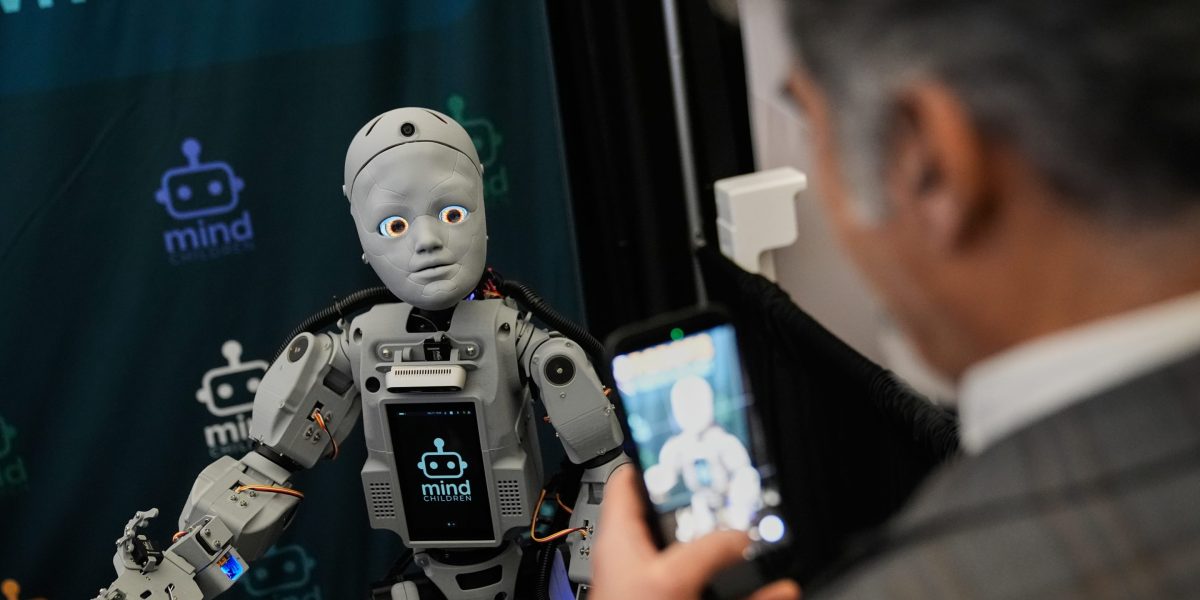
Alaoui, founder of the Humanoids Summit, gathered more than 2,000 people this week, including top robotics engineers from Disney, Google and dozens of startups, to showcase their technology and debate what it will take to accelerate a nascent industry.

Alaoui says many researchers now believe humanoids or some other kind of physical embodiment of AI are “going to become the norm.”

“The question is really just how long it will take,” he said.

Disney’s contribution to the field, a walking robotic version of “Frozen” character Olaf, will be roaming on its own through Disneyland theme parks in Hong Kong and Paris early next year. Entertaining and highly complex robots that resemble a human — or a snowman — are already here, but the timeline for “general purpose” robots that are a productive member of a workplace or household is farther away.

Even at a conference designed to build enthusiasm for the technology, held at a Computer History Museum that’s a temple to Silicon Valley’s previous breakthroughs, skepticism remained high that truly humanlike robots will take root anytime soon.

“The humanoid space has a very, very big hill to climb,” said Cosima du Pasquier, founder and CEO of Haptica Robotics, which works to give robots a sense of touch. “There’s a lot of research that still needs to be solved.”

The Stanford University postdoctoral researcher came to the conference in Mountain View, California, just a week after incorporating her startup.

“The first customers are really the people here,” she said.

Researchers at the consultancy McKinsey & Company have counted about 50 companies around the world that have raised at least $100 million to develop humanoids, led by about 20 in China and 15 in North America.

China is leading in part due to government incentives for component production and robot adoption and a mandate last year “to have a humanoid ecosystem established by 2025,” said McKinsey partner Ani Kelkar. Displays by Chinese firms dominated the expo section of this week’s summit, held Thursday and Friday. The conference’s most prevalent humanoids were those made by China’s Unitree, in part because researchers in the U.S. buy the relatively cheap model to test their own software.

In the U.S., the advent of generative AI chatbots like OpenAI’s ChatGPT and Google’s Gemini has jolted the decades-old robotics industry in different ways. Investor excitement has poured money into ambitious startups aiming to build hardware that will bring a physical presence to the latest AI.

But it’s not just crossover hype — the same technical advances that made AI chatbots so good at language have played a role in teaching robots how to get better at performing tasks. Paired with computer vision, robots powered by “visual-language” models are trained to learn about their surroundings.

One of the most prominent skeptics is robotics pioneer Rodney Brooks, a co-founder of Roomba vacuum maker iRobot who wrote in September that “today’s humanoid robots will not learn how to be dexterous despite the hundreds of millions, or perhaps many billions of dollars, being donated by VCs and major tech companies to pay for their training.” Brooks didn’t attend but his essay was frequently mentioned.

Also missing was anyone speaking for Tesla CEO Elon Musk’s development of a humanoid called Optimus, a project that the billionaire is designing to be “extremely capable” and sold in high volumes. Musk said three years ago that people can probably buy an Optimus “within three to five years.”

The conference’s organizer, Alaoui, founder and general partner of ALM Ventures, previously worked on driver attention systems for the automotive industry and sees parallels between humanoids and the early years of self-driving cars.

Near the entrance to the summit venue, just blocks from Google’s headquarters, is a museum exhibit showing Google’s bubble-shaped 2014 prototype of a self-driving car. Eleven years later, robotaxis operated by Google affiliate Waymo are constantly plying the streets nearby.

Some robots with human elements are already being tested in workplaces. Oregon-based Agility Robotics announced shortly before the conference that it is bringing its tote-carrying warehouse robot Digit to a Texas distribution facility run by Mercado Libre, the Latin American e-commerce giant. Much like the Olaf robot, it has inverted legs that are more birdlike than human.

Industrial robots performing single tasks are already commonplace in car assembly and other manufacturing. They work with a level of speed and precision that’s difficult for today’s humanoids — or humans themselves — to match.

The head of a robotics trade group founded in 1974 is now lobbying the U.S. government to develop a stronger national strategy to advance the development of homegrown robots, be they humanoids or otherwise.

“We have a lot of strong technology, we have the AI expertise here in the U.S.,” said Jeff Burnstein, president of the Association for Advancing Automation, after touring the expo. “So I think it remains to be seen who is the ultimate leader in this. But right now, China has certainly a lot more momentum on humanoids.”


Source link

Continue Reading

Trending

Copyright © Miami Select.