
Politics
Winner and Loser of the Year in Florida politics — 2025 edition
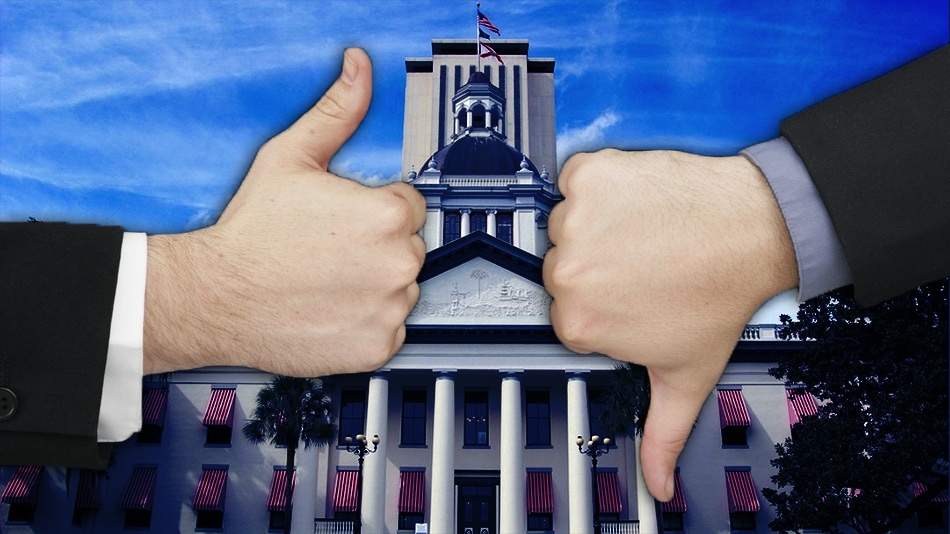
Welcome to our second annual end of year edition, where we look back at the top winners and losers in the Florida political scene in 2025.
Last year, we stuck to our normal structure and named three winners and losers for the year. But for 2025, we’re blowing out this column.
We tried to highlight all of the most notable names that stood out the past 12 months and landed on eight winners and eight losers. We know you need content over the holidays as publications like ours slow down a bit, so you’re welcome.
We’ll keep this intro brief since we’ve got plenty to say down below, but we hope the holiday season has been a cheerful one for you and yours. And with an election season next year including a changing of the guard at the top of the Florida political totem pole, we can’t wait to see what 2026 has in store.
But before that, it’s time to look back at 2025 in our yearly game of winners and losers.
Winners
— Blaise Ingoglia: Ingoglia isn’t treating the Chief Financial Officer’s office as a ceremonial post. He’s turning it into a political megaphone and a fiscal watchdog with constant visibility across the state.
After being appointed CFO in July, Ingoglia as one of his first moves launched aggressive audits of local governments under the Florida Department of Government Efficiency (DOGE) initiative, zeroing in on cities and counties such as Gainesville, Broward, Miami-Dade and Palm Beach.
His Office has publicly flagged what it calls “excessive, wasteful” spending — from more than $302 million in Miami-Dade’s budget to over $344 million in Palm Beach County’s — often framing these findings as drivers of high property taxes and unnecessary budget growth.
Ingoglia has pushed these audits publicly, holding news conferences and press briefings that call out specific localities for budget increases that outpace inflation and population growth, and urging officials to cut spending and provide property tax relief.

In December, he also unveiled legislative proposals aimed at standardizing budget transparency and accountability across all local governments so taxpayers can more easily see how money is spent.
Together, these actions have made the CFO’s Office far more active and media visible than in recent years, allowing him to build up his name ahead of a contested 2026 race to earn a full term in the role.
— Byron Donalds: Donalds closes out the year as the clear momentum candidate in the race to succeed term-limited DeSantis, having spent months steadily consolidating support and building a campaign operation that now looks formidable by any measure.
Donalds has dominated early fundraising, assembling a war chest that far outpaces the hauls of his opponents. That financial strength has allowed him to scale up quickly, invest in infrastructure, and project inevitability long before most rivals have found their footing.
Endorsements have also been plentiful. Donalds secured an early and consequential nod from Trump, a seal of approval that reshaped the dynamics of the primary and effectively froze out several would-be competitors. Since then, support from prominent Republicans in Florida and Washington has continued to pile up, reinforcing the perception that party leaders are coalescing around his candidacy.
Polling has reflected that consolidation, with Donalds consistently leading the Republican field and posting margins that suggest he is already running from the front. In a race that once appeared wide open, he has used a combination of money, messaging, and muscle to separate himself from the pack.
Of course, 2026 stands to be an even better year for Donalds should he get across the finish line. But for now, he’s dominating Republican candidates in the race and appearing to box out others due to his strength as a candidate.
And while Democrats hope to propel anti-Trump sentiment into a strong performance next November, it will take a massive blue wave to overcome Florida’s current Republican lean. Donalds enters 2026 in the driver’s seat in this race.
— Daniel Perez: Perez used his first year as House Speaker to send a clear message: The Legislature is no longer content to operate as a rubber stamp.
After years in which DeSantis dominated the policy agenda and lawmakers largely followed along, Perez has moved deliberately to reassert the House as an independent center of power.
Under Perez’s leadership, the House has shown a greater willingness to question priorities coming from the executive branch, slow-walk or reshape proposals, and assert its own prerogatives. That shift has been most evident in budget negotiations and oversight matters, where House leaders have pushed back on spending plans and demanded more transparency and accountability, particularly relating to Hope Florida (more on that later).
The result is a Capitol dynamic that looks different from recent years, with the House acting less as a supporting player and more as a coequal branch.
That led to some growing pains in 2025, with Session stretching past 100 days. The Governor and the Speaker continue to lock horns over high-profile issues like property tax changes and redistricting, signaling a possible repeat in 2026.
But while 2025 may have been an extreme example, this is how things are supposed to work. And Perez has led the effort to ensure lawmakers have a clear voice in shaping Florida policy.
— Eileen Higgins: Higgins capped the year by pulling off one of the more symbolically significant victories of 2025 — winning the Miami mayoral runoff decisively and pushing back against the narrative that South Florida is turning as red as other parts of the state.
Higgins became the first woman ever elected Mayor of Miami and the first registered Democrat to hold the post in nearly 30 years, defeating former City Manager Emilio González.
It wasn’t a total shock that she won given the favorable political climate for Democrats. But the margin is what caught people’s attention, beating a well-respected Republican leader by roughly 19 points in a race that drew national attention.
A former Miami-Dade County Commissioner known for championing affordable housing, public transit and sustainable development, Higgins leveraged that record — along with strong labor and community backing — to build a coalition in a city that had trended Republican in recent statewide elections.
And it wasn’t like Republicans didn’t try to make a play here, despite the Governor’s dismissive comments after the loss. Many major GOP leaders, including Trump, stepped into this race to push González over the finish line. They failed.
And for Higgins, the win boosts her profile going forward as someone who could continue stepping up should future opportunities present themselves.
— James Uthmeier: Uthmeier’s jump from behind-the-scenes Chief of Staff to Florida’s Attorney General has been one of the most consequential political shifts of 2025.
Appointed by Gov. Ron DeSantis in February, Uthmeier quickly signaled he would wield the state’s top legal post aggressively to advance the Governor’s agenda. He launched his tenure by opening high-profile criminal actions, underscoring a law-and-order agenda that has become a theme of his leadership.
Uthmeier has highlighted initiatives aimed at social issues that resonate with the state’s conservative base. His Office has filed suits against major tech platforms like Snapchat over alleged harms to children and launched investigations into online gaming platforms’ treatment of minors, tying his legal agenda to broader cultural priorities.
On immigration, Uthmeier has been similarly hawkish, publicly advocating expanded enforcement and collaborating with federal authorities on deportations. He also championed high-profile projects like the Everglades facility dubbed “Alligator Alcatraz,” which drew national attention and praise from former President Donald Trump as a visible symbol of Florida’s hard-line stance.
Even as controversies swirl — from ongoing scrutiny over his involvement in diverting funding to combat ballot initiatives to clashes with courts over immigration enforcement — Uthmeier has cemented himself as one of Florida’s most prominent legal and political figures in 2025.
— Marco Rubio: Rubio’s 2025 has positioned the former Senator as one of the most consequential figures in the Trump administration — and a name that won’t be going away anytime soon.
As U.S. Secretary of State, Rubio has taken on an unusually expansive portfolio within the Trump White House. In addition to managing traditional diplomacy, he has served in an acting capacity as National Security Adviser and has overseen U.S. Agency for International Development operations, an expansive portfolio not seen since Henry Kissinger in the 1970s.
Rubio has been front and center on major international issues. In just the past few days, he has articulated Washington’s strategy on conflicts like Sudan and diplomatic efforts to deliver humanitarian aid, while also steering U.S. policy on Russia-Ukraine, the Gaza conflict and Venezuela — defending the administration’s posture on global security and regional tensions.
Domestically and politically, 2025 has also featured speculation about Rubio’s future beyond the State Department. Even as he publicly emphasizes his focus on his current duties, he has kept the door ajar on the 2028 presidential cycle, voicing strong support for Vice President JD Vance while not explicitly ruling out his own ambitions. Trump himself has thrown some fuel on that fire, floating the idea that a Vance-Rubio pairing in 2028 could be “unstoppable.”
All in all, Rubio’s role in shaping U.S. diplomacy and the persistent buzz tying him to the next presidential cycle speak to an unusually robust year on the national stage.
— Republicans seeking higher ed positions: If you were a Republican politician looking to quit your day job and transition into a new line of work, 2025 was the year for you.
This wasn’t the first time we’ve seen Republicans shifting into higher ed positions across the state. But this year, the pace picked up.
The year started off with Lt. Gov. Jeanette Nuñez deciding to depart the position to serve as interim President of Florida International University. Eventually, she snagged the permanent role.
As we wrote at the time, this gave Nuñez an attractive out ahead of a 2026 Primary she really had no shot of winning in the current political climate. FIU has plenty of momentum as an institution, and Nuñez is at the wheel going forward.
Later in the year, three more GOP-aligned nominees also took over higher ed roles. Rep. John Temple resigned to lead Lake-Sumter State College. In the Panhandle, former Education Commissioner Manny Diaz Jr. was picked to serve as the University of West Florida President.
And Florida A&M University chose Marva Johnson to take over the top role. Johnson isn’t a former lawmaker, but has long been allied with top Republicans in the state.
All of this aligns with Gov. Ron DeSantis’ push to reshape education across Florida. And though the DeSantis era is ending, his impact in this area will remain for years to come.
— Rick Scott: Scott’s 2025 was marked less by one standout story and more by a steady stream of impactful moves throughout the year.
Scott began the year being selected to chair the Senate Steering Committee, a role he will hold for two years total. He secured the backing of some of the Senate’s most conservative members, allowing Scott to carve out a constituency loyal to him in the upper chamber.
Florida’s senior Senator was also one of the leading voices calling on the University of Florida to bail on its plan to select former University of Michigan President Santa Ono as the new UF President. The wisdom of those calls aside, they were successful, giving Scott another win.
A loyal Trump supporter, Scott also showed a willingness to be independent when the administration tried to push through egregiously unqualified individuals for important government posts.
Scott also continued putting front and center conversations that he’d like to close out in the years ahead; namely, efforts to “lock the clock” and to relocate NASA headquarters to Florida.
And on top of all that, Scott bookended the year with major Washington events. He and his wife, Ann, hosted the Sunshine State Ball to celebrate Trump’s inauguration in January. Then in early December, he led a policy summit that featured several prominent GOP voices from Washington and the state level.
All in all, Scott was there in moments that mattered, often in a leading capacity. He’ll look to grow that already substantial influence further once the calendar hits 2026.
Losers
— Brightline: Across 2025, multiple major investigative reports have spotlighted serious concerns about Brightline’s safety record. Deep dives by outlets including the Miami Herald and WLRN revealed that the privately operated rail line has been involved in an extraordinarily high number of deaths along its corridor, reporting roughly 182 fatalities since service began — about one every 13 days of operation — a tally that has led critics to label it “the deadliest major passenger railroad in the United States.”
These investigations also noted frequent injuries and vehicle collisions at crossings and raised questions about whether safety improvements have kept pace with the rail line’s expansion.
The public debate intensified further late in the year when a former Brightline conductor filed a $60 million lawsuit, alleging the company failed to implement adequate safety protections and forced employees to operate in conditions that contributed to psychological trauma and post-traumatic stress disorder.
Regulators and transportation officials have also weighed in. New Florida rail safety rules set to take effect won’t retrofit existing Brightline crossings, prompting stakeholders and local leaders to warn that piecemeal measures are not enough to address the ongoing dangers along the route.
On the financial side, Brightline’s challenges continued. Its bond rating was downgraded significantly to close the year, reflecting continuing operating losses and investor skepticism about the company’s long-term viability.
— Casey DeSantis/Hope Florida: The First Lady’s political star dimmed sharply in 2025 as the Hope Florida controversy became a major liability, undermining whatever momentum she had built toward a potential run for Governor.
Once seen as a prospective candidate to succeed her husband — leveraging her personal story, her leadership of the Hope Florida initiative, and strong early name recognition — DeSantis instead watched that signature program become the center of intense scrutiny.
At the heart of the issue was a $10 million payment tied to a Medicaid settlement that flowed into the Hope Florida Foundation, the nonprofit closely associated with her initiative. That donation — which critics said should have gone into state accounts overseen by the Legislature — was soon routed from the foundation through two other groups and ultimately to a political committee involved in defeating a high-profile ballot measure to legalize marijuana.
Republican lawmakers led investigations, publicly questioning the handling of settlement funds and the foundation’s compliance with reporting requirements. The controversy escalated to the point that prosecutors reportedly convened a grand jury to examine the matter.
The episode tarnished the very initiative that had been touted as her platform for statewide leadership. While DeSantis and her husband have called the controversy politically motivated, and denied personal wrongdoing, the cloud over Hope Florida has cast a long shadow on her ambitions and has left the Governor without a clear preferred successor.
— Cory Mills: Mills’ 2025 was dominated by a cascade of personal scandals that overshadowed his role in Congress and raised questions not only about whether he should run for re-election, but about whether he should resign from Congress immediately.
And it wasn’t Democrats or the media raising those questions, it was Mills’ GOP colleagues from Florida.
One of Mills’ many public controversies centered on allegations from a former romantic partner, Lindsey Langston, the reigning Miss United States and a Republican state committeewoman. She filed a police report and sought a protective order after accusing Mills of threatening to release sexually explicit photos and videos of her and to harm future romantic partners following their breakup earlier this year.
A Judge granted a restraining order against Mills, ordering him not to contact her.
That episode was not isolated. Reports showed that in February, Washington, D.C., police sought an arrest warrant for Mills on assault allegations involving a different girlfriend at his residence, though the U.S. Attorney’s Office declined to sign the warrant and the case was returned for further investigation. That woman has since said Mills committed no wrongdoing.
Against this backdrop, the U.S. House Ethics Committee filed a report on Mills, looking at a wide array of potential violations, including alleged “sexual misconduct.” That came amid a separate effort to censure Mills, which has so far failed.
These developments — the protective order, the assault inquiry and the ethics probe — have dominated headlines and consumed Mills’ political bandwidth all year. While he has denied wrongdoing and attributed many allegations to political attacks, the cumulative effect has been to undercut his credibility, leaving his standing in both Congress and the Florida Republican landscape diminished.
Late in the year, yet another story broke about a 2021 trip Mills took amid the chaotic U.S. withdrawal from Afghanistan — a trip that later became central to his political brand.
According to multiple reports, during a stopover in Tbilisi, Georgia, while en route with a group attempting to reach Afghanistan to evacuate stranded Americans, Mills was seen with sex workers in a hotel hallway. Members of the group were reportedly furious over the incident.
For a member of the Florida delegation who once entertained a 2026 Senate run, his fall from grace stood out as especially egregious, and who knows if he has further to fall heading into next year.
— Gary Farmer: Farmer started the year with a comfortable position as a Judge and ended the year suffering yet another dramatic fall.
The former Senate Democratic Leader’s tenure as a Broward County Circuit Court Judge unraveled amid a formal misconduct investigation that ultimately led to his suspension and resignation.
An investigative panel of the Florida Judicial Qualifications Commission found that Farmer repeatedly made inappropriate and “sexually charged” comments from the bench, conduct it said demonstrated “unfitness to serve” and risked damaging public confidence in the judiciary.
His suspension without pay was ordered by the Florida Supreme Court earlier this year, and Farmer subsequently resigned with the promise not to seek another judgeship.
Farmer’s critics argued his remarks — often framed as ill-timed jokes or attempts at levity — crossed a line for an officer of the court and overshadowed his decades of legal work. As we have noted previously, his struggles on the bench have been part of an ongoing series of missteps marking Farmer’s public service career.
— Jay Collins: After Casey DeSantis’ star faded, the Governor selected Collins as his new Lieutenant Governor (replacing Nuñez) with the intention of building up Collins’ standing to mount a GOP Primary challenge to Donalds.
Collins has done nothing but flounder since.
And it’s not like he didn’t have some buzz as a decorated Army veteran and a close Ron DeSantis ally. But his fledgling bid for higher office has so far failed to gain meaningful lift.
His early tenure was marred by odd controversies, including leaked text messages about the Governor that drew scrutiny and questions about judgment, as well as criticism over a high-profile extradition mission to California that opponents labeled “performative.”
But Collins nevertheless appeared to be plowing ahead with a run. But rumored announcement dates never materialized, and Collins has apparently hit a wall in trying to earn support from one of the Governor’s biggest backers. DeSantis also no-showed a call supporting Collins that contained a message stating DeSantis would appear. And DeSantis publicly resisted throwing an endorsement Collins’ way.
As we’ve pointed out before, Donalds is already ahead in terms of money and institutional support, running with the backing of the President. If Collins has committed this many missteps before even entering the race, we’re not sure that he’s capable of mounting a campaign capable of toppling the favorite.
Having left the Senate to serve as DeSantis’ No. 2, Collins will start 2026 without a clear political future.
— Marcos Lopez: Lopez’s year took a dramatic turn when the Osceola County Sheriff was arrested following a lengthy investigation by state and federal authorities into an alleged illegal gambling operation.
According to investigators, Lopez is accused of accepting payments in exchange for providing protection and advance warning to operators of unlawful gambling houses, allowing them to continue operating without interference from law enforcement.
Arrest affidavits allege the scheme involved multiple locations across four counties and unfolded over an extended period, with prosecutors laying out communications, financial records and cooperating witnesses.
The fallout was immediate. DeSantis suspended Lopez from office shortly after the arrest, installing an interim Sheriff and leaving the agency to manage the operational and reputational damage.
And after a series of plea deals, by mid-December, Lopez was the only one left facing racketeering charges.
The legal process will determine Lopez’s guilt or innocence, but politically the consequences were swift and severe. Losing his badge, his authority and his post in such public fashion ensured that his tenure as Sheriff will be remembered not for crime statistics or policy initiatives, but for the criminal case that ended it.
— Mike Waltz: Once a central figure in national security deliberations, Waltz saw his standing erode after “Signalgate” — the controversy surrounding the use of encrypted messaging platforms for sensitive discussions — became a political liability.
The fallout ultimately cost Waltz his position as National Security Advisor, an abrupt and public exit from one of the administration’s most powerful posts. While allies tried to argue the episode was overblown, the resignation underscored how serious of an error this was, with administration officials freely discussing military operations after accidentally adding a journalist to the group chat.
To be sure, Waltz didn’t land on his feet empty-handed. His appointment as Ambassador to the United Nations offered an off-ramp and preserved his relevance on the global stage. But even that fallback came with the unmistakable sheen of a consolation prize rather than a promotion.
For a former Florida Congressman who had climbed rapidly into the national security inner circle, 2025 will be remembered less for building up President Donald Trump’s foreign policy than for a scandal that earned him and other administration officials widespread derision.
— Sheila Cherfilus-McCormick: In November, a federal grand jury returned a 15-count indictment accusing the Democratic Congresswoman and several co-defendants of stealing $5 million in federal disaster relief funds that her family’s health care company received through a COVID vaccination staffing contract in 2021.
Prosecutors allege that after the company received a large overpayment, Cherfilus-McCormick and her brother conspired to convert that money for personal use and to benefit her 2021 congressional campaign, routing funds through multiple accounts to disguise their origin.
The indictment lays out a series of serious charges, including conspiracy to commit theft of government funds, money laundering, arranging and receiving straw donor campaign contributions, and filing false tax returns that allegedly mischaracterized campaign expenses and other personal spending.
In court proceedings this Fall, a Judge set $60,000 bond and conditions on her release, including surrendering her passport and travel restrictions, underscoring the legal peril she now faces as the case progresses.
Cherfilus-McCormick has strongly denied the allegations, calling the indictment “baseless” and asserting her innocence while pledging to fight the charges.
But the political blow has been immediate. She has stepped away from leadership roles on House committees, faces intense scrutiny in Washington and Florida alike, and now carries a federal criminal case into her re-election campaign.