Connect with us

Politics

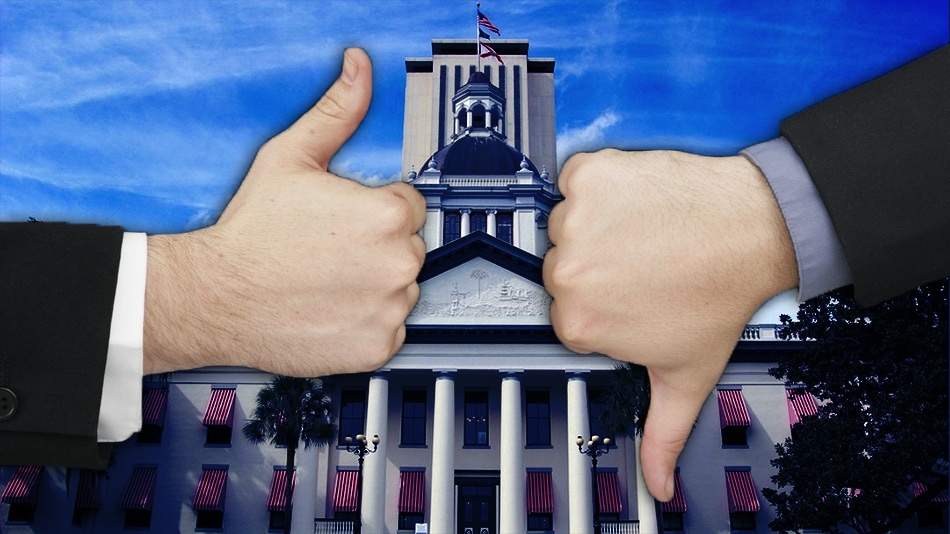
Winner and Loser of the Week in Florida politics — Week of 9.21.25
Published

on


Come on, FSU.

After years of watching programs like Georgia, Alabama, Clemson and Ohio State dominate the playoff conversation, this was supposed to be the renaissance year for Florida college football (sorry, Gators). And next Saturday’s mammoth matchup between the Hurricanes and Seminoles was set to be the epicenter, with rumors that ESPN’s Gameday would set up shop in Tallahassee.

And then, one of the Goliaths fell.

The University of Virginia stunned Florida State Friday night in double overtime, putting a dent in what FSU hoped to be a revival season following a historically bad 2024 campaign.

Mike Norvell’s program was hoping to further cement its case as not just the top team in the Sunshine State, but a legitimate contender on the national stage. Instead, that momentum and swagger was shot down by the Cavaliers.

Were the Seminoles looking past Virginia toward the showdown with “The U”? Or was FSU’s early season dominance a mirage all along, propped up by beating low-level teams and a win over an Alabama squad that still hasn’t proven it’s at the same level as the Nick Saban era?

It’s hard to say. Maybe it’s a bit of both, or maybe it’s neither and the team just underperformed for other reasons.

And look, next Saturday’s matchup is still a good one. It still offers a chance for both squads to show that Florida football — long the sport’s gold standard — is ready to dominate again.

But the aura of the game certainly got knocked down a peg following FSU’s fumble Friday. Here’s hoping we still get a competitive game.

Now, it’s onto our weekly game of winners and losers.

Winners

Honorable mention: Chassahowitzka River Campground. The Chassahowitzka River Campground scored a major win this week after months of uncertainty about its future.

The Southwest Florida Water Management District voted unanimously to approve a 40-year lease with Citrus County to take over management of the 40-acre site, keeping it in public hands and ensuring continued access for residents and visitors.

The campground, located on the banks of the Chassahowitzka River, had faced potential closure after a series of hurricanes left significant damage. District officials had floated the idea of shutting down the site or even selling it off, raising alarm among residents who cherish the river and surrounding springs as a recreational and environmental treasure.

That possibility sparked an outpouring of community activism, with local residents, conservation groups and outdoor enthusiasts pushing county leaders and the district to find a solution that preserved public access.

Under the new agreement, the district will retain ownership of the property but Citrus County will handle day-to-day operations, maintenance and improvements. The district also pledged up to $200,000 to help with capital repairs and upgrades, giving the county a runway to stabilize and improve the campground in the years ahead.

For Citrus County residents and the many Floridians who consider “the Chaz” a natural gem, the decision represents a victory for grassroots advocacy and collaborative problem-solving. Instead of losing a beloved public space, the campground will continue to serve campers, paddlers and nature lovers while remaining protected for future generations.

Almost (but not quite) the biggest winner: Miami Dade College. This week Miami Dade College became a central actor in a major political project, endorsing the state’s plan to place Donald Trump’s presidential library on college property.

The MDC Board of Trustees approved transferring a 2.63-acre parking lot adjacent to the historic Freedom Tower to the state, setting the stage for a vote by the Florida Cabinet to deed the land at its Sept. 30 meeting.

Once the Cabinet signs off, MDC will anchor one of the most visible — and controversial — projects in recent memory. MDC gains proximity to power and national attention. The school leadership, including President Madeline Pumariega, has publicly welcomed the project, describing it as “historic” for the institution.

Some critics, including former MDC President Eduardo Padrón, have decried the move as “unimaginable,” warning that the land was once intended for institutional expansion and that the decision lacked robust public discourse.

From MDC’s perspective, the college is now a key partner in what could become one of Florida’s most attention-grabbing civic landmarks.

The biggest winner: University of Central Florida. UCF has officially achieved the status of a “Preeminent State Research University,” a designation that places it among Florida’s top public institutions.

This milestone recognizes UCF’s significant advancements in research, student success, and faculty excellence. To attain this status, UCF met 12 of the 13 established metrics, including a notable 60% four-year graduation rate.

UCF’s journey to preeminence began in 2022 when it was named an “emerging preeminent” institution after meeting three-fourths of the criteria. Since then, the university has made significant strides, culminating in this recent designation.

Achieving preeminent status not only enhances UCF’s reputation but also provides access to additional state funding, further supporting its mission to deliver high-quality education and contribute to Florida’s workforce development. The accomplishment underscores UCF’s role as a leading institution in the state’s higher education landscape.

Losers

Dishonorable mention: Joseph Ladapo. Florida’s Surgeon General likes to talk tough and make broad, sweeping claims about vaccines when it comes to other people.

But when faced with a direct question this week about his own family’s vaccination status, Ladapo had a chance to confirm he’s putting his money where his mouth is.

“Some of the questions are just so funny,” Ladapo said. “And you know this idea of ‘Well, do you vaccinate? Did you take the COVID shot?’ … I actually don’t care about sharing information about that.”

Oh, great!

“I really don’t care at all.”

Perfect, here we go.

But I won’t. And I won’t because I’m not going to participate in the silly games that so much of the media chooses to partake in instead of the substantive parts of the issues.”

Well OK then.

It’s interesting because Ladapo in the past has had no problem screaming from the rooftops about his skepticism regarding vaccines, regardless of whether he has sound evidence to back it up.

So one would think he would follow through with that advice in his personal life. But suddenly, Ladapo went mum.

Look, we have no idea about the vaccine status of Ladapo or Gov. Ron DeSantis, who also punted on the question during this week’s presser. But one would think they would be ready to lead by example and not just be content with riding the wave of anti-establishment feelings on the Right via their repeated comments undercutting confidence in vaccines.

Unless the political benefit, rather than actual scientific rigor, is the point.

Almost (but not quite) the biggest loser: Brightline. Brightline’s momentum hit a wall this week as its planned Stuart station stalled in the face of a funding snafu.

Martin County officials had budgeted on a $45 million grant from the Federal Railroad Administration (FRA) to underwrite most of the station’s projected $60 million cost. But instead, the FRA denied the grant.

The agency did announce a new funding program with a broader $5 billion pool of eligible projects. Martin County can now apply for a piece of that pot.

But after missing out on the original grant, the station’s opening has been pushed out significantly — now projected for no earlier than 2028 — and Martin County is forced to reapply under tougher competition. County officials say they’ll submit their revised application by the Jan. 7, 2026 deadline, with decisions expected by Summer that year.

Without the federal backing, the financial equation is shaky. County leaders acknowledge that if they don’t secure the grant, the station project could be dead in the water.

Moreover, the optics of a for-profit rail company relying heavily on public subsidies, now with broken timelines, invites more skepticism. Brightline’s brand is dented by this stumble.

The biggest loser: Ryan Routh. This week, Routh was convicted on all federal charges tied to his failed 2024 assassination plot against Trump.

The jury delivered its decision after just a few hours of deliberation, rejecting Routh’s attempts to portray himself as harmless or misinterpreted. Prosecutors had built a case that he had scoped out Trump’s route, hidden in shrubbery with a functioning rifle and aimed in Trump’s direction before fleeing.

Given the gravity of the charges — including attempted assassination of a major presidential candidate, assault of a federal officer, and firearms violations — Routh is now staring at a sentence that could amount to life behind bars.

As the nation grapples with repeated instances of political violence, Routh’s reckoning will be a cautionary tale for fringe actors.


Post Views: 0


Source link

Continue Reading

Politics

Senate committee willing to test the waters on expanding swim lesson vouchers

Published

on


The Senate Health Policy Committee plunged into a proposal to expand the Florida swim lesson voucher program that provides financial help for teaching kids how to handle water.

The panel approved a measure (SB 428) by Sen. Clay Yarborough, a Jacksonville Republican, to allow older kids to qualify for the voucher program. The current program, originally enacted in 2024, provides vouchers for families of children aged 0 to 4 years old. Yarborough’s bill would allow kids 1 to 7 to qualify for vouchers.

Yarborough told the committee that in the first year of life for infants, they don’t really “learn” how to swim as much as they act instinctively in the water. Furthermore, he said, adding additional years will help ensure lessons for children who didn’t get around to learning how to swim earlier.

Corrine Bria, a pediatric emergency medical physician at Nemours Children’s Health facility in Orlando, spoke at the hearing and said the rise in young drownings is heartbreaking. Nemours has handled 35 drownings of children in the past three years, and 90% of those are under the age of 7, Bria said.

“As a physician in a pediatric emergency department I see firsthand what it looks like when a child gets carried into the ED (emergency department) by a parent or brought in on a stretcher after drowning,” Bria said. “We know that a child can drown in a matter of seconds and this happens too frequently in Florida.”

Jason Hagensick, President and CEO of the YMCA of South Palm Beach County, also addressed the committee on behalf of the Florida State Alliance of YMCAs and said the revision to the swimming lesson voucher program would be a big improvement.

“Drowning remains a leading cause of unintentional injury (and) death in the United States,” Hagensick said, adding that early swim lessons reduce the risk of drowning by 88%.

“Expanding the swim voucher program to include children up to the age of 7 will dramatically increase access to essential swim instruction at a time when those skills are most impactful,” Hagensick continued. “It will deepen water competency and strengthen confidence for kids and parents alike and help prevent needless tragedies that devastate families and communities.”

A similar bill (HB 85) is working its way through the House. The House Health Care Budget Subcommittee approved that measure last week. Rep. Kim Kendall, a St. Augustine Republican, is sponsoring the House version.


Source link

Continue Reading

Politics

Senate advances Jason Pizzo bill extending PTSD workers’ comp coverage to 911 dispatchers

Published

on


Legislation that would narrowly recategorize 911 dispatchers as first responders so they can receive workers’ compensation for work-related psychological injuries is one step closer to passing in the Legislature’s upper chamber.

Members of the Government Oversight and Accountability Committee voted unanimously to advance the bill (SB 774), which would eliminate a barrier that today denies aid to people who are often the first to respond to a crime.

The measure’s sponsor, Hollywood Sen. Jason Pizzo, noted that during his time as a prosecutor, playing a 911 call would often be the most effective thing to do to sway a jury.

“911, what’s your emergency? He’s going to kill me! He’s going to kill me! Now, imagine hearing that 12 times a day, 15 times a day,” he said.

“Two years ago, you all voted to require these 911 operators to be proficient in CPR so they could administer (it) over the phone. And they’re not considered first responders? They are first responders, and they’ve been grossly overlooked and screwed, and this brings some remedy.”

SB 774 would add 911 dispatchers to the group of “first responders” covered by Florida’s special workers’-compensation rules for employment-related mental or nervous injuries. It would apply the same framework to them as other first responders for mental health claims.

Essentially, if you’re a 911 dispatcher and develop post-traumatic stress disorder, anxiety or similar mental health injuries from traumatic calls, SB 774 would make it so you can get workers’ comp-covered treatment and that your claim is handled under the same special rules lawmakers already set for other first responders — without certain time-limit restrictions that typically apply to mental injury benefits.

Several dispatchers signaled or spoke in favor of the bill, as did representatives from the Florida Police Chiefs Association, Florida Sheriffs Association and Consolidated Dispatch Agency.

Jennifer Dana, a dispatcher with the Palm Beach Sheriff’s Office, noted that in a Senate analysis of SB 774, there’s a list of disturbing things first responders see and do on the job, from seeing dead children and witnessing murders to helping severely injured people, including those who commit suicide.

What it doesn’t include, she said, is that 911 dispatchers also witness those things.

“We’re seeing and hearing it,” she said. “We have the technology for people to livestream it now, so it’s a double-whammy for us, and we want to make sure we have the protections.”

Kim Powell, a licensed and clinical mental health counselor who oversees an employee behavioral health program at a 911 communications center in Leon County, detailed several examples of what dispatchers experience: a woman struggling to breathe while dying from a gunshot wound inflicted by her child’s father; an officer’s final words moments before his murder; the sound of a mother discovering her deceased infant; the 800 or so calls received in the wake of the Florida State University shooting last April.

“These are not isolated events; they are part of the job,” she said. “The trauma compounds over time with repeat exposure.”

St. Petersburg Republican Sen. Nick DiCeglie thanked Pizzo for carrying the bill and expressed gratitude to the “3,500 dispatchers” across Florida for their work.

“For me personally, (this) could be one of the most important bills that we have this Session because of the importance there is for your well-being and your quality of life,” he said.

Melbourne Republican Sen. Debbie Mayfield, who chairs the committee, echoed DiCeglie’s remarks.

Pizzo reminded the panel that four years ago, during COVID, a $280 million set-aside for payments to first responders and front-line workers did not extend to 911 dispatchers.

“They never stopped working,” he said, adding that Mayfield at the time acknowledged the oversight and pledged that the Legislature would get it right in the future. “So, it’s serendipitous that you were kind and gracious enough to put us on the agenda.”

SB 774 will next go to the Senate Appropriations Committee on Agriculture, Environment and General Government, after which it has one more stop before reaching a floor vote.

An identical bill (HB 451) by Republican Rep. Jeff Holcomb of Spring Hill awaits its first hearing in the House.


Source link

Continue Reading

Politics

Hillsborough College Trustees OK first step in Tampa Bay Rays stadium talks

Published

on


The Tampa Bay Rays’ search for a new home took a tangible step forward as the Hillsborough College Board of Trustees approved a nonbinding agreement that could ultimately shift the franchise away from St. Petersburg under its new ownership.

The Board voted to approve a memorandum of understanding (MOU) authorizing staff to negotiate with the Tampa Bay Rays over a potential stadium and mixed-use redevelopment at the college’s Dale Mabry Campus.

The agreement does not commit the college to the project and can be terminated by the Board at any time. Instead, it outlines key terms the parties would like to see in any future binding agreements, which would require separate Board approval at a later public meeting.

College officials characterized the MOU as the beginning of negotiations. Under the document, staff would begin drafting potential project agreements for Trustees to consider in the future, with an anticipated negotiation timeline of up to 180 days.

Rays CEO Ken Babby addressed Trustees during the meeting, calling the proposal an early milestone. He emphasized that the effort involves the college, the team, the state and local governments. Babby said the Rays are exploring a roughly 130-acre redevelopment anchored by a new stadium and an integrated college campus, alongside residential, commercial and entertainment uses. 

“As we envision this development, together in cooperation and partnership with the community and the college, we’ve been calling the campus portion of this work ‘Innovation Edge’ featuring Hillsborough College,” Babby said.

“It’ll be neighbored by, of course, what we envision to be ‘Champions Corridor,’ which we hope will be the mentioned home of the Tampa Bay Rays. Of course, this will be a mixed-use with residential, with commercial, and, as we’ve said, billions of dollars of economic impact to the region. … This is an incredible moment for our community.”

Public input was split. Supporters recognized the economic impact the project could have, while critics worried about the effect on housing affordability, in particular for college students.

Following the vote, Trustees acknowledged uncertainty among students, faculty and staff, particularly those based at the Dale Mabry campus, but stressed that the approval did not determine final outcomes.

“This is a major decision, and I truly hope that it leads Hillsborough College towards growth and advancement,” Student Trustee Nicolas Castellanos said. 

Trustee Michael Garcia echoed the sentiment.

“It’s a tremendous day for the future of Hillsborough College and for the future of Major League Baseball in the area and also for the future of the city of Tampa,” Garcia said.

Gov. Ron DeSantis publicly expressed support for the concept ahead of Tuesday’s meeting, saying it could benefit both the college and the region, while cautioning that details still need to be resolved.

“It could be very good for HCC, and I’ve met with the President about it. I think he’s excited about the possibility,” DeSantis said in Pinellas Park.

“Obviously, they’ve got to iron out details. But basically, we’re supportive of them pursuing that partnership because I think it could be good for them. I think it could be good for the state. But I definitely think it could be really good for this region.”

Also ahead of Tuesday’s meeting, Tampa Mayor Jane Castor told Florida Politics the city and Hillsborough County have been in ongoing discussions with the Tampa Bay Rays as the team explores long-term stadium options — including the potential Hillsborough College site. She emphasized that any future stadium proposal would require coordination among multiple governments and would be evaluated alongside existing contractual obligations related to other major sports facilities.

No timeline for construction, campus relocation or final land disposition was discussed Tuesday. College officials emphasized that any binding agreements would return to the Board of Trustees for approval at a future public meeting.

___

A.G. Gancarski and Janelle Irwin Taylor of Florida Politics contributed to this report.


Source link

Continue Reading

Trending

Copyright © Miami Select.