U.S. Rep. Maxwell Frost doesn’t represent a district that normally gets attention from House Republicans.
But the National Republican Congressional Committee (NRCC) this year sent out repeated attacks on other members of Florida’s U.S. House delegation for associating with the Orlando Democrat.
The most recent smear followed a Unidos US roundtable Frost attended with U.S. Rep. Darren Soto, a Kissimmee Democrat and one of two Florida Democrats being targeted by the NRCC in 2026. Frost posted a phots online of himself and Soto together discussing negative impacts of a GOP-crafted budget deal signed by President Donald Trump.
“Working families deserve better,” Frost posted on social media. “We’re fighting back to reverse these reckless policies and help hardworking families breathe easier.”
But the photo soon appeared in an NRCC email blast bearing the subject line: “Partners in Lies: Darren Soto and Maxwell Frost.
“Out of touch Darren Soto continues to show Floridians that his allegiance lies with radical lunatics like Maxwell Frost who want to dismantle public safety and life-saving programs at the expense of Florida families,” read a statement by NRCC spokesperson Maureen O’Toole. “Voters are ready to show Soto next fall that their allegiance doesn’t lie with him.”
It’s the latest press release sent out by the political arm of House Republicans this year that targets Soto based on his work with Frost. Soto and Frost represent neighboring districts in Central Florida. Nearly as many email blasts slammed U.S. Rep. Jared Moskowitz, a Parkland Democrat who is also in the NRCC’s sights this election cycle.
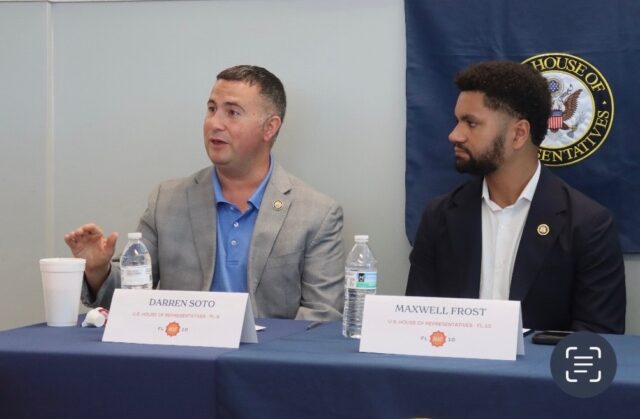
Darren Soto and Maxwell Frost at a Central Florida town hall. Image via NRCC
Soto’s campaign, for its part, has dismissed attacks.
“Trump’s mass deportations are trashing Florida’s economy, raising prices, and destroying local families. His tariffs will make costs go up even more, while his Big Ugly Law cuts Obamacare, Medicaid, SNAP, and Pell grants for local families. These harmful policies are why Trump is now so deeply unpopular. Rep. Soto will continue to support Central Floridians and push back against them,” reads a statement from the Soto campaign.
“Central Floridians are also outraged seeing their loved ones deported, TPS and parole cancelled for Cubans, Venezuelans, Haitians and others, and hearing about the civil rights violations taking place at detention centers, like ‘Alligator Alcatraz.’ Rep. Soto will continue to conduct rigorous oversight over ICE (Immigrations and Customs Enforcement) along with the rest of the Florida Democratic Delegation, including Rep Frost. His constituents demand it.”

But Republicans House Democrats in battlegrounds work with Frost at their own peril. They say Frost, the youngest member of Congress, represents the fringe of his own party. GOP sources note that while moderate Republicans show no reluctance in distancing themselves from the most extreme members of the Republican caucus, Frost has been embraced as a national surrogate for all House Democrats.
Both Soto and Moskowitz were part of a contingent of Democratic lawmakers, along with Frost, who took a high-profile tour in July of the soon-to-close Alligator Alcatraz facility in South Florida. And all of the Democrats have frequently co-signed letters from all Florida Democrats in Congress on issues including public education funding and Medicaid expansion. So there hasn’t been any significant effort to distance from Frost explicitly.
Moskowitz declined to comment for this story. But he and Frost hold a key bond as classmates, the only two Democrats newly elected to Congress in the 2022 election cycle. Shortly after being sworn in, both were named as Vice Chairs for the Democratic caucus’ Gun Violence Prevention Task Force.
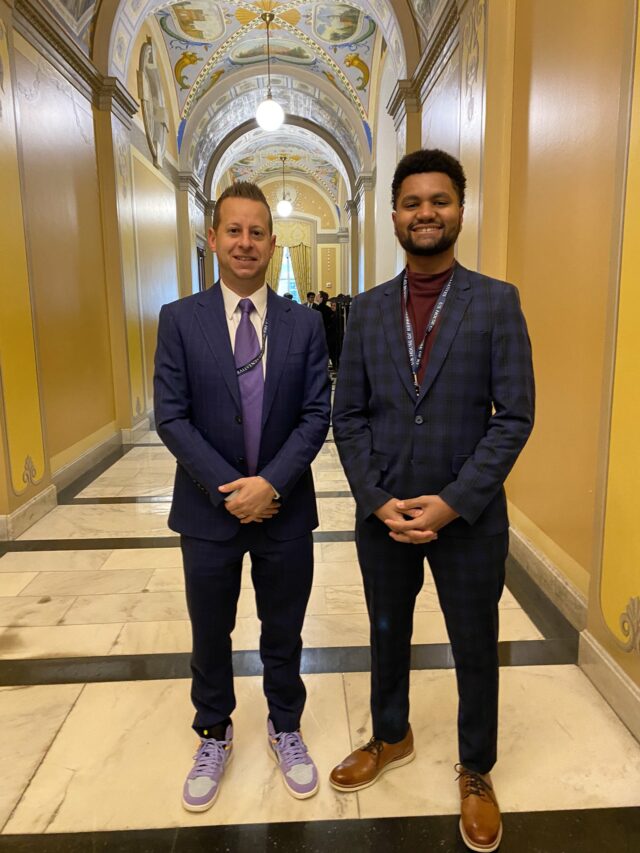
Jared Moskowitz, Maxwell Frost hope to make a dent in the country’s gun violence crisis. Image via Twitter.
As Moskowitz seeks a third term in a district that appears increasingly competitive, Republicans have tried to paint him as an ideological compatriot. Shortly after Trump signed an executive order against cashless bail, the NRCC sent out a release calling Frost the poster child for the progressive justice policy priority and labeling him “Moskowitz’s BFF” (best friend forever).
“Dangerous Democrat Jared Moskowitz is more interested in protecting criminals than Floridians. His outrageous pro-crime, anti-law enforcement agenda is wildly out of touch with voters, and they won’t forget it when they head to the polls next November,” O’Toole said.
For his part, Frost self-describes as a progressive, and has the voting record to prove it. The advocate website ProgressivePunch, which grades lawmakers positively for a liberal voting record, gives Frost an ‘A’ and ranks him as the 8th most progressive member of Congress with a 98.92% lifetime score.
The same site gives Soto a ‘B’ and Moskowitz a ‘D’, ranking them the 136th and 198th most progressive members of Congress respectively.
Frost told Florida Politics he thinks little of the attacks against his more moderate Democratic colleagues.
“This is the same group working to elect politicians who cut Medicaid and kicked two million Floridians off their healthcare,” Frost said. “I’m focused on tackling the affordability crisis, while Republicans are focused on tax breaks for billionaires and mega corporations.”
But his record includes tackling some issues long considered third rails with Florida Politics even for Democrats.
Frost voted last year against military aid for Israel, and issued a statement blaming Prime Minister Benjamin Netanyahu for a “seemingly endless war in Gaza that has claimed the lives of countless innocent Palestinian civilians.” Both Moskowitz and Soto voted for the funding, and Moskowitz has been an outspoken defender of Israel, but the NRCC hit both for Frost’s various Israel criticisms anyway.
“Radical anti-Israel, pro-Hamas Maxwell Frost puts our enemies first while our allies suffer,” O’Toole wrote in a statement this month. “And out of touch Democrat Jared Moskowitz stands shoulder to shoulder with him and his dangerous agenda.”
Similarly, as Republicans work to win over Hispanic voters across the country, the NRCC cast House Democrats as soft on crime, including acts tied to international crime organizations based in South America. After Frost and Soto held a joint town hall in July, the NRCC connected both to gang.
“Radical lunatic Maxwell Frost has it backwards,” O’Toole said in a statement. “Instead of fighting for Floridians, he cares about letting criminals run free and putting illegal aliens ahead of his law-abiding constituents. And Darren Soto is standing right there with him.”
And when Frost in April flew to El Salvador to draw attention to the deportation of a Maryland man Trump alleged was an MS-13 member, the NRCC offered to buy plane tickets for Moskowitz and Soto as well.
The interest in Frost doesn’t signal a belief his Orlando district will be in play next year. Nearly 61% of voters in Florida’s 10th Congressional District supported Democrat Kamala Harris for President in November, according to MCI Maps, even as Trump won more than 56% of the vote statewide.
But only about 51% of voters in Soto’s district favored Harris, and the Democratic presidential nominee barely won half the vote in Moskowitz’s jurisdiction.
The NRCC believes Florida will continue trending more conservative, and a recent analysis of national voter registration trends by The New York Times bolsters that view. And outside of the Orlando area represented by Frost, nowhere in Florida has elected a member of Congress with as liberal a voting record as the 28-year-old progressive champion.
The question now will be if voters feel like punishing members of Congress who work even on issues of regional interest with a Florida colleague from the left-most faction of the party.
Three Pinellas County Commission seats are up for election this year, and Republicans incumbents are seeking re-election in all of them. Those office-holders appear relatively safe if 2025 campaign finance reports are any indication.
BrianScott, who represents the countywide District 2 seat, is so far unopposed. Qualifying in the races runs June 8-12, so there is still time for a challenger to emerge. However, any would-be challenger would enter the race at an immediate funding disadvantage, with Scott raising more than $94,000 as of the end of 2025.
The other two incumbents facing re-election this year — DaveEggers in District 4 and KathleenPeters in District 6 — have drawn challengers, though neither have posted significant fundraising activity since entering the race.
There isn’t a Democrat challenging Eggers so far, but he faces intraparty opposition from fellow Republican TonyRingelspaugh. Ringelspaugh, who describes himself as retired, raised just $1,000 since entering the race in October, and half of that was a contribution from himself to his campaign. As of Dec. 31, he hadn’t spent any of it.
Eggers, meanwhile, has raised nearly $19,000 and retains about $13,000. It’s a small sum compared to fundraising activity in past Pinellas County Commission races — note Scott’s nearly six-figure haul for a so far unopposed race — but it’s still enough to create a wide funding gap between his opponent.
And Ringelspaugh doesn’t appear to be actively campaigning at this point. His most recent post to his campaign Facebook page was on Oct. 15 announcing his bid. Ringelspaugh does not appear to have a campaign website, either.
Eggers also has strong institutional support, including recent nods from U.S. Reps. Gus Bilirakis and Anna Paulina Luna.
Eggers faced intraparty opposition four years ago, but won re-election that year with 68% of the vote. If no Democrat enters the race, and no one files as a write-in to close the Primary, the GOP Primary will be open to all voters.
District 4 covers the northernmost parts of Pinellas County, including Palm Harbor, East Lake, Tarpon Springs, Dunedin and Safety Harbor.
Peters is the top fundraiser among incumbents up for re-election this year, with $103,000 raised as of Dec. 31. Her opponent, architect David Glenn Jr., a Democrat, has collected less than $2,300.
While Glenn entered the race in December and only had three weeks of fundraising to report, his early activity doesn’t show a lot of momentum. All of his funds came from the candidate himself. Still, he has been at least somewhat active on social media and in the community, speaking at local Democratic clubs. His campaign website, though, doesn’t list any upcoming events.
Glenn previously said he was running to disrupt what he describes as entrenched county leadership. His platform emphasizes land use and development policy, arguing the need for more density and carefully planned growth. He also favors increased support for public transportation and affordable housing, and wants to crack down on nuisance short-term rental properties, among other priorities.
But getting that message to voters amid a six-figure funding deficit will be a challenge, and like her colleagues on the dais, Peters will have plenty of support from the county’s donor class.
Peter’s fourth-quarter haul, which was nearly $40,000, included top $1,000 donations from a number of local businesses and interests, including Marine construction companies Speeler Helicals, Bayside Dredging, Tampa Bay Marine Contractors, Haven Dock & Marine, Decks & Docks Lumber, Waterfront Property Services, and BCJ 2.
She also received top donations from a couple of bowling alleys, and from interests in real estate development, insurance, restaurant and automotive industries. The political committee supporting state Rep. LindaChaney cut a $1,000 check in the fourth quarter, as did former state Rep. JackieToledo, both Republicans, among other donors.
First elected in 2018 with 60% of the vote over Democrat AmyKedron, Peters was re-elected in 2022 without opposition.
Taken collectively, the three County Commission seats up for election this year may prove to be sleepy affairs unless current challengers step up campaign efforts.
The lack of competitive races so far may be a result of Pinellas County’s position as an increasingly red region. For Scott, countywide voter registration favors Republicans by about 47,000 voters. In Eggers’ District 4, Republicans outnumber Democrats by about 29,000 voters, and Democrats trail Republicans in Peters’ District 6 by about 23,000 voters.
A new report on Florida’s resilience to natural disasters concludes there are key challenges ahead for the state, as well as opportunities to modernize infrastructure to help streamline recovery after an emergency.
The document analyzes how long-term economic competitiveness can expand in the face of severe weather endemic to the state. The report concludes that even as hurricanes, flooding and other severe weather events are part of Florida living, resilience can become an economic component as well as an environmental effort.
“Florida’s future will be defined by how well we prepare for and respond to storms and flooding,” said George S. LeMieux, Chair of FC 100. “Resilience is not just about repairing damage. It is about protecting our economy, safeguarding communities, and ensuring Florida remains one of the most competitive places in the world to live and do business.”
Some of the key findings in the report, published Tuesday, include warnings that failure to invest in storm preparedness will result in lost economic activity, business closings and disruption to the job market, while insurance costs could rise. Long-term investments in recovery plans can reduce losses and accelerate recovery after major weather events.
Beyond outlining the issues that could damage Florida’s business sector, the FC 100 report provides several recommendations, including:
— Streamlining post-disaster recovery and permitting to reduce delays and uncertainty
— Hardening infrastructure and utilities to limit outages and economic disruption
— Modernizing Florida’s building code to reflect evolving flood, wind, and energy risks
— Incentivizing resilience investments by homeowners and communities
— Supporting resilience innovation and commercialization to grow new industries and jobs
“The choices we make now will shape Florida’s quality of life and economic strength for generations,” said Michael Simas, President and CEO of the FC 100. “This report offers a clear path forward and an opportunity for Florida to define itself not by its exposure to storms, but by its ability to thrive despite them.”
The FC 100 has more than 200 companies in its membership that represent more than 1.3 million workers in the state.
A House subcommittee unanimously approved a bill to restore the Ocklawaha River that drew strong praise from environmentalists and fierce opposition from local officials in Putnam County.
The mixed public feedback on HB 981 makes it clear that the legislation to remove the river’s dam remains controversial after Gov. Ron DeSantis vetoed $6.25 million in funding for Ocklawaha River restoration during the 2025 Session.
“It’s a local decision. It’s a local issue. It needs to stay local,” said Putnam County Commissioner Larry Harvey, who voiced concerns about West Putnam lakes drying up.
“Putnam County wasn’t considered locally. We’ve never been asked about this. We don’t want this.”
Rep. Wyman Duggan, a Jacksonville Republican, defended his bill and argued the restoration project carries a greater importance since the Ocklawaha is the primary tributary running into the St. Johns River.
“This is, at a minimum, a regional issue. The Ocklawaha River touches 12 counties, but I submit it’s a state level issue. The St. Johns River is the longest river in the state and it’s the most significant,” Duggan said.
Behind the Everglades and the Kissimmee River Basin restoration projects, the Ocklawaha River will become “the third-greatest restoration in the state of Florida’s history,” said Rep. Jim Mooney Jr., an Islamorada Republican.
“I will be a strong supporter of it, and hope we can get this across the finish line this year,” said Cross, a St. Petersburg Democrat.
Duggan added that the Department of Environmental Protection (DEP) will oversee the river restoration and will take into account local residents’ concerns with water level impacts.
Duggan’s bill would require the DEP to develop a plan to restore the Ocklawaha River by Jan. 1, 2027, then finish the work by Dec. 31, 2032.
What made the bill necessary, Duggan said, was the U.S. Army Corps of Engineers designating the dam as a high hazard.
Living beyond its 50-year life span, the 58-year-old Rodman Dam doesn’t perform any flood control or generate electricity, Duggan said.
“There is no alarm system in place to warn the downstream communities in the event of a dam failure,” Duggan said. “It’s not even clear that if we try to reconstruct the dam, bring it up to code, that the Army Corps of Engineers would permit that effort.”
The dam is also known as the Kirkpatrick Dam.
Restoring the Ocklawaha would put 21 billion gallons of water into the St. Johns River, which environmentalists said will improve the water and help the fisheries and the manatees, Duggan explained.
Environmentalists also said removing the dam would bring back 20 lost springs.
Another major component of Duggan’s bill is to beef up economic development in Clay, Marion, Putnam and St. Johns counties to promote water and nature activities from swimming to fishing and wildlife viewing. The bill would create the Northeast Florida River and Springs Recreation and Economic Development Council and create a grant program to fund the council’s outdoor recreation plan.
“The bill shows people what they gain and not what they lose,” said Chip Laibl, Vice President of the Great Florida Riverway Trust. “It’s time to quit kicking this issue down the road for a vocal minority and consider the safety, economic needs, and recreation facilities for all of Putnam County and beyond.”
Laibl argued that HB 981 will make “Putnam County the outdoor recreation hub of the state.”