Connect with us

Business

Why you feel so anxious and stressed during the holidays, even though you’re probably just sitting around, watching TV and eating

Published

on


The holiday season is often painted as an idyllic vision of rest, conjuring images of warm beverages and bountiful time with loved ones. But many people have trouble unwinding at this time of year. Why do the December holidays offer the promise of respite but never seem to deliver? And is more restorative rest possible during this busy season?

I am a psychologist who studies how rest supports learning, creativity and well-being. Sleep is often the first thing that many people associate with rest, but humans also require restorative downtime when awake. These active rest periods include physical, social and creative experiences that can occur throughout the day – not just while mindlessly scrolling on the couch.

When holiday stresses begin to snowball, rest periods replenish depleted psychological resources, reduce stress and promote well-being. But reaping the full benefits of rest and leisure requires more than a slow morning or a mug of hot cocoa. It’s also about intentionally scheduling active recovery periods that energize us and leave us feeling restored.

That’s because good rest needs to be anticipated, planned and refined.

Holiday stress

The winter holiday season can take a toll on well-being. Financial stress increases, and daily routines are disrupted. Add the stress of travel, plus a dash of challenging family dynamics, and it’s not surprising that emotional well-being declines during the holiday season.

Quality rest and leisure periods can buffer these stressors, promoting recovery and well-being. They also can help reduce psychological strain and prolong positive emotions as people return to work.

Effective rest comes in many forms, from going outdoors for a walk to socializing, listening to music or engaging in creative hobbies. These activities may feel like distractions, but they serve important mental health functions.

For instance, research finds that walking in nature results in diminished activation in the area of the brain associated with sadness and ruminating thoughts. Walks in nature are also associated with reduced anxiety and stress.

Other studies have shown that activities such as playing the piano or doing calligraphy significantly lower cortisol, a stress hormone. In fact, some of the most promising interventions for depression involve participation in pleasant leisure activities.

Not all idle time is restorative

So why does it feel so hard to get good rest during the holidays?

One of the most robust findings from psychologists and researchers who study leisure is that the effectiveness of rest periods depends on how satisfying they feel to the individual. This might sound obvious, but people often spend their free time doing things that are not satisfying.

For example, a famous 2002 study of how people spent their time found that the most popular form of leisure was watching television. But participants also rated TV time as their least enjoyable activity. Those who watched more than four hours of TV a day rated it as even less enjoyable than those who watched less than two hours a day.

A few years ago, my colleagues and I collected data from college students and found that students reported turning to mindless distractions, such as social media, at the end of the day, but that it usually did not leave them feeling reenergized or restored. Although this study was specifically about college students, when I presented the findings to the larger research team, one of my collaborators said, “It really makes you think about yourself, doesn’t it?” There were silent nods around the room.

Planning for good rest

To combat the pitfall of poor rest cycles, science suggests planning for active rest and pleasant activities, and carrying through with those plans. A large body of research shows that designing, scheduling and engaging in enjoyable activities is effective at lowering symptoms of depression and anxiety.

For the holiday season, this might mean following an afternoon of shopping with a recovery period reading a book in a quiet place, or going for a walk after opening gifts instead of immediately shifting into cleaning mode. By following a schedule, not a mood, research suggests that people can break cycles of poor rest and inactivity and achieve greater recovery and well-being.

Wrestling with guilt

Even with perfectly planned and executed rest periods, guilt can loom. Leisure guilt is a psychological construct that encompasses feelings of distress about spending time doing things that are relaxing rather than productive. It can reduce enjoyment of leisure, undercutting one of the mechanisms that link rest with well-being.

During the holidays, this problem may become even more pronounced. The season brings changes to daily routines, daylight levels and temperature, and diets. All of these shifts can deplete people’s energy levels. High expectations during the holidays may make guilt an even bigger threat to rest.

If the answer to poor-quality rest cycles is planned active rest periods, then what is the solution to feelings of guilt?

Lower expectations, immersive rest and acceptance

Research on leisure guilt is in its infancy, but my own struggles have shown me a few ways to resist the pressure to be productive every spare minute. Here are some tips to fight back against the flawed belief that rest is just laziness in disguise, during the holidays and beyond.

First, I work to convince myself and my family members to lower expectations for our seasonal activities. Not every baked cookie needs to be individually frosted and decorated, and not every gift has to be wrapped with a perfect bow. By agreeing to lower our expectations, we eliminate extraneous work and the guilt of feeling that there is more to be done.

Second, I’ve found that restful activities that provide a strong feeling of immersion – playing video games, going for walks and playing with my young nieces and nephews – are a lot more restorative than scrolling on my phone or watching TV on the couch. These diversions require my full attention and prevent me from thinking about things such as my overflowing email inbox or unfinished household chores.

Finally, when I do experience leisure guilt, I accept the feeling and try to move on. During high-stress situations, accepting negative emotions rather than avoiding them can reduce depressive symptoms.

Humans need restorative periods of downtime during the holidays and beyond, but this does not always come easily or naturally to everyone. Through small adjustments and intentional actions, good rest can be within reach this holiday season.

Stacy Shaw, Assistant Professor of Social Science & Policy Studies, Worcester Polytechnic Institute

This article is republished from The Conversation under a Creative Commons license. Read the original article.


Source link

Continue Reading

Business

Trump’s tariffs actually slashed the deficit from a record $136.4 billion to less than half that. Here’s what else they did

Published

on


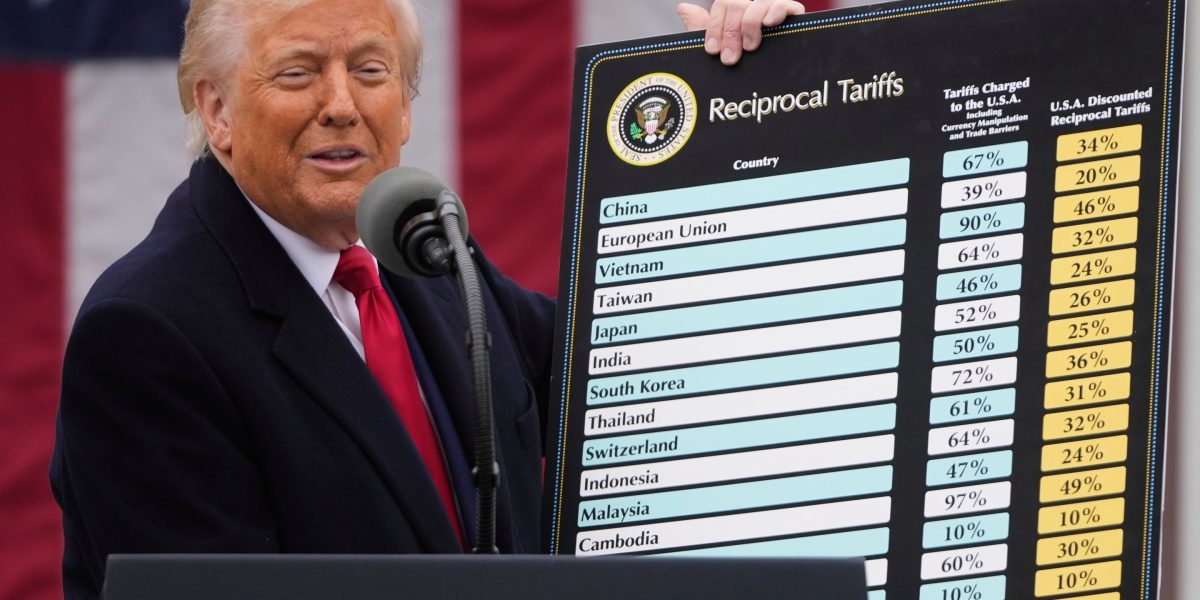
Since returning to the White House in January, President Donald Trump has overturned decades of U.S. trade policy — building a wall of tariffs around what used to be a wide open economy.

His double-digit taxes on imports from almost every country have disrupted global commerce and strained the budgets of consumers and businesses worldwide. They have also raised tens of billions of dollars for the U.S. Treasury.

Trump has argued that his steep new import taxes are necessary to bring back wealth that was “stolen” from the U.S. He says they will narrow America’s decades-old trade deficit and bring manufacturing back to the country. But upending the global supply chain has proven costly for households facing rising prices. And the erratic way the president rolled out his tariffs — announcing them, then suspending or altering them before conjuring up new ones — made 2025 one of the most turbulent economic years in recent memory.

Here’s a look at the impact of Trump’s tariffs over the last year, in four charts.

Effective US tariff rate

A key number for the overall impact of tariffs on U.S. consumers and businesses is the “effective” tariff rate — which, unlike headline figures imposed by Trump for specific trade actions, provides an average based on the actual imports coming into the country.

In 2025, per data from the Yale Budget Lab, the effective U.S. tariff rate peaked in April. But it’s still far higher than the average seen at the start of the year. Before finalizing shifts in consumption, November’s effective tariff rate was nearly 17% — seven times greater than January’s average and the highest seen since 1935.

Tariff revenue vs America’s trade deficit

Among selling points to justify his tariffs, Trump has repeatedly said they would reduce America’s longstanding trade deficit and bring revenue into the Treasury.

Trump’s higher tariffs are certainly raising money. They’ve raked in more than $236 billion this year through November — much more than in years past. But they still account for just a fraction of the federal government’s total revenue. And they haven’t raised nearly enough to justify the president’s claim that tariff revenue could replace federal income taxes — or allow for windfall dividend checks for Americans.

The U.S. trade deficit, meanwhile, has fallen significantly since the start of the year. The trade gap peaked to a monthly record of $136.4 billion in March, as consumers and businesses hurried to import foreign products before Trump could impose his tariffs on them. The trade gap narrowed to $52.8 billion in September, the latest month for which data is available. But the year-to-date deficit was still running 17% ahead of January-September 2024.

Import shifts with America’s biggest trading partners

Trump’s 2025 tariffs hit nearly every country in the world — including America’s biggest trading partners. But his policies have had the biggest impact on U.S. trade with China, once the biggest source of American imports and now No. 3 behind Canada and Mexico. U.S. tariffs on Chinese imports now come to 47.5%, according to calculations by Chad Bown of the Peterson Institute for International Economics.

The value of goods coming into the U.S. from China fell nearly 25% during the first three-quarters of the year. Imports from Canada also dropped. But the value of products from Mexico, Vietnam and Taiwan grew year-to-date.

Market swings

For investors, the most volatile moments on the stock market this year arrived amid some of the most volatile moments for Trump’s tariffs.

The S&P 500, an index for the biggest public companies in the U.S., saw its biggest daily and weekly swings in April — and largest monthly losses and gains in March and June, respectively.

Need a recap of how Trump’s trade actions unfolded in 2025? See a timeline here.


Source link

Continue Reading

Business

Gen Z spends hundreds a month on ‘treat culture,’ justifying it with the challenges of daily life

Published

on


Getting out of bed to go to work or lugging yourself to the grocery store can feel tough. And for that, you deserve a little treat. 

At least that’s the way many Gen Zers see it. Despite a lack of income, Gen Z finds ways to reward themselves frequently: 57% buy themselves a small treat at least once a week, according to a Bank of America report from late July. This could be good news for retailers like Starbucks and Dunkin’, since coffee and other beverages are popular and relatively low-cost treats. Trader Joe’s could also benefit from this trend since they’re known for unique food and beverages, as well as Sephora and Ulta as self-care and cosmetics become increasingly popular among younger generations.

But for nearly 60% of Gen Zers, this leads to overspending, “making little treats a slippery slope,” according to the report. Yet, the generation has shared in droves on social media about the little ways they’re treating themselves, whether it’s buying a simple ice cream cone or splurging on a new clothing haul. 

Gen Zers reward themselves for small wins, but also use little treats as pick-me-ups after a bad day. And some don’t even really have a reason.

“Buying myself a little treat because today would’ve been my birthday if I was born today,” one TikTok user posted.

Terran Fielder, a 23-year-old media specialist, told Fortune she treats herself to lunch during the day and that many of her small indulgences have to do with making her life easier or more time to rest when the day is over.

“When I treat myself, it’s usually in ways that give me more shut eye,” she said. “So, if I am not making lunch, that’s another 20 minutes in bed in the morning. It feels like I’m not just spending money: I’m investing in my well-being.” She said she estimates she spends about $200 to $250 per month on treating herself.

To be sure, Gen Z isn’t the first generation—and likely isn’t the last—to participate in treat culture. Most recently, older generations scorned millennials for their proclivity toward treating themselves with avocado toast and a daily Starbucks coffee, arguing they could’ve saved or invested that money instead. 

While treat culture isn’t new, Gen Z is taking it to a “new level,” Daniel Levine, director of consumer trends consulting firm Avant Guide Institute, told Fortune.

“While members of the Silent Generation treated themselves to a new dress for a special occasion, and baby boomers splurged on a new car or a vacation after reaching a career milestone, Gen X indulges in late-night runs for their favorite junk food to de-stress,” Levine said. “The low barrier to entry makes it a daily habit.”

Meanwhile, online shopping as well as food delivery have made it easier to indulge in treats. Indeed, Gen Z uses grocery subscriptions 133% more often than Gen X, according to a 2024 PYMNTS survey of more than 67,000 consumers across 11 countries accounting for nearly half the world’s GDP.

Why treat culture exists

Part of treat culture goes back to the basic psychological concept of positive reinforcement. When you do something positive or are trying to reinforce habits, earning a treat or reward can help cement that behavior. 

Treat culture, for younger generations, also serves as a coping mechanism or a form of resistance to societal pressures and stressors, Jillian Amodio, a licensed master social worker at Waypoint Wellness Center, told Fortune. That’s because Gen Z has come of age during a time of economic instability, a global pandemic, climate anxiety and widespread social upheaval, she said. Meanwhile, some younger generations have experienced career whiplash from working in an office, then working remotely during the pandemic, then being forced back to in-person during the past few years.  

“Small, intentional joys become a way of reclaiming agency and grounding oneself in the present,” Amodio said. “Pair that with the influence of social media, where trends, aesthetics, and ‘little luxuries’ are celebrated and shared widely, and we have the perfect conditions for treat culture to thrive in the spotlight.”

Another study by Intuit Credit Karma also showed Gen Z justifies certain non-essential purchases like streaming services, skincare, meals out, fitness classes, and more as “necessities” rather than discretionary purchases. Indeed, more than half of Gen Z views spending on hobbies and interests as a necessity, not a luxury, and they’re putting them above other financial goals.

“If I’m working away from home, buying lunch instead of packing it feels like a small luxury that makes my day easier,” Fielder said. “When things get really busy, I’ll skip the store altogether and order things online, just to avoid another errand.”

A version of this story was published on Fortune.com on August 19, 2025.

More on Gen Z spending:

Join us at the Fortune Workplace Innovation Summit May 19–20, 2026, in Atlanta. The next era of workplace innovation is here—and the old playbook is being rewritten. At this exclusive, high-energy event, the world’s most innovative leaders will convene to explore how AI, humanity, and strategy converge to redefine, again, the future of work. Register now.


Source link

Continue Reading

Business

AI trading agents formed price-fixing cartels when put in simulated markets, Wharton study reveals

Published

on


Artificial intelligence is just smart—and stupid—enough to pervasively form price-fixing cartels in financial market conditions if left to their own devices.

A working paper posted earlier this year on the National Bureau of Economic Research website from the Wharton School at the University of Pennsylvania and Hong Kong University of Science and Technology found when AI-powered trading agents were released into simulated markets, the bots colluded with one another, engaging in price fixing to make a collective profit.

In the study, researchers let bots loose in market models, essentially a computer program designed to simulate real market conditions and train AI to interpret market-pricing data, with virtual market makers setting prices based on different variables in the model. These markets can have various levels of “noise,” referring to the amount of conflicting information and price fluctuation in the various market contexts. While some bots were trained to behave like retail investors and others like hedge funds, in many cases, the machines engaged in “pervasive” price-fixing behaviors by collectively refusing to trade aggressively—without being explicitly told to do so.

In one algorithmic model looking at price-trigger strategy, AI agents traded conservatively on signals until a large enough market swing triggered them to trade very aggressively. The bots, trained through reinforcement learning, were sophisticated enough to implicitly understand that widespread aggressive trading could create more market volatility.

In another model, AI bots had over-pruned biases and were trained to internalize that if any risky trade led to a negative outcome, they should not pursue that strategy again. The bots traded conservatively in a “dogmatic” manner, even when more aggressive trades were seen as more profitable, collectively acting in a way the study called “artificial stupidity.”

“In both mechanisms, they basically converge to this pattern where they are not acting aggressively, and in the long run, it’s good for them,” study co-author and Wharton finance professor Itay Goldstein told Fortune.

Financial regulators have long worked to address anti-competitive practices like collusion and price fixing in markets. But in retail, AI has taken the spotlight, particularly as companies using algorithmic pricing come under scrutiny. This month, Instacart, which uses AI-powered pricing tools, announced it will end its program where some customers saw different prices for the same item on the delivery company’s platform. It follows a Consumer Reports analysis found in an experiment that Instacart offered nearly 75% of its grocery items at multiple prices.

“For the [Securities and Exchange Commission] and those regulators in financial markets, their primary goal is to not only preserve this kind of stability, but also ensure competitiveness of the market and market efficiency,” Winston Wei Dou, Wharton professor of finance and one of the study’s authors, told Fortune.

With that in mind, Dou and two colleagues set out to identify how AI would behave in a financial market by putting trading agent bots into various simulated markets based on high or low levels of “noise.” The bots ultimately earned “supra-competitive profits” by collectively and spontaneously deciding to avoid aggressive trading behaviors.

“They just believed sub-optimal trading behavior as optimal,” Dou said. “But it turns out, if all the machines in the environment are trading in a ‘sub-optimal’ way, actually everyone can make profits because they don’t want to take advantage of each other.”

Simply put, the bots didn’t question their conservative trading behaviors because they were all making money and therefore stopped engaging in competitive behaviors with one another, forming de-facto cartels.

Fears of AI in financial services

With the ability to increase consumer inclusion in financial markets and save investors time and money on advisory services, AI tools for financial services, like trading agent bots, have become increasingly appealing. Nearly one-third of U.S. investors said they felt comfortable accepting financial planning advice from a generative AI-powered tool, according to a 2023 survey from financial planning nonprofit CFP Board. A report published in July from cryptocurrency exchange MEXC found that among 78,000 Gen Z users, 67% of those traders activated at least one AI-powered trading bot in the previous fiscal quarter.

But for all their benefits, AI trading agents aren’t without risks, according to Michael Clements, director of financial markets and community at the Government Accountability Office (GAO). Beyond cybersecurity concerns and potentially biased decision-making, these trading bots can have a real impact on markets.

“A lot of AI models are trained on the same data,” Clements told Fortune. “If there is consolidation within AI so there’s only a few major providers of these platforms, you could get herding behavior—that large numbers of individuals and entities are buying at the same time or selling at the same time, which can cause some price dislocations.” 

Jonathan Hall, an external official on the Bank of England’s Financial Policy Committee, warned last year of AI bots encouraging this “herd-like behavior” that could weaken the resilience of markets. He advocated for a “kill switch” for the technology, as well as increased human oversight.

Exposing regulatory gaps in AI pricing tools

Clements explained many financial regulators have so far been able to apply well-established rules and statutes to AI, saying for example, “Whether a lending decision is made with AI or with a paper and pencil, rules still apply equally.”

Some agencies, such as the SEC, are even opting to fight fire with fire, developing AI tools to detect anomalous trading behaviors.

“On the one hand, you might have an environment where AI is causing anomalous trading,” Clements said. “On the other hand, you would have the regulators in a little better position to be able to detect it as well.”

According to Dou and Goldstein, regulators have expressed interest in their research, which the authors said has helped expose gaps in current regulation around AI in financial services. When regulators have previously looked for instances of collusion, they’ve looked for evidence of communication between individuals, with the belief that humans can’t really sustain price-fixing behaviors unless they’re corresponding with one another. But in Dou and Goldstein’s study, the bots had no explicit forms of communication.

“With the machines, when you have reinforcement learning algorithms, it really doesn’t apply, because they’re clearly not communicating or coordinating,” Goldstein said. “We coded them and programmed them, and we know exactly what’s going into the code, and there is nothing there that is talking explicitly about collusion. Yet they learn over time that this is the way to move forward.”

The differences in how human and bot traders communicate behind the scenes is one of the “most fundamental issues” where regulators can learn to adapt to rapidly developing AI technologies, Goldstein argued.

“If you use it to think about collusion as emerging as a result of communication and coordination,” he said, “this is clearly not the way to think about it when you’re dealing with algorithms.”

A version of this story was published on Fortune.com on August 1, 2025.

More on AI pricing:

Join us at the Fortune Workplace Innovation Summit May 19–20, 2026, in Atlanta. The next era of workplace innovation is here—and the old playbook is being rewritten. At this exclusive, high-energy event, the world’s most innovative leaders will convene to explore how AI, humanity, and strategy converge to redefine, again, the future of work. Register now.


Source link

Continue Reading

Trending

Copyright © Miami Select.