Connect with us

Business

Why this small business that sells cycling clothes for women decided to fight Trump’s tariffs — ‘our backs were up against the wall’

Published

on


From the moment President Donald Trump imposed tariffs on nearly every country, Nik Holm feared the company he leads might not survive.

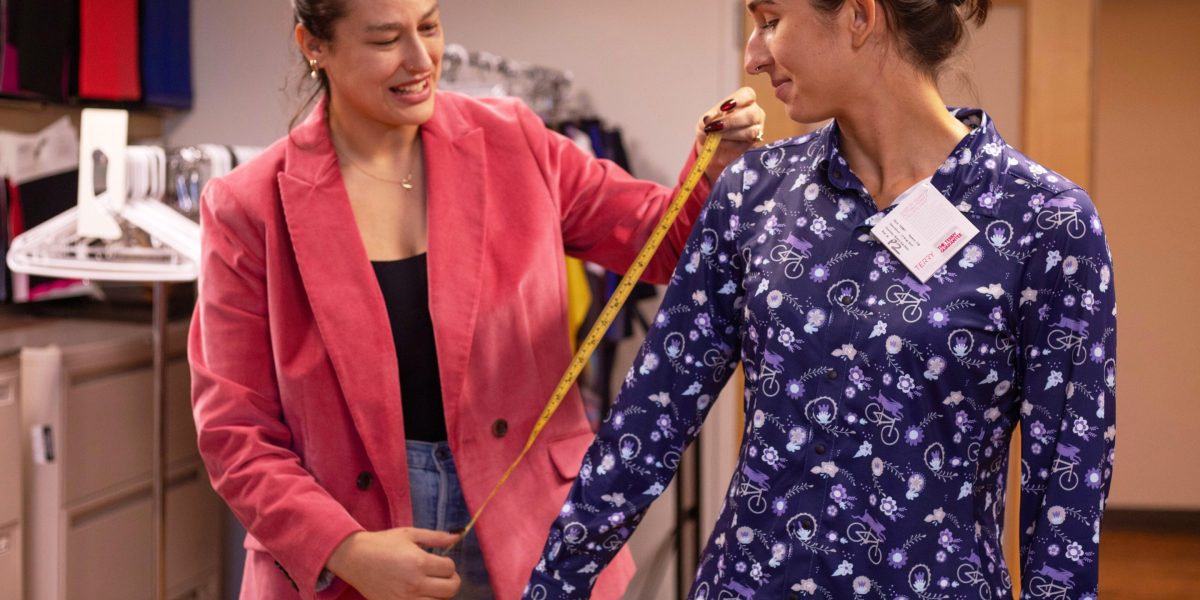
Terry Precision Cycling has made it 40 years with a product line specifically for women, navigating a tough early market, thin profit margins and a pandemic-era boom and bust. But Holm, the company president, wasn’t sure how his operation could pay the tariffs first announced in April and stay in business.

“We felt like our backs were up against the wall,” he said, explaining why he joined a lawsuit challenging the tariffs that the Supreme Court will hear next week.

Terry Precision Cycling’s offices are tucked behind a Burlington, Vermont, coffee shop on a leafy street that bursts into color in the fall. Local accolades share wall space with bike saddles and a color wheel’s worth of fabric samples. Orders are shipped out from a warehouse a few miles away.

It seems an unlikely epicenter for the furor over Trump’s tariffs playing out on the trading floors of global market exchanges and in the boardrooms of international corporations.

But Terry Precision Cycling is one of a handful of small businesses that are challenging many of Trump’s tariffs Wednesday before the Supreme Court in a case with extraordinary implications for the boundaries of presidential power and for the global economy.

Small businesses hit hard

The company is small, but it works with suppliers around the world. It sells cycling shorts manufactured in the U.S. using materials imported from France, Guatemala and Italy. Its distinctive, colorfully printed bike jerseys are made with high-tech material that can’t be found outside of China.

Tariffs mean the company has to pay more for all those imports, and without the cash reserves of a big company, it has few choices to make up the shortfall besides raising prices for customers. The bewildering pace of changes in tariffs, especially on goods from China, has made setting prices more like rolling the dice. “If we don’t know the rules of the game, how are we supposed to play?” Holm asked.

The company had to add $50 to one pair of shorts in the pipeline when China tariffs hit 145%, bringing the price to $199. “Name the cost and we can name the price, and then we can backtrack to see who can actually afford it,” Holm said.

The other companies in the lawsuit he joined are also small businesses, including a plumbing supply company in Utah, a wine importer from New York and a fishing-tackle maker in Pennsylvania.

Holm started working for the company more than a decade ago, taking up cycling in earnest alongside the job. He often rides his bike to work and props it outside his office, alongside the company’s designers and salespeople. A thin man with deep-set eyes and side-parted hair, Holm was named president about two years ago as the company started by women’s cycling pioneer Georgena Terry was wrestling with a downturn in the outdoor market after the coronavirus pandemic. His normally level demeanor gets animated when he talks about the design of their padded shorts or the level of SPF protection in the jerseys.

“It’s all about fit and function, and feeling safe and comfortable,” he said. “That’s our foundation, getting people, getting women, riding. More butts on bikes and getting out there.”

The businesses challenging Trump’s tariffs are represented by Liberty Justice Center, a libertarian-leaning legal group usually more aligned with conservative causes. But they say Trump is wrong on sweeping tariffs, which are projected to collect a total of some $3 trillion from businesses over the next decade, according to the Congressional Budget Office.

They argue the president is using an emergency powers law that doesn’t even mention tariffs to claim nearly unlimited powers to impose and change import duties at will, something no other president has done on such a scale.

“It is practically what the American Revolution was fought over, the principle that taxation is not legitimate unless it is adopted by the representatives of the people,” said Jeffrey Schwab, an attorney with the Liberty Justice Center.

Trump calls the case one of the country’s most important

The Trump administration said the law lets the president regulate importation, and that includes tariffs. The president has been vocal about the case, suggesting at one point he might go to the arguments himself — something no other sitting president is recorded to have done. “That’s one of the most important cases in the history of our country because if we don’t win that case, we will be a weakened, troubled financial mess for many, many years to come,” he said.

The law Trump used for many of his tariffs, the International Emergency Economic Powers Act, has been invoked dozens of times over the decades, often to impose sanctions on other countries.

But no president had used it for tariffs until February, when Trump placed duties on China, Mexico and Canada. He said the countries had not been doing enough to stop illegal immigration and drug trafficking.

In April, he unveiled “reciprocal” tariffs on nearly all U.S. trading partners with a baseline of 10% and higher increases for specific countries, though many of those have since been put on hold. Tariffs on China hit 145% at one point but have since come down and are headed to 20% overall under Trump’s latest deal with China.

Multiple lawsuits have been filed over the emergency-powers tariffs. The Supreme Court also will hear two other cases on Wednesday, one from a group of Democratic-leaning states and another from an Illinois educational toy company.

The plaintiffs have won two rounds in lower courts, though the government did convince four appellate judges that the law does allow the president broad power over tariffs.

How the Supreme Court will rule is an open question

The high court will now be asked to rule on the scope of a president’s authority. The justices, three of whom were appointed by Trump, have so far been reluctant to check his extraordinary flex of executive power.

But they have been skeptical of presidential claims of power before, as when Joe Biden tried to forgive $400 billion in student loans under a different law dealing with national emergencies. The court found that the law didn’t clearly give Biden the power to enact such a costly program.

Trump’s tariffs, by contrast, are expected to total in the trillions. They’re also projected to increase people’s bills by about $2,000 per household this year, an analysis from the Yale Budget Lab found.

Revenue from tariffs totaled $195 billion by September, more than double what it was the year before — though the government could have to pay back that money if the justices strike down the tariffs.

Trump has acknowledged that Americans could feel some short-term pain from tariffs but maintained that they’ll bring about more favorable trade deals and help American manufacturing. His administration says the tariffs are different from the Biden student-loan case because they’re about foreign affairs, an area where it says the courts should not be second-guessing the president.

For the people at Terry Precision Cycling, though, those big-picture political questions were far from their decision to join the lawsuit. Holm thought more about the company’s 20 or so employees, its legacy and the women who buy its products out of a love for cycling.

“If it becomes so unaffordable for them to do it, less can enter into that joy, that freedom of being on a bike,” he said. “It was about surviving this uncertainty.”


Source link

Continue Reading

Business

The day the crosswalk music died: Iconic Buddy Holly Glasses to be lifted from hometown crosswalk on Trump directive

Published

on


Fans of the Buddy Holly crosswalk in his hometown of Lubbock, Texas, with a painted depiction of the rock and roll legend’s iconic glasses, will soon have to say goodbye to it. That’ll be a day that will possibly make them cry.

Lubbock City Council members said this week they have no choice but to remove it, to comply with a directive from the Trump administration and Republicans to rid the public roadways of any political messages or artwork.

Laredo, in South Texas, removed a mural in October that protested the border wall along the southern border with Mexico. In August, Florida officials removed a rainbow-colored crosswalk outside the Pulse nightclub where 49 people were gunned down.

Lubbock’s crosswalk was first installed in 2020 and is near the Buddy Holly Center, a downtown museum with exhibits honoring Lubbock’s most famous native son.

“It’s such a tasteful cross section and people like it. But what do you do?” said City Council Member Christy Martinez-Garcia, who was among those questioning why it had to go.

Lubbock received a letter from the Texas Department of Transportation with “some harsh wording” that threatened the possible loss of state or federal funding for road projects if such artwork was not removed, David Bragg, Lubbock’s interim division director of public works, told council members on Tuesday.

“This was very broad letter. I don’t think it was intended to go after, say, the Buddy Holly glasses. Unfortunately it did,” Bragg said.

Mayor Mark McBrayer said the city had no choice but to comply.

“Probably everybody here got some communication from people wanting that not to be the case,” McBrayer said. “But I don’t really feel like we have the wherewithal to do anything about that without trying to litigate it and I don’t think there’s any appetite here anyway.” Bragg said the removal will happen during normal maintenance next year.

On Oct. 8, Abbott directed the department to ensure that all Texas cities and counties are in compliance with federal and state guidelines on roadway safety and that symbols, flags and other markings conveying social or political messages are prohibited, as well as any signage and signals that don’t directly support traffic control or safety.

“Texans expect their taxpayer dollars to be used wisely, not advance political agendas on Texas roadways,” Abbott said in a statement.

Abbott’s office did not immediately respond to an email seeking comment on Friday.

Abbott’s directive came after Trump’s Transportation Secretary Sean P. Duffy sent letters to all U.S. governors in July saying that intersections and crosswalks must be kept free from distractions.

“Roads are for safety, not political messages or artwork,” Duffy’s statement said.

Holly was born and raised in Lubbock, located in northwest Texas. He decided to play rock and roll music after seeing Elvis Presley perform in 1955. His best known songs include “That’ll Be the Day,” ’’Rave On” and “ Peggy Sue.”

Holly was only 22 when he died in a Feb. 3, 1959, plane crash near Clear Lake, Iowa, that also killed Ritchie Valens and J.P. “Big Bopper” Richardson. The three rockers’ deaths were immortalized in Don McLean’s 1971 song “American Pie,” and became known as “the day the music died.”


Source link

Continue Reading

Business

Despite AI bubble fears, Warren Buffett’s Berkshire Hathaway buys shares of hyperscaler Alphabet

Published

on


Wall Street has been consumed for months with fears that the artificial intelligence boom is actually a bubble about to pop, but that didn’t stop Berkshire Hathaway from buying shares of a top AI hyperscaler.

Warren Buffett’s conglomerate revealed in a regulatory filing late Friday that it purchased 17.8 million shares of Google parent Alphabet during the third quarter. The stock jumped 4% in after-hours trading yesterday.

It was the biggest stock addition last quarter and was worth about $4.3 billion at the end of September. Berkshire also bought shares of Chubb, Domino’s Pizza, Sirius XM and Lennar.

Meanwhile, Berkshire maintained its position in Amazon, another AI hyperscaler, in the third quarter.

The addition of Alphabet comes amid a massive rally. Even after the most recent AI-fueled stock market selloff, Alphabet shares are still up 46% this year.

To be sure, Alphabet has been on Berkshire’s radar in the past. In 2019, Buffett’s right-hand man at the time, the late Charlie Munger, admitted that he felt “like a horse’s ass for not identifying Google better. I think Warren feels the same way.”

Back then, Google’s dominance in search piqued Berkshire’s interest. But today, the company is among the tech giants leading the charge into AI.

Alphabet, Amazon, Meta Platforms and Microsoft alone are spending hundreds of billions of dollars a year with no signs of a slowdown.

Morgan Stanley has estimated AI hyperscalers plan to spend about $3 trillion on data centers and other infrastructure through 2028.

The relentless capital expenditures, much of which is coming via debt, have made Wall Street nervous about whether AI companies will be able to translate all those outlays into sustainable revenue and profits.

With Buffett due to step down as Berkshire’s CEO by year’s end, it’s not immediately clear whether he, successor Greg Abel, or another top executive made the call to buy Alphabet stock.

And investors may not hear directly from the “Oracle of Omaha” on the matter. In a letter published Monday, Buffett said he’ll be “going quiet,” and will no longer write Berkshire’s annual report, nor talk “endlessly” at the annual meeting.

Leading up to Buffett’s departure, Berkshire has been taking a cautious stance on the stock market as well as company acquisitions, sending its cash pile to record highs.

Buffett’s closely followed stock portfolio continued to shrink overall, as last quarter marked three straight years of net selling. The most recent round of selling included more shares of Apple, which Berkshire has been steadily offloading for more than a year.


Source link

Continue Reading

Business

Trump, who mocked Biden’s use of autopen, caught posting identical signatures on pardons

Published

on


The Justice Department posted pardons online bearing identical copies of President Donald Trump’s signature before quietly correcting them this week after what the agency called a “technical error.”

The replacements came after online commenters seized on striking similarities in the president’s signature across a series of pardons dated Nov. 7, including those granted to former New York Mets player Darryl Strawberry, former Tennessee House speaker Glen Casada and former New York police sergeant Michael McMahon. In fact, the signatures on several pardons initially uploaded to the Justice Department’s website were identical, two forensic document experts confirmed to The Associated Press.

Within hours of the online speculation, the administration replaced copies of the pardons with new ones that did not feature identical signatures. It insisted Trump, who mercilessly mocked his predecessor’s use of an autopen, had originally signed all the Nov. 7 pardons himself and blamed “technical” and staffing issues for the error, which has no bearing on the validity of the clemency actions.

The questions about Trump’s signature come amid a new flurry of clemency and weeks after the president claimed to not even know Changpeng Zhao, a crypto billionaire he pardoned last month. He said in an interview with 60 Minutes that the case had been “a Biden witch hunt.”

“A basic axiom of handwriting identification science is that no two signatures are going to bear the exact same design features in every aspect,” said Tom Vastrick, a Florida-based handwriting expert who is president of the American Society of Questioned Document Examiners.

“It’s very straightforward,” said Vastrick, who compared the apparently identical images, now only visible through the online Internet Archive, with the replacements at AP’s request.

Chad Gilmartin, a Justice Department spokesperson, said the “website was updated after a technical error where one of the signatures President Trump personally signed was mistakenly uploaded multiple times due to staffing issues caused by the Democrat shutdown.”

“There is no story here other than the fact that President Trump signed seven pardons by hand and DOJ posted those same seven pardons with seven unique signatures to our website,” Gilmartin said in a statement to AP, referring to the latest wave of clemency Trump has granted in recent weeks.

White House spokesperson Abigail Jackson wrote in an email that Trump “signed each one of these pardons by hand as he does with all pardons.”

“The media should spend their time investigating Joe Biden’s countless auto penned pardons, not covering a non-story,” she wrote.

Trump has been an outspoken critic of Biden’s use of the autopen to conduct executive business, going as far as to display a picture of one such device in place of a portrait of his predecessor in a new “Presidential Walk of Fame” he created along the West Wing colonnade. His Republican allies in Congress last month released a blistering critique of Biden’s alleged “diminished faculties” and mental state during his term that ranked the Democrat’s use of the autopen among “the greatest scandals in U.S. history.”

The Republicans said their findings cast doubt on all of Biden’s actions in office and sent a letter to Attorney General Pam Bondi urging a full investigation.

“Senior White House officials did not know who operated the autopen and its use was not sufficiently controlled or documented to prevent abuse,” the House Oversight Committee found. “The Committee deems void all executive actions signed by the autopen without proper, corresponding, contemporaneous, written approval traceable to the president’s own consent.”

On Friday, Republicans who control the committee released a statement that characterized Trump’s potential use of an electronic signature as legitimate, which it distinguished from Biden’s.

But Rep. Dave Min, a California Democrat on the House Oversight Committee, seized on the apparent similarities in the initial version of the pardons and called for an investigation of the matter, deploying the Republican arguments against Biden in a statement to AP that “we need to better understand who is actually in charge of the White House, because Trump seems to be slipping.”

Regardless, legal experts say the use of an autopen has no bearing on the validity of the pardons.

“The key to pardon validity is whether the president intended to grant the pardon,” said Frank Bowman, a legal historian and professor emeritus at the University of Missouri School of Law who is writing a book on pardons. “Any re-signing is an obvious, and rather silly, effort to avoid comparison to Biden.”

Much of Trump’s mercy has gone to political allies, campaign donors and fraudsters who claimed they were victims of a “weaponized” Justice Department. Trump has largely cast aside a process that historically has been overseen by nonpolitical personnel at the Justice Department.

Casada, a disgraced former Republican speaker of the Tennessee House, was sentenced in September to three years in prison. He was convicted of working with a former legislative aide to win taxpayer-funded mail business from state lawmakers who previously drove Casada from office amid a sexting scandal.

Strawberry was convicted in the 1990s of tax evasion and drug charges. Trump cited the 1983 National League Rookie of the Year’s post-career embrace of his Christian faith and longtime sobriety when pardoning him.

McMahon, a former New York City police sergeant, was sentenced this spring to 18 months in prison for his role in what a federal judge called “a campaign of transnational repression.” He was convicted of acting as a foreign agent for China after he tried to scare an ex-official into going back to his homeland.

McMahon’s defense attorney, Lawrence Lustberg, said he was not aware the pardon documents had been replaced until he was contacted Friday by an AP reporter.

“It is and has always been our understanding that President Trump granted Mr. McMahon his pardon,” Lustberg wrote in an email.

___

Mustian reported from Natchitoches, Louisiana. AP reporter Eric Tucker contributed reporting from Washington.


Source link

Continue Reading

Trending

Copyright © Miami Select.