Connect with us

Business

Why Singapore is the only Southeast Asian country in Pax Silica, the U.S.’s new AI ‘inner circle’

Published

on


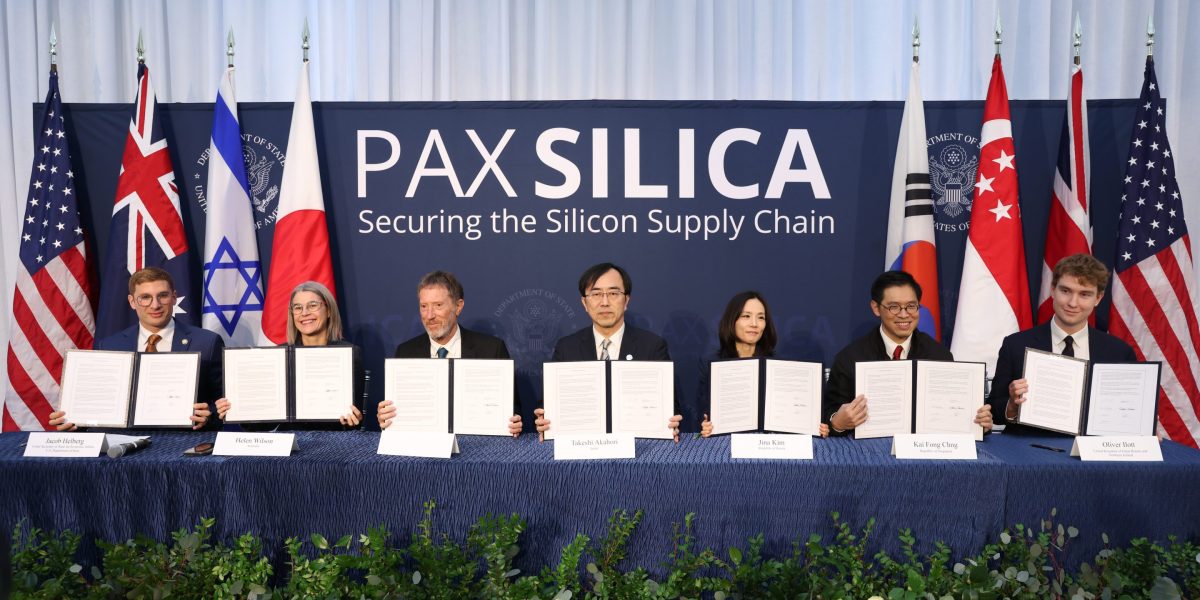
With its new Pax Silica Declaration, Washington has picked its most trusted partners in the AI sector: An array of close U.S. allies, including Australia, the U.K., and Israel. 

Yet despite deepening trade relations between the U.S. and ASEAN nations like Thailand, Malaysia and Vietnam, Singapore remains the agreement’s only Southeast Asian signatory. That decision comes even as ASEAN nations like Malaysia are investing in their own AI industries, like semiconductors and data centers.

Singapore is “precisely the kind of ‘trusted node’ the U.S. is seeking to anchor AI-era supply chains,” says Ruben Durante, a professor of economics and Provost’s Chair at the National University of Singapore (NUS). Singapore “offers strong governance, regulatory credibility, capital markets, logistics, and advanced data center and connectivity infrastructure.”

The country has a long history with chips. U.S.-based National Semiconductor set up a plant there in 1968, followed by the government’s creation of Chartered Semiconductor Manufacturing in 1987. Singapore now accounts for around 10% of all chip production. 

More recently, Singapore has strived to become an “AI nation,” investing in skilling programs to train its workforce and encouraging local AI development. The country has also attracted billions of dollars’ worth in cloud computing and data centers, including from Big Tech companies like Amazon and Google

While the U.S. is trying to shore up its AI supply chain, Singapore might also benefit from being part of Pax Silica, Atreyi Kankanhalli, a computing professor from NUS, suggests. Being part of Pax Silica gives the country—which has less land area than New York City—a seat at the table when the U.S. discusses joint ventures in chip production and logistics. It also gives the resource-poor city-state a safety net to ward off future supply shocks, while enabling access to the latest AI technologies. 

Both the U.S. and China are trying to leverage their dominance in particular industries against each other. 

Washington has blocked the sale of advanced processors, key to training and running AI models, to China since 2022. Beijing, in turn, has slapped export controls on rare earth minerals, a crucial component used for semiconductors and magnets in the AI supply chain. (China has a stranglehold on rare earths, supplying 90% of the world’s processed rare earths and rare earth magnets.)

“The AI race is often framed as a battle over data or models, but the real constraints are increasingly physical—chips, energy and supply chains,” says Simon Chesterman, a law professor from NUS and the senior director of AI governance at research institute AI Singapore.

In addition to Singapore, the U.S. included several close allies in the Pax Silica agreement: Japan, South Korea, Australia, the U.K. and Israel.

Japan and South Korea were chosen as they anchor advanced semiconductor manufacturing, says Durante of NUS. Additionally, Australia is central for critical minerals, the U.K. contributes standards-setting and intelligence alignment, and Israel brings high-end AI and defense-related innovation.

Experts think that the U.S.’s inner circle on AI will soon expand. Durante, from NUS, argues that a small founding group will facilitate early coordination on sensitive issues. Several non-signatories, like the Netherlands and the United Arab Emirates, were involved in initial discussions of the Pax Silica, which Durante sees as an “outer ring” of contributors, even if they’re not yet fully aligned with the U.S

“Expansion will depend on whether Pax Silica develops concrete mechanisms, such as financing, standards, or procurement coordination,” he says, adding that countries which combine industrial relevance with willingness to align on economic-security priorities are the most likely candidates for addition. 

While other Southeast Asia countries could eventually become important nodes in the AI supply chain, they still face constraints like a lack of infrastructure and dispersed talent, explains Anant Shivraj, a managing director and partner at Boston Consulting Group (BCG). 

Yet this could soon change, as Vietnam and Malaysia strive to become key hubs in the region, particularly in semiconductors and data centers.

“Pax Silica’s first wave is more focused on countries that can anchor long-term control, governance, and security across the AI stack,” says Shivraj. “Many countries play essential roles, and even if they are not part of the inner circle yet, that circle may well expand.”


Source link

Continue Reading

Business

Simon Sinek says not to worry about salaries during a job interview. Instead, ‘choose the job based on who you’re going to work for’

Published

on


Considering the inflationary period Americans are struggling through, compounded with the impacts of tariffs, it’s hard not to get fixated on the dollar amount in job descriptions. But management expert Simon Sinek argues there’s something more important to consider when interviewing for jobs: the person you’ll be working for.

“If I got one thing right as a young person, it’s that I always chose jobs based on who I would work for,” Sinek told The Diary of a CEO podcast. “I didn’t care how much money they’re going to pay.”

Sinek is best known for his 2009 TED Talk on the concept of “why,” and his “Golden Circle” theory, which encourages leaders and organizations to define their core purpose or belief as the basis for inspiring employees and customers. His TED Talk was one of the most-watched of all time, with more than 60 million views on the TED website alone. Sinek has more than 8.7 million followers on LinkedIn today. 

This management guru trained as an ethnographer, studying the patterns in how effective leaders and organizations think, act, and communicate to create environments where people operate at their most optimal level. He studied cultural anthropology at Brandeis University and later began, but did not complete, law school at City University of London. Early in his career, he worked in advertising for New York-based agencies including Euro RSCG and Ogilvy & Mather, but later launched his own consultancy, Sinek Partners. 

But Sinek credits his career success to his early days when he prioritized finding the best mentors over a higher salary. 

“By the way, it’s not like I had money, [but] I knew they were going to pay me something. I knew I could pay my bills,” Sinek said. “I’m not a trust fund baby—like, I needed an income. But one company offered me $5,000 more, and one company offered me $5,000 less. But I really like the person over here, [so] I took that job.”

“Yes, I made less money than all of my friends in the short term,” he continued. But “I got an education and care from somebody who took me under their wing.”

What other experts say about prioritizing mentorship over salary

Some of the most successful people in business have also preached prioritizing mentorship over salary during your early career. 

Warren Buffett, who is set to retire as Berkshire Hathaway’s CEO in just a couple of days, said it’s “enormously important” to one’s success with whom they associate. 

“Don’t worry too much about starting salaries and be very careful who you work for because you will take on the habits of the people around you,” Buffett said at a shareholder meeting in May. “There are certain jobs you shouldn’t take.”

He said he’s had five bosses in his life, “and I liked every one of them.”

“They were all interesting,” Buffett continued. “I decided that I’d rather work for myself than anybody else. But if you find people that are wonderful to work with, that’s the place to go.”

Oprah Winfrey has also credited her continued success to the early days of her career when legendary writer Maya Angelou mentored her. Winfrey met Angelou in 1986, the year she debuted The Oprah Winfrey Show. Although she had already established herself as a talk show host, her relationship with Angelou continued to inspire her throughout her career. 

“Anybody who’s had any level of success in their life got to where they are because somebody, somewhere, was a guiding light,” Winfrey wrote in a 2024 article about her mentorship from Angelou. “Maybe they weren’t a full-on, consistent mentor in your life, but nobody, but nobody makes it out here alone.”

This story was originally featured on Fortune.com


Source link

Continue Reading

Business

AI adoption at scale is hard. Just look at India, which processes about 20 billion transactions every month 

Published

on


Shankar Maruwada is CEO and co-founder of the EkStep Foundation. He was part of the founding team of Aadhaar, India’s digital identity program reaching more than 1.4 billion people, and as Head of Demand Generation and Communication at the Unique Identification Authority of India, he helped drive its national adoption. He has worked with governments and global institutions, including the MIT Media Lab, on population-scale digital systems.

Angela Chitkara is founder of the US–India Corridor, a cross-border advisory firm, and serves on the faculty of Columbia University’s School of International and Public Affairs. She advises companies and institutions on governance, risk and resilience, and workforce transformation, and has worked on India’s Aadhaar project.


Source link

Continue Reading

Business

Florida congresswoman accused of stealing $5 million in COVID funds insists she’s innocent

Published

on


U.S. Rep. Sheila Cherfilus-McCormick reiterated her innocence Monday outside a Miami federal courthouse, where she faces charges of conspiring to steal $5 million in federal COVID-19 disaster funds.

Cherfilus-McCormick was scheduled to be arraigned, but her attorney requested the proceeding be rescheduled to Jan. 20 so that she could finalize her legal team. Prosecutors didn’t object, and Judge Lisette Reid agreed to the new date. The hearing lasted less than five minutes.

“I just want to make it very clear that I am innocent,” Cherfilus-McCormick said immediately after leaving court. “In no way did I steal any kind of funds. I’m committed to the people of Florida and my district.”

Cherfilus-McCormick, a Democrat, has pleaded not guilty. She is facing 15 federal counts that accuse her of stealing funds that had been overpaid to her family’s health care company, Trinity Healthcare Services, in 2021. The company had a contract to register people for COVID-19 vaccinations.

Cherfilus-McCormick’s attorney, David Oscar Markus, said the case involves mistakes that generally aren’t even misdemeanors, let alone felonies. He said he believes the case is politically motivated.

Cherfilus-McCormick was arrested in November and then freed on a $60,000 bond. In addition to bail, the judge said Cherfilus-McCormick must surrender her personal passport, and is allowed to travel only between Florida, Washington, D.C., Maryland and the Eastern District of Virginia.

She has been allowed to retain her congressional passport so she can perform certain duties for her job.

According to the federal indictment, prosecutors said that within two months of receiving the funds in 2021, more than $100,000 had been spent on a 3-carat yellow diamond ring for the congresswoman.

The health care company owned by Cherfilus-McCormick’s family had received payments through a COVID-19 vaccination staffing contract, the indictment said. Her brother, Edwin Cherfilus, requested $50,000, but they mistakenly received $5 million and didn’t return the difference.

Prosecutors said the funds received by Trinity Healthcare were distributed to various accounts, including to friends and relatives who then donated to Cherfilus-McCormick’s campaign for Congress.

Cherfilus-McCormick won a special election in January 2022 to represent Florida’s 20th District, which includes parts of Broward and Palm Beach counties, after Rep. Alcee Hastings died in 2021.

The charges she faces include theft of government funds; making and receiving straw donor contributions; aiding and assisting a false and fraudulent statement on a tax return; money laundering, as well as conspiracy charges associated with each of those counts.

According to a previous statement provided by Cherfilus-McCormick’s chief of staff, she doesn’t plan to resign from office. She said she has cooperated with “every lawful request” and will continue to do so until the matter is resolved.


Source link

Continue Reading

Trending

Copyright © Miami Select.