Connect with us

Business

Why one of the world’s most qualified chief design officer calls Samsung his ‘dream job’

Published

on


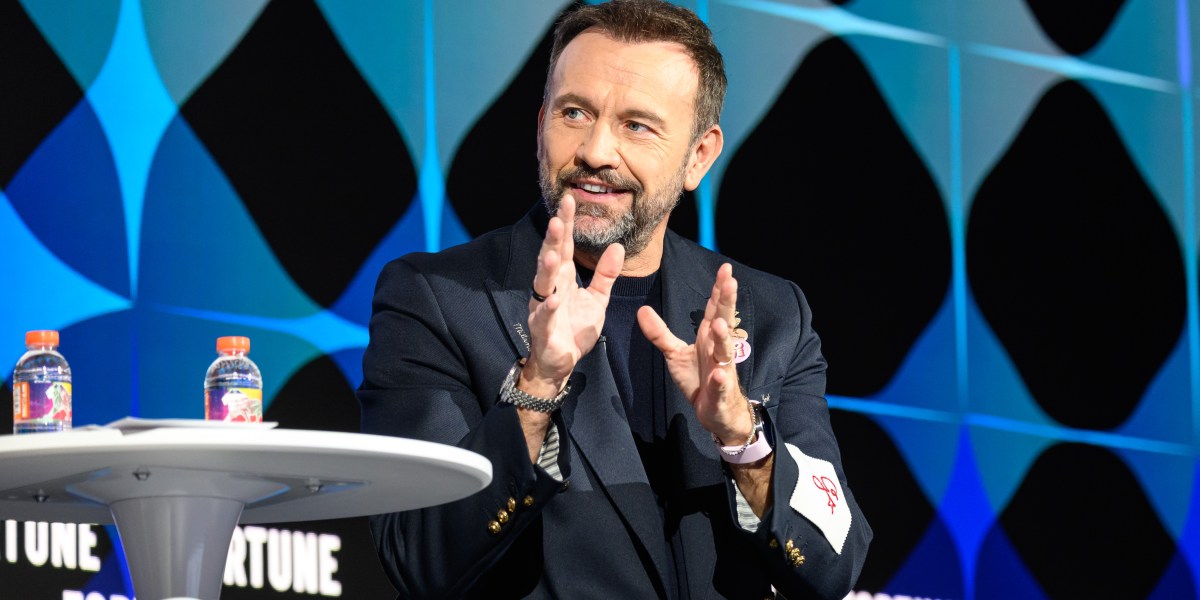
Mauro Porcini, Samsung Electronics’ first-ever chief design officer, sees his path leading design at some of the world’s largest companies as something close to a calling.  

“It felt like faith, God, or whatever you believe in, was looking down and saying ‘Wait a second, before going after your dream, you need to prepare yourself. You need to be ready,’” Porcini says in his office at Samsung’s R&D center near Seoul’s lively Gangnam district. “I needed to get ready for probably my dream job: Being in tech, in a world where tech is about to completely change the way we live.”

Porcini feels slightly out-of-place in the Korean chaebol’s offices. Hailing from Gallarate, a small town outside of Milan, Porcini wears plaid trousers with white racing stripes down the side, platform boots, and a beige jacket with a red lapel, quite different from the more plainly-dressed Korean designers and office workers that sit at Samsung’s desks.

For decades, Samsung, maker of consumer electronics like smartphones, televisions, computer monitors and refrigerators, relied on its vast internal design workforce to become a brand rivaling Apple in prestige.

But renewed competition now threatens to unseat the Global 500 manufacturer from its place at the top of the consumer electronics market. Apple likely overtook Samsung to become the No. 1 smartphone seller in 2025 for the first time in over a decade, according to Counterpoint Research, a market intelligence firm. And up-and-coming Chinese firms like Xiaomi (for phones) and TCL (for TVs) are starting to encroach on Samsung’s premium markets. Then add AI, which threatens to shake up what smart devices can do. 

Samsung has thus turned to an outsider—Porcini—and asked him use his approach to design to help the Korean company to better compete with its rivals “How can we evolve our portfolio to be as meaningful as possible to people and to the business? This is the overall mission.” Porcini asks. “How can we create the best possible products? What is their identity? How do people interact with them?”

It’s a continued bet on design from the Global 500 company, even as cost pressures and new technologies could limit the corporate appetite for expensive human designers.

A career of firsts

Porcini could, arguably, be called the most qualified corporate designer in business today. Few others have worked at so many Fortune Global 500 companies: 3M (No. 489), PepsiCo (No. 115), and now Samsung (No. 27).

In 2011, he took over design responsibilities at 3M, where he fought to make aesthetics part of the product process. “If I was making beautiful and functional products in ugly packaging, or if the experience in retail or digital was wrong, we were going to go nowhere,” he recalls. Porcini went into the field: “It wasn’t easy, because it wasn’t in my job description,” he says. “I needed to step on the toes of so many people.”

A year later, PepsiCo tapped him to be its first-ever head of design. “Industrial designers in tech, historically, focus on the product,” he says. “What I learned in consumer packaged goods was the importance of the overall experience with the brand.”

Both 3M and PepsiCo gave Porcini an appreciation for what non-designers bring to the conversation. “The ideal configuration is one where you have designers coming in with a human-centric approach, you have marketing coming in with a business perspective, and R&D coming in with a technology perspective,” he says.

A return to tech roots

Samsung is a return, of sorts, for Porcini. The designer wrote his master’s thesis on wearables, foreseeing how smart clothing and other technologies could become part of daily life even before wireless technologies like Wifi and Bluetooth were standard. And when Porcini brought PepsiCo CEO Indra Nooyi around the world to look at leaders in design, he made sure to make a stop at Samsung. 

“We came all the way to Seoul in 2013 to meet the top management of Samsung and really understand how it was investing in design,” he remembers. Porcini highlights two lessons he learned from Samsung: A constant push to reinvent and revitalize its products, and “uniting the entire organization around one design mission.”

That forward-thinking approach can be attributed to late chairman Lee Kun-Hee, who pushed Samsung, one of the mega-conglomerates or chaebols that dominate South Korea’s economy, to ditch its reputation as a fast follower and compete with the best companies in consumer tech. In his 1993 “Frankfurt Declaration,” Lee urged executives to “change everything except your wife and children.”

“Lee understood design’s power in digital technology,” says Youngjin Yoo, a professor at the London School of Economics and former Samsung adviser. 

Samsung designers studied how people interacted with devices; for example, consumers keep their TVs off for most of the day; they’re more like a piece of furniture than a source of entertainment. Samsung treated the television as the centerpiece to a room, a philosophy the company continues today with screens that could pass for art when not in use. (Porcini, during our conversation, points to what looks like a reproduction of Salvador Dali’s “The Persistence of Memory” behind him. “Did you know that’s a TV?” he says.)

“What Samsung did with the Bespoke line of refrigerators [a fully customizable model] and other categories was pretty brave,” Porcini says. “We need to double down on what the company is already doing, and take it to the next level.”

Still, Samsung is dogged by accusations that it copies its competition. Apple sued Samsung in 2011 for allegedly infringing its design patents; the two giants settled their long legal feud in 2018. 

Yoo thinks the company lost momentum after the 2016 Galaxy Note 7 crisis, when exploding batteries forced a massive recall. “Samsung could have continued to innovate. But I think they stalled in a way,” he said. 

Now, Samsung needs to grapple with how to integrate AI into its smart products, which don’t seem quite as smart as they used to in an age of LLMs and AI agents. Yet companies large and small have yet to crack the code on how to make a truly AI-enabled device. Early experiments, like the Humane AI pin, have flopped due to high prices and poor performance. 

Samsung is aggressively pushing its AI across its products, with Samsung Electronics co-CEO Roh Tae-moon promising to get its Galaxy AI services onto 800 million mobile devices this year. “We will apply AI to all products, all functions, and all services as quickly as possible,” he told Reuters in an early January interview

Design’s value in the age of AI

AI also poses a threat to designers. Generative AI could be a hugely useful tool for creatives, allowing them to mock up and refine ideas much more quickly and at much lower costs. But AI could also automate their work, which could threaten jobs as companies pay closer attention to costs. 

That’s partly why Porcini sees his appointment as Samsung’s chief design officer as a rare bit of good news for corporate design. “When I announced my appointment on Linkedin, and I saw hundreds of thousands of impressions … so many designers around the world saw this as hope,” he says. “I felt the pressure. Now I need to deliver, right?”

Perhaps unsurprisingly, he’s optimistic that AI will, in fact, reinforce the value that human designers can bring to companies. “Eventually, AI and robots will become a commodity,” he suggests. “Technology is a tool.”

And “in an age of extreme technology, businesses need the best humans more than ever,” he says. “Designers are the ambassadors for human beings. And creating value for humans is one of the most powerful competitive advantages you can build at a company.”


Source link

Continue Reading

Business

Trump order says Venezuelan oil money is being held by US for ‘governmental and diplomatic purposes’

Published

on


President Donald Trump’s new executive order on Venezuelan oil revenue is meant to ensure that the money remains protected from being used in judicial proceedings.

The executive order, made public on Saturday, says that if the funds were to be seized for such use, it could “undermine critical U.S. efforts to ensure economic and political stability in Venezuela.”

The order comes amid caution from top oil company executives that the tumult and instability in Venezuela could make the country less attractive for private investment and rebuilding.

“If we look at the commercial constructs and frameworks in place today in Venezuela, today it’s uninvestable,” said Darren Woods, CEO of ExxonMobil, the largest U.S. oil company, during a meeting convened by Trump with oil executives on Friday.

During the session, Trump tried to assuage the concerns of the oil companies and said the executives would be dealing directly with the U.S., rather than the Venezuelan government.

Venezuela has a history of state asset seizures, ongoing U.S. sanctions and decades of political uncertainty.

Getting U.S. oil companies to invest in Venezuela and help rebuild the country’s infrastructure is a top priority of the Trump administration after the dramatic capture of now-deposed leader Nicolás Maduro.

The White House is framing the effort to “run” Venezuela in economic terms, and Trump has seized tankers carrying Venezuelan oil, has said the U.S. is taking over the sales of 30 million to 50 million barrels of previously sanctioned Venezuelan crude, and plans to control sales worldwide indefinitely.

“I love the Venezuelan people, and am already making Venezuela rich and safe again,” Trump, who is currently in southern Florida, wrote on his social media site on Saturday. “Congratulations and thank you to all of those people who are making this possible!!!”

The order says the oil revenue is property of Venezuela that is being held by the United States for “governmental and diplomatic purposes” and not subject to private claims.

Its legal underpinnings are the National Emergencies Act and the International Emergency Economic Powers Act. Trump, in the order, says the possibility that the oil revenues could be caught up in judicial proceedings constitutes an “unusual and extraordinary threat” to the U.S.


Source link

Continue Reading

Business

As U.S. debt soars past $38 trillion, corporate bond flood is a growing threat to Treasury supply

Published

on


As the Treasury Department looks to ensure investors continue absorbing the fresh supply of debt it must sell, growing competition from companies issuing their own bonds could send rates higher, according to Apollo Chief Economist Torsten Slok.

In a note on Saturday, he pointed out that Wall Street estimates for the volume of investment grade debt that’s on the way this year reach as high as $2.25 trillion.

That’s as the AI boom increasingly sends companies, including hyperscalers and adjacent firms, to the bond market to fund massive investments in data centers and other infrastructure.

“The significant increase in hyperscaler issuance raises questions about who will be the marginal buyer of IG paper,” Slok said. “Will it come from Treasury purchases and hence put upward pressure on the level of rates? Or might it come from mortgage purchases, putting upward pressure on mortgage spreads?”

With U.S. debt topping $38 trillion, the federal government has already borrowed $601 billion in the first three months of the 2026 fiscal year, which began in October 2025, according to the latest data from the Congressional Budget Office.

That’s $110 billion less than the deficit during the same period a year earlier as tariffs helped revenue outpace spending. But the Supreme Court could strike down President Donald Trump’s global tariffs soon, and this year’s tax season should see a surge of refunds to account for new tax cuts under the One Big Beautiful Bill Act.

Meanwhile, Trump has vowed to boost defense spending to $1.5 trillion a year from $1 trillion, threatening to further deepen federal budget deficits.

And despite the Federal Reserve’s series of rate cuts this past autumn, Treasury yields remain about where they were in early September, suggesting the government will not see much relief on debt-servicing costs that are also contributing to the overall tally of red ink.

“The bottom line is that the volume of fixed-income products coming to market this year is significant and is likely to put upward pressure on rates and credit spreads as we go through 2026,” Slok said.

Apollo

To make sure there’s sufficient demand among bond investors, Treasury yields must remain attractive relative to the competition. Failure to draw enough investors raises the risk of so-called fiscal dominance, or when a central bank must step into to finance widening deficits.

That’s what former Treasury Secretary Janet Yellen warned of last weekend, during a panel hosted by the American Economic Association.

“The preconditions for fiscal dominance are clearly strengthening,” she said, noting debt is on a steep upward trajectory toward 150% of GDP over the next three decades.

At the same time, he holders of U.S. debt have shifted drastically over the past decade, tilting more toward profit-driven private investors and away from foreign governments that are less sensitive to prices.

That threatens to turn the U.S. financial system more fragile in times of market stress, according to Geng Ngarmboonanant, a managing director at JPMorgan and former deputy chief of staff to Yellen during her tenure at Treasury.

Foreign governments accounted for more than 40% of Treasury bond holdings in the early 2010s, up from just over 10% in the mid-1990s, he wrote in a New York Times op-ed last month. This reliable bloc of investors allowed the U.S. to borrow vast sums at artificially low rates.

“Those easy times are over,” he warned. “Foreign governments now make up less than 15% of the overall Treasury market.”


Source link

Continue Reading

Business

ICE shooting that killed Renee Good sets up budget standoff ahead of shutdown deadline

Published

on


The killing of Renee Good by an Immigration and Customs Enforcement agent in Minnesota has sparked a potential funding battle just as the federal government faces another shutdown deadline on Jan. 30.

Democrats in Congress are considering ways to rein in President Donald Trump’s immigration crackdown after the fatal shooting, and legislation to fund the Department of Homeland Security could be one vehicle for it.

Sen. Chris Murphy, the ranking Democrat on the subcommittee that oversees the DHS budget, plans to introduce legislation that would require agents to have warrants for arrests, ban them from wearing masks during enforcement operations, limit the use of guns by ICE during civil actions, and restrict the Border Patrol to the border.

He is trying to gather enough Democrats who will demand guardrails on DHS in exchange for their votes to pass a spending bill for the department, sources told Axios.

“Democrats cannot vote for a DHS budget that doesn’t restrain the growing lawlessness of this agency,” Murphy said in a post on X on Wednesday.

At least one Republican, Sen. Sen. Lisa Murkowski from Alaska, has called for policy changes, saying the shooting in Minnesota “was devastating, and cannot happen again.”

“The videos I’ve seen from Minneapolis yesterday are deeply disturbing,” she said in a statement. “As we mourn this loss of life, we need a thorough and objective investigation into how and why this happened.”

Some Democrats in the House, where Republicans hold a razor-thin majority that has gotten narrower, have also said legislation for DHS appropriations should be used as leverage.

And Rep. Adriano Espaillat, a member of the House Appropriations Committee, suggested at a news conference Friday that Democrats should take an even more aggressive stance.

“I was of the belief that perhaps we could reform ICE. Now I am of the belief that it has to be dismantled as an entity,” he said. “This unaccounted for violence is part of its culture. And so we must dismantle it and build it from the ground up again.”

But after the longest government shutdown ever last fall took a heavy toll on the economy and social services, top Democrats like Senate Minority Leader Chuck Schumer have signaled they want to avoid another one a few months later.

Still, House Speaker Mike Johnson admitted on Friday he’s concerned Democrats’ targeting of immigration enforcement funding could interfere with overall negotiations on government appropriations.

“We should not be limiting funding for Homeland Security at a dangerous time,” Johnson said, according to Politico. “We need officials to allow law enforcement to do their job. Immigration and Customs Enforcement is a critically important function of the government. It is a top concern for Americans, as demonstrated by the last election cycle.”


Source link

Continue Reading

Trending

Copyright © Miami Select.