Connect with us

Business

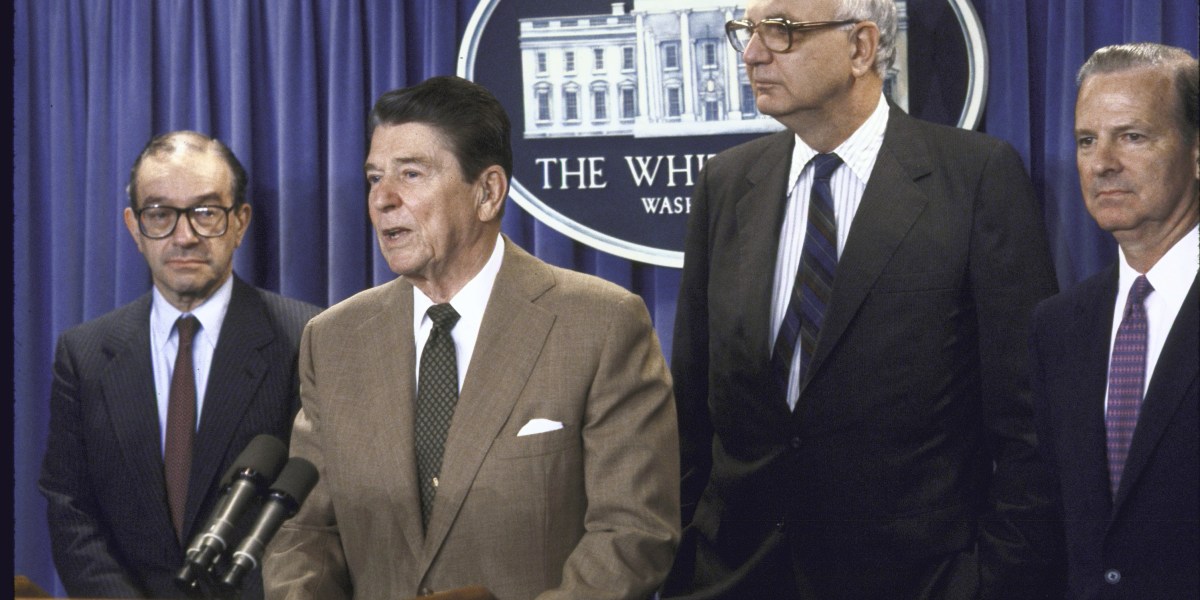
Why does an independent Fed matter? Just look at Ronald Reagan’s economy with Paul Volcker hiking rates to nearly 20%

Published

on


President Donald Trump this week called on a Federal Reserve governor to resign over an accusation of mortgage fraud, the latest effort by his administration to exert greater control over one of the few remaining independent agencies in Washington.

Federal Reserve governor Lisa Cook says she won’t leave her post.

Trump has repeatedly attacked the Fed’s chair, Jerome Powell, for not cutting its short-term interest rate, and even threatened to fire him. Powell, who will speak Friday at an economic symposium in Jackson Hole, Wyoming, says the Fed wants to see how the economy responds to Trump’s sweeping tariffs on imports, which Powell says could push up inflation.

Powell’s caution has infuriated Trump, who has demanded the Fed cut borrowing costs to spur the economy and reduce the interest rates the federal government pays on its debt. Trump has also accused Powell of mismanaging the U.S. central bank’s $2.5 billion building renovation project.

Firing the Fed chair or forcing out a governor would threaten the Fed’s venerated independence, which has long been supported by most economists and Wall Street investors. Here’s what to know about the Fed:

Why the Fed’s independence matters

The Fed wields extensive power over the U.S. economy. By cutting the short-term interest rate it controls — which it typically does when the economy falters — the Fed can make borrowing cheaper and encourage more spending, accelerating growth and hiring. When it raises the rate — which it does to cool the economy and combat inflation — it can weaken the economy and cause job losses.

Economists have long preferred independent central banks because they can more easily take unpopular steps to fight inflation, such as raise interest rates, which makes borrowing to buy a home, car, or appliance more expensive.

The importance of an independent Fed was cemented for most economists after the extended inflation spike of the 1970s and early 1980s. Former Fed Chair Arthur Burns has been widely blamed for allowing the painful inflation of that era to accelerate by succumbing to pressure from President Richard Nixon to keep rates low heading into the 1972 election. Nixon feared higher rates would cost him the election, which he won in a landslide.

Paul Volcker was eventually appointed chair of the Fed in 1979 by President Jimmy Carter, and he pushed the Fed’s short-term rate to the stunningly high level of nearly 20%. (It is currently 4.3%). The eye-popping rates triggered a sharp recession, pushed unemployment to nearly 11%, and spurred widespread protests.

Yet Volcker didn’t flinch. By the mid-1980s, inflation had fallen back into the low single digits. Volcker’s willingness to inflict pain on the economy to throttle inflation is seen by most economists as a key example of the value of an independent Fed.

Investors are watching closely

An effort to fire Powell would almost certainly cause stock prices to fall and bond yields to spike higher, pushing up interest rates on government debt and raising borrowing costs for mortgages, auto loans, and credit card debt. The interest rate on the 10-year Treasury is a benchmark for mortgage rates.

Most investors prefer an independent Fed, partly because it typically manages inflation better without being influenced by politics but also because its decisions are more predictable. Fed officials often publicly discuss how they would alter interest rate policies if economic conditions changed.

If the Fed was more swayed by politics, it would be harder for financial markets to anticipate — or understand — its decisions.

The Fed’s independence doesn’t mean it’s unaccountable

Fed chairs like Powell are appointed by the president to serve four-year terms, and have to be confirmed by the Senate. The president also appoints the six other members of the Fed’s governing board, who can serve staggered terms of up to 14 years.

Those appointments can allow a president over time to significantly alter the Fed’s policies. Former president Joe Biden appointed four of the current seven members: Powell, Cook, Philip Jefferson, and Michael Barr. A fifth Biden appointee, Adriana Kugler, stepped down unexpectedly on Aug. 1, about five months before the end of her term. Trump has already nominated his top economist, Stephen Miran, as a potential replacement, though he will require Senate approval. Cook’s term ends in 2038, so forcing her out would allow Trump to appoint a loyalist sooner.

Trump will be able to replace Powell as Fed chair in May 2026, when Powell’s term expires. Yet 12 members of the Fed’s interest-rate setting committee have a vote on whether to raise or lower interest rates, so even replacing the Chair doesn’t guarantee that Fed policy will shift the way Trump wants.

Congress, meanwhile, can set the Fed’s goals through legislation. In 1977, for example, Congress gave the Fed a “dual mandate” to keep prices stable and seek maximum employment. The Fed defines stable prices as inflation at 2%.

The 1977 law also requires the Fed chair to testify before the House and Senate twice every year about the economy and interest rate policy.

Could the president fire Powell before his term ends?

The Supreme Court earlier this year suggested in a ruling on other independent agencies that a president can’t fire the chair of the Fed just because he doesn’t like the chair’s policy choices. But he may be able to remove him “for cause,” typically interpreted to mean some kind of wrongdoing or negligence.

It’s a likely reason the Trump administration has zeroed in on the building renovation, in hopes it could provide a “for cause” pretext. Still, Powell would likely fight any attempt to remove him, and the case could wind up at the Supreme Court.

Introducing the 2025 Fortune Global 500, the definitive ranking of the biggest companies in the world. Explore this year’s list.


Source link

Continue Reading

Business

Why the worst leaders sometimes rise the fastest

Published

on


History is crowded with CEOs who have flamed out in very public ways. Yet when the reckoning arrives, the same question often lingers: How did this person keep getting promoted? In corporate America, the phenomenon is known as “failing up,” the steady rise of executives whose performance rarely matches their trajectory. Organizational psychologists say it’s not an anomaly. It’s a feature of how many companies evaluate leadership.

At the core is a well-documented bias toward confidence over competence. Studies consistently show that people who speak decisively, project certainty, and take credit for wins—whether earned or not—are more likely to be perceived as leadership material. In ambiguous environments, boards and senior managers often mistake boldness for ability. As long as a leader can narrate failure convincingly—blaming market headwinds, legacy systems, or uncooperative teams—their upward momentum may continue.

Another driver is asymmetric accountability. Senior executives typically oversee vast, complex systems where outcomes are hard to tie directly to individual decisions. When results are good, credit flows upward. When results are bad, blame diffuses downward, and middle managers, project leads, and market conditions become convenient shock absorbers. This allows underperforming leaders to survive long enough to secure their next promotion.

Then there’s the mobility illusion. In many industries, frequent job changes are read as ambition and momentum rather than warning signs. An executive who leaves after short, uneven tenures can reframe each exit as a “growth opportunity” or a strategic pivot. Recruiters and boards, under pressure to fill top roles quickly, often rely on résumé signals, like brand-name firms, inflated titles, and elite networks, rather than deep performance audits.

Ironically, early visibility can also accelerate failure upward. High-profile roles magnify both success and failure, but they also increase name recognition. An executive who runs a troubled division at a global firm may preside over mediocre results, yet emerge with a reputation as a “big-company leader,” making them attractive for a CEO role elsewhere.

The reckoning usually comes only at the top. As CEO, the buffers disappear. There is no one left to blame, and performance is judged in the blunt language of earnings, stock price, profitability, or layoffs. The traits that once fueled ascent, such as overconfidence, risk-shifting, and narrative control, become liabilities under full scrutiny.

The central lesson for aspiring CEOs is that the very system that rewards confidence, visibility, and narrative control on the way up often masks weak execution until the top job strips those protections away. Future leaders who want to avoid “failing upward” must deliberately build careers grounded in verifiable results and direct ownership of outcomes because at the CEO level, there is no narrative strong enough to substitute for performance.

Ruth Umoh
ruth.umoh@fortune.com

Smarter in seconds

Big biz buy-in. Anthropic is all in on ‘AI safety’—and that’s helping the $183 billion startup win over big business

Old guard upgrade. How the bank founded by Alexander Hamilton is transforming for the future of finance

Pressure test. Inside the Fortune 500 CEO pressure cooker: surviving is harder than ever and requires an ‘odd combination’ of traits

Rank racing. The one-upmanship driving CEOs

Leadership lesson

Anthropic’s Dario Amodei on when a startup gets too big to know all employees: “It’s an inevitable part of growth.”

News to know

Investors are questioning OpenAI’s profitability amid its massive spending while increasingly viewing Alphabet as the deeper-pocketed winner in the AI race. Fortune

Trump warned that Netflix’s $72 billion bid for Warner Bros. Discovery could face antitrust scrutiny, suggesting it would create an overly dominant force in streaming. Fortune

An etiquette camp is trying to help Silicon Valley shed its sloppy image by teaching tech elites how to dress and behave as their influence grows. WaPo

IBM is reportedly in advanced talks to buy data-infrastructure firm Confluent for about $11 billion, bolstering its AI data capabilities. WSJ

Even as women reach top roles in politics and business at record levels, public confidence in their leadership is stagnating or declining. Bloomberg

Terence “Bud” Crawford, the undefeated 38-year-old boxing champion, has earned more than $100 million and even turned Warren Buffett into a fan. Forbes

Big Tech leaders now warn that artificial intelligence is advancing to the point where it could begin replacing even CEOs, reshaping the very top of corporate leadership. WSJ

This is the web version of the Fortune Next to Lead newsletter, which offers strategies on how to make it to the corner office. Sign up for free.


Source link

Continue Reading

Business

The workforce is becoming AI-native. Leadership has to evolve

Published

on


One of the most insightful conversations I have had recently about artificial intelligence was not with policymakers or peers. It was with a group of Nokia early-careers talents in their early 20s. What stood out was their impatience. They wanted to move faster in using AI to strengthen their innovation capabilities. 

That makes perfect sense. This generation began university when ChatGPT launched in 2022. They now account for roughly half of all ChatGPT usage, applying it to everything from research to better decision-making in knowledge-intensive work. 

Some people worry that AI-driven hiring slowdowns are disproportionately impacting younger workers. Yet the greater opportunity lies in a new generation of AI-native professionals entering the workforce equipped for how technology is transforming roles, teams, and leadership.

Better human connectivity 

One of the first tangible benefits of generative AI is that it allows individual contributors to take on tasks once handled by managers. Research by Harvard Business School found that access to Copilot increased employee productivity by 5% in core tasks. As productivity rises and hierarchies flatten, early-career employees using AI are empowered to focus on outcomes, learn faster, and contribute at a higher level.

Yet personal productivity is not the real measure of progress. What matters most is how well teams perform together. Individual AI gains only create business impact when they align with team goals and that requires greater transparency, alignment, and accountability.

At Nokia, we ensure that everyone has clear, measurable goals that support their teams’ objectives. Leaders need to be open about their goals to their managers and to their reports. And everyone means everyone. Me included. That way goals are not only about recognition and reward. They become an ongoing dialogue between leaders and their teams. It’s how we’re building a continuous learning culture that thrives on feedback and agility, both essential in the AI era. 

Humans empowered with AI, not humans versus AI

AI’s true power lies in augmenting human skills. Every role has a core purpose – whether in strategy, creativity, or technical problem-solving – and AI helps people focus on that. 

During the COVID-19 pandemic, more than 60 chatbots were deployed in 30 countries to handle routine public health queries, freeing up healthcare workers to focus on critical patient care. Most health services never looked back. 

The same pattern applies inside companies. Some of the routine tasks given to new hires are drudge work and not a learning experience. AI gives us a chance to rethink the onboarding, training, and career development process.

Take an early-career engineer. Onboarding can be a slow process of documentation and waiting for reviews. AI can act as an always-on coach that gives quick guidance and helps people ramp up. Mentors then spend less time on the basics and more time helping engineers solve real problems. Engineers can also have smart agents testing their designs, ideas, and simulating potential outcomes. In this way, AI strengthens, rather than substitutes, the human connection between junior engineers and their mentors and helps unlock potential faster.

Encourage experimentation and entrepreneurship 

During two decades of the Internet Supercycle (1998-2018), start-ups created trillions of dollars in economic value and roughly half of all new jobs in OECD countries

As AI lowers the barriers to launching and scaling ventures, established companies must find new ways to encourage experimentation, nurture innovation through rapid iterations, and give employees the chance to commercialize and scale their ideas.

There is a generational shift that increases the urgency: more than 60% of Gen Z Europeans hope to start their own businesses within five years, according to one survey. To secure this talent, large organizations must provide the attributes that make entrepreneurship attractive. Empowering people with agility, autonomy, and faster decision-making creates an edge in attracting and keeping top talent.

At Nokia, our Technology and AI Organization is designed to strengthen innovation capabilities, encourage entrepreneurial thinking, and give teams the support to turn ideas into real outcomes.

More coaching, less managing 

Sporting analogies are often overused in business as the two worlds don’t perfectly align, yet the evolution of leadership in elite football offers useful lessons. Traditionally, managers oversaw everything on and off the pitch. Today, head coaches focus on building the right team and culture to win. 

Luis Enrique, the manager of Paris-St. Germain football club, last season’s UEFA Champion’s League winner, exemplifies this shift. He transformed a team of stars into a star team, while also evolving his coaching style, elevating both individual and collective potential.

Of course, CEOs must switch between both roles (as I said, the worlds don’t perfectly align) – setting vision and strategy while also cultivating the right team and culture to succeed. AI can help leaders do both with more focus. It gives us quicker insight into what is working, what is not, and where teams need support.

I have been testing these tools with my own leadership team. We are using generative AI to help us evaluate our decisions and to understand how we work together. It has revealed patterns we might have missed, and it has helped us get to the real issues faster. It does not replace judgment or experience. It supports them.

Yet the core of leadership does not change. AI cannot build trust. It cannot set expectations. It cannot create a culture that learns, improves, and takes responsibility. That still comes from people. And in a world shaped by AI, the leaders who succeed will be the ones who coach, who listen, and who help teams move faster with confidence.

Nokia’s technology connects intelligence around the world. Inside the company, connecting intelligence is about how people work together. It means giving teams the tools, support and culture they need to grow and perform with confidence. Connecting intelligence is how teams win.

The opinions expressed in Fortune.com commentary pieces are solely the views of their authors and do not necessarily reflect the opinions and beliefs of Fortune.


Source link

Continue Reading

Business

Procurement execs often don’t understand the value of good design, experts say

Published

on


Behind every intricately designed hotel or restaurant is a symbiotic collaboration between designer and maker.

But in reality, firms want to build more with less—and even though visions are created by designers, they don’t always get to see them to fruition. Instead, intermediaries may be placed in charge of procurements and overseeing the financial costs of executing designs.

“The process is not often as linear as we [designers] would like it to be, and at times we even get slightly cut out, and something comes out on the other side that wasn’t really what we were expecting,” said Tina Norden, a partner and principal at design firm Conran and Partners, at the Fortune Brainstorm Design forum in Macau on Dec. 2.

“To have a better quality product, communication is very much needed,” added Daisuke Hironaka, the CEO of Stellar Works, a furniture company based in Shanghai. 

Yet those tasked with procurement are often “money people” who may not value good design—instead forsaking it to cut costs. More education on the business value of quality design is needed, Norden argued.

When one builds something, she said, there are both capital investment and a lifecycle cost. “If you’re spending a bit more money on good quality furniture, flooring, whatever it might be, arguably, it should last a lot longer, and so it’s much better value.”

Investing in well-designed products is also better for the environment, Norden added, as they don’t have to be replaced as quickly.

Attempts to cut costs may also backfire in the long run, said Hironaka, as business owners may have to foot higher maintenance bills if products are of poor design and make.

AI in interior and furniture design

Though designers have largely been slow adopters of AI, some luminaries like Daisuke are attempting to integrate it into their team’s workflow.

AI can help accelerate the process of designing bespoke furniture, Daisuke explained, especially for large-scale projects like hotels. 

A team may take a month to 45 days to create drawings for 200 pieces of custom-made furniture, the designer said, but AI can speed up this process. “We designed a lot in the past, and if AI can use these archives, study [them] and help to do the engineering, that makes it more helpful for designers.” 

Yet designers can rest easy as AI won’t ever be able to replace the human touch they bring, Norden said. 

“There is something about the human touch, and about understanding how we like to use our spaces, how we enjoy space, how we perceive spaces, that will always be there—but AI should be something that can assist us [in] getting to that point quicker.”

She added that creatives can instead view AI as a tool for tasks that are time-consuming but “don’t need ultimate creativity,” like researching and three-dimensionalizing designs.

“As designers, we like to procrastinate and think about things for a very long time to get them just right, [but] we can get some help in doing things faster.”


Source link

Continue Reading

Trending

Copyright © Miami Select.