Although it took until October, fall has finally arrived in New York City. The signs are everywhere: The streets no longer harbour that rich, gourmet cheese aroma of rotting garbage. Everyone says they’re excited to make dinner plans, but no one has an open evening until November. High school kids have taken over subway cars in their elbowy scrums, always shouting. And, of course, the finance bros have broken out their Barbour jackets.
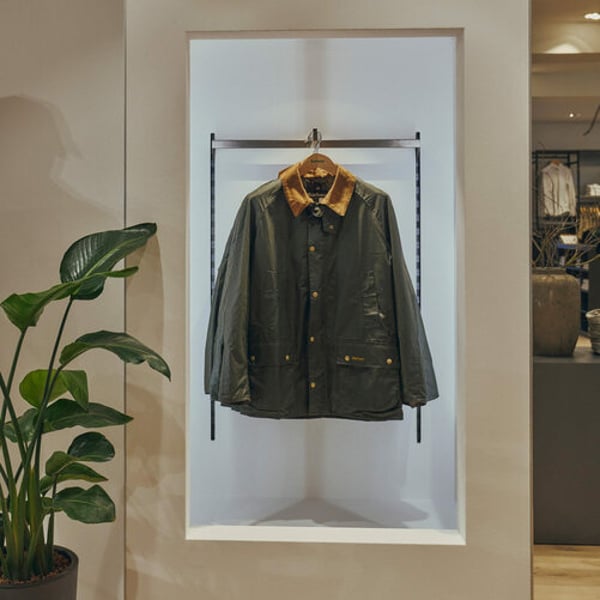
Barbour is known for its waxed outerwear
The last is probably the most subtle shift, but it may have the longest lineage. A Northeastern preppy tradition that stretches back, like so many do, to Britain, Barbour apparel can trace its heritage to 1894, when Scotsman John Barbour launched a business selling oilskins to sailors and fishermen who worked in the rugged weather of northeastern England. In the 1930s the brand’s outerwear became a standard uniform for motorcyclists and the British submarine service. Later, the company received a royal warrant for its regular use by kings and queens as they stomped around in muddy wellies on Scotland’s perpetually damp Balmoral estate.
Nowadays, it’s a very specific signifier of belonging to a certain class- worn by folks for whom work almost never involves exposure to bad weather. A classic coastal shibboleth, the older a Barbour appears, the more powerful a signifier it is. A rough square of mending stitches tells the tale of a long-forgotten Christmas tree incident, and faded spots on the shoulders are hallmarks of the backpack years in college. But only the wearer really knows its whole story.
A Barbour jacket doesn’t look attractive, exactly. It looks like it does a job, and well. At around $400, it’s not much pricier than, say, a Patagonia– but if you have one, there’s a strong chance your mother bought it for you, and you have been wearing it for decades. The Barbour’s oversize brass zippers never seem to snag, the soft tartan lining is warm but rarely too hot, and the collar never seems to sit exactly the right way, giving it a rakish look. If you need one with longer sleeves, Barbour will just slap on some extra inches of cotton- a practice I wish just about every other brand would adopt.
“One of the unique things about our brand is that we always hear the stories that come with the garments,” says Paul Stephan, Barbour’s vice president of marketing for North America. “‘This was bought for me by my parents or handed down for me by my grandparents.’ We’ve heard stories of a jacket that’s lasted 40, 50 years.”
Here’s the secret: People can keep their Barbours for decades because you can get them rewaxed- which, like waxing your car or polishing your shoe, boosts its water resistance, nurtures the underlying material and protects its surface from wear and tear.
You used to only be able to mail your coat in for service, or bring it to a Barbour or Orvis store. But now you can drop it off at a wide array of retail locations, including Nordstrom, and get it shipped back to you in about about four weeks- a faster turnaround time than a few years ago. You can also take it to the Barbour boutique located in Washington’s Georgetown neighbourhood or on New York’s Upper East Side and watch it be waxed before your eyes. (The store clerk will put it on a heating table and spread hot wax on it with a sponge. It takes about 15 minutes total and is uncannily soothing to witness, like watching that old Mister Rogers video of how crayons are made.)
Every year in late September, I try to remind people through a post on Instagram to rewax their coats. Many followers respond with, “What are you talking about?” But a select few will say, “Thank you, I usually remember when it’s too late.”
This little secret is becoming more widely known as shoppers become more attracted to items with real patina- the signs of use and love. Over the summer, GQ published an article about how Gen Z shoppers are snatching up weathered LL Bean Boat and Totes for hundreds of dollars. Original Boat and Totes cost all of $40, and beating them up is free, so this was a surprise to me. Who knew my mudroom closet contained thousands of dollars worth of merchandise?
In my house, we have a surfeit of Bean Bags, but our inner Northeastern cheapskates won’t let us throw any away. Once, as a housewarming gift a decade ago, someone gave my husband and I a tote with our street address stitched into the side—but with the wrong building number. Obviously we still use it. And now I’m glad, because its coffee and baby formula stains, which I initially sighed over and then eventually learned to ignore, apparently make it even more valuable.
But if you’ve decided your Barbour coat has gotten too tattered for even your preppiest predilections, the company will buy it back from you for an $80 store credit. Company artisans will stitch, mend and wax it back together and then sell it again as part of the “Re-Loved” program that launched in 2019. Sometimes they’ll employ contrast-colour patches and tartan on the exterior to give the garments even more personality. Thousands of jackets, which start at $325, have been sold through the program, the company says.
“We’ll take in that jacket, clean, repair it to make it feel like new again. But it comes with the character that it was preowned, and there is such a big market for that nowadays,” Stephan says. “Shoppers will come straight to Re-Loved sometimes, in part because it’s a more approachable price point. Talk about a younger, let’s say, a college consumer: They’re shopping second hand anyway. This lets us be part of the conversation.”
In a partnership that began this year, designer Paul Smith made his own line of Re-Loved Barbours as part of his “Paul Smith loves Barbour” collection, featuring purple patches, jaunty oversize cuts, and, of course, stripes.
This glorification of the well-worn reminds me of when I was a kid, and I thought nothing was cooler than going in the back of my dad’s closet and wearing his butter-soft, beat-up jeans from college. I have squirreled away some of my own worn-in denim for my daughter for exactly this reason—she and her friends are going to look at the rectangular iPhone outlines etched into the left thigh of each pair and screech with laughter to one another through their brain computers. I can’t wait.
Of course, denim purveyors have been trying to replicate the knee tears and the lap creases of long-term use for decades. But when patina is applied in a factory, it rarely looks real. That’s part of the appeal of Levi Strauss & Co.’s Secondhand program, which the brand introduced in 2020. Leadership wanted to boost the life of its rugged denim by buying some back and offering it at lower prices—character, at a discount.
There are similar re-loved programs from American companies including Coach, Carhartt, Patagonia, Arc’teryx and Filson. They’re aimed squarely at Gen Z and millennial consumers who say they shop based on sustainability and durability.
Indeed, with the rise of resale sites in recent years, and Gen Z’s love of them, a younger generation has gotten hip to things that look old. Even in handbag and watch collecting, where for many years finding something in mint condition- which promised the best resale value- reigned supreme, now serious collectors scour eBay and other vintage sights for watches that have unique signs of wear.
“I think younger people are so tired of all the digital stuff. Everything around them is digital. Obviously this is why they feel nostalgic for a pre-technology time. And preowned and vintage anything hearkens back to that,” says Tony Traina, the author of a popular Substack called “Unpolished.” The name refers to the current trend in watch collecting that favours timepieces in their original configuration, even if that means it’s slightly scuffed, and not polished or updated to look perfect. “Collectors appreciate the wear that comes naturally with these types of watches and- and are loving that and putting a value on that- instead of things looking all artificial and minty.”
I recently got an old 1956 Girard-Perregaux watch fixed up at WatchCheck and wrote on the instruction sheet “DO NOT POLISH.” Its uneven Speidel bracelet, once gold-toned but now rubbed over the course of decades to a shiny hay colour, is my favourite thing about the watch. And last week, I got my Barbour rewaxed at the Madison Avenue store in Manhattan- where I learned that throughout the fall there are customisation pop-ups at Bloomingdale’s stores in New York, Chicago and Norwalk, Connecticut where Re-Loved items will be sold. The designs are very cute.
I recommend you go and check out one of the pop-ups. That way, when your friends compliment you on your distinctive new jacket, you can say, “What, this old thing?”
Carlo Capasa reports a 3% drop in turnover for Italy’s textile and apparel industry in 2025- a relatively contained figure given the extremely challenging economic and geopolitical backdrop. The president of CNMI unveiled the upcoming Milan Men’s Fashion Week, to be held in Milan from January 16–20, 2026, announcing 76 appointments in total: 18 physical and seven digital shows, 39 presentations, and 12 events.
Italian fashion: exports hold up in 2025, but 3,000 companies lost in three years
“We expect a decrease in turnover of only 3% for the full 2025 financial year for textiles and apparel, including accessories, because the last few months have been better than the first. Unfortunately, however, we cannot delude ourselves by looking only at the elements that drive the sector, as there are weaknesses and difficulties along the supply chain, as ICE president Matteo Zoppas has also pointed out,” explains Carlo Capasa. “A striking figure is that in 2022 we had 62,000 companies and now there are 59,000. We have lost 3,000 in three years. All together- we, the associations- with the support of the government, which is and remains fundamental, must do our utmost to overcome this phase.”
Exports amount to 87.5 billion euros, still a very high share of the total 93 billion euros in turnover. Moreover, Capasa recalls, in 2023 the shortfall in domestic consumption was 13 billion euros; now it is half that. “Unfortunately, if salaries have grown little compared to the cost of living, this weighs heavily on domestic consumption,” says the president of Camera Nazionale della Moda Italiana, adding that “imports have increased because we are importing much more from China (+11.8%), while exports have decreased because we are exporting much less to China (around -20%).”
The positive note, according to Capasa, is that US duties have been absorbed fairly well and, after an initial period of difficulty, trade relations with the US are improving. Companies are not standing still; many will present their Cruise collections in the US- Moncler, for example, will be in Aspen- as a signal of their intention to stimulate this key market.
Jewellery and eyewear, which performed strongly in recent years, have run into headwinds in 2025. Most notably, jewellery was down 4.1% in the first nine months, with eyewear down 2%. “We hope for a better result in 2026, since in the last two years we have lost 10 billion in turnover- a significant loss, also in absolute terms,” Capasa recalled.
In menswear, Italy is the world’s second-largest exporter after China, with an 8% share. “Here too, from April to August, after a negative start to the year, exports grew by 5% across all categories. The final outcome, after the first eight months were flat, is that we are at the same level as last year, so menswear has, in some respects, outperformed womenswear,” said the executive. Exports to the US were strong for menswear, outperforming other categories, rising by 9% from January to November.
Turning to Fashion Week, the communications campaign, created with the City of Milan and Yes Milano, again shines a spotlight on new talents and emblematic locations in Milan, weaving a narrative that includes collaboration with the Milan Cortina 2026 Olympic and Paralympic Winter Games. The location chosen this time is the entrance to a historic 1940s building on Via Foppa. The campaign was shot by photographer Alessandro Burzigotti, with styling by Daria Di Gennaro and the support of Stilema Studio for set design, and is enriched with objects loaned by the Olympic Museum in Lausanne. The brands involved are Ascend Beyond, Cascinelli, Federico Cina, Gams Note, Meriisi, Moarno, Mordecai, Mtl Studio, Noskra, Setchu and Viapiave33.
MFW men’s January 2026: 9 new runway shows, 7 presentation debuts
The official Milan Fashion Week menswear show calendar will feature Ralph Lauren, Domenico Orefice, and Victor Hart for the first time. Meanwhile, the digital show calendar will welcome Absent Findings, Ajabeng, Kente Gentlemen, Raimondi, State of Chaos, and Subwae as new additions. Returning to the runway calendar are Zegna and Dsquared2, whose show will be followed by a party.
As for the presentations calendar, there will be seven new brands: Bottega Bernard, Dunhill, K-Way, Plās Collective, Moarno, Sagaboi, and Stone Island, while Ferragamo returns.
The major names in Italian menswear are all confirmed. Showing (or presenting) at this Fashion Week are leading names such as Brunello Cucinelli, Prada, Giorgio Armani, Corneliani, Tod’s, Brioni, Lardini, Kiton, Mordecai, and Montecore.
MFW men’s January 2026: anniversaries and events
This edition also sees the celebration of important anniversaries: Blauer will mark its 25th anniversary, Pronounce its 10th and Marcello Pipitone–Bonola its 5th. Among the events, EA7 Emporio Armani will celebrate in store the Milan Cortina 2026 Olympic and Paralympic Games. K-Way, together with Vogue and GQ, will present ‘Montagna Milano: The Alpine Club in Town.’ The event, open to the public, will take place over three days and include panels, workshops, and après-ski experiences.
Li-Ning will then celebrate movement, culture, and the brand’s evolution in sportswear with a runway presentation of its Autumn–Winter 2026/27 Men’s and Women’s collections. Stone Island will present ‘Prototype Research_Series 09, Air Blown Lamination On Knit’ through an installation by Ken-Tonio Yamamoto featuring garments born of non-industrial research and experimentation processes.
Finally, for this edition, Fondazione Sozzani will serve as CNMI’s space during Men’s Fashion Week, with the aim of supporting and promoting the new generation of designers. Domenico Orefice and Simon Cracker will show there, while the labels Bottega Bernard, Maragno, Marcello Pipitone–Bonola, Moarno, Mtl Studio, Pecoranera, and Sagaboi will be present with a showcase.
Ralph Lauren will show for the first time at Milan Men’s Fashion Week – Ralph Lauren
“It will be a vibrant space where many things will happen; it will be a pleasure to spend time there, because it is a special environment,” Carlo Capasa assured about the location chosen by CNMI at Fondazione Sozzani. “Streaming and international broadcasting of the Milan Fashion Week Collection will be ensured in this edition as well,” he added. “The event will be streamed on the Milan Fashion Week platform, which will also host a section dedicated to virtual showrooms, both multi-brand and mono-brand. This is an important point, because we must always remember that Milan has the most important fair in the world, which is the citywide showroom fair- 800 showrooms with 3,000 brands, open seven months a year, that showcase and sell to the world the visions of a great many designers.”
A Fashion Week intertwined with the Milan Cortina 2026 Olympic Games
“As with every Fashion Week, Milan becomes an international crossroads of meetings, contacts and relationships that constitute that precious heritage supporting creativity, know-how and innovation recognised all over the world. A Men’s Fashion Week with events and locations that will surely make it rich and interesting and that will herald a moment we hope will be fruitful for Milan and for fashion as a whole: the Olympic Games. A union that already begins with the advertising campaign,” recalled Alessia Cappello, councillor for Economic Development and Labour Policies with responsibility for Commerce, Fashion, and Design, in her speech.
“The economic impact that the event will generate is not yet precisely known. Our research centre believes that dovetailing with the Winter Olympic Games will bring even more visitors and tourists to Milan- namely people who will be interested not only in fashion but also, and above all, in sport,” Cappello continued. “It will be a relay: Men’s Milan Fashion Week in January, the Olympics in February, women’s fashion week placed between the end of the Games and the beginning of the Paralympics. Usually the economic impact is around 80 million euros during men’s Fashion Weeks and 100 million during women’s Fashion Weeks, but we think it will be even higher this time. I also want to mention the very important synergy with Florence, with which there is a solid and fruitful relationship. Because men’s fashion week starts in Florence and ends in Milan,” concluded Alessia Cappello.
This article is an automatic translation. Click here to read the original article.
The thieves who stole crown jewels from the Louvre in October evaded police with just 30 seconds to spare due to avoidable security failures at the Paris museum, a damning investigation revealed on Wednesday.
The glass entrance to the Louvre in Paris, France – DR
The probe, ordered by the culture ministry after the embarrassing daylight heist, revealed that only one of two security cameras was working near the site where the intruders broke in on the morning of Sunday October 19.
Agents in the security control room did not have enough screens to follow the images in real-time, while a lack of coordination meant police were initially sent to the wrong place once the alarm was raised, the report unveiled at the French Senate’s Culture Commission stated.
“It highlights an overall failure of the museum, as well as its supervisory authority, to address security issues,” the head of the commission, Laurent Lafon, said at the start of a hearing.
One of the most startling revelations was that the robbers left only 30 seconds before police and private security guards arrived on the scene. “Give or take 30 seconds, the Securitas (private security) guards or the police officers in a car could have prevented the thieves from escaping,” the head of the investigation, Noel Corbin, told senators.
He said that measures such as a modern CCTV system, more resistant glass in the door cut open with angle grinders, or better internal coordination could have prevented the loss of the jewels- worth an estimated $102 million- which have still not been found.
Major security vulnerabilities were highlighted in several studies seen by management of the Louvre over the last decade, including a 2019 audit by experts at the jewellery company Van Cleef & Arpels. Their findings stressed that the riverside balcony targeted by the thieves was a weak point and could be easily reached with an extendable ladder — exactly what transpired in the heist.
Corbin confirmed that under-fire Louvre boss Laurence des Cars had not been aware of the audit which was ordered by her predecessor, Jean-Luc Martinez. “The recommendations were not acted on and they would have enabled us to avoid this robbery,” Corbin said, adding that there had been a lack of coordination between the two government-appointed administrators.
Police believe they have arrested all four intruders, who escaped on powerful motorbikes, having carried out the heist in the Apollo Gallery in around 10 minutes in total, according to the investigation. The revelations on Wednesday are likely to pile more pressure des Cars, the first woman in the role who was appointed by President Emmanuel Macron in 2021.
Questions have swirled since the break-in over whether it was avoidable and why a national treasure that is the world’s most-visited museum appeared to be so poorly protected. France’s lower house of parliament is carrying out its own inquiry, while des Cars and Martinez are set to be grilled by senators next week.
Last month, France’s state auditor said security upgrades had been carried out at a “woefully inadequate pace” and the museum had prioritised “high-profile and attractive operations” instead of protecting itself.
Senior police officer Guy Tubiana, a security advisor at the culture ministry who took part in the investigation, told senators he was “stunned” by what he had discovered at the museum. “There was a succession of malfunctions that led to catastrophe but I never would have thought the Louvre could have so many malfunctions,” he said.
Staff at the Louvre at set to go on strike on Monday to demand management act against what they see as understaffing and overcrowding at the museum, which welcomed 8.7 million people last year. At the weekend, the museum revealed that a water leak had damaged 300 to 400 journals, books and documents in the Egyptian department in late November.
Frasers Group’s Gieves & Hawkes brand is continuing to expand at retail and has returned to the city of Bath with the opening of a store in the newly redeveloped Shire’s Yard.
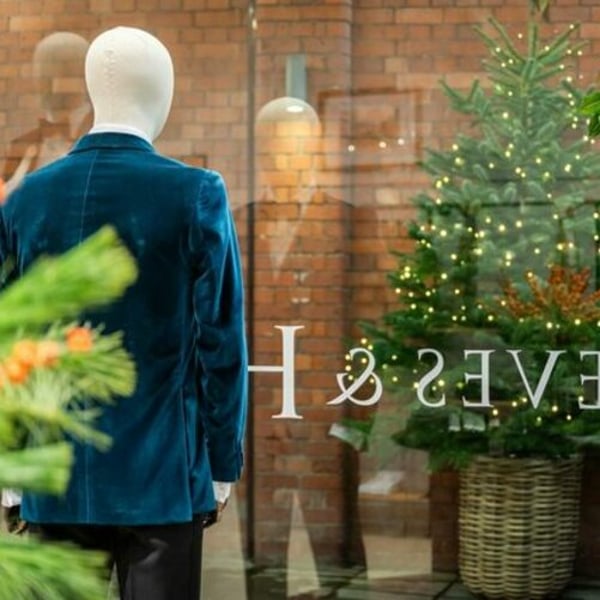
Gieves & Hawkes, Bath
Bath is a key destination for both UK and and international tourists, as well as having an affluent local catchment, so it looks like a strong move for the heritage menswear brand.
The 2 Broad Street store is set across three floors in a prime location at the heart of the city with the company saying the opening is “a significant moment in the brand’s continued celebration of craftsmanship and heritage”.
The space covers 2,085 sq ft and showcases the full breadth of the Gieves & Hawkes offering, from ready-to-wear tailoring and “refined” casualwear to the made-to-measure service for which the label is known.
Managing director Jason Gerrard said of the opening: “Bath is a city where Gieves & Hawkes has enjoyed a longstanding presence and loyal following. The opening of our new store is within the exceptional Shire’s Yard development, and we are privileged to be part of its vibrant community. Our new store represents our long-term commitment to Bath and the Southwest.”
Gieves & Hawkes, Bath
The Bath return is part of an ongoing national expansion strategy. Earlier this year, in a 254-year retail first, the brand opened a store-in-store within Frasers Group’s Flannels flagship in Leeds.
At the time Frasers said the debut “marks a significant milestone in the brand’s history and is a precursor to a wider regional expansion strategy to tap into a desire for craftsmanship, integrity, and authenticity outside of the capital”.