“We want everything to move really, really fast and we want to get a new molecule that’s going to change the world in another six months,” says Diogo Rau, Eli Lilly’s chief information and digital officer. But despite that urgency, Rau acknowledges that science still takes time. New drug discovery can take well over a decade and well north of $2 billion, on average, before they can obtain regulatory approval.
Rau and Eli Lilly are betting that AI can speed things up. In late October, the company announced plans to create a new Nvidia-chip powered “supercomputer” and “AI factory” that will go online by early 2026, allowing scientists to utilize models trained on millions of experiments to test new therapies. Some of the proprietary AI models will be made available on Lilly TuneLab, a platform that Lilly launched in September that gives smaller biotech firms access to AI models that have been trained on the larger firm’s research.
Separately, J&J on the same day, announced its own partnership with Nvidia, relying on the AI company’s foundation models to create simulated environments for surgical teams to plan their kidney stone procedures. J&J says this application of so-called “physical AI” will optimize the process to map out procedures, make it easier to train doctors, and will result in more consistent and better clinical outcomes for patients.
“There’s only so many hours in the day,” says Neda Cvijetic, senior vice president and global head of robotics and digital research and development for J&J’s MedTech division. “Sometimes it’s super helpful to see that difficult case in a very realistic, simulated environment first, to help best prepare.”
The pharmaceutical and medical products industries can potentially unlock tens of billions in value from investments in generative AI alone if the sector is successfully able to deploy the technology to improve drug discovery, speed up clinical trials and the regulatory process, and more adeptly market and administer new treatments to the right patients.
But there still remains a bit of a gap between the highly specific AI use cases that are most powerful for the life sciences industry and the technologies that AI hyperscalers offer today. Recently, solutions have become more tailored for the sector, partly reflected by partnerships emerging between Eli Lilly and J&J with Nvidia, and also Novo Nordisk’s relationship with Anthropic and Amazon Web Services, as well as AI hyperscaler’s own efforts. Last month, Anthropic launched Claude for Life Sciences, which was designed to speed up R&D.
Delphine Zurikiya, a senior partner in both the life sciences and technology practices at McKinsey, said that until recently, AI hyperscalers were spending most of their time working with chief information officers. But as AI budgets have expanded and use cases proliferated, there’s been more interest in business-specific applications for those technologies all across the pharmaceuticals industry.
“The business leaders have less patience with generic platforms,” says Zurikiya. “They’ll want something that’s customized to what they need.”
“We don’t even just want the life sciences knowledge model,” says Rau. “We want one that knows Lilly.”
Lilly’s Chief AI Officer Thomas Fuchs adds that the greatest AI advancements will come from the combination of the company’s trove of proprietary data, the compute investments Lilly is making to train large foundation models, and then deploying that tech to thousands of chemists and biologists, who can use those AI tools to make new discoveries.
Fuchs says that precise science can’t be echoed for every large pharmaceutical company. That would be like an astronomer relying on a telescope sold by a big-box retailer. “We are building a space-based telescope,” says Fuchs.
Kimberly Powell, a VP of healthcare at Nvidia who worked on the J&J surgical AI project, touts the potential for physical AI to tap the advancements of computer vision technology and large language models to turn AI into physical workers.
While that may raise questions about the impact of AI on the job of a surgeon, Powell points to data from the World Health Organization that projects a shortfall of 11 million health workers globally by 2030. She also predicts that a new operating room—a hybrid mix of human surgeons working alongside physical robots and digital agents—could result in breakthroughs in new procedure techniques.
“There is a future goal of how we go from robotic-assisted surgery to robotic surgery, where the robot is actually taking some action on its own,” says Powell. “We’re laying all the groundwork to do that.”
John Kell
Send thoughts or suggestions to CIO Intelligence here.
NEWS PACKETS
Cloudflare outage ensnares OpenAI, X. Service was disrupted across the web on Tuesday as Cloudflare, a web infrastructure provider, says it was impacted by a crash in the software system that handles traffic for a number of the company’s services. Cloudflare added that there was “no evidence” that the disruption was due to an attack or caused by any malicious activity. “We now have AWS, Azure and Cloudflare outages in the span of a month,” said David Choffnes, a professor of computer science at Northeastern University, toldThe New York Times. “That’s a very large portion of the biggest cloud providers in the world.”
TurboTax maker Intuit and OpenAI strike deal. Intuit has struck a multiyear deal with OpenAI that will expose the business and financial software provider’s products, which includes QuickBooks and Credit Karma, to a broader range of potential users on OpenAI’s ChatGPT, according to The Wall Street Journal. Intuit will also gain substantial access to OpenAI’s APIs, which the companies say will allow the tech giant to explore more use cases across its business. The companies also announced that they expect the deal will generate more than $100 million in revenue for OpenAI over an unspecified number of years.
Big Tech’s profits linked to AI hyperscaler losses.WSJ also reported last week that strong quarterly profits from the likes of Alphabet, Amazon, and Microsoft highlighted AI-related profits coming from being a supplier to, or an investor in, private companies like OpenAI and Anthropic. But the AI hyperscalers are continuing to lose billions as they invest in chips and cloud computing to support their large language models. That means that investors will have to continue to shoulder billions in costs in the hopes that these AI companies can sell more revenue-generating products to cover the money they spend on computing and research. Are we in an AI bubble? No one can say for sure. But U.S. stocks are under pressure in recent days amid concerns about frothy valuations.
No real sign of investor fatigue as Databricks is in talks to raise billions more. Data analytics startup Databricks is reportedly in talks to raise funds at a valuation north of $130 billion, which Bloomberg reports would be a 30% increase in what the company was worth just back in September. Databricks would use the fresh funding for hiring and acquisitions, though it hasn’t signed a term sheet, according to the outlet, which cited initial reporting from the Information. Bloomberg also reports that there are some whispers of caution when it comes to AI investing, citing two examples in Peter Thiel’s hedge fund and SoftBank Group both recently disclosing exits from AI chip maker Nvidia.
Anthropic thwarts AI cyberattack. The AI startup behind the large language models named Claude disclosed that it was able to disrupt what it called the first large-scale cyberattack that was orchestrated predominantly by AI, a campaign that it first detected in mid-September in which hackers used AI agents “to an unprecedented degree—using AI not just as an advisor, but to execute the cyberattacks themselves.” Anthropic said that it also had “high confidence” that the threat actor was a Chinese state-sponsored group. Separately last week, on a more positive note, Anthropic also announced it would invest $50 billion in new data center infrastructure.
ADOPTION CURVE
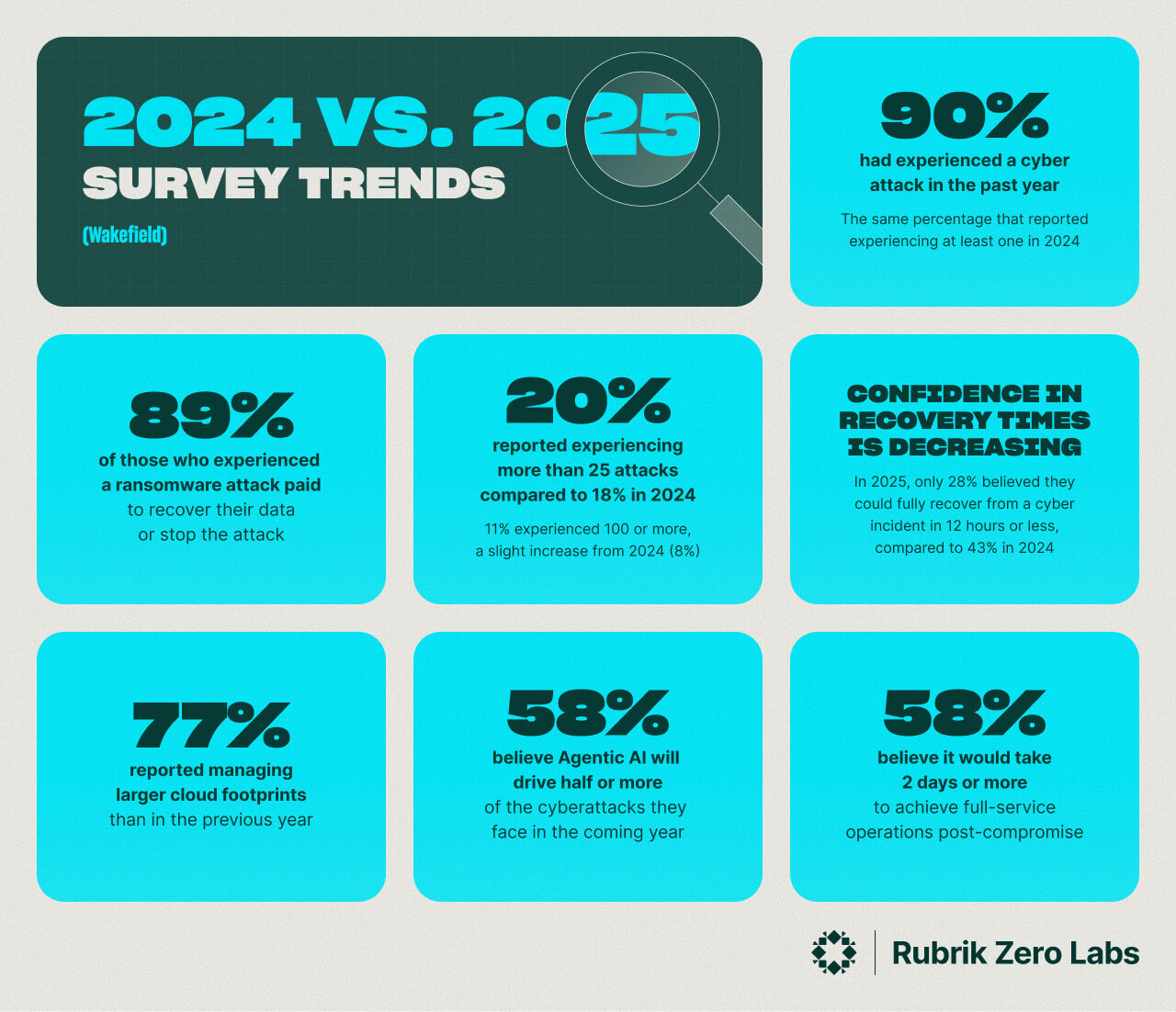
Identity-driven cyber attacks vex IT and the majority see new risk from agentic AI. The overwhelming majority of companies have experienced a cyber attack in the past year and agree that identity-driven breaches—which includes phishing and social engineering campaigns—are the top threat to their organizations, according to a recent survey of 1,625 IT and security leaders by Rubrik Zero Labs and Wakefield Research.
Rubrik says IT leaders have been evolving their approach in how they aim to protect identities within their firms, initially prioritizing privileged accounts, which have greater access to sensitive data and systems. But today, when asked which identities they are most concerned about, they are nearly evenly split on all five identity groups: executive, third-party, general end-users, privileged, and machine.
They’re also less confident in their resiliency: with only 28% believing they could fully recover from a cyber incident in 12 hours or less, compared to 43% in 2024. And looking ahead, 58% of those surveyed believe that agentic AI will drive half or more of the cyberattacks that they face in the coming year.
Courtesy of Rubrik Zero Labs
JOBS RADAR
Hiring:
– MIT Lincoln Laboratory is seeking a CIO, based in Lexington, Massachusetts. Posted salary range: $360K-$410K/year.
– MELE Associates is seeking a CIO, based in Rockville, Maryland. Posted salary range: $150K-$180K/year.
– GE Aerospace is seeking an executive CTO for the company’s defense and systems division. The role is remote. Posted salary range: $250K-$325K/year.
– Sentry is seeking a head of IT, based in San Francisco. Posted salary range: $200K-$250K/year.
Hired:
– Warner Music Group has promoted Leho Nigul to the role of CTO after previously serving as SVP of engineering. The music entertainment company also announced that Ariel Bardin, president of technology, will leave the company after a three-year tenure in that role. He will remain at Warner Music until the end of 2025 to help with the leadership transition. Before joining WMG in 2023, Nigul held leadership roles at grocery delivery company Instacart and tech giant IBM.
– Douglas Elliman Realty announced the appointment of Chris Reyes as CTO, joining the residential brokerage from real estate firm Brown Harris Stevens, where he also served as CTO. In his new role, he will oversee the company’s tech team, infrastructure, product launches, and software development. Reyes also previously served as CTO at mortgage lender GuardHill Financial.
– SmartRent has appointed Sangeeth Ponathil as CIO, joining the real estate software company to architect IT systems and expand the use of AI and automation. Ponathil will lead the engineering, product development, applications, security, data, and support teams. He most recently served as SVP of technology and head of product engineering at mortgage products company loanDepot.
– Avoya Travel named Karl Treier as CTO, a newly established C-suite role, where he will lead the IT and product development teams. Treier joins the travel booking service provider after spending eight years on the private equity consulting team for accounting firm RSM. He has also served as CTO for multiple organizations, including software developer Bluespring.
– McAfee & Taft appointed Mark Wyckoff as CIO, where he will steer the IT team, as well as the cybersecurity and compliance initiatives. Prior to joining the Oklahoma law firm, Wyckoff served as SVP of technology, CIO, and HIPAA security officer for the eye care company Dean McGee Eye Institute.
– Infravision appointed Frank Tybor as CTO, joining the developer of aerial robotics intended to build power grids just a couple weeks after the startup disclosed it raised $91 million in a Series B funding round. Tybor previously served as CTO at space infrastructure company ThinkOrbital and spent six years in engineering roles at rockets and spacecraft maker SpaceX.
– End of an Era announced Ken Schirrmacher has been named as CTO, joining the estate planning company to oversee all aspects of product architecture, AI innovation, and data security. He previously served as CTO of airport parking operator Park ‘N Fly and at cybersecurity company ObligeAI.
– Altus named Tarn Shant as CTO, joining the debt collection agency after most recently serving as SVP of technology at outsourcing company iQor. As CTO, Shant will lead Altus’ technology and data science team, overseeing the integration of AI, predictive analytics, and platform modernization.









 Politics8 years ago