Connect with us

Business

Whole Foods cofounder John Mackey’s hardest ever decision was firing his dad from his company board

Published

on


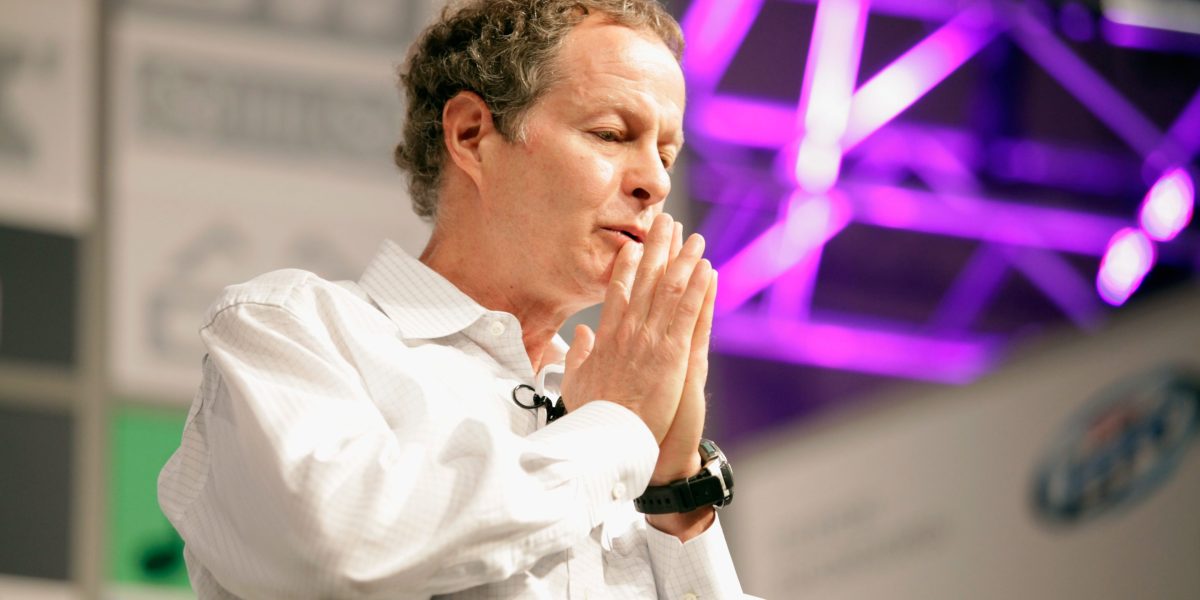
Whole Foods cofounder John Mackey knew the exact moment he came of age in the business world.

In a recent podcast interview with David Senra, Mackey recalled one of his most challenging moments: firing his father from the Whole Foods board in 1994 after nearly 15 years of advising Mackey on the direction of the company.

“That was the most difficult thing I ever did was firing my dad from that board,” Mackey said. “It took all the courage I had. I love my dad so much, and it hurt him so badly. It was so hard to do, but it was also a pivotal event in my own evolution.”

Mackey, who served as co-CEO of Whole Foods from its 1980 founding until his 2022 retirement, described his younger self as a “shirtless hitchhiking hippie” who dropped out of college. A man of contradictions, Mackey has called for marriage equality and claimed that taking psychedelics helps him find business inspiration, and in the same breath, has touted capitalism as humankind’s greatest invention while ripped labor unions, once comparing them to herpes (“It won’t kill you,” Mackey told the New Yorker in 2010, “but it’s very unpleasant, and will make a lot of people not want to be your lover.”)

In 2022, the business leader claimed “socialists are taking over,” and that young people weren’t willing to work anymore because they want to find meaningful work, something that eludes most people in the early stages of their careers.

His relationship with his father, as it relates to business, is no less complicated. As a younger man, the free-market vegan was looking to take risks to grow his wealth, even if it meant breaking from the guidance of his father, an original investor in Whole Foods. Mackey described his father as always being a man who preferred to conserve his cash, even if it meant sacrificing the growth of his wealth. As he aged, Mackey’s father became more rigid in his beliefs, which Mackey attributed in part to an Alzheimer’s diagnosis, made a couple years after his father’s departure from the board.

These diverging philosophies were most salient during the grocery chain’s 1992 IPO, when Mackey’s father encouraged the cofounder to sell company stock. Mackey, trusting his father, obliged, but later regretted it. He said the growing differences in doctrines around money fractured their relationship, leading Mackey to seek out independence from his father.

“That was when my mentorship was over,” he said. “He still advised me but from that point onward, really I was on my own. I was not going to follow him any longer. Before then, I pretty much did whatever my dad suggested.”

Mackey was largely responsible for transforming a single boutique health food store into a grocery giant. Founded in Austin in 1980, Whole Foods soon expanded across Texas and grew nationally, with 12 locations coast-to-coast at the time of its IPO, when the company was valued at $100 million. In 2017, Mackey sold the grocery giant to Amazon for a cool $13.7 billion. Whole Foods now has more than 500 locations across the U.S. and UK.

Mackey’s evolving business philosophy

At the core of Mackey’s businessperson identity is his doctrine of “conscious capitalism,” the flavor of free enterprise he said should operate with strong ethical foundations with the goal to create more than just profit in service of all business stakeholders, from customers to employees. Mackey first identified this value in 1981, when only a year after opening the first Whole Foods, the store flooded, severely damaging nearly everything inside. He recounted getting help from friends, customers, and suppliers, and was able to operate the business again 28 days after the flood.

Mackey said he internalized some value in making conservative financial decisions from his father, whom he said was a child of the Great Depression. Mackey’s father reached adulthood in the midst of World War II and operated under fear of another financial disaster for most of his life.

“He was always thinking there was going to be another Great Depression,” Mackey said. “So he was always trying to protect himself from that because it was such a traumatic experience for him.”

Mackey himself has admitted that making money isn’t everything. In 2007, the CEO said he felt financially secure and slashed his own salary to $1. (According to Forbes, he has a net worth of more than $75 million.)

However, the cofounder’s “expansive” philosophy of business increasingly diverged from his father, particularly in the way he kept shares of the business. When Mackey asked his father to step away from the board, he encouraged him to sell half his company shares and watch what happens to the other half. Whole Foods doubled in stock price over the next year.

While Mackey and his father were able to reconcile their differences, he recalled 1994 as the moment in which he prioritized his own business tactics over his mentor’s.

“I’m not going to do what you tell me to do any longer, particularly when it comes to growth,”  Mackey recalled telling his father. “We’re going to grow this business.”


Source link

Continue Reading

Business

Americans have been quietly plundering Greenland for over 100 years, since a Navy officer chipped fragments off the Cape York iron meteorite

Published

on


The Army also imagined hundreds of miles of rail lines buried inside Greenland’s ice sheet. On Project Iceworm’s tracks, atomic-powered trains would move nuclear-tipped missiles in snow tunnels between hidden launch stations – a shell game covering an area about the size of Alabama.

In the end, Project Iceworm never got beyond a 1,300-foot (400-meter) tunnel the Army excavated at Camp Century. The soft snow and ice, constantly moving, buckled that track as the tunnel walls closed in. In the early 1960s, first the White House, and then NATO, rejected Project Iceworm.

A U.S. Army truck with railroad wheels sits on a 1,300-foot-long track beneath the snow at Camp Century, Greenland. This is the closest the military got to realizing Project Iceworm. Robert W. Gerdel Papers, Ohio State University

In 1966, the Army abandoned Camp Century, leaving hundreds of tons of waste inside the ice sheet. Today, the crushed and abandoned camp lies more than 100 feet (30 meters) below the ice sheet surface. But as the climate warms and the ice melts, that waste will resurface: millions of gallons of frozen sewage, asbestos-wrapped pipes, toxic lead paint and carcinogenic PCBs.

Who will clean up the mess and at what cost is an open question.

Greenland remains a tough place to turn a profit

In the past, the American focus in Greenland was on short-term gains with little regard for the future. Abandoned bases, scattered around the island today and in need of cleanup, are one example. Peary’s disregard of the lives of local Greenlanders is another.

History shows that many of the fanciful ideas for Greenland failed because they showed little consideration of the island’s isolation, harsh climate and dynamic ice sheet.

Large rusted construction trucks and some fuel drums.

World War II-vintage trucks abandoned at a U.S. airfield in east Greenland were still there decades later. Posnov/Moment via Getty Images

Trump’s demands for American control of the island as a source of wealth and U.S. security are similarly shortsighted. In today’s rapidly warming climate, disregarding the dramatic effects of climate change in Greenland can doom projects to failure as Arctic temperatures climb.

Recent floods, fed by Greenland’s melting ice sheet, have swept away bridges that had stood for half a century. The permafrost that underlies the island is rapidly thawing and destabilizing infrastructure, including the critical radar installation and runway at Thule, renamed Pituffik Space Base in 2022. The island’s mountain sides are crashing into the sea as the ice holding them together melts.

The U.S. and Denmark have conducted geological surveys in Greenland and pinpointed deposits of critical minerals along the rocky, exposed coasts. However, most of the mining so far has been limited to cryolite and some small-scale extraction of lead, iron, copper and zinc. Today, only one small mine extracting the mineral anorthosite, which is useful for its aluminum and silica, is running.

It’s the ice that matters

The greatest value of Greenland for humanity is not its strategic location or potential mineral resources, but its ice. https://www.youtube.com/embed/9lnP0Rjb2E0?wmode=transparent&start=0 A NASA animation of satellite data shows Greenland’s ice sheet mass losses between 2002 and 2023, measured in meters of water equivalent in the ice.

If human activities continue to heat the planet, melting Greenland’s ice sheet, sea level will rise until the ice is gone. Losing even part of the ice sheet, which holds enough water to raise global sea level 24 feet in all, would have disastrous effects for coastal cities and island nations around the world.

That’s big-time global insecurity. The most forward-looking strategy is to protect Greenland’s ice sheet rather than plundering a remote Arctic island while ramping up fossil fuel production and accelerating climate change around the world.

Paul Bierman, Professor of Natural Resources and Environmental Science, University of Vermont

This article is republished from The Conversation under a Creative Commons license. Read the original article.

The Conversation


Source link

Continue Reading

Business

Bitcoin closes in on $100,000 in surprise surge

Published

on


New Year, new hope for Bitcoin. After several months of sputtering, Bitcoin is back on the rise. On Wednesday, the original cryptocurrency surpassed $97,000 for the first time in two months and is up more than 6% in the last week. 

The jump in Bitcoin came after Federal Reserve Chair Jerome Powell issued a remarkable statement that accused President Donald Trump’s administration of directing a baseless criminal investigation at him in order to intimidate the agency. Meanwhile, the price of gold and other precious metals shot up as investors fled towards safe haven assets. 

In addition to the uncertainty over the Fed’s independence, the latest inflation numbers appear to be driving the recent Bitcoin surge. 

“The global macro backdrop is supportive as CPI came in cool on Tuesday, amidst generalized concerns about Fed independence following Powell’s speech, which put pressure on the dollar, which is generally negatively correlated to Bitcoin,” said Russell Thompson, chief investment officer at Hilbert Group.

Smaller cryptocurrencies like Ethereum and Solana have also experienced a boost of late. The former is up more than 4% in the last week to about $3,338, and the latter increased more than 3% during that time to its current price of roughly $144. 

By all accounts, 2025 was a disappointing year for Bitcoin. Despite more favorable policies from the Trump administration, most notably the Genius Act signed in July, the original cryptocurrency’s price dropped more than 6% on the year. That’s in stark contrast to the S&P 500, which grew at a rate of about 17% during that time. 

In early October, Bitcoin reached its all-time high price of more than $126,000, but the final three months of 2025 erased those gains and then some. The original cryptocurrency plummeted to $84,000 in late November, a roughly 33% drop from its high. Much of this decline was sustained after what has been termed the “October flash crash”, the day traders lost $19 billion in assets. 

While the last quarter of 2025 was one to forget for Bitcoin, its price is off to an auspicious beginning in 2026. 

Join us at the Fortune Workplace Innovation Summit May 19–20, 2026, in Atlanta. The next era of workplace innovation is here—and the old playbook is being rewritten. At this exclusive, high-energy event, the world’s most innovative leaders will convene to explore how AI, humanity, and strategy converge to redefine, again, the future of work. Register now.


Source link

Continue Reading

Business

Landmark crypto bill on knife’s edge as Coinbase CEO pulls support ahead of key Senate vote
Published

on


As the Senate Banking Committee prepares to debate long-anticipated legislation that would establish regulation for the crypto industry, the fate of the bill is in limbo after Coinbase CEO Brian Armstrong declared his opposition in a Wednesday night post on X

“We’d rather have no bill than a bad bill,” Armstrong wrote, outlining several blockchain sector critiques, including a key battle with the banking industry over offering rewards for stablecoin holdings. “Hopefully we can all get to a better draft.” 

The legislation, which focuses on market structure issues such as supervisory divisions between different federal agencies, has long been a priority for the crypto industry. The bill would address thorny questions that led to bruising lawsuits under previous administrations, including how to classify and regulate different types of cryptocurrencies. 

After helping elect a wave of pro-blockchain candidates fueled by millions in campaign donations, the crypto industry notched a major win over the summer with the passage of the Genius Act, which established a regulatory framework for stablecoins, or a type of dollar-backed cryptocurrency. But market structure has proven trickier, especially after the banking lobby pushed back against provisions in the Genius Act that allows companies to offer customers yield on their stablecoin holdings, similar to savings accounts. 

After the House of Representatives advanced their version of the market structure legislation, called the Clarity Act, in July, the Senate delayed in taking up the bill. But with the Senate Banking Committee finally set to debate amendments on Thursday morning in the markup process, arguments over the issue of yield, as well as conflict of interest ethics provisions targeted at the Trump administration, could stymie the bill’s progress. 

“There’s a real chance this could blow up in committee,” one crypto lobbyist told Fortune, speaking on the condition of anonymity to discuss sensitive industry dynamics. “People are pretty fired up here.” 

Lack of clarity

For many in the crypto industry, the success of the stablecoin-focused Genius Act over the summer was just an appetizer to the main course: wide-ranging market structure legislation that would finally grant legitimacy to the renegade sector. But after years of fierce debate, the product coming out of the Senate might be worse than no bill at all. 

The most significant wedge issue going into Thursday remains the battle over stablecoin yields. The bank lobby has argued that the Genius Act effectively created a loophole, preventing stablecoin issuers themselves from offering yield to users, but allowing partners and third parties to provide rewards. Those programs have been key to many crypto companies, such as Coinbase, which reported $355 million in stablecoin-related revenue in the third quarter of 2025 and offers yields to holders of its stablecoin, USDC. Bank lobbyists have argued that this could threaten the U.S. financial system by suctioning money out of bank deposits. 

A bipartisan group of senators has offered a compromise in the Clarity Act, which would allow crypto companies to offer yield for stablecoin-related transactions, similar to credit cards, as well as other activity. But it remained unclear whether Coinbase, one of the most outspoken and deepest-pocketed crypto figures in Washington, would support the agreement, with Armstrong’s Wednesday post seeming to indicate it would take a hard-line approach. 

“It’s still very much in negotiations right now,” said Ron Hammond, who serves as head of policy at the crypto trading firm Wintermute. “But it’s crypto and there’s always last-second drama, and so it seems to be one of the wedges here.” 

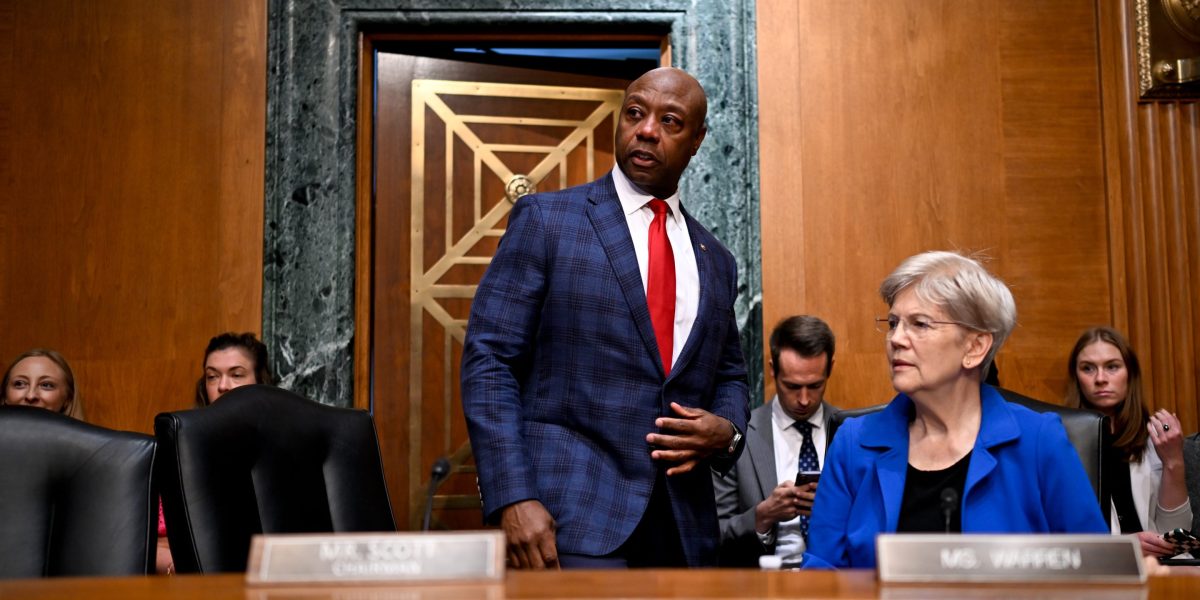
Another debate pushed by Democrats is language that would prevent politicians, including the President, from profiting off of crypto holdings or interest. The issue has become a lightning rod due to the Trump family’s deep entanglement with the crypto industry, including its digital asset platform World Liberty Financial, which recently applied for a federal bank license. But Republicans have strongly pushed back against the possibility, with Senate Banking Committee Chair Tim Scott (R-S.C.) telling CoinDesk on Wednesday that ethics provisions don’t belong in the Clarity Act. 

But a letter sent to Scott and Ranking Member Elizabeth Warren (D-Mass.) from a number of nonprofit watchdog groups, obtained by Fortune, describes the lack of provisions in the proposed bill addressing governmental conflicts of interest as “deeply concerning.” 

If Democrats such as Ruben Gallego (D-Ariz.), who has referred to an ethics provision as a “red line,” pull their support, the bill could be stuck in committee, which needs a simple majority vote, though Republicans hold the edge

The lobbyist who spoke on the condition of anonymity lamented that the bill has lurched to the left in an effort to gain bipartisan support, including through additional provisions that would regulate DeFi, or decentralized finance, as well as the listing process for crypto tokens and oversight responsibilities handed to the Securities and Exchange Commission. “They’ve lost their north star,” the lobbyist told Fortune


Source link

Continue Reading

Trending

Copyright © Miami Select.