Connect with us

Business

When SNAP payments stopped, a fast-moving $50 cash program rushed in—and kept families fed

Published

on


Finances already looked tight for Jade Grant and her three children as she entered the year’s final months.

“Everyone’s birthday is back-to-back,” the 32-year-old certified nursing assistant said. “You have holidays coming up. You have Thanksgiving. Everything is right there. And then, boom. No (food) stamps.”

Grant is among the nearly 42 million lower-income Americans who get help buying groceries from the Supplemental Nutrition Assistance Program, or SNAP. When the federal shutdown began in October, she wasn’t worried about losing her benefits — she said she is used to government “foolishness.”

But circumstances got dicey when the budget impasse entered its second month and President Donald Trump took the unprecedented step of freezing November SNAP payments. With one child who eats gluten free and another with many allergies, specialty items already drove up her grocery bill. Now Grant wondered how she’d put food on the table — especially with her youngest’s 6th birthday approaching.

Then Grant logged into Propel, an app used by 5 million people to manage their electronic benefits transfers, where she saw a pop-up banner inviting her to apply for a relief program. Within a minute she’d completed a survey and about two days later she got a virtual $50 gift card.

The total didn’t come close to her monthly SNAP allotment. But the Palm Bay, Florida, resident said it was enough to buy a customized “ Bluey ” birthday cake for her son.

Nearly a quarter of a million families got that same cash injection from the nonprofit GiveDirectly as they missed SNAP deposits many need to feed their households. The collaboration with Propel proved to be the largest disaster response in the international cash assistance group’s history outside of COVID-19; non-pandemic records were set with the $12 million raised, more than 246,000 beneficiaries enrolled and 5,000 individual donors reached.

Recipients are still recovering from the uncertainty of last month’s SNAP delays. Company surveys suggest many are dealing with the long-term consequences of borrowing money in early November when their benefits didn’t arrive on time, according to Propel CEO Jimmy Chen. At a time when users felt the existing safety net had fallen through, they credit the rapid payments for buoying them — both financially and emotionally.

“It’s not a lot. But at the same time, it is a lot,” Grant said. “Because $50 can do a lot when you don’t have anything.”

A ‘man-made disaster’ forces partners to try something new

It’s not the first partnership for the antipoverty nonprofit and for-profit software company. They have previously combined GiveDirectly’s fast cash model with Propel’s verified user base to get money out to natural disaster survivors — including $1,000 last year to some households impacted by Hurricanes Milton and Helene.

“This particular incident with the shutdown we saw as akin to a natural disaster,” Chen said, “in the sense that it created a really sudden and really acute form of hardship for many Americans across the country.”

The scope differed this time. The “man-made disaster,” as GiveDirectly U.S. Country Director Dustin Palmer put it, was not geographically isolated. The benefits freeze impacted more people than they usually serve. SNAP costs almost $10 billion a month, Palmer said, so they never expected to raise enough money to replace the delayed benefits altogether.

But 5,000 individual donors — plus $1 million gifts from Propel and New York nonprofit Robin Hood, as well as other major foundations’ support — provided a sizable pot. Palmer found that the issue resonated more than he expected.

GiveDirectly reports that the median donation was $100. Palmer took that response as a sign the issue hit close for many Americans.

“You and I know SNAP recipients. Maybe we’ve been SNAP recipients,” Palmer said. “So that was not a disaster in Central Texas where I’ve never been, but something in our communities.”

The greatest question revolved around the total sum of each cash transfer. Should they reach more people with fewer dollars or vice versa? Los Angeles wildfire survivors, for example, got $3,500 each from a similar GiveDirectly campaign. But that’s because they wanted to provide enough to cover a month’s worth of lodging and transit to those who lost their houses.

They settled on $50 because Palmer said they wanted a “stopgap” that represented “a meaningful trip to the grocery store.” To equitably focus their limited resources on the that would be missing the most support, Palmer said they targeted families with children that receive the maximum SNAP allotment. Propel’s software allowed them to send money as soon as the app detected that a family’s benefits hadn’t arrived at the usual time of the month.

Recipients decided whether their prepaid debit cards arrived physically, which might allow them to take cash out of an ATM, or virtually, which could be used almost immediately. The split is usually pretty even, according to Palmer, but this time more than 90% of recipients went with the virtual option.

“To me, that speaks to the speed and need for people,” Palmer said. “Just saying, ‘Oh yeah, I just need food today. I don’t want to wait to get it mailed.’”

Recipients lost trust when closely watched benefits were disrupted

Dianna Tompkins relies on her SNAP balance to feed her toddler and 8-year-old child.

“I watch it like a hawk, honestly,” she said.

But she said she entered “panic mode” when she missed what is usually a $976 deposit last month. She’s a gig worker, completing DoorDash and Uber Eats orders when she finds the time.

Her pantry is always stocked with non-perishables — canned goods, pastas, sauces — in case her unreliable van stops working and she can’t get to the store. But she couldn’t risk running out as uncertainty continued over the shutdown’s length and future SNAP payments.

GiveDirectly’s $50 bought her milk and bread — not much but a “big help,” she said. Her local food pantries in Demotte, Indiana, had proven inconsistent. One week they gave far more than expected, she said, but the following week they were “so overwhelmed” that it almost wasn’t worth visiting.

She said it’s “scary” the government “can just decide to not feed so many people.”

“At least I have my safety net but not everybody’s lucky,” she said. “I’ve never trusted the government and that’s just a new solid reason why I don’t trust them.”

Chen, the Propel CEO, said his company’s research suggests that November’s freeze damaged many recipients’ confidence in the government. Even with SNAP funded through the next fiscal year, Chen said, many respondents are concerned about another shutdown.

“Now it’s introduced this seed of doubt for people that this really fundamental thing that they use to pay for food may not be there when they need it,” Chen said.

The gap persists for many. Propel estimates that just over half of SNAP recipients got their benefits late last month. GiveDirectly launched an additional “mop-up” campaign to distribute cash retroactively for more than 8,000 people still reeling.

The delay disrupted the financial balancing act that Grant had going. She put off payments for her electricity bill and car insurance.

“Government shuts down and that just throws everything completely off,” she said.

___

Associated Press coverage of philanthropy and nonprofits receives support through the AP’s collaboration with The Conversation US, with funding from Lilly Endowment Inc. The AP is solely responsible for this content. For all of AP’s philanthropy coverage, visit https://apnews.com/hub/philanthropy.


Source link

Continue Reading

Business

Down Arrow Button Icon

Published

on


After a half-century immersed in the world of trade, customs broker Amy Magnus thought she’d seen it all, navigating mountains of regulations and all sorts of logistical hurdles to import everything from lumber and bananas to circus animals and Egyptian mummies.

Then came 2025.

Tariffs were imposed in ways she’d never seen. New rules left her wondering what they really meant. Federal workers, always a reliable backstop, grew more elusive.

“2025 has changed the trade system,” says Magnus. “It wasn’t perfect before, but it was a functioning system. Now, it is a lot more chaotic and troubling.”

Once hidden cogs in the international trade machine, customs brokers are getting a rare spotlight as President Donald Trump reinvents America’s commercial ties with the world. If this breathless year of tariffs amounts to a trade war, customs brokers are its front lines.

Few Americans have been exposed as exhaustively to every fluctuation of trade policy as the customs broker. They were there in the opening days of Trump’s second term, when tariffs were announced on Canada and Mexico, and two days later, when those same levies were paused. They were there through every rule on imports of steel and seafood, on cars and copper, on polysilicon and pharmaceuticals, and on and on. For every tariff, for every carve-out, for every order, brokers have been left to translate policy into reality, line by line and code by code, in a year when it seemed every passing week brought change.

“We were used to decades of a certain way of processing, and from January to now, that universe has been turned kind of upside-down on us,” says Al Raffa, a customs broker in Elizabeth, New Jersey, who helps shepherd containerloads of cargo into the U.S. packed to the brim with everything from rounds of brie to boxes of chocolate.

Each arrival of products imported to the country requires filings with U.S. Customs and Border Protection and often, other agencies. Importers often turn to brokers to handle the regulatory legwork and, with a spate of new trade rules unleashed by the Trump administration, they’ve seen their demand grow alongside their workloads.

Many shipments that entered duty free now are tariffed. Other imports that had minimal levies that might cost a company a few hundred dollars have had their bills balloon to thousands. For Raffa and his crew, the ever-expanding list of tariffs means a given product could be subjected to taxes under multiple separate tariff lines.

“That one line item of cheese that previously was just one tariff, now it could be two, three, in some cases five tariff numbers,” says 53-year-old Raffa, who has had jobs in trade since he was a teenager and who has a button emblazoned with “Make Trade Boring Again.”

Government regulations have always been a reality for brokers, and the very reason for their existence. When thick tomes of trade rules changed in the past, though, they typically were issued long ahead of their effective dates, with periods for comment and review, each word of policy crafted in an attempt to project clarity and definition.

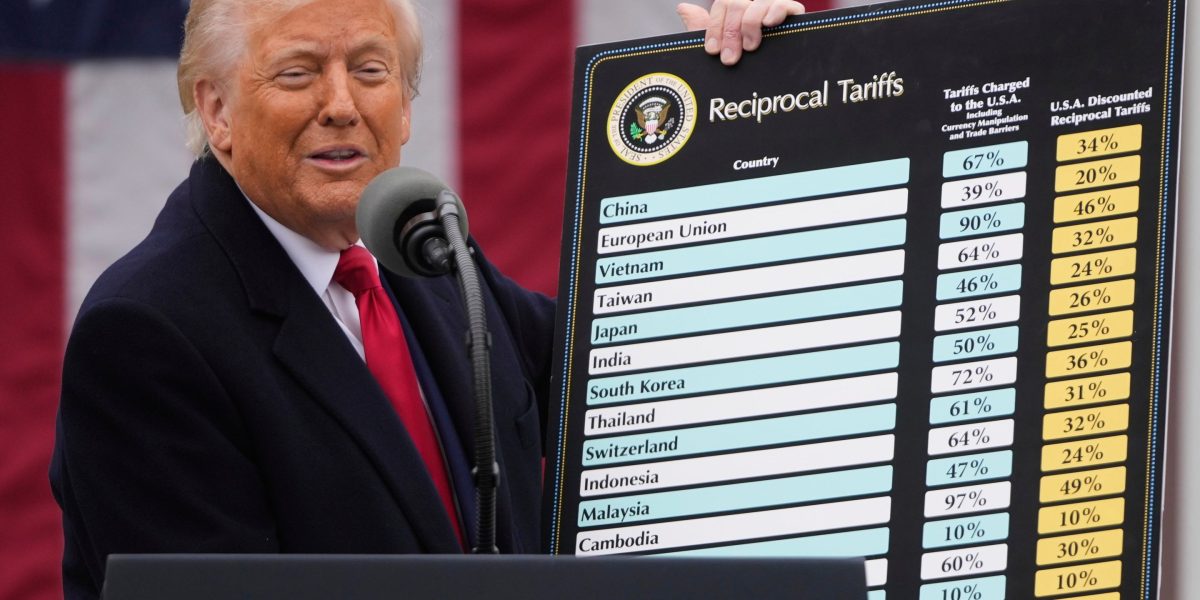
With Trump, word of a major change in trade rules might come in a Truth Social post or an oversized chart clutched by the president in a Rose Garden appearance.

“You’d be remiss not to be looking at the White House website on a daily basis, multiple times a day, just to see what executive order is going to be announced,” Raffa says.

Each announcement sends brokerage firms into a scramble to attempt to dissect the rules, update their systems to reflect them and alert their customers who may have shipments en route and for whom any shift in tariffs could mean a major hit to their bottom line.

JD Gonzalez, a third-generation customs broker in Laredo, Texas, and president of the National Customs Brokers and Forwarders Association of America, says the volume and speed of changes have been challenging enough. But the wording of White House orders has often left more unanswered questions than brokers are accustomed to.

“The order is kind of vague sometimes, the guidance that’s being provided is sometimes murky, and we’re trying to make the determination,” 62-year-old Gonzalez says.

Gonzalez rattles off 10-digit tariff codes for alcohol and doors and recites the complicated web of rules that determine the duties on a chair with a frame made of steel produced in the U.S. but processed in Mexico. As brokers’ work has grown tougher, he says some of their firms have begun charging customers more for their services because each item they’re responsible for tracking on a bill of lading takes longer.

“You double the time,” he says.

Brokers can’t help but see the imprints of their work everywhere they go. Gonzalez looks at a T-shirt tag and thinks of what a broker did to get it into the country. Magnus sees Belgian chocolate or Chinese silk and is awed, despite all the things that could have kept something from landing on a store shelf, that it still arrived. Raffa walks through the supermarket, picks up a can of artichoke hearts, and considers every possible regulation that might apply to secure its import into the country.

It has been heartening for brokers, who existed in the gray arcana of hidden bureaucracy unseen by most Americans, to now earn a bit more recognition.

“It was maybe taken for granted how that wonderful piece of gourmet cheese got on the shelf, or that Gucci bag,” says Raffa. “Up until this year, people were clueless what I did.”

Magnus, who is in her 70s and based on Marco Island, Florida, spent 18 years at U.S. Customs before starting at a brokerage in 1992. She came to find comfort in the precision of rules governing every import she cleared the way for, from crude oil to diamonds.

“We don’t like to have any doubt, we don’t like to leave anything up to interpretation,” she says. “When we ourselves are struggling, trying to interpret and understand the meaning of some of these things, it is a very unsettling place to be.”

It’s not just the White House orders that have complicated her work.

The Department of Government Efficiency cost-cutting blitz under billionaire Elon Musk led to layoffs and retirements of trusted government workers that brokers turn to for guidance. A shutdown slowed operations at ports. And fear of being out of step with the administration has some federal employees cautious about decoding trade orders, making answers on interpretation of tariff rules sometimes tough to come by.

Magnus was befuddled by moves that seemed at odds with everything she knew of trade policy. Canada as adversary? Switzerland subjected to 39% tariffs? It defied how she had come to see the choreography of cargo and what it says about the world.

“It’s like an incredible ballet to be able to trade with all these countries all over the world,” she says. “In my own mind, I always felt that as long as we were trading and we were friendly with each other, we were reducing the chance of war and killing each other.”

Work has been so hectic this year that Magnus hasn’t managed to take a vacation. Weekends have so frequently been upended by Friday afternoon edicts announcing a tariff is going into effect or being taken away that it has become an inside joke with colleagues.

“It’s Friday afternoon,” she says. “Is everybody watching?”

A couple hours after Magnus repeats this, the next White House order is posted, undoing a slew of tariffs on agricultural products and sending brokers into another scurry.


Source link

Continue Reading

Business

Most Americans decide 2025 isn’t the year for charity, poll says

Published

on


Most Americans aren’t making end-of-year charitable giving plans, according to the results of a new AP-NORC poll, despite the many fundraising appeals made by nonprofits that rely on donation surges in the calendar’s final month to reach budget targets.

The survey, which was conducted in early December by The Associated Press-NORC Center for Public Affairs Research, found that about half of U.S. adults say they’ve already made their charitable contributions for 2025. Just 18% say they’ve donated and will donate again before the year is over. Only 6% report they haven’t given yet but will do so by December’s end. The rest, 30%, haven’t donated and don’t plan to.

Everyday donors faced competing priorities this year. President Donald Trump’s social services grant cutssevere foreign aid rollbacks and November SNAP benefits freeze — plus natural disasters like Los Angeles’ historically destructive wildfires — left no shortage of urgent causes in need of heightened support. But weaker income gains and steep price inflation meant lower-income households had less money to redistribute. Other surveys have also found a yearslong decline in the number of individuals who give.

Trump’s tax and spending legislation offered an extra incentive to give more starting in January; most filers will see new charitable deductions next tax year of up to $1,000 for individuals and $2,000 for married couples. Some itemizers may make more gifts this year, though, ahead of a new floor for donation write-offs that takes effect in 2026.

December still serves as a “very important deadline” for donors, according to Dianne Chipps Bailey, managing director of Bank of America’s Philanthropic Solutions division. She cited estimates from the National Philanthropic Trust that nearly one-third of annual giving happens in the final month.

“December 31 does provide a target to make sure that they’ve given what they intended to give before the year is over,” Bailey said.

Few donate on GivingTuesday

Perhaps no day is more consequential for fundraisers than GivingTuesday. The well-known celebration of generosity sees many nonprofits leverage the attention to solicit donations on the Tuesday after Thanksgiving. Americans donated an estimated $4 billion to nonprofits this most recent GivingTuesday.

But Americans were much more likely to make a Black Friday purchase than a GivingTuesday gift this year. Just under half say they bought something for Black Friday, according to the poll, compared to about 1 in 10 who say they donated to a charity for GivingTuesday.

“Black Friday gets the lion’s share of things,” said Oakley Graham, a 32-year-old from Missouri. “And then you’ve got GivingTuesday a couple days later. Most people have probably spent all their spending money at that point.”

Graham said his family has “definitely tightened the financial belt” in recent years. He and his wife are dealing with student loan debts now that the Trump administration suspended their repayment plan. Their two young children are always growing out of their clothes. It’s good if there’s anything left for savings.

He still tries to help out his neighbors — from handiwork to Salvation Army clothing donations.

“Not that I’m not willing to give here and there,” he said. “But it seems like it’s pretty tough to find the extra funds.”

Checkout charity proves more popular

Another avenue for nudging Americans to give is more widely used, even if individual donations are small. The AP-NORC poll found that about 4 in 10 U.S. adults say they donated to a charity when checking out at a store this year.

Among them is Graham. As an outdoorsy person who enjoys hunting and fishing when he can, he said he is “always susceptible to giving for conservation” — likely rounding up once or twice at Bass Pro Shops for that reason.

“With the finances, I don’t do a lot of buying these days. But a couple cents here or there is like — I can do that,” he said. “It doesn’t sound like much. But I know if everybody did it would make a difference.”

The poll found that older adults — those over 60 — are more likely than Americans overall to donate at store checkouts.

One Texas architect’s unusual process for year-end donations

About one-quarter of Americans plan to donate in the last weeks of the year, and Chuck Dietrick is one of them. The 69-year-old architect applies what he calls a “shotgun approach” as the year comes to a close.

He and his wife give monthly to Valley Hope, a nonprofit addiction services provider where their son did inpatient rehab. And then there are eight or so organizations that they support with end-of-the-year gifts.

“We’re doing our own thing,” he said. “I don’t do Black Friday or Cyber Monday, either … So, I don’t do the GivingTuesday thing.”

Dietrick estimates their household donated somewhere between $501 and $2,500. The Dallas-Fort Worth area couple mostly contributes to organizations that touched their lives or the lives of their friends.

There’s the Florida hospice that Dietrick said did a “super job” caring for his mother. He has relatives and friends who served in the military, so he also gives to the Disabled American Veterans and the Wounded Warrior Project.

“I would rather give a smaller amount of money to a variety of institutions that I care about rather than giving a big chunk of money to one,” he explained.

Giving plans went unaffected by federal funding cuts or the shutdown

Most 2025 donors say the amount they gave wasn’t affected much by this year’s federal funding cuts or the government shutdown, according to the AP-NORC poll, although about 3 in 10 say those situations did impact the charities they chose to support.

The survey suggests that, while private donors mobilized millions to fill funding gaps and hunger relief groups saw donation totals spike last month, many Americans did not respond with their pocketbooks to the nonprofit sector’s newfound pressures this year.

The cuts did compel Jeannine Disviscour to give more.

“I did not donate on GivingTuesday,” the 63-year-old Baltimore teacher said. “But I did donate that week because I was feeling the need to support organizations that I felt might not continue to get the support they needed to get to be successful.”

She estimates her household gave between $501 and $2,500. That included support for National Public Radio. Congress eliminated $1.1 billion allocated to public broadcasting this summer, leaving hundreds of NPR stations with some sort of budget hole. She said she wanted to ensure journalism reached news deserts where residents have few media options.

Living in an area that is home to many refugees, Disviscour also donated her time and money to the Asylee Women Enterprise. She said the local nonprofit helps asylum-seekers and other forced migrants find food, shelter, clothing, transportation and language classes.

“There is a gap in funding and there’s more need than ever,” she said. “And I wanted to step up. And it’s in my community.”

___

Sanders reported from Washington.

___

Associated Press coverage of philanthropy and nonprofits receives support through the AP’s collaboration with The Conversation US, with funding from Lilly Endowment Inc. The AP is solely responsible for this content. For all of AP’s philanthropy coverage, visit https://apnews.com/hub/philanthropy.

___

The AP-NORC poll of 1,146 adults was conducted Dec. 4-8 using a sample drawn from NORC’s probability-based AmeriSpeak Panel, which is designed to be representative of the U.S. population. The margin of sampling error for adults overall is plus or minus 4 percentage points.


Source link

Continue Reading

Business

Tesla faces NHTSA probe over Model 3 emergency door handles

Published

on


Tesla Inc.’s door handles are facing renewed scrutiny in the US after federal auto safety regulators opened a probe into the emergency releases in certain Model 3 vehicles.

The National Highway Traffic Safety Administration said it’s evaluating claims that the mechanical door release “is hidden, unlabeled, and not intuitive to locate during an emergency,” according to a filing on the agency’s website. The move stems from a petition filed by Kevin Clouse, a Tesla owner in Georgia who says he was trapped in his vehicle in 2023 and requested a defect investigation. NHTSA said it hasn’t decided whether to grant or deny the petition.

Read More: Tesla Doors Can Trap People Desperate to Escape

The probe covers an estimated 179,071 Model 3 sedans from the 2022 model year.

Tesla and NHTSA didn’t immediately respond to requests for comment.

The move expands on the federal examination of Tesla door problems following a monthslong investigation into the issue by Bloomberg, which uncovered a series of incidents in which people were severely injured or died after becoming trapped in their Teslas. In September, NHTSA opened an investigation into whether the doors are defective in certain Model Y SUVs amid reports of children stuck in vehicles when the 12-volt battery dies. The Model 3 and Model Y are by far Tesla’s top-selling vehicles.

The automaker was a pioneer of electrically powered handles, which can stop functioning without warning, particularly after a crash. A Bloomberg analysis this week found at least 15 deaths in a dozen incidents over the past decade in which occupants or rescuers were unable to open the doors of a Tesla that had crashed and caught fire. 

Bloomberg separately reported that potential safety issues with electric handles were raised with Chief Executive Officer Elon Musk during the development of the Model 3, and that he insisted on the futuristic design, which would include manual releases to mitigate power-loss problems.

Read More: Elon Musk Demanded Tesla’s Electric Doors Despite Safety Worries

Clouse filed a petition last month over a 2023 incident in which he says he had to kick his way out of his burning Model 3 when the doors wouldn’t open. Bloomberg previously cited details of Clouse’s case.

“I was unaware of the location of the hidden mechanical emergency door release because it is not visibly labeled, not explained upon delivery, and not intuitive in an emergency,” he said in a complaint filed with NHTSA. “I was forced to climb to the back seat and break the rear passenger window with my legs to escape while the interior was burning.”

Tesla shares fell 0.7% as of 11:41 a.m. Wednesday in New York.

This story was originally featured on Fortune.com


Source link

Continue Reading

Trending

Copyright © Miami Select.