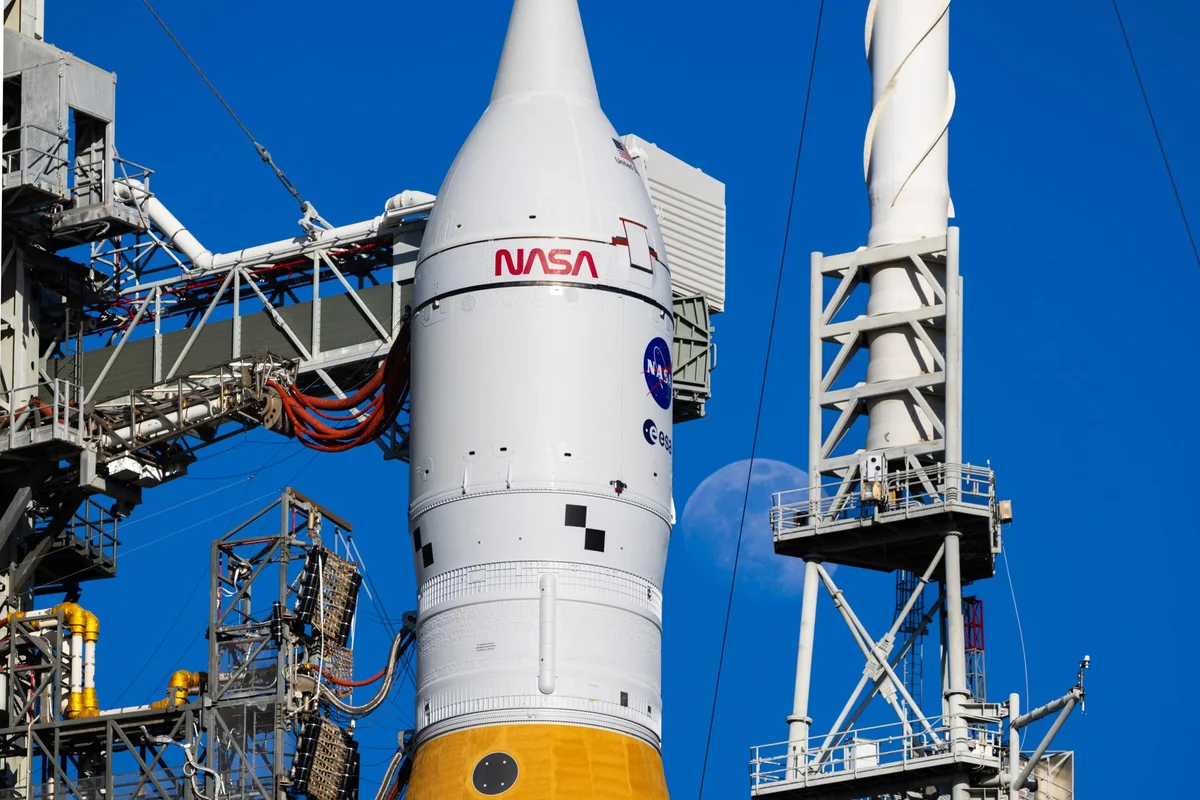
During next year’s revamped Artemis III, astronauts will stick closer to home the same way Apollo 9 did in 1969. Instead of attempting a moon landing as originally envisioned, they will practice docking their Orion capsule in orbit around Earth with one or both lunar landers under development by Elon Musk’s SpaceX and Jeff Bezos’ Blue Origin. The rival companies are accelerating work on their landers in a bid to be first.
The Soviets were America’s fierce rivals during Apollo, but their moon rockets kept exploding at liftoff and they eventually gave up. Now the Chinese are the competition.
China already has landed robotic spacecraft on the moon’s far side — the only nation to achieve that — and is scrambling to land astronauts near the lunar south pole by 2030.
NASA is aiming for the same polar region, where shadowed craters are thought to hold vast amounts of ice that could provide drinking water and rocket fuel. Like his predecessor Bill Nelson, Isaacman is determined to beat China to the finish line and win this second space race.
Apollo’s Saturn V rockets stood 363 feet (110 meters), with five first-stage engines. The Artemis SLS rocket comes in at 322 feet (98 meters) but packs more liftoff thrust with its four main engines and two strap-on boosters.
All but one Saturn V rocket soared from Kennedy Space Center’s Launch Complex 39-A, now leased by SpaceX. NASA will use neighboring pad 39-B for all SLS flights. While the Saturn V launched twice before carrying astronauts, the SLS has flown only once. Hydrogen fuel leaks delayed the SLS debut in 2022 and struck again during a countdown test in February, stalling Artemis II. Then helium trouble reappeared, causing further delay. NASA is now targeting an April liftoff.
Launch Control remains at the same place. There was one woman in the packed firing room for the liftoff of Apollo 11. Now a woman leads it: Artemis launch director Charlie Blackwell-Thompson.
Apollo 8 still ranks as the gutsiest space mission of all time. Frank Borman, Jim Lovell and Bill Anders became the first humans to launch to the moon in 1968. Borman, the commander, insisted on as few lunar orbits as possible given the risks. He and his bosses settled on 10 orbits as a warmup for 1969’s moonwalk by Armstrong and Aldrin.
NASA decided long ago against orbiting the moon on Artemis’ crew debut, judging it too dangerous. The main goal is to test the Orion capsule’s life-support equipment, flying for the first time.
One big similarity between Apollo 8 and Artemis II is the troubled times surrounding them. “If we can contribute a little bit to hope for humanity,” said Artemis II pilot Victor Glover of NASA, “that is a huge thing.”
The Artemis astronauts will orbit Earth for a day to make certain everything is working properly before igniting the main engine and heading for the moon. It will take three to four days for the capsule to reach the moon and continue some 5,000 miles (8,000 kilometers) beyond, exceeding the distance record set by 1970’s ill-fated Apollo 13.
Like Apollo 13, Artemis II will take advantage of the moon and Earth’s gravity, making a figure eight after whipping around the moon to head home in what’s known as a free-return trajectory requiring little if any fuel. It got Apollo 13’s three astronauts safely back although they had to abandon their moon landing.
Artemis astronauts will parachute into the Pacific after their mission like the Apollo crews did.
___
Republished with permission of The Associated Press.