Connect with us

Politics

What it means for workers, federal programs and the economy
Published

on


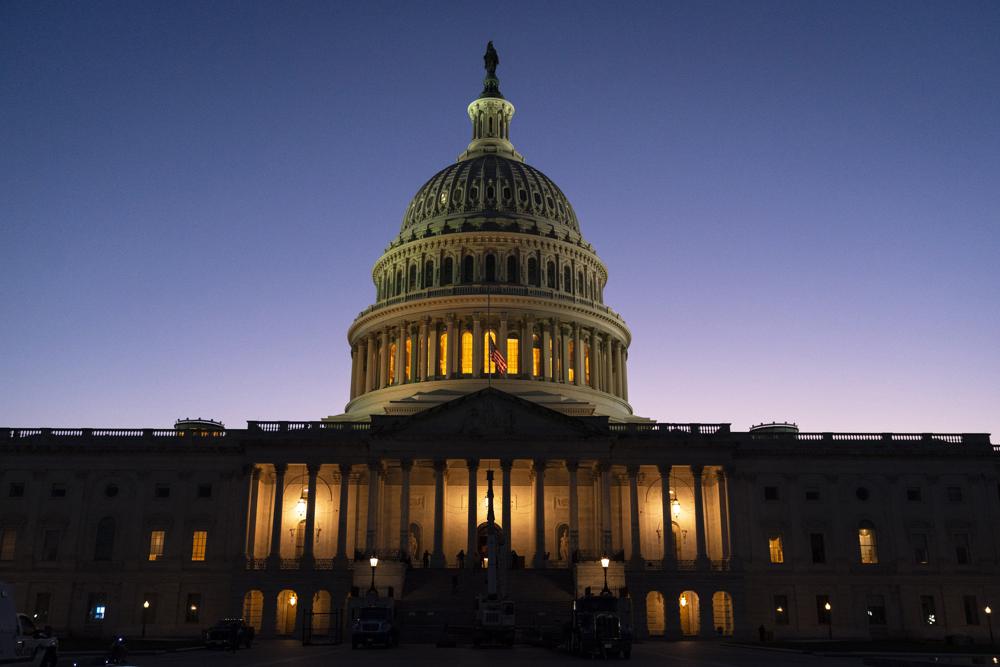
The federal government shutdown is quickly approaching the second longest on record with no end in sight. Some lawmakers are predicting it could become the longest, surpassing the 35 days from President Donald Trump’s first term.

The Trump administration is using the current shutdown to buttress priorities it favors while seeking to dismantle those it doesn’t. Nevertheless, Democrats are insisting that any funding bill include help for millions of Americans who will lose health insurance coverage or face dramatically higher monthly premiums if Congress does nothing.

The shutdown began Oct. 1. Here’s a look at its impact so far on workers, the economy and the services the government provides.

Furloughs and firings: The federal government employed nearly 2.3 million civilian employees as of March 31. The Congressional Budget Office estimated that about 750,000 of those employees would be furloughed each day during a shutdown. That means they don’t report to work until the shutdown ends. Others are considered “excepted” and do go to work, helping to protect life and property and perform other essential services.

Both groups of workers will get paid, but on a retroactive basis. That means they are facing the prospect of missing a full paycheck later this month after receiving a partial one earlier for work performed in late September.

The nation’s 1.3 million active-duty service members got a temporary reprieve. They were looking at missing a paycheck on Wednesday. But Trump directed the Pentagon to redirect money. A second reprieve looks unlikely.

Of note for taxpayers, the government tab for paying furloughed workers while they are at home comes to roughly $400 million a day, according to a CBO estimate provided at the request of Sen. Joni Ernst.

The administration is also trying to fire thousands of federal workers in agencies that don’t align with its priorities. Republican leaders in Congress have said that’s part of the fallout from a shutdown. Past presidents, however, did not use shutdowns to engage in mass firings.

The Republican administration has announced one reduction in force affecting 4,100 workers, with the biggest cuts happening at the departments of Treasury, Health and Human Services, Education and Housing and Urban Development.

White House budget chief Russ Vought said in an interview on “The Charlie Kirk Show” that many more are planned.

“I think we’ll probably end up being north of 10,000,” Vought said.

“We want to be very aggressive where we can be in shuttering the bureaucracy,” Vought said. “Not just the funding, but the bureaucracy, that we now have an opportunity to do that.”

A federal judge has temporarily blocked the firings, saying the cuts appeared to be politically motivated and were being carried out without much thought. White House press secretary Karoline Leavitt said Thursday that the administration was “100%” confident that it will prevail on the merits in subsequent legal action.

Lawmakers acknowledge that many federal workers live paycheck to paycheck and will face some financial stress during the shutdown. Food banks in some communities have boosted efforts to help them. The Capital Area Food Bank, for example, said it would hold additional food distributions in the Washington region beginning Monday to support federal workers and contractors.

Economic Impact: Past shutdowns have had slight impacts on the economy, reducing growth in the quarter during which the shutdown occurs, but growth increases slightly in the following three months to help make up for it.

One estimate from Oxford Economics said a shutdown reduces economic growth by 0.1 to 0.2 percentage points per week. A shutdown that lasts the entire quarter, which has never occurred, would reduce growth for those three months by 1.2 to 2.4 percentage points.

Some industries are hurt worse than others.

The U.S. Travel Association said the travel economy is expected to lose $1 billion a week as travelers change plans to visit national parks, historic sites and the nation’s capital, where many facilities such as Smithsonian Institution museums and the National Zoo are now closed to visitors.

The U.S. Chamber of Commerce noted that the Small Business Administration supports loans totaling about $860 million a week for 1,600 small businesses. Those programs close to new loans during the shutdown. The shutdown also has halted the issuance and renewal of flood insurance policies, delaying mortgage closings and real estate transactions.

The Federal Aviation Administration has reported air controller shortages in cities across the United States, from airports in Boston and Philadelphia, to control centers in Atlanta and Houston. Flight delays have spread to airports in Nashville, Tennessee, Dallas, Newark, New Jersey and more.

Political fallout: The party that insists on conditions as part of a government funding bill generally doesn’t get its way. That was the case in 2013 and 2018 for Republicans. It remains to be seen how things will shake out this time, but neither side appears to be budging.

So far, the public is rather split on who is to blame for the impasse. Roughly 6 in 10 U.S. adults say Trump and Republicans in Congress have “a great deal” or “quite a bit” of responsibility for the shutdown, while 54% say the same about Democrats in Congress, according to the poll from The Associated Press-NORC Center for Public Affairs Research.

Perceptions could change depending upon how much the White House uses the shutdown to eliminate Democratic priorities and Democratic-leaning states and cities.

The administration has put on hold roughly $18 billion to fund a new rail tunnel beneath the Hudson River between New York City and New Jersey and an extension of the city’s Second Avenue subway. It canceled $7.6 billion in grants that supported hundreds of clean energy projects in 16 states, all of which voted for Democrat Kamala Harris in last year’s presidential election. The administration cited reasons apart from the shutdown for the funding changes.

In the end, there does not appear to be an easy way out of the shutdown. Republicans insists any negotiations on health care occur after the government is fully open for business. “We’re not conducting negotiations in a hostage situation,” said Senate Majority Leader John Thune.

Across the Capitol, House Democratic leader Hakeem Jeffries of New York said Democrats “are not going to bend and we’re not going to break because we are standing up for the American people.”

___

Republished with permission of the Associated Press.


Source link

Continue Reading

Politics

Miami Beach Commission poised to rebuke Fabián Basabe over ‘false, misleading’ claims about city

Published

on


Days after lawmakers greenlit Republican Rep. Fabián Basabe’s request for a sweeping audit of Miami Beach’s governance, local officials are preparing to denounce what they describe as “false, misleading, and unsubstantiated public claims” he’s made about the city and its leaders.

In a new resolution filed for the panel’s Dec. 17 meeting, Mayor Steven Meiner and Commissioners Tanya Bhatt, Laura Dominguez and Alex Fernadnez assert that the city operates with “transparency, ethical governance, responsible public communication, and evidence-based oversight.”

But for years, the resolution says, Basabe has repeatedly undermined public trust by publicly accusing the city of corruption, mismanagement, favoritism, improper contracting and unethical behavior — none of which, the item says, has been backed by evidence.

The resolution highlights Basabe’s initial request in October for an audit of Miami Beach, which, among other things, raised concerns of “financial mismanagement, procurement irregularities,” “inflated contracts, diversion of funds, and questionable budget allocations.”

Basabe has yet to provide substantiation for any of those claims, according to the resolution, which also cites Basabe’s amplification of social media claims alleging that Commissioners are controlled by insiders or engaged in improper dealings, calling those assertions “completely without evidence.”

Similarly, the item says Basabe’s criticism of Miami Beach’s homelessness ordinance has been “factually and legally baseless,” contradicting census data from the Miami-Dade Homeless Trust showing homelessness at “historic lows.” His claims regarding misuse of voter-approved general obligation bond funds are also “categorically false,” according to the resolution.

The Miami Beach Commission is a seven-member body, meaning that if Meiner, Bhatt, Dominguez and Fernandez all vote for the measure they sponsored, it will pass. Commissioner Joseph Magazine, who was traveling when contacted Thursday, said he’d heard the gist of the resolution but won’t decide whether he’ll be supportive until he reads it.

Commissioner David Suarez, who this year lodged accusations against Dominguez similar to those Basabe intimated, responded to a query from Florida Politics about the issue, but did not say whether he’d support or oppose the resolution.

Commissioner-elect Monica Matteo-Salinas, a former Fernandez staffer who is to be sworn in Dec. 15, did not immediately respond.

Meiner, Magazine and Suarez have no party affiliation. Bhatt, Dominguez, Fernandez and Matteo-Salinas are Democrats.

Senators and Representatives in the Joint Legislative Auditing Committee voted unanimously on Monday to direct Florida Auditor General Sherill Norman to examine Miami Beach’s operations.

Norman will now set the scope of the review, and auditors will coordinate with the city in the coming weeks to begin document requests and on-site work. A final report is expected roughly one year after the audit formally begins.

In a lengthy statement, Basabe accused the resolution’s sponsors of “trying to turn a basic oversight measure into a political fight,” noting that the measure was placed on the Commission’s consent agenda, “where it can be passed in a batch without discussion unless a Commissioner pulls it.”

“This alone tells you how uncomfortable they are with transparency. Challenging an independent audit is never in the best interest of residents, and trying to bury a political attack inside a procedural shortcut should concern anyone who cares about honest government,” he said.

“It is defensive and calculated to serve as a shield to their calculated ecosystem of donors, lobbyists and contract-holders who rely on secrecy and confusion to operate. Residents deserve clarity, clean bookkeeping and honest government. They also deserve leaders willing to collaborate in good faith.”

This isn’t the first time Basabe has sought potentially punitive action against local officials in cities he represents. In August, he successfully pushed for Bay Harbor to fire its Town Attorney, Democratic Miami-Dade School Board member Joe Geller. The action, effectuated by a 6-1 Town Council vote, prompted one of Geller’s law firm partners to opine that the number of municipalities Basabe has scrutinized “probably correlates to the number of political enemies he has.”

Fernandez said in a brief phone interview that he welcomes the audit, noting that the city operates at a surplus, has reduced its millage rate in recent years, and enjoys strong bond ratings. Miami Beach also has an independent Inspector General who regularly checks the city’s books for waste and abuse, Fernandez said before accusing Basabe of both.

“We have a public official that is lying to his colleagues about one of his cities, and now we have public resources being dedicated to looking into falsehoods,” he said. “Everything that he has alleged is false and misleading, and now it’s leading to an audit that wastes taxpayers’ money.”

Fernandez added that Basabe may have also engaged in a “criminal misuse of public office” by including his official Florida House letterhead in communications accusing him and Dominguez of wrongdoing and calling for candidates to challenge them.

In one letter addressed to “the Residents of Miami Beach,” he asked, “WILL ANYONE RUN AGAINST FERNANDEZ OR DOMINGUEZ? Step up to and help to save our city!” In another that did not include their names, the lawmaker wrote, “If you vote for any of these incumbents, you’re endorsing deceit and rewarding incompetence.”

Florida Statute 104.31 provides that a public official may not use their authority or influence “for the purpose of interfering with an election or nomination of office or coercing or influencing another person’s vote or affecting the result thereof.”

Miami Beach resident Jo Manning cited that statute and others in September ethics complaints she filed against Suarez, who used the city’s seal and letterhead in communications aimed at defeating Dominguez in the city’s November election.

Fernandez won re-election last month with a record-breaking 84% of the vote, while Dominguez took 61% of the vote to defeat a Republican challenger that Suarez backed.


Source link

Continue Reading

Politics

Last Call for 12.11.25 – A prime-time read of what’s going down in Florida

Published

on


Last Call – A prime-time read of what’s going down in Florida politics.

Ed. Note — After a hectic Election Night on Tuesday, we have decided to give Sunburn the night off. Don’t worry, the morning read of what’s HOT in Florida Politics will return to your inboxes bright and early Monday morning! Thanks for your support, and have a wonderful weekend.

___

A huge top-of-Last-Call birthday shoutout to our friend, Florida TaxWatch President & CEO Dominic Calabro.

___

Happening tomorrow — The Florida Department of Health is holding a rulemaking workshop in Panama City Beach on proposed changes to Rule 64D-3.046, which governs immunization requirements for children in public and private schools and child care. Surgeon General Joseph Ladapo has signaled interest in dropping several routine childhood vaccines from the school/child care list, revisiting the Florida SHOTS registry, and broadening the process for obtaining religious exemptions. Pediatric, legal and patient advocates from American Families for Vaccines, Florida Families for Vaccines, the Florida Chapter of the American Academy of Pediatrics, Southern Legal Counsel, the Pro-Vaccine Legal Alliance, and The J.A.I.M.E. Group are on-site, urging DOH to keep long-standing protections in place and avoid moves they say could put Florida families at greater risk for preventable disease: 9 a.m. CT, Hyatt Place Panama City Beach, 15727 Front Beach Rd., Dunes Conference Room, Panama City Beach.

First Shot

Gov. Ron DeSantis is supporting a plan that boots the University of South Florida from its Sarasota-Manatee campus and shifts every building, dorm and facility to New College of Florida, which would mark a dramatic reshaping of Sarasota’s higher education landscape.

The measure, pitched as part of the Governor’s 2026-27 budget proposal, would create a new section of Florida law directing the two institutions to shift all real property, buildings, leaseholds and related liabilities associated with the Sarasota-Manatee campus from USF to New College.

“This is a policy matter that is going to be discussed, debated and worked through over the coming months of the Legislative Session,” USF Board of Trustees Chair Will Weatherford said during a meeting on Thursday. “We don’t control the outcome of that discussion.”

The conforming bill specifies that no students, employees, fund balances, research contracts or grants would be part of the transfer, which applies only to real estate, fixed capital facilities, particular furnishings and any outstanding debts tied to those facilities. It would also ensure that current USF Sarasota-Manatee students can complete their degrees for up to four more years.

“Our priority, and what we do control as a university, is how we treat and protect our students, our faculty and our staff,” Weatherford said.

If approved, New College would be required to assume full legal and financial liability for the campus’s outstanding facility debt no later than Oct. 30, 2026. Until that assumption is complete, New College would make monthly payments of $166,617 to USF to cover the debt service. Failure by New College to make those payments would void the transfer and return the facilities to USF.

The real property transfer must be completed by July 1, 2026, with specific assets and liabilities identified in a joint agreement approved by both schools’ Boards of Trustees and submitted to the Board of Governors.

Read more on Florida Politics.

Evening Reads

—”Always on my mind: Donald Trump’s enduring focus on Joe Biden” via Shawn McCreesh of The New York Times

—”Disguised and in danger: How a Nobel Peace Prize winner escaped Venezuela” via José de Córdoba, Vera Bergengruen and Alex Leary of The Wall Street Journal

—”The Republicans fighting Trump’s latest redistricting plan” via Kelli Wessinger and Anstead Herndon of Vox

—”When did the job market get so rude?” via Franklin Schneider of The Atlantic

—”Doxxers posing as cops are tricking Big Tech firms into sharing people’s private data” via David Gilbert of WIRED

—“The VA was a safe space for veterans. That era is over” via Michael Embrich of Rolling Stone

—”Florida leads nation in cuts to environmental protection jobs, report says” via Jeffrey Schweers of the Orlando Sentinel

—“Eileen Higgins says backlash to Trump’s ‘trickle-down hatred’ helped her Miami Mayor win” via Jesse Scheckner of Florida Politics

—“House Committee advances bill expanding E-Verify to all Florida businesses” via Gabrielle Russon of Florida Politics

—”University of West Florida approves American Civic Republicanism Center” via Jay Waagmeester of the Florida Phoenix

Quote of the Day

“Every time a state does something like this, we get that much further away from all of our goals, which is to fix immigration in this country.”

— AFL-CIO lobbyist Rich Templin, on a bill expanding E-Verify to all businesses.

Put it on the Tab

Look to your left, then look to your right. If you see one of these people at your happy hour haunt, flag down the bartender and put one of these on your tab. Recipes included, just in case the Cocktail Codex fell into the well.

It needs a real-world recipe, but once that’s hammered out, Attorney General James Uthmeier gets The Bite of ’87 for going after Roblox creeps in court.

With Florida farmers getting a chunk of a $1 billion federal specialty crop bailout, it’s time for a Tomatini — c’mon, a citrus-based cocktail would’ve been low-hanging fruit.

Rep. Dean Black’s HB 4017 would serve the Nassau County Recreation & Water Conservation & Control Districts a Trashcan, whether they like it or not.

Breakthrough Insights

Tune In

Army-Navy takes college football spotlight this weekend

With conference championship games played and the College Football Playoff not kicking off until Dec. 19, this weekend is highlighted by a singular spectacle of college football: the 126th playing of the Army-Navy game, this year in Baltimore (3 p.m. ET Saturday, CBS).

Both teams will play in a bowl game. Army is scheduled to face UConn in the Fenway Bowl on Dec. 27, while Navy is booked for the Liberty Bowl against Cincinnati on Jan. 2. But this is the game that will live the longest in the minds of the players.

Army (6-5) is coming off a three-point win over Texas-San Antonio. The Black Knights’ last four games have been decided by three points or less. In that stretch, Army has won three games, with the only loss coming in a 26-25 defeat by Tulsa. As usual, Army’s offense is based around the ground game. Quarterback Cale Hellums has rushed for 1,078 yards while throwing for just 504 yards this season.

Navy (9-2) won the last two games after suffering its only losses of the season in back-to-back weeks. After falling to North Texas and then No. 10 Notre Dame, the Midshipmen responded with wins over 24th-ranked South Florida and at Memphis.

Like Army, Navy’s top rusher is a quarterback. Blake Horvath has thrown for 1,390 yards and rushed for 1,040 yards this season. Navy is the top rushing team in the nation, averaging 298.4 yards per game, while Army ranks fifth at 256.9 yards per game. 

___

Last Call is published by Peter Schorsch, assembled and edited by Phil Ammann and Drew Wilson, with contributions from the staff of Florida Politics.


Source link

Continue Reading

Politics

Ashley Moody, Rick Scott vote to kill extension of health care subsidies

Published

on


The U.S. Senate has shot down a proposal to extend health care subsidies for three years. Both U.S. Sens. Rick Scott and Ashley Moody voted against the proposal.

The rejection from Florida’s Senate delegation came even though Florida has 4.7 million consumers, more than any other state, relying on tax credits obtained in the Affordable Care Act (ACA) Marketplace.

As of now, those consumers are set to see premiums increase without subsidies that were expanded in 2020 in response to the COVID pandemic. A shorter extension of the subsidies is still possible, but no plan has been agreed upon despite price hikes nearing.

The Florida Senators drew pushback from Florida Democrats immediately.

“It is exactly two weeks before Christmas and 4.7 million Floridians are terrified they are going to lose access to their healthcare,” said Florida Democratic Party Chair Nikki Fried.

“Instead of fighting for their health and safety our Senators, Rick Scott and Ashley Moody have decided to leave them out in the cold by voting against ensuring their health and safety. Floridians are scrambling to keep food on the table and the lights on during this affordability crisis. The least our elected officials can do is ensure that their healthcare costs don’t balloon by thousands of dollars, pushing more Florida families to the brink.”

But it’s little surprise that either Scott or Moody voted against the bill.

Scott, a Naples Republican, made clear throughout a Rescuing the American Dream summit he led in Washington last week that he considers the ACA subsidies bad policy. He instead has pushed his alternative More Affordable Care Act, which seeks out free market solutions to reduce the costs paid by consumers.

Ahead of the vote, he said Congress should not continue down the road of further subsidizing insurance.

“American families see clearly that Obamacare has failed to deliver on its promises — instead, it created a broken system that screwed over the American people with higher costs and fewer options,” Scott said.

“Families are left paying higher premiums and higher deductibles for health care plans that don’t even fit their needs. We can fix that: we just have to let Americans be the consumer so they can get care that truly fits their needs and drive competition to lower costs.”

Shortly after the vote against extending subsidies, Scott’s Office issued a roundup of conservative groups endorsing his bill, though the Republican majority in the Senate has failed to coalesce around Scott’s plan, or any other specific health care proposal.

Moody hasn’t been vocal on health care, but was among the 48 Republicans who voted against taking up a Democratic bill to extend subsidies. While 51 Senators supported taking up the bill, Senate rules require 60 votes to advance legislation.

Notably, Moody, who was appointed to the Senate in January, stands for election in 2026. A Republican polling firm in October released survey results earlier this year showing the Plant City Republican may be more vulnerable to a challenge if she does not support extending tax credits, a program supported by 73% of Florida voters.

Democrats suggested they intend to highlight the vote against subsidies in the Midterms. Due to the vote, all Floridians receiving subsidies will likely see them expire at the close of 2025.

“If these subsidies expire, costs will skyrocket forcing families to make impossible choices — including forgoing healthcare. That means higher costs, strained services, and longer wait times for everyone,” Fried said.

“Floridians deserve better. Healthcare should not be a partisan issue and it’s a shame that millions of Americans have to endure this during the holidays.”

The debate around the subsidies for insurance were at the heart of a government shutdown this year.


Source link

Continue Reading

Trending

Copyright © Miami Select.