Connect with us

Business

What CEOs are saying about the government shutdown

Published

on


Good morning. I was talking to a CEO by phone yesterday about the potential business impact of a government shutdown when the news broke that the White House is withholding $18 billion in federal infrastructure funds to New York City. “Whoa! Look at this,” he said, reading out allegations that the city has “discriminatory, unconstitutional” contracting processes.  “If you work with the government, that could be more significant.”

Maybe. The impact of a shutdown will, of course, depend on its length and the reaction of those impacted. Investors aren’t happy, but that could pass. While roughly three-quarters of federal employees are classified as “essential” workers who must stay on the job, some may stop showing up if they’re not paid. As another CEO pointed out yesterday, a raft of no-show TSA workers can make for annoying security lines but a dozen “sick” air traffic controllers can seriously disrupt air travel.

The U.S. has weathered 10 shutdowns since the current budget policy was established in 1976.

One difference this time around is that DOGE cuts and policy shifts have already disrupted various aspects of government operations, from education grants to public health programs, making yesterday’s “orderly shutdown” yet another challenge to navigate. The main message from CEOs I reached yesterday: Check back in a week or two.

While CEOs are keeping an eye on the economic impact of a shutdown, they have to stay focused on growing their business, recruiting top talent and leveraging or developing breakthrough technologies in areas from clean energy to AI. That’s why gatherings like the Fortune Global Forum in Riyadh on the 26th and 27th of this month are so important. It’s an opportunity for leaders to learn and connect around shared challenges and opportunities. Among the CEOs joining us are Qualcomm’s Cristiano Amon, Masdar’s Mohamed Jameel Al Ramahi, Delta’s Ed Bastian, Abhijit Dubey of NTT Data, Mary Callahan Erdoes of JPMorgan Chase, JLL’s Christian Ulbrich, Bill Winters of Standard Chartered, Cohere’s Aidan Gomez, Nokia’s Justin Hotard, Tony Han of WeRide, Jenny Johnson of Franklin Templeton, Zimmer Biomet’s Ivan Tornos, Tan Su Shan of DBS Group, Gilberto Tomazoni of JBS, Jonathan Ross of Groq and many more. You can check out more about the upcoming forum here and click here to apply to attend.

Contact CEO Daily via Diane Brady at diane.brady@fortune.com

Top news

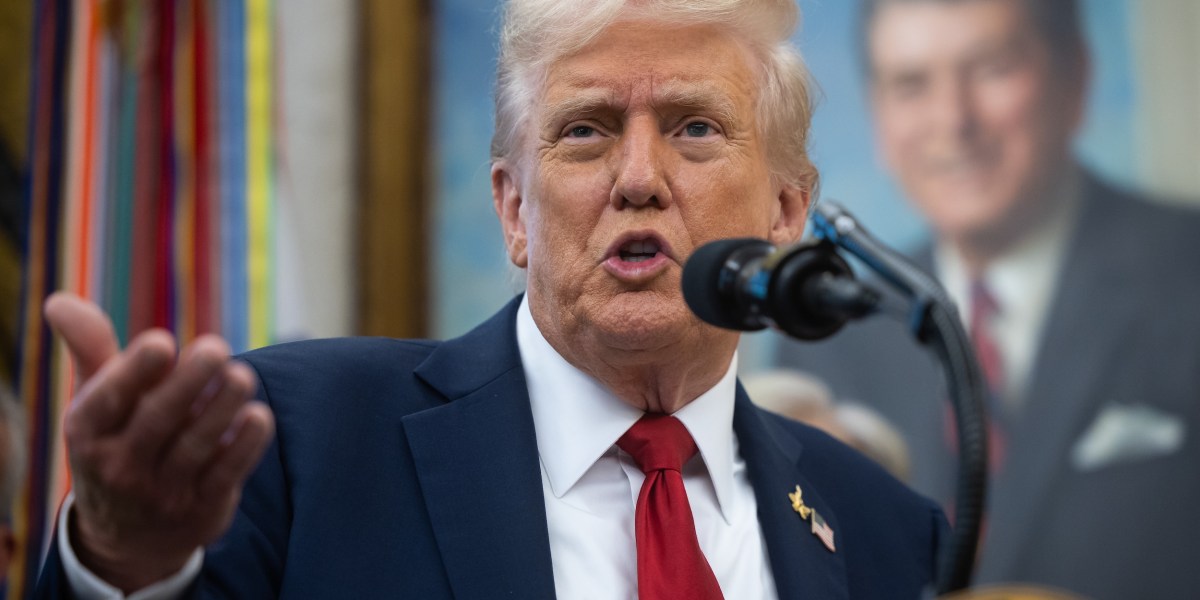
Trump uses shutdown to cut spending, fire workers 

“Republicans must use this opportunity of Democrat forced closure to clear out dead wood, waste, and fraud. Billions of Dollars can be saved,” the president said on Truth Social. White House budget director Russell Vought said $26 billion in funding for previously approved programs was on hold, much of which had been earmarked for Democrat-led states or cities. Permanent layoffs are expected to begin the in the next day or so. The White House is using government agency web sites to refer to the shutdown as “Democrat-led.”

U.S. to provide intelligence for long-range strikes on Russia

More evidence that Trump’s break with Putin is serious: The WSJ reports that the White House has approved sharing intelligence with Ukraine that will help Kyiv conduct long-range strikes deep into Russia, potentially targeting the oil and power infrastructure that fuels the invasion of Ukraine. Washington is also considering sending Ukraine long-range missiles but has not made a final decision.

Supreme Court delays decision on Fed’s Cook

The high court ruled that it will not take up Fed Governor Lisa Cook’s lawsuit against President Trump until January, after lower courts have dealt with the case. The move is a potential signal that the court is skeptical that the White House has the legal right to fire her.

PIMCO: There are “cracks” in the corporate credit market 

PIMCO President Christian Stracke told CNBC that the private credit market for companies seeking debt funding was going through a difficult patch. “We’re seeing some real problems in the credit markets. There have been some high-profile defaults in the credit markets — in the public markets — where it’s very difficult for the company to negotiate with the lenders to preserve value in the company,” he said.

The turnaround at Ralph Lauren

Ralph Lauren was staring irrelevance in the face when Procter & Gamble veteran Patrice Louvet took over as CEO and brought the fashion brand back to its luxury roots. Now, with profits at a 13-year high, Louvet says “It’s got to stay fresh.”

Two weeks of bro-co-CEOs 

In just the past two weeks, three large companies—Spotify, Oracle, and Comcast—either added a co-CEO to their corner office or replaced their CEO with a leadership duo. Fortune’s Lila MacLellan describes the phenomenon as the “rise of the bro-co-CEO.”

Citi mandates AI training for most employees

Citi is mandating AI training for the majority of its 229,00 employees, according to an internal memo shared with American Banker. A Citi representative told Fortune that “This training is about teaching our colleagues the possibilities of great prompting versus basic prompting to generate impactful results.”

OpenAI officially worth $500 billion

Sam Altman’s AI company has completed a funding round that values his company at a higher level than SpaceX, making it the world’s most valuable startup.

Bitcoin treasury craze cools

Companies that diluted their stock by selling shares specifically to fund purchases of Bitcoin have seen their values tumble by 20% to 50%, according to the WSJ. While their valuations remain above the price of Bitcoin on their balance sheets, it seems the market is not willing to buy an endless number of self-diluting Bitcoin treasury companies. Michael Saylor’s Strategy fell 20% in Q3.

The markets

S&P 500 futures were up 0.16% this morning. The index closed up 0.34% in its last session. STOXX Europe 600 was up 0.7% in early trading. The U.K.’s FTSE 100 flat in early trading. Japan’s Nikkei 225 was up 0.87%. China’s CSI 300 was up 0.45%. The South Korea KOSPI was up 2.7%. India’s Nifty 50 was up 0.92% before the end of the session. Bitcoin rose to $118.6K.

Around the watercooler

Walmart now plans to bring drone deliveries to ‘most areas that we operate in’, exec says by Jessica Mathews

The economy is just getting stronger, not weaker, and ‘we in the economics profession need to look ourselves in the mirror,’ top analyst says by Nick Lichtenberg

22-year-old AI CEO behind ‘friend.com’ necklace welcomes graffiti on his $1 million ad campaign: ‘Capitalism is the greatest artistic medium’ by Eva Roytburg

Former Wall Street darling Charlie Javice says ‘I have remorse deeper than I knew possible’ in tearful apology to JPMorgan shareholders by Dave Smith

CEO Daily is compiled and edited by Joey Abrams and Jim Edwards.

This is the web version of CEO Daily, a newsletter of must-read global insights from CEOs and industry leaders. Sign up to get it delivered free to your inbox.


Source link

Continue Reading

Business

The rise of AI reasoning models comes with a big energy tradeoff

Published

on


Nearly all leading artificial intelligence developers are focused on building AI models that mimic the way humans reason, but new research shows these cutting-edge systems can be far more energy intensive, adding to concerns about AI’s strain on power grids.

AI reasoning models used 30 times more power on average to respond to 1,000 written prompts than alternatives without this reasoning capability or which had it disabled, according to a study released Thursday. The work was carried out by the AI Energy Score project, led by Hugging Face research scientist Sasha Luccioni and Salesforce Inc. head of AI sustainability Boris Gamazaychikov.

The researchers evaluated 40 open, freely available AI models, including software from OpenAI, Alphabet Inc.’s Google and Microsoft Corp. Some models were found to have a much wider disparity in energy consumption, including one from Chinese upstart DeepSeek. A slimmed-down version of DeepSeek’s R1 model used just 50 watt hours to respond to the prompts when reasoning was turned off, or about as much power as is needed to run a 50 watt lightbulb for an hour. With the reasoning feature enabled, the same model required 7,626 watt hours to complete the tasks.

The soaring energy needs of AI have increasingly come under scrutiny. As tech companies race to build more and bigger data centers to support AI, industry watchers have raised concerns about straining power grids and raising energy costs for consumers. A Bloomberg investigation in September found that wholesale electricity prices rose as much as 267% over the past five years in areas near data centers. There are also environmental drawbacks, as Microsoft, Google and Amazon.com Inc. have previously acknowledged the data center buildout could complicate their long-term climate objectives

More than a year ago, OpenAI released its first reasoning model, called o1. Where its prior software replied almost instantly to queries, o1 spent more time computing an answer before responding. Many other AI companies have since released similar systems, with the goal of solving more complex multistep problems for fields like science, math and coding.

Though reasoning systems have quickly become the industry norm for carrying out more complicated tasks, there has been little research into their energy demands. Much of the increase in power consumption is due to reasoning models generating much more text when responding, the researchers said. 

The new report aims to better understand how AI energy needs are evolving, Luccioni said. She also hopes it helps people better understand that there are different types of AI models suited to different actions. Not every query requires tapping the most computationally intensive AI reasoning systems.

“We should be smarter about the way that we use AI,” Luccioni said. “Choosing the right model for the right task is important.”

To test the difference in power use, the researchers ran all the models on the same computer hardware. They used the same prompts for each, ranging from simple questions — such as asking which team won the Super Bowl in a particular year — to more complex math problems. They also used a software tool called CodeCarbon to track how much energy was being consumed in real time.

The results varied considerably. The researchers found one of Microsoft’s Phi 4 reasoning models used 9,462 watt hours with reasoning turned on, compared with about 18 watt hours with it off. OpenAI’s largest gpt-oss model, meanwhile, had a less stark difference. It used 8,504 watt hours with reasoning on the most computationally intensive “high” setting and 5,313 watt hours with the setting turned down to “low.” 

OpenAI, Microsoft, Google and DeepSeek did not immediately respond to a request for comment.

Google released internal research in August that estimated the median text prompt for its Gemini AI service used 0.24 watt-hours of energy, roughly equal to watching TV for less than nine seconds. Google said that figure was “substantially lower than many public estimates.” 

Much of the discussion about AI power consumption has focused on large-scale facilities set up to train artificial intelligence systems. Increasingly, however, tech firms are shifting more resources to inference, or the process of running AI systems after they’ve been trained. The push toward reasoning models is a big piece of that as these systems are more reliant on inference.

Recently, some tech leaders have acknowledged that AI’s power draw needs to be reckoned with. Microsoft CEO Satya Nadella said the industry must earn the “social permission to consume energy” for AI data centers in a November interview. To do that, he argued tech must use AI to do good and foster broad economic growth.


Source link

Continue Reading

Business

SpaceX to offer insider shares at record-setting valuation

Published

on


SpaceX is preparing to sell insider shares in a transaction that would value Elon Musk’s rocket and satellite maker at a valuation higher than OpenAI’s record-setting $500 billion, people familiar with the matter said.

One of the people briefed on the deal said that the share price under discussion is higher than $400 apiece, which would value SpaceX at between $750 billion and $800 billion, though the details could change. 

The company’s latest tender offer was discussed by its board of directors on Thursday at SpaceX’s Starbase hub in Texas. If confirmed, it would make SpaceX once again the world’s most valuable closely held company, vaulting past the previous record of $500 billion that ChatGPT owner OpenAI set in October. Play Video

Preliminary scenarios included per-share prices that would have pushed SpaceX’s value at roughly $560 billion or higher, the people said. The details of the deal could change before it closes, a third person said. 

A representative for SpaceX didn’t immediately respond to a request for comment. 

The latest figure would be a substantial increase from the $212 a share set in July, when the company raised money and sold shares at a valuation of $400 billion.

The Wall Street Journal and Financial Times, citing unnamed people familiar with the matter, earlier reported that a deal would value SpaceX at $800 billion.

News of SpaceX’s valuation sent shares of EchoStar Corp., a satellite TV and wireless company, up as much as 18%. Last month, Echostar had agreed to sell spectrum licenses to SpaceX for $2.6 billion, adding to an earlier agreement to sell about $17 billion in wireless spectrum to Musk’s company.

Subscribe Now: The Business of Space newsletter covers NASA, key industry events and trends.

The world’s most prolific rocket launcher, SpaceX dominates the space industry with its Falcon 9 rocket that launches satellites and people to orbit.

SpaceX is also the industry leader in providing internet services from low-Earth orbit through Starlink, a system of more than 9,000 satellites that is far ahead of competitors including Amazon.com Inc.’s Amazon Leo.

SpaceX executives have repeatedly floated the idea of spinning off SpaceX’s Starlink business into a separate, publicly traded company — a concept President Gwynne Shotwell first suggested in 2020. 

However, Musk cast doubt on the prospect publicly over the years and Chief Financial Officer Bret Johnsen said in 2024 that a Starlink IPO would be something that would take place more likely “in the years to come.”

The Information, citing people familiar with the discussions, separately reported on Friday that SpaceX has told investors and financial institution representatives that it is aiming for an initial public offering for the entire company in the second half of next year.

A so-called tender or secondary offering, through which employees and some early shareholders can sell shares, provides investors in closely held companies such as SpaceX a way to generate liquidity.

SpaceX is working to develop its new Starship vehicle, advertised as the most powerful rocket ever developed to loft huge numbers of Starlink satellites as well as carry cargo and people to moon and, eventually, Mars.


Source link

Continue Reading

Business

U.S. consumers are so strained they put more than $1B on BNPL during Black Friday and Cyber Monday

Published

on


Financially strained and cautious customers leaned heavily on buy now, pay later (BNPL) services over the holiday weekend.

Cyber Monday alone generated $1.03 billion (a 4.2% increase YoY) in online BNPL sales with most transactions happening on mobile devices, per Adobe Analytics. Overall, consumers spent $14.25 billion online on Cyber Monday. To put that into perspective, BNPL made up for more than 7.2% of total online sales on that day.

As for Black Friday, eMarketer reported $747.5 million in online sales using BNPL services with platforms like PayPal finding a 23% uptick in BNPL transactions.

Likewise, digital financial services company Zip reported 1.6 million transactions throughout 280,000 of its locations over the Black Friday and Cyber Monday weekend. Millennials (51%) accounted for a chunk of the sizable BNPL purchases, followed by Gen Z, Gen X, and baby boomers, per Zip.

The Adobe data showed that people using BNPL were most likely to spend on categories such as electronics, apparel, toys, and furniture, which is consistent with previous years. This trend also tracks with Zip’s findings that shoppers were primarily investing in tech, electronics, and fashion when using its services.

And while some may be surprised that shoppers are taking on more debt via BNPL (in this economy?!), analysts had already projected a strong shopping weekend. A Deloitte survey forecast that consumers would spend about $650 million over the Black Friday–Cyber Monday stretch—a 15% jump from 2023.

“US retailers leaned heavily on discounts this holiday season to drive online demand,” Vivek Pandya, lead analyst at Adobe Digital Insights, said in a statement. “Competitive and persistent deals throughout Cyber Week pushed consumers to shop earlier, creating an environment where Black Friday now challenges the dominance of Cyber Monday.”

This report was originally published by Retail Brew.


Source link

Continue Reading

Trending

Copyright © Miami Select.