Connect with us

Business

‘We’ve never had a fundraising deck’: Here’s where venture capital stands now and where it’s going next

Published

on


If you want a pulse check on where the venture capital industry is at, consider the software supply chain security startup Chainguard, which has raised $500 million across two rounds in less than a year. 

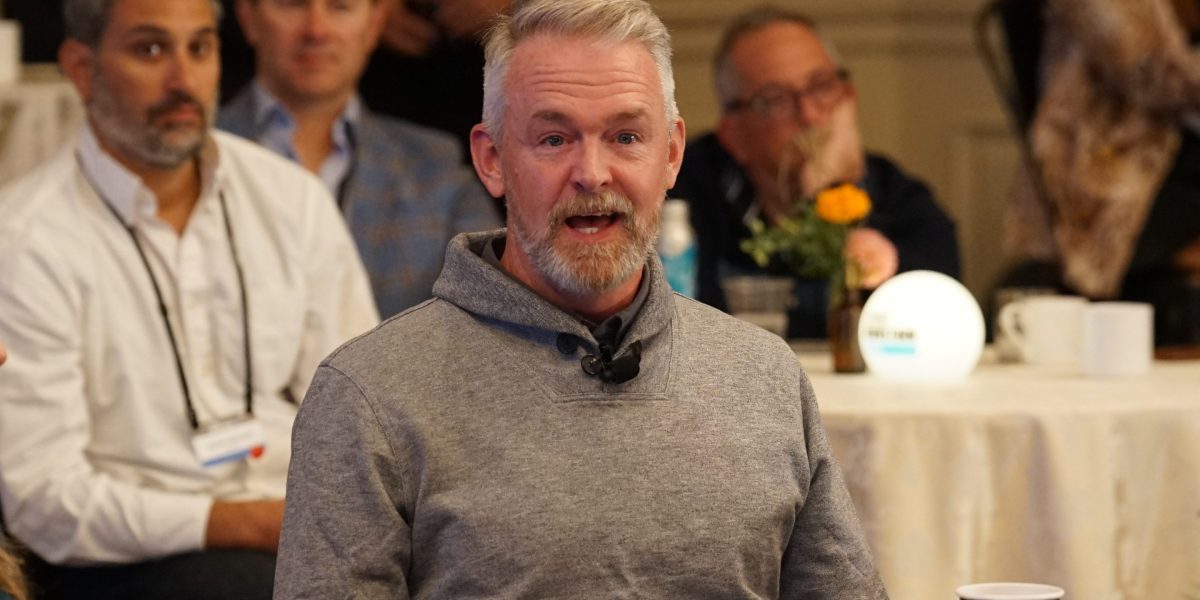
“We’ve never had a fundraising deck,” Ryan Carlson, president of Chainguard, said yesterday on the Future of Venture Capital insight exchange at Fortune’s Brainstorm Tech conference in Park City, Utah. He added later: “We’re not going to create a deck next time either.”

For some companies, deals can’t get done fast enough. OpenAI is reportedly worth some $500 billion these days and raised $40 billion in funding earlier this year. Autonomous weapons startup Anduril notched a $30.5 billion valuation earlier this year, less than a year after its last multi-billion funding round. If you are looking at companies in the cybersecurity, generative AI, and defense tech space, deals are hot. But it’s not everyone. 

“Some companies, no matter what you’re doing, you’re not getting any term sheets,” says Aydin Senkut of Felicis Ventures. “And the ones that are getting interest are getting, like, 12, 15—I mean, they’re double digits. And I’ve been in this business for 20 years, and I’m trying to remember the last time when there were double-digit term sheets for the hot companies.”

Investors disagreed about whether we have entered an AI bubble, as OpenAI CEO Sam Altman suggested at a small dinner with reporters last month—or even an era akin to the dot-com boom, in which investors poured capital into any company related to the internet only for many of those companies to end up going under. 

The economics for AI companies, in particular, are different. As Sapphire Ventures’ Cathy Gao pointed out, companies are growing to $100 million in ARR faster than ever—and with fewer people. But they are also not as efficient as software companies once were, as they have to spend exorbitant fees on things like compute.

“People are betting on the fact that compute costs will continue to decline, and over time, it’ll be a much more profitable company. So we’ll see if that plays out,” Gao said.

Where will things play out? Adam Zeplain of mark vc had some thoughts on that one. “Here’s what I know—that none of us know shit,” he said. “Two years from now, we’ll all be sitting here, and the competition will be very different, and there’s a lot of humility, and there’s a lot of excitement in that.”

More from Brainstorm Tech… We are out here in Park City, Utah, chatting about self-driving cars, fertility benefits, and ŌURA rings. This week, DoorDash Tony Xu talked about how the path to autonomous deliveries has been filled with “lots of pain and suffering.” Lyft CEO David Risher said that the company would save some $200 million from reduced insurance costs after the union deal it struck with California lawmakers. Jeffrey Katzenberg said legislation to protect children from online harm is unlikely. The Walmart U.S. CEO says staffing levels will remain steady even as A.I. becomes a bigger part of work.

See you tomorrow,

Jessica Mathews
X:
@jessicakmathews
Email: jessica.mathews@fortune.com

Submit a deal for the Term Sheet newsletter here.

Joey Abrams curated the deals section of today’s newsletter. Subscribe here.

VENTURE DEALS

Strive Health, a Denver, Colo.-based Kidney Care company, raised $300 million in Series D funding. New Enterprise Associates led the Series A and was joined by CVS Health Ventures, CapitalG, Echo Health Ventures, Town Hall Ventures, Redpoint, and others.

Harbor Health, an Austin, Texas-based primary and specialty care clinic group and health insurance company, raised $130 million in funding. General Catalyst, 8VC, and Alta Partners led the round and were joined by DFO Management and others.

Aven, a San Francisco-based home equity-backed credit card company, raised $110 million in Series E funding. Khosla Ventures led the round and was joined by existing investors General Catalyst, Caffeinated Capital, GIC, Electric Capital, and Founders Fund.

DataCrunch, a Helsinki, Finland-based AI infrastructure company, raised €55 million ($64.4 million) in Series A funding. byFounders, Skaala, Varma PensionFund, and Tesi and were joined by J12 Ventures and angel investors.

Scientil Photonics, a Grenoble, France-based developer of Heterogeneous Integrated Photonics for AI infrastructure, raised $58 million in Series B funding. Yotta Capital Partners and NGP Capital led the round and was joined by Nvidia

Fyxer.ai, a London, U.K.-based AI program for emails and meetings, raised $30 million in Series B funding. Madrona led the round and was joined by Lakestar Capital.

Teton.ai, a Copenhagen, Denmark-based developer of predictive intelligence technology for health care, raised $20 million in Series A funding. Plural led the round and was joined by Bertelsmann Investments, Antler Elevate, Nebular, and PSV Tech.

Lightspun, a Boston-based AI-powered dental insurance administration platform, raised $13 million in Series A funding. Brewer Lane led the round and was joined by Virtue, Cambrian, and Industry Ventures. 

Runware, a San Francisco-based performance & price-focused AI-as-a-Service provider, raised $13 million in funding. Insight Partners led the round and was joined by existing investors a16z Speedrun, Begin Capital, and Zero Prime.

Nuclearn, a Phoenix, Ariz.-based AI platform designed for nuclear professionals and critical infrastructure operators, raised $10.5 million in Series A funding. Blue Bear Capital led the round and was joined by SJF Ventures and existing investors AZ-VC and Nucleation Capital.

Sphinx, a New York City-based developer of AI software designed for data scientists, raised $9.5 million in seed funding. Lightspeed led the round and was joined by Bessemer Venture Partners, Box Group, K5, Impatient VC, and others. 

wehandle, a São Paulo, Brazil-based SaaS platform for third-party workforce management, raised $6 million in funding. Canary led the round and was joined by ONEVC, Valutia, Blustone, and Quartzo.

Candid Intelligence, a San Francisco, Calif.-based developer of AI agents for engineering, procurement, and construction projects, raised $5.5 million in pre-seed funding. Quiet Capital led the round and was joined by MIT’s E14 Fund, Liquid 2 Ventures, Flexcap Ventures, Yann LeCun, and others.

Dig Energy, a Manchester, N.H.-based developer of geothermal-specific drilling technology, raised $5 million in seed funding. Azolla Ventures and Avila VC led the round and was joined by Drew Scott.

Metal, a New York City-based AI-powered research platform for private market investors, raised $5 million in funding from Base10 Partners

Pathwork, a San Francisco-based AI-powered life and health insurance distribution platform, raised $3.5 million in seed funding. Costanoa led the round and was joined by Logos Fund, American Family Ventures, Meridian Ventures, and angel investors. 

OpenHealth, a Berlin, Germany-based lab data company, raised $3 million in seed funding. GoHub Ventures, xdeck ventures, Edenbase, and Exceptional Ventures led the round and were joined by YZR Capital, Octopus Ventures, and calm/Storm Ventures.

Marloo, a London, U.K. and Auckland, Australia-based AI assistant designed for financial advisers, raised $2.7 million in ore-seed funding. Blackbird led the round and was joined by angel investors.

Aurva, a Sunnyvale, Calif. and Bengaluru, India-based AI-powered data security program, raised $2.2 million in seed funding. Nexus Venture Partners led the round and was joined by DeVC and angel investors.

PRIVATE EQUITY

Vitruvian Partners invested $637 million in DeepIntent, a New York City-based health care demand-side platform. 

Polycorp, a portfolio company of Arsenal Capital Partners, acquired Burke Industries, a San Jose, Calif.-based custom elastomeric product supplier. Financial terms were not disclosed.

Shenandoah, backed by GenNx360 Capital Partners, acquired Nu-Pipe LLC, a St. Petersburg, Fla.-based pipe rehabilitation company. Financial terms were not disclosed. 

TMA Systems, a portfolio company of Silversmith Capital Partners, acquired Facil-it, a Williston, N.Y.-based facilities maintenance platform. Financial terms were not disclosed.

EXITS

Ariel Alternatives acquired Groome Industrial Service Group, a Denville, N.J.-based specialty maintenance services company, from Argosy Private Equity. Financial terms were not disclosed. 

Bansk Group agreed to acquire a majority stake in BYOMA, a New York City-based skin health brand, from Yellow Wood Partners. Financial terms were not disclosed.

Chamberlain Group, backed by Blackstone, acquired Arrow Tru-Line, a Archbold, Ohio-based manufacturer of garage door hardware components, from MiddleGround Capital. Financial terms were not disclosed. 

Minute Media acquired VideoVerse, a San Francisco and Los Angeles-based video editing platform, from Bluestone Equity Partners. Financial terms were not disclosed.

PEOPLE

Percheron Capital, a San Francisco and New York City-based private equity firm, hired Manish Goyal as a managing director and head of the firm’s portfolio support group. He was formerly with Berkshire Partners.


Source link

Continue Reading

Business

Databricks CEO Ali Ghodsi says company will be worth $1 trillion by doing these three things

Published

on


Ali Ghodsi, the CEO and cofounder of data intelligence company Databricks, is betting his privately held startup can be the latest addition to the trillion-dollar valuation club.

In August, Ghodsi told the Wall Street Journalthat he believed Databricks, which is reportedly in talks toraise funding at a $134 billion valuation, had “a shot to be a trillion-dollar company.” At Fortune’s Brainstorm AI conference in San Francisco on Tuesday, he explained how it would happen, laying out a “trifecta” of growth areas to ignite the company’s next leg of growth.

The first is entering the transactional database market, the traditional territory of large enterprise players like Oracle, which Ghodsi said has remained largely “the same for 40 years.” Earlier this year, Databricks launched a link-based offering called Lakehouse, which aims to combine the capabilities of traditional databases with modern data lake storage, in an attempt to capture some of this market.

The company is also seeing growth driven by the rise of AI-powered coding. “Over 80% of the databases that are being launched on Databricks are not being launched by humans, but by AI agents,” Ghodsi said. As developers use AI tools for “vibe coding”—rapidly building software with natural language commands—those applications automatically need databases, and Ghodsi they’re defaulting to Databricks’ platform.

“That’s just a huge growth factor for us. I think if we just did that, we could maybe get all the way to a trillion,” he said.

The second growth area is Agentbricks, Databricks’ platform for building AI agents that work with proprietary enterprise data.

“It’s a commodity now to have AI that has general knowledge,” Ghodsi said, but “it’s very elusive to get AI that really works and understands that proprietary data that’s inside enterprise.” He pointed to the Royal Bank of Canada, which built AI agents for equity research analysts, as an example. Ghodsi said these agents were able to automatically gather earnings calls and company information to assemble research reports, reducing “many days’ worth of work down to minutes.”

And finally, the third piece to Ghodsi’s puzzle involves building applications on top of this infrastructure, with developers using AI tools to quickly build applications that run on Lakehouse and which are then powered by AI agents. “To get the trifecta is also to have apps on top of this. Now you have apps that are vibe coded with the database, Lakehouse, and with agents,” Ghodsi said. “Those are three new vectors for us.”

Ghodsi did not provide a timeframe for attaining the trillion-dollar goal. Currently, only a handful of companies have achieved the milestone, all of them as publicly traded companies. In the tech industry, only big tech giants like Apple, Microsoft, Nvidia, Alphabet, Amazon, and Meta have managed to cross the trillion-dollar threshold.

To reach this level would require Databricks, which is widely expected to go public sometime in early 2026, to grow its valuation roughly sevenfold from its current reported level. Part of this journey will likely also include the expected IPO, Ghodsi said.

“There are huge advantages and pros and cons. That’s why we’re not super religious about it,” Ghodsi said when asked about a potential IPO. “We will go public at some point. But to us, it’s not a really big deal.”

Could the company IPO next year? Maybe, replied Ghodsi.


Source link

Continue Reading

Business

New contract shows Palantir working on tech platform for another federal agency that works with ICE

Published

on


Palantir, the artificial intelligence and data analytics company, has quietly started working on a tech platform for a federal immigration agency that has referred dozens of individuals to U.S. Immigration and Customs Enforcement for potential enforcement since September.

The U.S. Citizenship and Immigration Services agency—which handles services including citizenship applications, family immigration, adoptions, and work permits for non-citizens—started the contract with Palantir at the end of October, and is paying the data analytics company to implement “Phase 0” of a “vetting of wedding-based schemes,” or “VOWS” platform, according to the federal contract, which was posted to the U.S. government website and reviewed by Fortune.

The contract is small—less than $100,000—and details of what exactly the new platform entails are thin. The contract itself offers few details, apart from the general description of the platform (“vetting of wedding-based schemes”) and an estimate that the completion of the contract would be Dec. 9.Palantir declined to comment on the contract or nature of the work, and USCIS did not respond to requests for comment for this story.

But the contract is notable, nonetheless, as it marks the beginning of a new relationship between USCIS and Palantir, which has had longstanding contracts with ICE, another agency of the Department of Homeland Security, since at least 2011. The description of the contract suggests that the “VOWS” platform may very well be focused on marriage fraud and related to USCIS’ recent stated effort to drill down on duplicity in applications for marriage and family-based petitions, employment authorizations, and parole-related requests.

USCIS has been outspoken about its recent collaboration with ICE. Over nine days in September, USCIS announced that it worked with ICE and the Federal Bureau of Investigation to conduct what it called “Operation Twin Shield” in the Minneapolis-St. Paul area, where immigration officials investigated potential cases of fraud in immigration benefit applications the agency had received. The agency reported that its officers referred 42 cases to ICE over the period. In a statement published to the USCIS website shortly after the operation, USCIS director Joseph Edlow said his agency was “declaring an all-out war on immigration fraud” and that it would “relentlessly pursue everyone involved in undermining the integrity of our immigration system and laws.” 

“Under President Trump, we will leave no stone unturned,” he said.

Earlier this year, USCIS rolled out updates to its policy requirements for marriage-based green cards, which have included more details of relationship evidence and stricter interview requirements.

While Palantir has always been a controversial company—and one that tends to lean into that reputation no less—the new contract with USCIS is likely to lead to more public scrutiny. Backlash over Palantir’s contracts with ICE have intensified this year amid the Trump Administration’s crackdown on immigration and aggressive tactics used by ICE to detain immigrants that have gone viral on social media. Not to mention, Palantir inked a $30 million contract with ICE earlier this year to pilot a system that will track individuals who have elected to self-deport and help ICE with targeting and enforcement prioritization. There has been pushback from current and former employees of the company alike over contracts the company has with ICE and Israel.

In a recent interview at the New York Times DealBook Summit, Karp was asked on stage about Palantir’s work with ICE and later what Karp thought, from a moral standpoint, about families getting separated by ICE. “Of course I don’t like that, right? No one likes that. No American. This is the fairest, least bigoted, most open-minded culture in the world,” Karp said. But he said he cared about two issues politically: immigration and “re-establishing the deterrent capacity of America without being a colonialist neocon view. On those two issues, this president has performed.”


Source link

Continue Reading

Business

CoreWeave CEO: Despite see-sawing stock, IPO was ‘incredibly successful’ amid challenges of tariff timing

Published

on


CoreWeave has been rocked by dizzying stock swings—with its stock currently trading 52% below its post-IPO high—and a frequent target of market commentators, but CEO Michael Intrator says the company’s move to the public markets has been “incredibly successful. And he takes the public’s mixed reaction in stride, given the novelty of CoreWeave’s “neocloud” business which competes with established cloud providers like Amazon AWS and Google Cloud.

“When you introduce new models, introduce a new way of doing business, disrupt what has been a static environment, it’s going to take some people some time,” Intrator said Tuesday at Fortune’s Brainstorm AI conference in San Francisco. But, he added, more people are beginning to understand the CoreWeave’s business model.

“We came out into one of the most challenging environments,” Intrator said of CoreWeave’s March IPO, which occurred very close to President Trump’s “Liberation Day” tariffs in April. “In spite of the incredible headwinds, we’re able to launch a successful IPO.”

CoreWeave, which priced its IPO at $40 per share, has experienced frequent severe up-and-down price swings in the eight months since its public market debut. At its closing price of $90.66 on Tuesday, the stock remains well above its IPO price.

As Fortune reported last month, CoreWeave’s rapid rise has been fueled by an aggressive, debt-heavy strategy to stand up data centers at unprecedented speed for AI customers. And for now, the bet is still paying off. In its third-quarter results released in November, the company said its revenue backlog nearly doubled in a single quarter—to $55.6 billion from $30 billion—reflecting long-term commitments from marquee clients including Meta, OpenAI, and French AI startup Poolside. Both earnings and revenue came in ahead of Wall Street expectations.

But the numbers were not all celebratory. CoreWeave disclosed a further increase in the debt it has taken on to finance its expansion, and it revised its full-year revenue outlook downward—suggesting that, even with historic demand in the pipeline.

With media headlines calling CoreWeave a “ticking time bomb,” with critics calling out insider stock sales, circular financing accusations and an overreliance on Nvidia, Intrator was asked whether he felt CoreWeave was misunderstood.

“Look, we built a company that is challenging one of the most stable businesses that exist—that cloud business, these three massive players,” he said, referring to AWS, Microsoft Azure and Google Cloud.  I feel like it’s incumbent on CoreWeave to introduce a new business model on how the cloud is going to be built and run. And that’s what we’re doing.” 

He repeatedly framed CoreWeave not as a GPU reseller or traditional data-center operator but as a company purpose-built from scratch to deliver high-performance, parallelized computing for AI workloads. That focus, he said, means designing proprietary software that orchestrates GPUs, building and colocating its own infrastructure, and moving “up the stack” through acquisitions such as Weights & Biases and OpenPipe.

Intrator also defended the company’s debt strategy, saying CoreWeave is effectively inventing a new financing model for AI infrastructure. He pointed to the company’s ability to repurpose power sources, rapidly deploy capacity, and finance large-scale clusters as proof it is solving problems incumbents never had to face.

“When I look back at history of the company, it took us a year with with a company investor like Fidelity, before they were like, ‘Oh, I get it,’” he said. “So look, we’ve been public for eight months. I couldn’t be prouder of what the company has accomplished.” 


Source link

Continue Reading

Trending

Copyright © Miami Select.