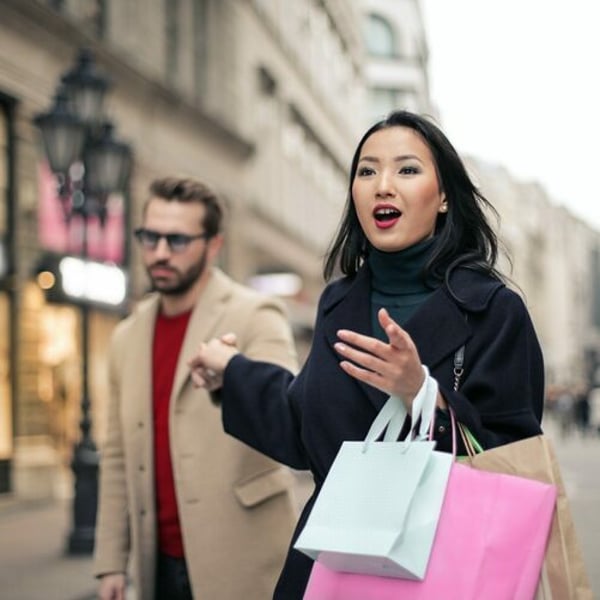
One key part of London’s West End saw big uplift in visitors during December with new figures from the Heart of London Business Alliance (HOLBA) saying footfall was up 19% year on year last month.
Photo: Pexels/Public domain
The area HOLBA covers includes Piccadilly, Leicester Square and Haymarket, which don’t account for the main shopping district but are just a stone’s throw from Regent Street, Bond Street and Covent Garden.
HOLBA’s figures also show that dwell time increased by 42 minutes per day compared to a year ago.
Overall, footfall was 20% above the average seem from 2022-24, and between 15 and 29 December, visits were up 35%, all of which HOLBA said underlines the area’s recovery from the pandemic.
Deputy chief executive, Mark Williams, said the figures “show that London’s West End continues to outperform national trends, with visitor numbers on the rise. This underscores its appeal as a global destination and the power of the experience economy in attracting people to the area”.
The New West End Company (NWEC), which represents businesses across the wider West End, hasn’t yet released its own figures for December. But it had earlier said that the area bucked the national trend over the Black Friday period. West End footfall was up 9% in the previous week, up 4.1% in Black Friday week itself and 6.2% the week after.
That further underlines how well the West End has bounced back after several years in which its status as one of Europe’s top tourist shopping districts was at risk. From 2020 onwards, the large number of store closures, the proliferation of so-called American candy stores and the (still-ongoing) absence of tax-free shopping for tourists meant central London was slow to recover. ‘Rival’ shopping cities such as Paris and Milan meanwhile have taken less time to get back to pre-pandemic footfall levels and London Mayor Sadiq Khan this week revealed that he’s lobbied the government to get the decision on cancelling the tax-free shopping perk reversed.
The house of Ralph Lauren very rarely stages menswear runway shows in Milan, which is a pity as its catwalk display this Friday was the coolest and cleverest display of menswear classicism we’ve seen in many moons.
Ralph Lauren in Milan – FashionNetwork.com
The smoothest of shows too. Presented with polish inside Ralph Lauren’s European headquarters, a geometric Rationalist era jewel of a building. Guests- from Tom Hiddleston and Colman Domingo to Nick Jonas- imbibing biscuity champagne as they took their places on leather bench seats.
Opening with a score of looks from Polo, a rich selection of kicky, preppy ideas: red flannel shirts with turkey prints; Navajo graphic wool sweaters; snow crystal pattern cardigans; and even a brown three-piece Prince of Wales suit. All anchored by Alpine hiking boots or hyped-up L.L. Bean style waders; or accessorised by Black Watch tartan carpet bags.
Plenty of Western looks, from urban cowboy brown suede fringed jackets, worn by a model with an acoustic guitar on his back, to lace ties, rancher hats, and riding boots. Very Yellowstone in Lombardy.
Black Watch tartan by Ralph Lauren – FashionNetwork.com
Backed up by a great soundtrack- where Nina Simone’s Sinnerman followed Texas Sun by Khruangbin and Leon Bridges. Ideal for some bold and colourful motor-bike jackets that read: Ralph Lauren Racing.
As day shifted to evening, Scottish baronial chic made an appearance: from Clan Stewart red plaid tuxedos worn under a Count Dracula cape to a great black Grenadier guards military tunic worn with a black silk stock– un petit merci to Dior. Albeit seen on models sporting New York Yankees baseball caps.
“We had so many looks and ideas in this collection that it just seemed right to stage a show this week in Milan,” explained Andrew Lauren, sitting among the movie stars in the villa’s covered courtyard.
Tailoring by Ralph Lauren – FashionNetwork.com
All worn by a highly diverse cast, from all the world’s continents. And, one could not help noticing that when he came to the two chalk stripe impeccable bankers, these were worn by a South and an East Asian.
Though there was clearly no deliberate political message, the very heterogeneousness of the cast was a reminder of how Ralph has always celebrated the diversity of America. Which, at a moment when ICE are clearly racially profiling citizens in the United States, made this show feel very powerful.
This is the melting pot America that Europeans love. Not the white supremacism currently being rammed down people’s throats.
German online fashion platform Zalando SE is preparing to announce its first deal with an American client soon, marking a break into the US market with the company’s business-to-business offerings.
Zalando is embracing AI – Archiv
“We now have the first teams on the ground to also develop the market for us- to talk to brands and retailers about their needs,” Zalando co-chief executive officer David Schröder said in an interview this week. “We are now finally approaching- and that makes us very happy- the closure of the first deals here in the US, which we hope to announce in the coming months.”
Zalando’s business-to-business operations have historically focused exclusively on Europe. But the company has hailed the US as “one of the biggest opportunities” for its Scayle software, which it gained through the acquisition of rival About You Holding SE in 2025. The software helps firms manage inventory and branding across sales channels. Schröder described Zalando’s business-to-business operations as a “multibillion-euro” opportunity. While much of that consists of logistics, he expects software to account for “a few hundred million” in revenue.
Zalando shares jumped on Friday as much as 4% on the news before paring gains.
The financial targets the company had issued last year failed to impress investors. The Berlin-based company has lost more than $20 billion in market value since peaking as a pandemic darling in 2021. Its shares slid after the pandemic as consumers returned to brick and mortar stores for their shopping needs. Despite some momentum in Zalando’s earnings, investors remain cautious about its ability to expand margins.
“There seems to be still some doubt on whether we’ll get there or not, especially on the margin side,” Schröder said of investors’ reaction to the company’s financial forecasts. “This year, we will prove again that the margin goes up and we continue to grow.” When Zalando reports full-year results in March, Schröder said executives will also “communicate a simpler story to make clear what our priorities are,” while reiterating financial targets.
Schröder said he sees traffic to Zalando’s shopping platform from artificial-intelligence chatbots and agents growing in the coming years. Today, more than 80% of Zalando’s traffic is organic and isn’t coming from paid advertising, Schröder said, with the rest largely coming through paid channels such as Google and Meta Platforms Inc. But “a low single-digit percentage” is now being directed through AI, he said.
While some have warned that AI tools threaten to undermine the business model of e-commerce companies, Schröder said he’s optimistic the technology will help Zalando reach new customers. The company recently started working with Google’s open standard for agentic commerce, designed to help retailers connect with consumers using AI to shop.
“We obviously want to be where customers are,” Schröder said.
While agentic commerce may create some disruption for the industry, Bankhaus Metzler analyst Felix Dennl recently said in a note that he sees AI as an opportunity for Zalando to create content and optimise returns.
December temperatures, 3.5 degrees Celsius above the 35-year norm recorded by Météo-France, are thought to have severely hit year-end sales of long-sleeved items. This unusual mildness spared no brick-and-mortar retail channel.
Independent retailers were the hardest hit, down 6.8% in December. Department stores and popular stores (Monoprix) fell by 4.7% over the period. Specialist chains were down 4.2%, while mass-market chains (Kiabi, Gémo, etc.) managed to limit their decline to 3.1%.
These figures, which will shortly be supplemented by online sales data, stand in contrast to the stability posted a year earlier, when the fashion sector was essentially flat in 2024 (+0.1%). This was a welcome sign at the time, following the 1.3% drop recorded between 2022 and 2023.
Sales trends by channel between December 2024 and 2025 – IFM