Connect with us

Business

‘We eat with our eyes’: Pepsi plays with purple sweet potatoes and various carrot colors as it races to remove dyes, says VP of R&D

Published

on


Pepsi has a new challenge: keeping products like Gatorade and Cheetos vivid and colorful without the artificial dyes that U.S. consumers are increasingly rejecting.

PepsiCo, which also makes Doritos, Cap’n Crunch cereal, Funyuns and Mountain Dew, announced in April that it would accelerate a planned shift to using natural colors in its foods and beverages. Around 40% of its U.S. products now contain synthetic dyes, according to the company.

But just as it took decades for artificial colors to seep into PepsiCo’s products, removing them is likely to be a multi-year process. The company said it’s still finding new ingredients, testing consumers’ responses and waiting for the U.S. Food and Drug Administration to approve natural alternatives. PepsiCo hasn’t committed to meeting the Trump administration’s goal of phasing out petroleum-based synthetic dyes by the end of 2026.

“We’re not going to launch a product that the consumer’s not going to enjoy,” said Chris Coleman, PepsiCo’s senior director for food research and development in North America. “We need to make sure the product is right.”

Coleman said it can take two or three years to shift a product from an artificial color to a natural one. PepsiCo has to identify a natural ingredient that will have a stable shelf life and not change a product’s flavor. Then it must ensure the availability of a safe and adequate supply. The company tests prototypes with trained experts and panels of consumers, then makes sure the new formula won’t snag its manufacturing process. It also has to design new packaging.

Experimenting with spices to color Cheetos

Tostitos and Lay’s will be the first PepsiCo brands to make the shift, with naturally dyed tortilla and potato chips expected on store shelves later this year and naturally dyed dips due to be on sale early next year. Most of the chips, dips and salsas in the two lines already are naturally colored, but there were some exceptions.

The reddish-brown tint of Tostitos Salsa Verde, for example, came from four synthetic colors: Yellow 5, Yellow 6, Red 40 and Blue 1. Coleman said the company is switching to carob powder, which gives the chips a similar color, but needed to tweak the recipe to ensure the addition of the cocoa alternative wouldn’t affect the taste.

In its Frito-Lay food labs and test kitchens in Plano, Texas, PepsiCo is experimenting with ingredients like paprika and turmeric to mimic the bright reds and oranges in products like Flamin’ Hot Cheetos, Coleman said.

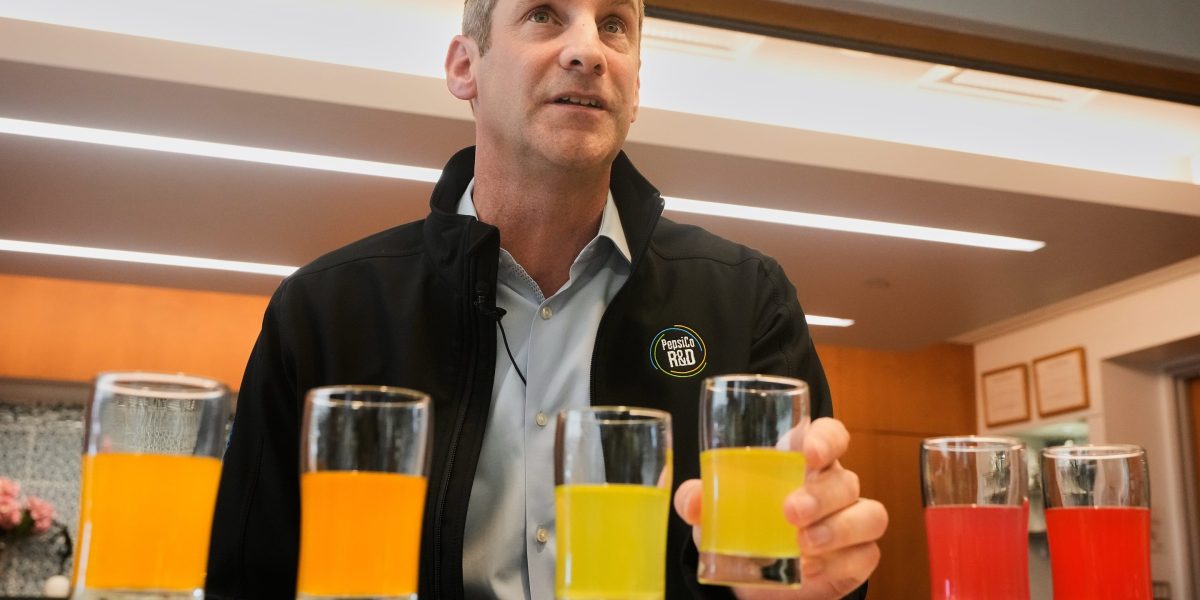
The company is looking at purple sweet potatoes and various types of carrots to color drinks like Mountain Dew and Cherry 7Up, according to Damien Browne, the vice president of research and development for PepsiCo’s beverage division based in Valhalla, New York.

Getting the hue right is critical, since many consumers know products like Gatorade by their color and not necessarily their name, Browne said.

“We eat with our eyes,” he said. “If you look at a plate of food, it’s generally the different kinds of colors that will tell you what you would like or not.”

Consumer demand goes from a whisper to a roar

When the Pepsi-Cola Company was founded in 1902, the absence of artificial dyes was a point of pride. The company marketed Pepsi as “The Original Pure Food Drink” to differentiate the cola from rivals that used lead, arsenic and other toxins as food colorants before the U.S. banned them in 1906.

But synthetic dyes eventually won over food companies. They were vibrant, consistent and cheaper than natural colors. They are also rigorously tested by the FDA.

Still, PepsiCo said it started seeing a small segment of shoppers asking for products without artificial colors or flavors more than two decades ago. In 2002, it launched its Simply line of chips, which offer natural versions of products like Doritos. A dye-free organic Gatorade came out in 2016.

“We’re looking for those little signals that will become humongous in the future,” Amanda Grzeda, PepsiCo’s senior director of global sensory and consumer experience, said of the company’s close attention to consumer preferences.

Grzeda said the whisper PepsiCo detected in the early 2000s has become a roar, fueled by social media and growing consumer interest in ingredients. More than half of the consumers PepsiCo spoke to for a recent internal study said they were trying to reduce their consumption of artificial dyes, Grzeda said.

Synthetic and natural colors are in FDA’s hands

Some states, including West Virginia and Arizona, have banned artificial dyes in school lunches. But Browne said he thinks consumers are driving the push to overhaul processed foods.

“Consumers are definitely leading, and I think what we need to do is have the regulators catching up, allowing us to approve new natural ingredients to be able to meet their demand,” he said.

The U.S. Food and Drug Administration has said it’s expediting approval of natural additives after calling on companies to halt their use of synthetic dyes. In May, the FDA approved three new natural color additives, including a blue color derived from algae. In July, the agency approved gardenia blue, which is derived from a flowering evergreen.

The FDA banned one petroleum-based dye, Red 3, in January because it was shown to cause cancer in lab rats. And in September, the agency proposed a ban on Orange B, a synthetic color that hasn’t been used in decades.

Six synthetic dyes remain FDA-approved and widely used, despite mixed studies that show they may cause neurobehavioral problems in some children. Red 40, for example, is used in 25,965 food and beverage items on U.S. store shelves, according to the market research firm NIQ.

But even if decades of research has shown that synthetic colors are safe, PepsiCo has to weigh public perceptions, Grzeda said.

“We could just blindly follow the science, but it probably would put us at odds with what our consumers believe and perceive in the world,” she said.

Passing taste and texture tests

PepsiCo also has to balance the needs of consumers who don’t want their favorite snacks and drinks to change or get more expensive because of the costs of natural dyes. NIQ data shows that unit sales of products advertised as free of artificial colors fell sharply in 2023 as prices rose.

Susan Mazur-Stommen, a small business owner in Hinton, West Virginia, picked up some Simply brand Cheetos Puffs recently at a convenience store because they were the only variety available. She found the texture to be much different from regular Cheetos Puffs, she said, and their pallid color made them less appetizing.

Mazur-Stommen said she agrees with the move away from petroleum-based dyes, but it’s not a critical issue for her.

“What I am looking for is the original formulation,” she said.

Ultimately, PepsiCo does not want customers to have to choose between natural colors and familiar flavors and textures, Grzeda said.

“That’s where it requires the deep science and ingredients and magic,” she said.

___

Durbin reported from Detroit.


Source link

Continue Reading

Business

Apple is experiencing its biggest leadership shakeup since Steve Jobs died, with over half a dozen key executives headed for the exits

Published

on


Apple is currently undergoing the most extensive executive overhaul in recent history, with a wave of senior leadership departures that marks the company’s most significant management realignment since its visionary co-founder and CEO Steve Jobs died in 2011. The leadership exodus spans critical divisions from artificial intelligence to design, legal affairs, environmental policy, and operations, which will have major repercussions for Apple’s direction for the foreseeable future.

On Thursday, Apple announced Lisa Jackson, its VP of environment, policy, and social initiatives, as well as Kate Adams, the company’s general counsel, will both retire in 2026. Adams has been Apple’s chief legal officer since 2017, and Jackson joined Apple in 2013. Adams will step down late next year, while Jackson will leave next month.

Jackson and Adams join a growing list of top executives who have either left or announced their exits this year. AI chief John Giannandrea announced his retirement earlier this month, and its design lead Alan Dye, who took charge of Apple’s all-important user interface design after Jony Ive left the company in 2019, was just poached by Mark Zuckerberg’s Meta this week.​

The scope of the turnover is unprecedented in the Tim Cook era. In July, Jeff Williams, Apple’s COO who was long thought to succeed Cook as CEO, decided to retire after 27 years with the company. One month later, Apple’s CFO Luca Maestri also decided to step back from his role. And the design division, which just lost Dye, also lost Billy Sorrentino, a senior design director, who left for Meta with Dye. Things have been particularly turbulent for Apple’s AI team, though: Ruoming Pang, who headed its AI Foundation Models Team, left for Meta in July and took about 100 engineers with him. Ke Yang, who led AI-driven web search for Siri, and Jian Zhang, Apple’s AI robotics lead, also both left for Meta.

Succession talks heat up

While all of these departures are a big deal for Apple, the timing may not be a coincidence. Both Bloomberg and the Financial Times have reported on Apple ramping up its succession plan efforts in preparation for Cook, who has led the company since 2011, to retire in 2026. Cook turned 65 in November and has grown Apple’s market cap from about $350 billion to a whopping $4 trillion under his tenure. Bloomberg reports John Ternus has emerged as the leading internal candidate to replace him.​

Apple choosing Ternus would be a pretty major departure from what’s worked for Apple during the past decade, which has been letting someone with an operational background and a strong grasp of the global supply chain lead the company. Ternus, meanwhile, is focused on hardware development, specifically for the iPhone, iPad, Mac, and Apple Watch. But it’s that technical expertise that’s made him an attractive candidate, especially as much of the recent criticism about Apple has revolved around the company entering new product categories (Vision Pro, but also the ill-fated Apple Car), as well as its struggling AI efforts.​

Now, of course, with so many executives leaving Apple, succession plans extend beyond the CEO role. Apple this week announced it’s bringing in Jennifer Newstead, who currently works as Meta’s chief legal officer, to replace Adams as the company’s general counsel starting March 1, 2026. Newstead is expected to handle both legal and government affairs, which is essentially a consolidation of responsibilities among Apple’s leadership team, merging Adams’ and Jacksons’ roles into one.​

Alan Dye, meanwhile, will be replaced by Stephen Lemay, a move that’s reportedly being celebrated within Apple and its design team in particular. John Gruber, who’s reported on Apple for decades and has deep ties within the company, wrote a pretty scathing critique about Dye, but in that same breath said employees are borderline “giddy” about Lemay—who has worked on every major Apple interface design since 1999, including the very first iPhone—taking over.

Meanwhile, on the AI team, John Giannandrea will be replaced by Amar Subramanya, who led AI strategy and development efforts at Google for about 16 years before a brief stint at Microsoft.

Hitting the reset button

All of the above departures cover critical functions for Apple: AI competitiveness, design innovation, regulatory navigation, and operational efficiency. Each replacement brings specialized expertise that aligns with the challenges Cook’s successor will inherit.

The real test will be execution across multiple fronts simultaneously. Can Subramanya accelerate Apple’s AI development to match competitive threats? Will Lemay’s design leadership maintain Apple’s interface advantages as AI reshapes user interaction? Can Newstead navigate regulatory challenges while preserving Apple’s privacy-first approach?

What’s certain is the company will look fundamentally different in 2026—and the executive team that grew Apple into a $4 trillion behemoth is departing. The transformation could be as profound as any since Jobs handed the reins to his COO at the time, Tim Cook, 14 years ago.


Source link

Continue Reading

Business

Elon Musk says Tesla owners will soon be able to text while driving

Published

on


Elon Musk has given the thumbs up to some Tesla drivers texting behind the wheel.

The EV maker recently introduced a 30-day free trial of its Full Self-Driving (Supervised) (FSD) features on its North American cars, which has traffic-aware cruise control, autosteer, and autopark. To the Tesla CEO, the automated features in place are enough to condone texting while driving. According to safety experts, Musk’s suggestion is actually plain illegal.

In response to an X user’s question on Thursday about being able to text and drive while a Tesla is operating FSD v14.2.1, its latest full self-driving capabilities, Musk responded: “Depending on context of surrounding traffic, yes.”

Musk’s response mirrors his comments at Tesla’s annual shareholder meeting last month, where he said the company would soon feel comfortable with a multitasking driver.

“We’re actually getting to the point where we almost feel comfortable allowing people to text and drive, which is kind of the killer [application] because that’s really what people want to do,” Musk said. “Actually right now, the car is a little strict about keeping eyes on the road, but I’m confident that in the next month or two—we’re going to look closely at the safety statistics—but we will allow you to text and drive essentially.”

With a $1 trillion pay package on the line, Musk has worked to jumpstart Tesla after continued lagging sales. His lofty automation goals tied to the compensation plan include delivering 20 million vehicles and having 10 million active FSD subscriptions, as well as 1 million robotaxis on the commercially operational.

FSD roadbumps 

Tesla’s FSD rollout, much like its other automated technologies, has hit snags. In October, the U.S. Department of Transportation-run National Highway Traffic Safety Administration (NHTSA) opened an investigation into the EV maker, alleging its FSD software violated traffic laws and led to six crashes, four of which resulted in injuries. It cited data from 18 complaints from Tesla users claiming the FSD-equipped cars ran red lights or swerved into other lanes, including into oncoming traffic.

There is another complication for Musk’s vision of a Tesla owner typing away behind the wheel: Texting and driving is illegal in nearly the entire country, barring Montana, according to the U.S. Bureau of Transportation Statistics. According to the NHTSA, distracted driving resulted in 3,275 deaths in 2023.

Even Tesla has warned owners against texting while driving, even with some automated features in place: Tesla’s Model Y Owner’s Manual asks drivers not to use their phones while driving with Autopilot software enabled. (Autopilot refers to Tesla’s basic driver assistance features requiring hands on the steering wheel, while FSD is a paid subscription package with enhanced automated features and does not require a driver to have hands on the steering wheel.)

“Do not use handheld devices while using Autopilot features,” the manual said. “If the cabin camera detects a handheld device while Autopilot is engaged, the touchscreen displays a message reminding you to pay attention.”

Tesla did not respond to Fortune’s request for comment.

What experts are saying

Alexandra Mueller, senior research scientist for Insurance Institute for Highway Safety, told Fortune condoning texting while behind the wheel completely undermines the purpose of Tesla’s current automated features Tesla, which are a level 2 on the five-point automation scale, meaning the models require the driver to still be fully in control of the vehicle.

“Having partial automation support doesn’t mean that you suddenly can kick back and text and not worry about driving,” Mueller said, “because that’s just not how these systems are designed to be used—and that’s also not the responsibility that the driver has when using these systems, and that’s by design.”

She said automated systems like Tesla’s are not designed to replace the driver and work because they are “human-in-the-loop” and were designed to support the driver’s discretion behind the wheel. Beeps and notifications from the vehicle if a driver changes lanes without signalling can help shape good behaviors, Mueller noted. Encouraging multitasking behind the wheel turns these features into convenience factors, rather than the safety precautions they were intended to be.

“Suddenly all your safety assessments on the technology don’t apply anymore, because you’ve changed the very nature of how the technology is supporting human-in-the-loop behavior,” Mueller concluded.


Source link

Continue Reading

Business

Analyst says Netflix’s $72B bet on Warner Bros. isn’t about ‘Death of Hollywood.’ It’s about Google

Published

on


Netflix’s $72 billion play for Warner Bros. is as much a bet on the future of artificial intelligence (AI) and chips as it is on movies and shows, according to a top Wall Street analyst, who said in an interview with Fortune the deal cannot be understood without looking at Google’s technology ambitions.

Amid cries from the jilted Ellison family about a “tainted” sale process and indie producers and theater owners of the “death of Hollywood,” Melissa Otto, Head of Research at S&P Global Visible Alpha, sees a different game being played. Otto said she thinks the tech angle of the industry is being overlooked.

“I think there’s this much bigger conversation that is being missed,” she said: Google and its TPU chips.

A key question for the future of entertainment, Otto told Fortune, is control over premium video at massive scale in an era when generative AI will increasingly create, remix, and personalize moving images.​ (Otto called it the “video corpus” that will train and power the next generation of AI models.)​ Over the long term, Otto added, that is a key part of the mystery behind why Netflix, long a builder rather than a buyer, would make Hollywood history by taking out one of its biggest rivals and one of the town’s prestige legacy studios.

Co-CEO Greg Peters was asked a blunt question about that same thing this morning on the call with analysts about the historic merger. Rich Greenfield of LightShed Partners cited Peters’ own previous statement at a Bloomberg conference about how there’s a long history of failed media mega-mergers, so he questioned: “Why is this going to end differently than every other media transaction essentially of this scale and history?”

Peters, while clarifying his remarks at the conference were a bit more nuanced, acknowledged “historically, many of these mergers haven’t worked, some have, but you really got to take a look at this on a case by case basis.” Still, Peters argued most previous big deals showed a lack of understanding about the underlying business, and Netflix understands these assets and has a “clear thesis about how the critical parts of Warner Brothers accelerate our progress.” He also acknowledged Netflix isn’t expert at doing large-scale M&A.

After all, this is expensive. “We are surprised that Netflix felt the need to spend $80bn+ and pay a premium for something Netflix disrupted,” Barclays analysts wrote in reaction to the deal, “and it is not clear what problem or opportunity Netflix is solving for that couldn’t have been achieved organically.”

In a statement emailed to Fortune, Dave Novosel, a Gimme Credit senior bond analyst, said the deal looks expensive to him as well, with Netflix assuming nearly $11 billion of debt.

“While the WBD assets bring an amazing amount of attractive content, NFLX is paying a steep EBITDA multiple of more than 25x, which seems extravagant,” Novosel wrote. Once it reaches the advertised synergies, he added, the resulting multiple of closer to 15x seems more reasonable. While those are pending, “the huge amount of debt that Netflix will need to raise to fund the deal will take leverage to well more than 4x initially.” Novosel wrote investors may need to be patient. Bloomberg’s credit team, meanwhile, reported the $59 billion bridge loan being taken out to finance this deal is among the biggest in corporate history.

Here’s what Otto sees happening in Northern California, far from Tinseltown, where the Warner deal is all anybody can talk about, and why Netflix took such a big swing.

Is the future of entertainment Northern or Southern California?

Part of Netflix’s thesis, according to Otto, is that it’s a tech company at heart and it recognizes Google’s rapid advancements in AI, particularly its advancements in TPU chips.

“What TPU chips do really, really well is in the modality of video in generative AI,” Otto said, as they essentially turn mathematical representations into moving pictures in much the same way GPUs revolutionized natural language AI by tokenizing and modeling text. Instead of ChatGPT and text, think Gemini 3 and YouTube videos.

Netflix already trails YouTube in total share of streaming time, with Bank of America Research recently citing Nielsen data showing YouTube held 28% of U.S. streaming, versus Netflix’s 18%. Otto said this threatens to go up another notch when and if Google’s TPU chips turbocharge content made with generative AI.

“I’m sure that it’s feeding into the strategy,” Otto said. “If I were Netflix and I knew that Google, one of their formidable competitors, had this chip technology and was essentially plowing billions and billions of dollars into developing the infrastructure so that they could carve out the corpus of the video modality in generative AI, I would want to build a moat around my business.”

On the surface, Netflix is buying a legacy studio with a deep library, beloved franchises, and a global brand—and paying up to do it. The combined streaming and studio business generates about $25 billion in revenue and roughly $4 billion to $5 billion in EBITDA, but margins on streaming remain thin, making the economics of the deal look tough in the near term. Executives have emphasized overlapping subscribers, obvious cost cuts and an expected $5.5 billion in efficiencies, the kind of “low‑hanging fruit” that can occupy management for the next 12 to 24 months, Otto said.

But in a world where TPUs can make high‑quality video “basically for free,” any player lacking both the chips and the content could find itself outgunned as AI reshapes how entertainment is produced and consumed.​ That makes Netflix’s big splash for Batman, Harry Potter, and the like a different kind of moat, and a different kind of game than the classic Hollywood rivalries of yore. Otto said it was plausible generative AI entertainment could be seen as an extension of the recent IP wars that saw Hollywood deluged by floods of superhero movies and sequels, with Disney’s Marvel Studios ushering in a computer generated revolution in the 21st century. “I think that’s not an outrageous assumption.”

By absorbing Warner Bros., Netflix increases the volume and diversity of content it can feed into recommendation systems, experimentation and, eventually, its own AI‑driven video tools. Otto also noted the deal potentially gives Netflix more exposure to advertising, an area in which Alphabet has dominated and where Warner Bros. still generates $6 billion–$7 billion in ad revenue. While the ultimate destination of that ad talent remains unclear, as they may go to the spinco that includes WBD’s cable assets such as CNN and TNT. (Netflix has only been active in ads since 2022, having been a premium subscription service since it pivoted from DVD rentals to streaming in the late 2000s.)

Imagine a world, Otto said, where you could create your own versions of the crime classic Columbo starring an AI-generated version of legendary actor Peter Falk, who died in 2011. (Columbo had several homes on TV on neither Warner Bros. nor Netflix, as it was first an NBC property in the 1970s, and then an ABC property from the late ’80s onward.) “In this day and age, boy, wouldn’t it be interesting?” Otto asked rhetorically.

In many ways, she added, this moment is remarkable because Netflix may end up neither a subscription nor an advertising business, but an AI-based one that doesn’t quite exist yet. “It’s kind of exciting because it means that it’s anybody’s game,” Otto said.

Otto also raised the spectre of TikTok, the social media giant partially under the control of Larry Ellison.

“They’re a formidable competitor as well,” she said. What’s likely, she added, is the future will be unpredictable. The rise of AI “could provide some really amazing innovation over the next couple of years.” She agreed it could create a bonanza for show business lawyers who wrangle over the rights of things like the likeness of Falk, which was a major issue in the recent Hollywood strikes.

“That may be the real story,” she said.

[Disclosure: The author worked internally at Netflix from June 2024 through July 2025.]


Source link

Continue Reading

Trending

Copyright © Miami Select.