Connect with us

Business

‘We are Jerome Powell’: Gen Z finds an unlikely meme hero in the Fed chair via AI songs and fan edits

Published

on


Memes tend to gravitate toward pop stars, politicians and villains. But this week, the internet found a central banker.

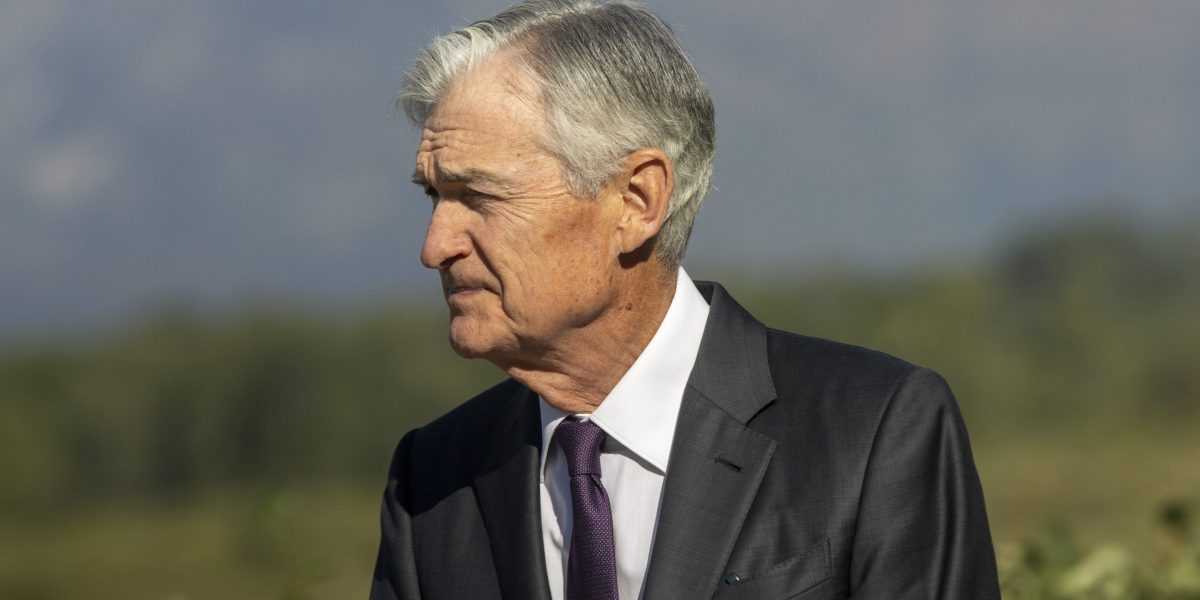
Jerome Powell, the 72-year-old chair of the Federal Reserve, is not the kind of guy you’d expect to see flashing across Instagram and Tiktok to the tune of a high-saturated techno remix. Yet, his image has broken containment over the last few days, as Gen Z has turned the famously taciturn technocrat into a symbol of defiance of the second Trump era, clad with reverent edits usually reserved for K-Pop stars. 

It’s been quite a development for the central banker that Trump initially chose as the replacement for Janet Yellen, who would go on to become Joe Biden’s Treasury Secretary. Trump was reported back in 2017 to appreciate that Powell had a “central casting” air to him, but the longtime Washingtonian surprised onlookers over the next several years by maintaining and even extending Yellen’s focus on the “full employment” side of the Fed’s dual mandate. 

In August 2020, Powell revealed that the Fed had revised its monetary policy framework to emphasize the “broad-based and inclusive goal” of maximum employment, running the economy as hot as it took to get all Americans back to work. Critics soon pounced, warning of the risk of higher inflation, and Powell’s series of aggressive rate hikes in 2022 and 2023 made this policy a close-but-distant memory. Still, during the period known as “the Great Resignation,” when labor had the most leverage to command salary hikes in a generation, Jerome Powell was a millennial-era hero

It looks like Gen Z is discovering what their older siblings did, half a decade ago.

One manifestation of the trend began with a video made by Democratic strategist and popular YouTuber Keith Edwards. Riffing on the “We are Charlie Kirk” song that conservatives championed after the death of the right-wing activist, Edwards decided to flip the script and make it “We are Jerome Powell.”

We are Jerome Powell, we carry the line,” the voice of a man wistfully moans. “Not to a man – but to law and time.”

Edwards said he used AI to generate both the lyrics and the video itself. 

“I personally believe if you look at the memes from 2016, they were very liberal-coded,” Edwards told Fortune. “I think that’s flipped. Conservative ideas travel faster on the internet now.”

For Edwards, the Powell meme is a tactical necessity in what he describes as a literal “information war.”

“We are at war,” Edwards said. “When you’re in war, you grab the biggest weapon you can and you fire it. I’m going to pull every single grenade I can and throw it.”

In this context, Powell is the “grenade.”

After Powell released a rare video statement confirming that the Justice Department had subpoenaed him over Federal Reserve office renovations, and explicitly framed the inquiry as political pressure tied to his refusal to cut interest rates faster, he emerged online as an unlikely symbol of resistance. 

Edwards explained that, to him, Powell represents a vanishing archetype: the technocratic figure who still believes in institutional norms and does things “by the book.” It’s a similar and yet different Powell boomlet to the pandemic “maximum employment” era, when the Georgetown figurehead was arguably woke in his commitment to getting every American back to work.

The internet—or more specifically, Gen Z—decided that Edwards’ video “went hard,” as it were. They’ve now taken to making fancams with videos of Powell looking tough; him posing in a sleek suit, him giving Trump a dirty look as they both stand around in hardware hats. This recalls another #resistance hero who took on an almost Marlboro man-style American toughness in meme world: the former FBI chief and special counsel, Robert Mueller.

According to Aiden Walker, a researcher who specializes in internet culture, the appeal is more that Powell doesn’t look cool. He suggested the “alchemy” lies in the contrast: Powell is both “venerable” and “unassuming,” and placing that persona into a fan cam typically reserved for K-Pop idols or action stars has a “gently subversive irony” to it.

Powell is also very “authentic to himself,” Walker said, and Gen Z loves authenticity (or, like Trump, they love the central casting aspect of the gray-haired politico).

“He’s an old banker, he’s been around the block,” Walker said. As an example, he pointed out the moment of Powell and Trump in their construction hats as they argue over the renovation numbers to the building. 

“It’s his posture there,” Walker said. “He’s clearly not a guy who wears construction hats, but that’s what they’re doing, and he’s very true to himself, and I think people online love that in a figure.” 

But there is also a deeper shift in how the public relates to the Fed. We are no longer in an era where the Federal Reserve is a black box to everyone but Wall Street. Commission-free apps like Robinhood and the exploding popularity of pandemic-era “meme stocks” and spaces like r/WallStreetBets on Reddit have made something of a culture around retail investing in the 2020s.

The numbers back that up. Prior to the pandemic, retail order flow rarely exceeded 10% of daily U.S. equity trading.  By contrast, J.P. Morgan reports that retail activity reached an all-time-high of 36% of total order flow on April 29, 2025. 

“There are so many more retail investors today,” Walker noted. “Twenty-somethings own a couple of stocks on Robinhood. They feel much closer to the market.”

The result is a new kind of familiarity with figures like Powell, even among left-leaning Gen-Zers who might otherwise distrust the Federal Reserve.

“There’s a fandom logic now,” Walker said. “And he’s kind of a fun, ironic figure, because he clearly doesn’t want to be famous necessarily. It’s just kind of been forced.”

AI and accelerationism 

In 2016–a time on many people’s minds as the internet celebrates the origin of a slower internet culture—a political meme might have taken days or weeks to saturate the culture. In 2026, AI-generated content has compressed that cycle into hours.

“AI generation makes it a lot easier and faster to make your Jerome Powell edit,” Walker said. “You can watch a clip of Powell, and within two hours, have your edit responding to it.” This speed doesn’t just accelerate the meme, but it changes its nature and the nature of its subject, where news events become absurd spectacles of participation.

In postmodern theory, this is what is known as “accelerationism.” By feeding a stodgy institutional figure like Powell into the AI-meme deluge, the internet hijacks the Federal Reserve’s image and accelerates it past the point of professional control. The process of taking a serious person out of their serious context—what French psychoanalysts Gilles Deleuze and Felix Guattari called deterritorialization—plugs them into a high-speed digital world where they are fashioned into a particular vibe. In this framework, the meme is what psychoanalysts call a “hyperstition,” a digital fiction that, through the sheer power of speed and repetition, begins to dictate how we perceive the actual stability of our institutions. Philosophers sometimes use the example of cyberspace to explain superstition, pointing to how science-fiction author William Gibson’s imagined cyberpunk world shaped the ethos of what actually became the internet. 

Despite the ultimate one-dimensionality or “frivolousness” of the Powell meme, Walker said he is glad that Gen Z is paying attention.

“I’d say there’s a lot of people who probably saw a reel like that, and maybe Googled who he was or what he said,” Walker said. “We are Jerome Powell, it out-ironies the ironic post because it makes it sincere again, because we enjoy him.” 

This story was originally featured on Fortune.com


Source link

Continue Reading

Business

EU set to halt U.S. trade deal over Trump’s latest tariff threat

Published

on


European Union lawmakers are poised to block approval of the EU’s trade deal with the US over President Donald Trump’s vow to impose tariffs on countries that supported Greenland in the face of American threats.  

Manfred Weber, president of the European People’s Party, the largest political group in the European Parliament, said on Saturday that agreement with the US is no longer possible.

“The EPP is in favor of the EU-US trade deal, but given Donald Trump’s threats regarding Greenland, approval is not possible at this stage,” Weber posted on social media. He added that the EU agreement to lower tariffs on “US products must be put on hold.” 

The EU-US trade agreement, which European Commission President Ursula von der Leyen struck with Trump last summer, has already been implemented but still needs a nod from parliament. If EPP lawmakers join left-leaning political groups, it’s likely they’ll have enough votes to delay or block approval.  

Read More: Trump to Impose Tariffs on 8 European Nations Over Greenland

The trade agreement set a 15% US tariff for most EU goods in exchange for a pledge by the EU to eliminate duties on US industrial goods and some agricultural products. Von der Leyen, who oversees trade negotiations for the EU, made the deal in the hopes of avoiding a full-blown trade war with Trump.

A vocal faction of EU lawmakers have long railed against the agreement, arguing it was too lopsided in favor of the US. That anger has deepened as the US expanded a 50% tariff on steel and aluminum to hundreds of additional EU products after the July accord.

This story was originally featured on Fortune.com


Source link
Continue Reading

Business

Trump blasts Dimon, threatens to sue JPMorgan over debanking

Published

on


President Donald Trump railed against JPMorgan Chase & Co. and its leader Jamie Dimon, threatening to sue the banking giant over his claim that he was debanked after the Jan. 6, 2021, Capitol riot.

In a post Saturday, Trump responded to a Wall Street Journal story that said Trump offered Dimon the role of Federal Reserve chief several months ago in a way that Dimon interpreted as a joke. 

“There was never such an offer and, in fact, I’ll be suing JPMorgan Chase over the next two weeks for incorrectly and inappropriately DEBANKING me after the January 6th Protest,” Trump wrote. 

He didn’t elaborate. JPMorgan didn’t immediately respond to a weekend request for comment.

Trump claimed in August that JPMorgan “discriminated against me very badly” when he alleged the bank asked him to close accounts he held for decades, an action he believes was connected to his supporters stormed the Capitol to stop the 2021 certification of President Joe Biden’s victory. The bank later said it’s facing reviews, investigations and legal proceedings tied to the Trump administration’s fight against “debanking.”

Dimon said earlier this week he wouldn’t consider being the Fed chair.

In response to a question Thursday at a US Chamber of Commerce event about whether he’d consider taking over the central bank, Dimon said, “Chairman of the Fed, I’d put in the absolutely, positively no chance, no way, no how, for any reason.” 

As for running the Treasury, “I would take the call,” he said.

Trump has not yet said who he will nominate to succeed Fed Chair Jerome Powell, whose term as Chair ends in May. Trump said Friday he has a pick in his mind but declined to identify them.

Read More: Trump Voices Reluctance at Nominating Hassett as Fed Chair

Dimon’s comments follow a public back-and-forth between Dimon and Trump earlier this week over the president’s attacks on the Fed, including criminal subpoenas issued by the Justice Department over the renovation of the Fed’s headquarters. Dimon said Tuesday that chipping away at Fed independence is “not a great idea,” and could lead to higher inflation and interest rates over time.

Dimon has pushed back in the past against attempts by Trump’s allies to suggest that the bank’s customer decisions are biased.

“We do not debank people’s religious or political affiliations,” Dimon told Fox Business in December.


Source link

Continue Reading

Business

Iran’s supreme leader concedes thousands killed in unrest

Published

on


Iran’s Supreme Leader Ayatollah Ali Khamenei on Saturday said “several thousand people” died in this month’s anti-government demonstrations, his first acknowledgment of the deadly scale of the unrest.  

Some of those were killed “brutally and inhumanely,” Khamenei said without offering detail in a public meeting broadcast on state TV. He accused the US and Israel of aiding the killings and said the Islamic Republic has evidence to support the claim.

Iran doesn’t intend to push the country toward war, but won’t allow either domestic or international criminals to go unpunished, Khamenei said. 

He said US President Donald Trump was culpable for “deaths, damage, and accusations he has inflicted on the Iranian people,” and that Washington’s broader policy goal was to place Iran under military, political, and economic domination.

The toll suggested by Khamenei was in line with estimates from human rights groups and others that some 3,500 people had perished. The groups estimate that more than 22,000 people have been detained. 

Trump told Politico that Iran needs new leadership and said Khamenei is guilty of “the complete destruction of the country and the use of violence at levels never seen before.”

The protests have taken place during a record long internet blackout for Iran’s population of about 92 million people. 

Read more: Trump Signals He’ll Hold Off Another Attack on Iran for Now 

Earlier, local media reported that internet connectivity had been partially restored, even as most residents appeared to remain largely cut off from the outside world for a ninth day.

Iran’s government shut down internet and mobile phone services on Jan. 8 to quell rising unrest sparked by a currency crisis late last month. 

“Internet access has now been restored for some subscribers,” the semi-official Mehr news agency said without specifying which restrictions had been lifted or whether users had regained access to international platforms and services.   

The semi-official Fars news agency also reported that mobile text messages had been reactivated after being blocked earlier.

The internet traffic monitoring group NetBlocks said there had been a “very slight rise” in connectivity on Saturday, adding that overall access remained at about 2% of normal levels, with “no indication of a significant return.”

Users in Iran appeared largely offline as of early Saturday afternoon local time, with few signs of activity evident on platforms such as Telegram, Instagram, and X — services they previously accessed via virtual private networks (VPNs). 

Near‑total communications blackouts have become a familiar tool for Islamic Republic authorities during critical situations, from this month’s nationwide protests to the June conflict with Israel. That’s cut off much of the population from the global internet, and diverted users onto a government‑controlled domestic network that operates independently of the wider web.

NetBlocks on Friday said the current blackout had surpassed the internet shutdown imposed during the country’s 2019 protests.

Read more: Iran’s Exiled Prince Is Buoyed by Nation Desperate for Change 

Earlier on Saturday, Fars cited authorities who weren’t identified as saying that internet and other communications services were being gradually restored, but that some restrictions would remain in place “as long as security conditions require.”  


Source link

Continue Reading

Trending

Copyright © Miami Select.