Connect with us

Business

Warren Buffett’s son says he didn’t know his dad was a billionaire until he was in his 20s

Published

on


Warren Buffett is synonymous with ambition, success, and fortune. The former Berkshire Hathaway CEO was once the world’s richest man, famously dethroning Bill Gates in 2008 with a $62 billion net worth, and held the spot for quite some time. 

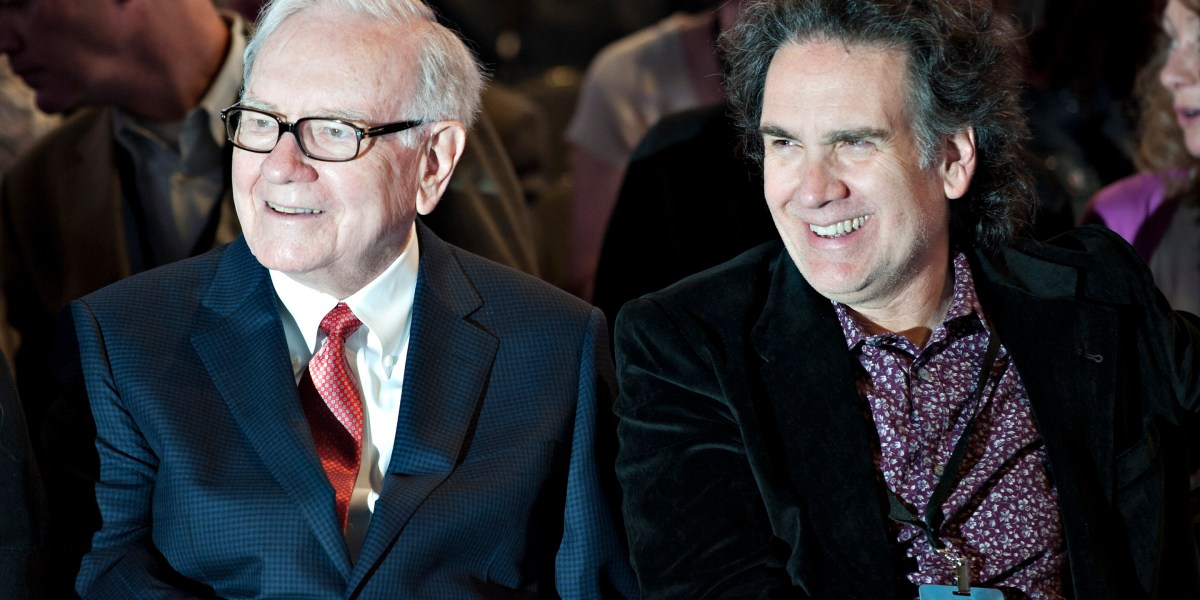
But one of the people closest to him didn’t even know how wealthy and successful Buffett was: his own son, Peter Buffett. 

Peter, now 67, didn’t realize his own father’s status until he was in his 20s. The realization happened when Peter saw his dad’s name on the Forbes list of the richest Americans, according to a 2013 Forbes interview with both Peter and Warren Buffett.

“I’m not kidding. It was when I was in my 20s that my mom and I talked at some point, because there he was, on this list,” Peter said. “And we laughed about it, because we said, ‘Well, isn’t it funny? You know, we know who we are, but everybody’s treating us differently now.’” 

Peter is the youngest of Warren Buffett’s three children with his first wife, Susan Alice Buffett. Peter is an American musician, composer, author, and philanthropist who has won a regional Emmy Award, become a New York Times best-selling author, and served as co-chair of the NoVo Foundation. But Peter recalled that conversation with his mom, with little effect on his outlook or perception of his family.

“It was a fascinating switch, although not a huge one because we didn’t live in that world or a cultural framework where there was a lot of wealth being shown,” Peter said. “Our friends were as surprised as I was.”

Warren Buffett backed up his son, saying that by the time his children found out just how rich they were, they had already formed their own personalities and paths.

“The kids were formed by that time, and they knew who their friends were, and their friends were their friends because they liked ’em, and not because they were the rich kid on the block or anything of the sort,” Warren Buffett said. 

Warren Buffett’s net worth and outlook on money

While Warren Buffett may no longer be the world’s richest man, he is still very much a billionaire, worth about $145 billion, making him the 10th wealthiest person in the world.

Still, Buffett has never been much of one to brag about money—and it’s not how he defines success. 

“Greatness does not come about through accumulating great amounts of money, great amounts of publicity or great power in government,” Buffett wrote in his final Berkshire Hathaway shareholder letter published in November.

The 95-year-old “Oracle of Ohama,” known as one of the most successful investors of all time, also lives a very frugal life. He eats McDonald’s, drives a beat-up old car, and still lives in his modest Nebraska home, which he bought for just $31,500 in 1958. His license plate once read “THRIFTY.” Rather, he says he prioritizes helping others using his fortune, which he will ultimately pass down to his children, who will use it for their respective philanthropic organizations.

“When you help someone in any of thousands of ways, you help the world,” Buffett wrote. “Kindness is costless but also priceless. Whether you are religious or not, it’s hard to beat The Golden Rule as a guide to behavior…Keep in mind that the cleaning lady is as much a human being as the Chairman.”


Source link

Continue Reading

Business

California’s billionaires tax isn’t the solution, budget expert says. He blames a ‘perfect storm of craziness’ for this populist climate

Published

on


California’s proposed wealth tax is coming in for a lot of criticism these days. From Gov. Gavin Newsom, who counts many billionaires as friends and donors and yet was raised by a single mother juggling three jobs, to Anduril founder Palmer Luckey‘s vociferous objections, to the Google guys Larry Page and Sergey Brin voting with their feet, much of the Golden State’s ultrawealthy is objecting to this policy. But what if the policy wouldn’t even work that well, once implemented? That’s what budget expert Kent Smetters thinks.

The Wharton School professor and faculty director of the Penn Wharton Budget Model (PWBM), speaking to Fortune from his office in Philadelphia, recently argued that the measure is an inefficient revenue tool born from a “perfect storm of craziness” in the current economic and social climate that makes “populist” ideas like this so sticky. As the state grapples with a significant budget shortfall, Smetters warns that taxing the ultrawealthy would simply fail to provide the expected windfall. Blame behavioral economics and “the money illusion,” he said.

Smetters’ PWBM is widely used in Washington DC to analyze the fiscal and macroeconomic effects of federal policy proposals.​ And he brings a lot of Beltway policy chops to the role, with a background that includes serving as an economist at the Congressional Budget Office and as Deputy Assistant Secretary for Economic Policy at the U.S. Treasury. He has advised Congress on dynamic scoring, and policymakers from both parties consult him while drafting major tax and spending legislation. Smetters has described much of the PWBM’s work as private analysis, even a “sandbox,” for legislators to workshop ideas before bills are written.​ He lives and breathes economic policy.

According to Smetters, the primary issue with wealth taxes is that they rarely meet revenue expectations. “When you think about the wealth tax itself,” he told Fortune, “it’s not really a super efficient way of raising money over time, and it also often doesn’t actually raise as much revenue as people think.” He noted that many countries that adopted a wealth tax “gave up on it, partly just because it raised a lot less revenue than what they were thinking.”

Examples are legion of countries abandoning wealth-targeted taxes, from Austria in 1994 to Denmark and Germany in 1997, to France in 2018. As of June 2024, only four countries in the OECD had a wealth tax, and the U.S. does not have any on the books; it’s unclear whether any would be constitutional. Smetters noted that almost all repealed wealth taxes raised an amount less than or equal to 0.3% of GDP, often much less, showing his point that there just isn’t as much money in them as people think. Also, the administrative costs were high relative to revenue, especially due to asset valuation and avoidance. Noting that most repeals were permanent, not experimental reversals, he said France was an exception, replacing a general wealth tax with a narrow real-estate tax.

Smetters cited some PWBM research that asked the question: what would happen if it were illegal to be a billionaire, as some far-left figures such as Zohran Mamdani have previously suggested. If the federal government seized every dollar from every individual above $999 million at current market value, the resulting “wealth grab” would only fund the federal government for about seven to eight months, he said. “What people don’t realize is [there’s] just not as much money there as people think.”

A Different Path Forward

Instead of “jacking up” income taxes or implementing a wealth tax that targets illiquid assets—such as sports teams or startups—Smetters suggested that California could do with “broader participation in tax revenue,” recommending that the state consider more stable, broad-based options like a large sales tax or a value added tax (VAT). Without such discipline, Smetters warned that the state’s reliance on a highly progressive and volatile tax system will continue to leave it vulnerable to economic shifts.

Some progressive policy analysts and economists argue that PWBM, under Smetters’ direction, builds in assumptions that overstate the growth costs of deficits and taxes while understating the benefits of public investment, which they claim biases the model against expansive social spending.. If anything, Smetters argues, the PWBM does the opposite. Critics argue this biases PWBM’s results against expansive social spending, whereas Smetters offers examples of spending that grows the economy if designed well, including investments in pre-K education, healthcare, the environment, and some public goods. PWBM analysis also shows that, contrary to popular opinion, more high-skill immigration generally raises all wages, including for native-born workers.

Smetters said that he has a free-market bias somewhat, in the sense that he jokingly calls himself “80% libertarian,” meaning he generally thinks free market principles are the most effective at increasing human welfare, with some regulatory exceptions including pollution control and some human capital investments, especially at younger ages. In contrast, a lot of government spending today goes higher-income and older people.

Could the economy actually be harmed, Fortune asked Smetters, if the massively improved standard of living means that life is full of annoying, hidden expenses, prompting a widespread dissatisfaction with the economy and a populist thirst for wealth taxes? Smetters noted that even some conservative economists such as Milton Friedman and Martin Feldstein (his own dissertation advisor), had a very strong free-market orientation, “but they would basically agree that markets work well when you don’t deceive people and exploit people.”

A ‘Perfect Storm of Craziness’

When asked why he thinks there is such a push for a billionaires tax at the moment, Smetters described what he saw as a “perfect storm of craziness” involving the rise of artificial intelligence (AI) and the influence of social media. The concentration in the S&P 500 is one thing, he said, with only 10 companies at the top really driving all the gains in the three-year bull market since ChatGPT was released, and an existential fear (driven on by tech billionaires) about AI coming to replace everyone’s job. Smetters said this was making people “unnecessarily anxious” that “we’re getting replaced by robots and so forth.”

Standing in front of a row of terminals working away on his budget analyses, Smetters insisted that “the reality is that AI is not going to be that as impactful as people think.” Pointing at the computers all around him, he noted, “I literally have models running right now, and so I am a big user of AI,” but many were “probably embellishing how much impact it’s going to potentially have.” He distinguished between the two types of technologies: labor-augmenting versus labor-replacing, insisting that AI would be the former.

The economist cited a well-known phenomenon in behavioral economics known as the “money illusion,” where people don’t believe that they have, in fact, actually gotten richer because they are shocked by higher prices they see around them. “The reality is that, in fact, we have a much higher standard of living than we had even 20 or 30 years ago,” Smetter said. He allowed that much of this is poorly measured, and some goods are even priced at zero. “I’m not saying there’s no problems,” he allowed, but he said it’s a much different world from when he was growing up, and his low-income family had to budget for, say, their car breaking down every so often.

There’s a similar, wider money illusion at work around American debates over who should be taxed and how much. “What people don’t realize is just how progressive the United States income tax system is,” he said, describing it as “by far” the most progressive in the OECD, meaning that the wealthy pay a disproportionate amount of tax in the U.S. and the poorer you are, the less you pay, at times even a negative tax burden due to programs like the earned income tax credit. It’s also true, he noted, that the U.S. raises a lot less revenue from its tax system than many other OECD counrties. “You know, it’s really hard to raise a lot of revenue with with such a progressive tax system … This whole idea of who pays taxes and the debates about it, it’s actually a very American debate.”


Source link

Continue Reading

Business

FAA urges pilots to exercise caution over eastern Pacific, citing ‘military activities’

Published

on


The Federal Aviation Administration on Friday urged U.S. aircraft operators to “exercise caution” when flying over the eastern Pacific Ocean near Mexico, Central America and parts of South America, citing “military activities” and possible satellite navigation interference.

The warning was issued in a series of Notices to Airmen (NOTAMs) issued by the FAA. They say, “Potential risks exist for aircraft at all altitudes, including during overflight and the arrival and departure phases of flight.” The alerts are in effect for 60 days. Such notices are issued routinely in any region where there are hostilities nearby.

The notices come after nearly four months of U.S. military strikesagainst boats in the Caribbean Sea and the eastern Pacific that the U.S. alleged were trafficking drugs. That campaign included 35 known strikes that killed at least 115 people, according to the Trump administration.

In November, the FAA warned all pilots to exercise caution when flying in the airspace over Venezuela “due to the worsening security situation and heightened military activity.”

On Jan. 3, the U.S. conducted a “large-scale strike” across Caracas, the capital of Venezuela. President Nicolás Maduro and his wife, Cilia Flores, were seized and transported to New York, where they face federal drug trafficking charges.

In December, a JetBlue flight from the small Caribbean nation of Curaçao halted its ascent to avoid colliding with a U.S. Air Force refueling tanker.

Join us at the Fortune Workplace Innovation Summit May 19–20, 2026, in Atlanta. The next era of workplace innovation is here—and the old playbook is being rewritten. At this exclusive, high-energy event, the world’s most innovative leaders will convene to explore how AI, humanity, and strategy converge to redefine, again, the future of work. Register now.


Source link

Continue Reading

Business

When AI decides how shareholders vote, boards need to rethink governance

Published

on


When one of the country’s largest financial institutions announced in early January that it would stop using external proxy advisory firms and instead rely on an internal AI system to guide how it votes on shareholder matters, the move was widely framed as an investor story. But its implications extend well beyond asset managers.

For corporate boards, the shift signals something more fundamental: governance is increasingly being interpreted not just by people, but by machines. And most boards have not yet fully reckoned with what that means.

Why Proxy Advisors Became So Powerful

Proxy advisory firms did not set out to become power brokers. They emerged to solve practical problems of scale and coordination.

As institutional investors came to own shares in thousands of companies, proxy voting expanded dramatically, covering everything from director elections and executive compensation to mergers and an array of shareholder proposals. Voting responsibly across that universe required time, expertise, and infrastructure that many firms did not have.

Proxy advisors filled that gap by aggregating data, analyzing disclosures, and offering voting recommendations. Over time, a small number of firms came to dominate the market. Their influence grew not because investors were required to follow them, but because alignment was efficient, defensible, and auditable.

Just as important, proxy advisors addressed a coordination problem that had left shareholders effectively voiceless. Their intellectual roots lie with activists such as Robert Monks, who believed dispersed ownership had allowed corporate power to become insulated from challenge. The aim was not to automate voting, but to help shareholders act collectively; to deliver uncomfortable truths to management that might otherwise never reach the top. Over time, however, the mechanisms built to carry that judgment increasingly substituted for it, as scale, standardization, and efficiency crowded out confrontation.

What began as a method to coordinate shareholder judgment increasingly became, in practice, a substitute for it.

Why the Model Is Changing

The forces that allowed proxy advisors to scale also exposed the tension between efficiency and judgment.

Standardized policies brought consistency, but often at the expense of context. Complex governance decisions, CEO succession timing, strategic trade-offs, board refreshment, were increasingly reduced to binary outcomes. Political and regulatory scrutiny intensified. And asset managers began asking a fundamental question: if proxy voting is a core fiduciary responsibility, why is so much judgment outsourced?

The result has been a gradual reconfiguration. Proxy advisors are moving away from one-size-fits-all recommendations. Large investors are building internal stewardship capabilities. And now, artificial intelligence has entered the picture.

What AI Changes, and What It Doesn’t

AI promises what proxy advisors once did: scale, consistency, and speed. Systems are designed to process thousands of meetings, filings, and disclosures efficiently.

But AI does not eliminate judgment. It relocates it.

Judgment now lives upstream, in model design, training data, variable weighting, and override protocols. Those choices are no less consequential than a proxy advisor’s voting policy. They are simply less visible.

Where proxy advisors once aggregated shareholder voice to challenge managerial power, AI risks making that challenge quieter, cleaner, and harder to trace.

For boards, this changes the audience for governance disclosures. It is no longer only human analysts reading between the lines. Increasingly, it is algorithms reading literally, historically, and without context, unless boards provide that context themselves.

The Governance Questions Boards Haven’t Been Asking

This shift raises a set of questions many boards have not yet fully engaged.

How are we being assessed? AI systems can draw from filings, earnings calls, websites, media coverage, and other public sources. Governance signals now accumulate continuously, not just during proxy season.

Where could we be misread? Language that works for human readers: nuance, discretion, evolving commitments, can confuse machines. Ambiguity may be interpreted as inconsistency. Silence can be read as risk.

And when something goes wrong, who is accountable? There is no universal appeals process for AI-informed proxy votes. Responsibility may ultimately rest with the asset manager, but escalation paths may be opaque, informal, or slow, particularly for routine votes.

Boards should assume that if an algorithm misinterprets their governance, there may be no analyst to call and no clear way to correct the record before a vote is cast.

Consider This Scenario

A company’s board chair shares a name with a former executive at another firm who was involved in a governance controversy several years earlier. An AI system scanning public information associates the controversy with the wrong individual, quietly elevating perceived governance risk ahead of director elections.

At the same time, the board delays CEO succession by a year to preserve stability during a major acquisition. The decision is thoughtful and intentional, but the rationale is scattered across filings, earnings calls, and investor conversations. The AI system flags the delay as a governance weakness.

Days before the annual meeting, a third-party blog posts speculative criticism of board independence. The claims are unfounded but public. The AI system ingests the content before any human review occurs.

The board never sees the errors. There is no analyst to engage, only a voting outcome to react to after the fact.

None of this requires bad actors or malicious intent. It is simply what happens when scale, automation, and ambiguity intersect.

What Boards Can, and Cannot, Do

Boards cannot control how asset managers design their AI systems. Nor should they try to optimize disclosures for algorithms.

But boards can govern differently.

Some boards are already experimenting with clearer narrative disclosures including more explicit explanations of governance philosophy, how trade-offs are made, and how judgment is exercised. Not because algorithms “care,” but because humans still design, supervise, and sometimes override these systems.

Clarity reduces the risk of misinterpretation. Consistency lowers the cost of human review. Context makes it easier for judgment to survive automation.

This does not mean boards should explain every decision publicly or eliminate discretion. Over-disclosure carries its own risks. But it does mean being deliberate about which judgments require context to be understood, and which cannot safely be left to inference.

Boards should also rethink engagement. Conversations with investors can no longer focus solely on policies and outcomes. They should include questions about process: where human judgment enters, what triggers review, how factual disputes are handled, and how quickly errors can be corrected.

This is not about mastering AI. It is about understanding where accountability lives when governance decisions are mediated by machines.

Governance in an Algorithmic Age

In an AI-assisted voting environment, some familiar assumptions no longer hold.

Silence is rarely neutral. Ambiguity is rarely benign. And consistency, across time, across platforms, across disclosures, will become a governance asset.

The shift matters now because proxy voting outcomes are increasingly shaped before boards realize a conversation needs to happen.

The boards that navigate this transition best will not be those optimizing for scores or checklists. They will be the boards that document judgment, explain trade-offs, and tell a coherent governance story that holds up whether it is read by a human analyst, a proxy advisor, or a machine.

That is not a technology challenge.

It is a governance one.

The opinions expressed in Fortune.com commentary pieces are solely the views of their authors and do not necessarily reflect the opinions and beliefs of Fortune.


Source link

Continue Reading

Trending

Copyright © Miami Select.