Connect with us

Business

Warren Buffett’s Berkshire Hathaway may have scored a ‘genius’ win-win in $10 billion acquisition that may be the last big deal of his career

Published

on


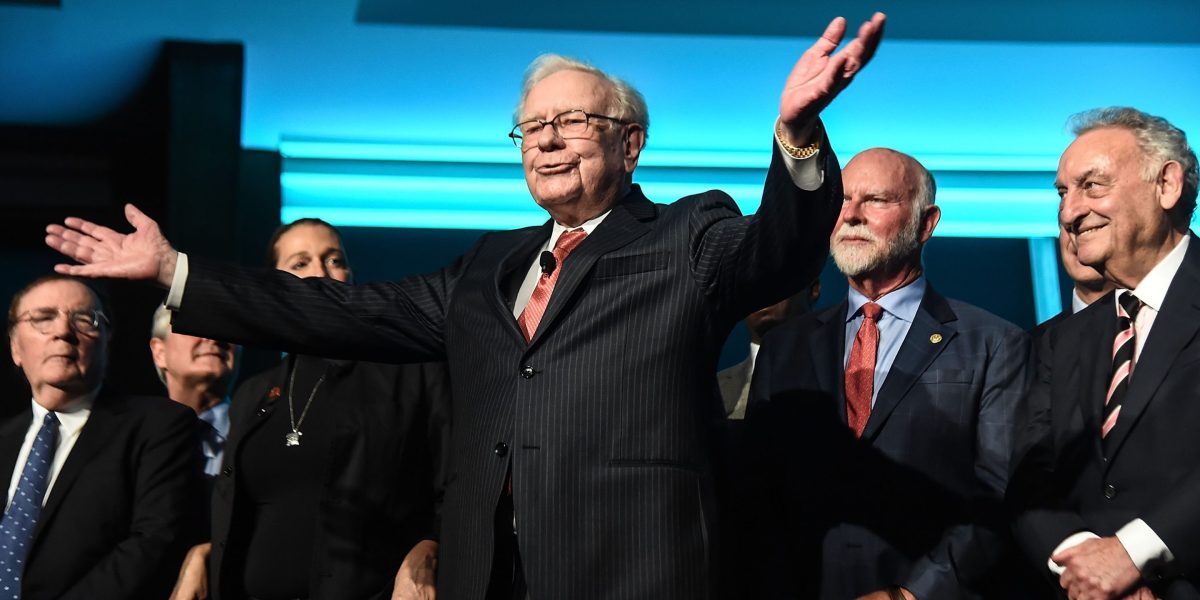
The big move by Warren Buffett’s Berkshire Hathaway to buy the chemicals business of oil giant Occidental Petroleum for nearly $10 billion is a double win for Berkshire, analysts say, in Buffett’s potential swan song deal before retiring at the end of December.

The Oct. 2 deal is the first-ever Berkshire announcement that quotes incoming CEO Greg Abel and doesn’t mention the current chief executive by name.

The OxyChem business will operate as a strong stand-alone for Berkshire, while the deal should boost Berkshire’s nearly 30% ownership of parent Oxy because the Houston company will use the bulk of the proceeds to pay off the high debt load that’s dragged down its stock in recent years, said Doug Leggate, Wolfe Research energy analyst.

“It’s genius. It’s certainly a win-plus for Berkshire because it also helps the company that they own 30% of,” Leggate said. “It’s completely self-serving, it’s logical, and—not in any nefarious way—definitely helpful.”

The $9.7 billion, all-cash OxyChem deal is Berkshire’s largest since scooping up insurance player Alleghany in 2022. In recent years, Berkshire has focused on selling off stakes of its investments and is sitting on a whopping mound of almost $350 billion in cash.

Leggate called OxyChem a steady potential cash cow that focuses on its growing chlor-alkali business manufacturing PVC (polyvinyl chloride) resin for piping, construction materials, medical equipment, and more. Its business largely moves with the housing market, which could soon benefit more from falling interest rates. “It’s a low-volatile, uncontroversial, niche business that has pricing power given the market structure,” he said.

The 95-year-old Buffett announced his retirement plans in May, although Abel has long been tapped as his eventual successor (you can read Fortune’s in-depth profile of Abel here).

Abel, the longtime Berkshire vice chairman of noninsurance operations, praised the OxyChem deal and Oxy CEO Vicki Hollub in the announcement.

“Berkshire is acquiring a robust portfolio of operating assets, supported by an accomplished team,” Abel said in the announcement. “We look forward to welcoming OxyChem as an operating subsidiary within Berkshire. We commend Vicki and the Occidental team for their commitment to Occidental’s long-term financial stability, as demonstrated by their plan to use proceeds to reinforce the company’s balance sheet.”

Berkshire did not immediately respond to interview requests.

Specifically, Oxy said, it will use $6.5 billion of the proceeds to reduce debt and bring its principal debt below the $15 billion target it set following the late 2023 acquisition of Permian Basin oil producer CrownRock for $12 billion.

Hollub said the deal helps Oxy focus on its core oil and gas business, especially in the booming Permian, while strengthening its financial position through debt reduction.

OxyChem represents almost 20% of Oxy’s total pretax income, bringing in more than $1 billion annually.

The Berkshire-Oxy courtship

The intimate Berkshire-Oxy relationship dates back to 2019 when Oxy entered a dramatic bidding war with the much larger Chevron to acquire oil producer Anadarko Petroleum.

Anadarko had chosen to sell to Chevron when Oxy came back with a larger $38 billion offer that included much more cash—too good for Anadarko to turn down.

That offer only came to fruition when Hollub took a whirlwind trek to Omaha to see Warren Buffett and his Berkshire team. After a 90-minute meeting, Buffett committed $10 billion to finance the merger in exchange for preferred shares and a stake in the expanded Oxy.

The agreements allowed Oxy to boost its cash offer to about 80% of the purchase price in its successful David-versus-Goliath bidding war against Chevron.

Since then, Buffett has increased Berkshire’s stake in Oxy to more than 28%.

But in the meantime, the big acquisitions left Oxy with a much greater debt load, especially going into the pandemic in 2020. Oxy barely survived the downturn, slashing its dividend from 79 cents per share each quarter down to just one penny. Since then, the dividend has risen back up to 24 cents—still much lower than in 2019.

The OxyChem deal largely solves the debt problem, although Oxy won’t begin redeeming Berkshire’s preferred shares—and their 8% annual interest—until 2029.

“In a world where crude [pricing] is softening, Oxy has too much debt. It’s unequivocal that it’s a good thing for Oxy to raise cash and pay down debt,” said Dan Pickering, founder and chief investment officer of Pickering Energy Partners consulting and research firm.

While Abel may already be in the dealmaking driver’s seat for Berkshire, Pickering said, “[Buffett] was the driver of the original Oxy investment, so I’m sure he was involved.”

Pickering compared Berkshire’s likely double win for both OxyChem and Oxy to a “circular loop” like the booming AI sector’s recent investments in one another’s companies: “AI is in a circular loop where Nvidia gives money to somebody, who gives money to somebody, who gives it back to Nvidia.”

The only problem for Oxy on Oct. 2, though, was its stock surprisingly fell by 7%. Oxy had outperformed the S&P Oil & Gas Exploration & Production ETF by about 2.5% this week through Oct. 1, largely baking in the deal before the Oct. 2 announcement.

Oxy is selling its chemicals business at a bit of a discount when the broader petrochemical sector is near a cyclical trough.

Pickering said there was some “sell the news dynamic” at play. But the sale also diminishes some hopes that Berkshire would buy Oxy in its entirety, potentially hurting the stock.

“By buying these pieces, the odds that he’s going to buy it all have gone down,” Pickering said.

A year ago, this reporter asked Hollub at what point Berkshire might control too much Oxy stock. Her response: “We would never consider it to be too much.”

Fortune Global Forum returns Oct. 26–27, 2025 in Riyadh. CEOs and global leaders will gather for a dynamic, invitation-only event shaping the future of business. Apply for an invitation.


Source link

Continue Reading

Business

Billionaire Marc Benioff challenges the AI sector: ‘What’s more important to us, growth or our kids?’

Published

on


Imagine it is 1996. You log on to your desktop computer (which took several minutes to start up), listening to the rhythmic screech and hiss of the modem connecting you to the World Wide Web. You navigate to a clunky message board—like AOL or Prodigy—to discuss your favorite hobbies, from Beanie Babies to the newest mixtapes.

At the time, a little-known law called Section 230 of the Communications Safety Act had just been passed. The law—then just a 26-word document—created the modern internet. It was intended to protect “good samaritans” who moderate websites from regulation, placing the responsibility for content on individual users rather than the host company.

Today, the law remains largely the same despite evolutionary leaps in internet technology and pushback from critics, now among them Salesforce CEO Marc Benioff. 

In a conversation at the World Economic Forum in Davos, Switzerland, on Tuesday, titled “Where Can New Growth Come From?” Benioff railed against Section 230, saying the law prevents tech giants from being held accountable for the dangers AI and social media pose.

“Things like Section 230 in the United States need to be reshaped because these tech companies will not be held responsible for the damage that they are basically doing to our families,” Benioff said in the panel conversation which also included Axa CEO Thomas Buberl, Alphabet President Ruth Porat, Emirati government official Khaldoon Khalifa Al Mubarak, and Bloomberg journalist Francine Lacqua.

As a growing number of children in the U.S. log onto AI and social media platforms, Benioff said the legislation threatens the safety of kids and families. The billionaire asked, “What’s more important to us, growth or our kids? What’s more important to us, growth or our families? Or, what’s more important, growth or the fundamental values of our society?”

Section 230 as a shield for tech firms

Tech companies have invoked Section 230 as a legal defense when dealing with issues of user harm, including in the 2019 case Force v. Facebook, where the court ruled the platform wasn’t liable for algorithms that connected members of Hamas after the terrorist organization used the platform to encourage murder in Israel. The law could shield tech companies from liability for harm AI platforms pose, including the production of deepfakes and AI-Generated sexual abuse material.

Benioff has been a vocal critic of Section 230 since 2019 and has repeatedly called for the legislation to be abolished. 

In recent years, Section 230 has come under increasing public scrutiny as both Democrats and Republicans have grown skeptical of the legislation. In 2019 the Department of Justice under President Donald Trump pursued a broad review of Section 230. In May 2020, President Trump signed an Executive Order limiting tech platforms’ immunity after Twitter added fact-checks to his tweets. And in 2023, the U.S. Supreme Court heard Gonzalez v. Google, though, decided it on other grounds, leaving Section 230 intact.

In an interview with Fortune in December 2025, Dartmouth business school professor Scott Anthony voiced concern over the “guardrails” that were—and weren’t—happening with AI. When cars were first invented, he pointed out, it took time for speed limits and driver’s licenses to follow. Now with AI, “we’ve got the technology, we’re figuring out the norms, but the idea of, ‘Hey, let’s just keep our hands off,’ I think it’s just really bad.”

The decision to exempt platforms from liability, Anthony added, “I just think that it’s not been good for the world. And I think we are, unfortunately, making the mistake again with AI.”

For Benioff, the fight to repeal Section 230 is more than a push to regulate tech companies, but a reallocation of priorities toward safety and away from unfettered growth. “In the era of this incredible growth, we’re drunk on the growth,” Benioff said. “Let’s make sure that we use this moment also to remember that we’re also about values as well.”


Source link

Continue Reading

Business

Palantir CEO says AI “will destroy” humanities jobs but there will be “more than enough jobs” for people with vocational training

Published

on


Some economists and experts say that critical thinking and creativity will be more important than ever in the age of artificial intelligence (AI), when a robot can do much of the heavy lifting on coding or research. Take Benjamin Shiller, the Brandeis economics professor who recently told Fortune that a “weirdness premium” will be valued in the labor market of the future. Alex Karp, the Palantir founder and CEO, isn’t one of these voices. 

“It will destroy humanities jobs,” Karp said when asked how AI will affect jobs in conversation with BlackRock CEO Larry Fink at the World Economic Forum annual meeting in Davos, Switzerland. “You went to an elite school and you studied philosophy — I’ll use myself as an example — hopefully you have some other skill, that one is going to be hard to market.”

Karp attended Haverford College, a small, elite liberal arts college outside his hometown of Philadelphia. He earned a J.D. from Stanford Law School and a Ph.D. in philosophy from Goethe University in Germany. He spoke about his own experience getting his first job. 

Karp told Fink that he remembered thinking about his own career, “I’m not sure who’s going to give me my first job.” 

The answer echoed past comments Karp has made about certain types of elite college graduates who lack specialized skills.

“If you are the kind of person that would’ve gone to Yale, classically high IQ, and you have generalized knowledge but it’s not specific, you’re effed,” Karp said in an interview with Axios in November. 

Not every CEO agrees with Karp’s assessment that humanities degrees are doomed. BlackRock COO Robert Goldstein told Fortune in 2024 that the company was recruiting graduates who studied “things that have nothing to do with finance or technology.” 

McKinsey CEO Bob Sternfels recently said in an interview with Harvard Business Review that the company is “looking more at liberal arts majors, whom we had deprioritized, as potential sources of creativity,” to break out of AI’s linear problem-solving. 

Karp has long been an advocate for vocational training over traditional college degrees. Last year, Palantir launched a Meritocracy Fellowship, offering high school students a paid internship with a chance to interview for a full-time position at the end of four months. 

The company criticized American universities for “indoctrinating” students and having “opaque” admissions that “displaced meritocracy and excellence,” in their announcement of the fellowship. 

“If you did not go to school, or you went to a school that’s not that great, or you went to Harvard or Princeton or Yale, once you come to Palantir, you’re a Palantirian—no one cares about the other stuff,” Karp said during a Q2 earnings call last year.

“I think we need different ways of testing aptitude,” Karp told Fink. He pointed to the former police officer who attended a junior college, who now manages the US Army’s MAVEN system, a Palantir-made AI tool that processes drone imagery and video.  

“In the past, the way we tested for aptitude would not have fully exposed how irreplaceable that person’s talents are,” he said. 

Karp also gave the example of technicians building batteries at a battery company, saying those workers are “very valuable if not irreplaceable because we can make them into something different than what they were very rapidly.”

He said what he does all day at Palantir is “figuring out what is someone’s outlier aptitude. Then, I’m putting them on that thing and trying to get them to stay on that thing and not on the five other things they think they’re great at.” 

Karp’s comments come as more employers report a gap between the skills applicants are offering and what employers are looking for in a tough labor market. The unemployment rate for young workers ages 16 to 24 hit 10.4% in December and is growing among college graduates. Karp isn’t too worried. 

“There will be more than enough jobs for the citizens of your nation, especially those with vocational training,” he said. 


Source link

Continue Reading

Business

AI is boosting productivity. Here’s why some workers feel a sense of loss

Published

on


Welcome to Eye on AI, with AI reporter Sharon Goldman. In this edition…Why some workers feel a sense of loss while AI boosts productivity…Anthropic raising fresh $10 Billion at $350 billion valuation…Musk’s xAI closed $20 billion funding with Nvidia backing…Can AI do your job? See the results from hundreds of tests.

For months, software developers have been giddy with excitement over “vibe coding”– prompting desired software functions or features in natural language—with the latest AI code generation tools. Anthropic’s Claude Code is the darling of the moment, but OpenAI’s Codex, Cursor and other tools have also led engineers to flood social media with examples of tasks that used to take days and are now finished in minutes. 

Even veteran software design leaders have marvelled at the shift. “In just a few months, Claude Code has pushed the state of the art in software engineering further than 75 years of academic research,” said Erik Meijer, a former senior engineering leader at Meta

Skills honed seem less essential

However, that same delight has turned disorienting for many developers, who are grappling with a sense of loss as skills honed over a lifetime suddenly seem less essential. The feeling of flow—of being “in the zone”—seems to have vanished as building software becomes an exercise in supervising AI tools rather than writing code. 

In a blog post this week titled “The Grief When AI Writes All the Code,” Gergely Orosz of The Pragmatic Engineer, wrote that he is “coming to terms with the high probability that AI will write most of my code which I ship to production.” It already does it faster, he explained, and for languages and frameworks he is less familiar with, it does a better job. 

“It feels like something valuable is being taken away, and suddenly,” he wrote. “It took a lot of effort to get good at coding and to learn how to write code that works, to read and understand complex code, and to debug and fix when code doesn’t work as it should.” 

Andrew Duca, founder of tax software Awaken Tax, wrote a similar post this week that went viral, saying that he was feeling “kinda depressed” even though he finds using Claude Code “incredible” and has “never found coding more fun.” 

He can now solve customer problems faster, and ship more features, but at the same time “the skill I spent 10,000s of hours getting good at…is becoming a full commodity extremely quickly,” he wrote. “There’s something disheartening about the thing you spent most of your life getting good at now being mostly useless.” 

Software development has long been on the front lines of the AI shift, partly because there are decades of code, documentation and public problem-solving (from sites like GitHub) available online for AI models to train on. Coding also has clear rules and fast feedback – it runs or it doesn’t – so AI systems can easily learn how to generate useful responses. That means programming has become one of the first white-collar professions to feel AI’s impact so directly.

These tensions will affect many professions

These tensions, however, won’t be confined to software developers. White-collar workers across industries will ultimately have to grapple with them in one way or another. Media headlines often focus on the possibility of mass layoffs driven by AI; the more immediate issue may be how AI reshapes how people feel about their work. AI tools can move us past the hardest parts of our jobs more quickly—but what if that struggle is part of what allows us to take pride in what we do? What if the most human elements of work—thinking, strategizing, working through problems—are quietly sidelined by tools that prize speed and efficiency over experience?

Of course, there are plenty of jobs and workflows where most people are very happy to use AI to say buh-bye to repetitive grunt work that they never wanted to do in the first place. And as Duca said, we can marvel at the incredible power of the latest AI models and leap to use the newest features even while we feel unmoored. 

Many white-collar workers will likely face a philosophical reckoning about what AI means for their profession—one that goes beyond fears of layoffs. It may resemble the familiar stages of grief: denial, anger, bargaining, depression, and, eventually, acceptance. That acceptance could mean learning how to be the best manager or steerer of AI possible. Or it could mean deliberately carving out space for work done without AI at all. After all, few people want to lose their thinking self entirely.

Or it could mean doing what Erik Meijer is doing. Now that coding increasingly feels like management, he said, he has turned back to making music—using real instruments—as a hobby, simply “to experience that flow.”

With that, here’s more AI news.

Sharon Goldman
sharon.goldman@fortune.com
@sharongoldman

FORTUNE ON AI

As Utah gives the AI power to prescribe some drugs, physicians warn of patient risks – by Beatrice Nolan

Google and Character.AI agree to settle lawsuits over teen suicides linked to AI chatbots – by Beatrice Nolan

OpenAI launches ChatGPT Health in a push to become a hub for personal health data – by Sharon Goldman

Google takes first steps toward an AI product that can actually tackle your email inbox – by Jacqueline Munis

Fusion power nearly ready for prime time as Commonwealth builds first pilot for limitless, clean energy with AI help from Siemens, Nvidia – by Jordan Blum

AI IN THE NEWS

Anthropic raising fresh $10 Billion at $350 billion valuation. According to the Wall Street Journal, OpenAI rival Anthropic is planning to raise $10 billion at a roughly $350 billion valuation, nearly doubling its worth from just four months ago. The round is expected to be led by GIC and Coatue Management, following a $13 billion raise in September that valued the company at $183 billion. The financing underscores the continued boom in AI funding—AI startups raised a record $222 billion in 2025, per PitchBook—and comes as Anthropic is also preparing for a potential IPO this year. Founded in 2021 by siblings Dario Amodei and Daniela Amodei, Anthropic has become a major OpenAI rival, buoyed by Claude’s popularity with business users, major backing from Nvidia and Microsoft, and expectations that it will reach break-even by 2028—potentially faster than OpenAI, which is itself reportedly seeking to raise up to $100 billion at a $750 billion valuation.

Musk’s xAI closed $20 billion funding with Nvidia backing. Bloomberg reported that xAI, the AI startup founded by Elon Musk, has completed a $20 billion funding round backed by investors including Nvidia, Valor Equity Partners, and the Qatar Investment Authority, underscoring the continued flood of capital into AI infrastructure. Other backers include Fidelity Management & Research, StepStone Group, MGX, Baron Capital Group, and Cisco’s investment arm. The financing—months in the making—will fund xAI’s rapid infrastructure buildout and product development, the company said, and includes a novel structure in which a large portion of the capital is tied to a special-purpose vehicle used to buy Nvidia GPUs that are then rented out, allowing investors to recoup returns over time. The deal comes as xAI has been under fire for its chatbot Grok producing non-consensual “undressing” images of real people.

Can AI do your job? See the results from hundreds of tests. I wanted to shout-out this fascinating new interactive feature in the Washington Post, which presented a new study that found that despite fears of mass job displacement, today’s AI systems are still far from being able to replace humans on real-world work. Researchers from Scale AI and the Center for AI Safety tested leading models from OpenAI, Google, and Anthropic on hundreds of actual freelance projects—from graphic design and creating dashboards to 3D modeling and games—and found that the best AI systems successfully completed just 2.5% of tasks on their own. While AI often produced outputs that looked plausible at first glance, closer inspection revealed missing details, visual errors, incomplete work, or basic technical failures, highlighting gaps in areas like visual reasoning, long-term memory, and the ability to evaluate subjective outcomes. The findings challenge predictions that AI is poised to automate large swaths of human labor anytime soon, even as newer models show incremental improvement and the economics of cheaper, semi-autonomous AI work continue to put pressure on remote and contract workers.

EYE ON AI NUMBERS

91.8%

That’s the percentage of Meta employees who admitted to not using the company’s AI chatbot, Meta AI, in their day-to-day work, according to new data from Blind, a popular anonymous professional social network. 


According to a survey of 400 Meta employees, only 8.2% said they use Meta AI. The most popular chatbot was Anthropic’s Claude, used by more than half (50.7%) of Meta employees surveyed. 17.7% said they use Google’s Gemini and 13.7% said they used OpenAI’s ChatGPT. 


When approached for comment, Meta spokesperson pointed out that the number (400 of 77,000+ employees) is “not even a half percent of our total employee population.”

AI CALENDAR

Jan. 19-23: World Economic Forum, Davos, Switzerland.

Jan. 20-27: AAAI Conference on Artificial Intelligence, Singapore.

Feb. 10-11: AI Action Summit, New Delhi, India.

March 2-5: Mobile World Congress, Barcelona, Spain.

March 16-19: Nvidia GTC, San Jose, Calif.

April 6-9: HumanX, San Francisco. 


Source link

Continue Reading

Trending

Copyright © Miami Select.