
Business
War against Iran set to escalate as we approach six-week ‘TACO’ timetable, analysts say
Oil rose above $115 again this morning. The S&P 500 is down 7% year-to-date, and down 9% from its most recent peak. S&P futures were up 0.45% this morning, but, obviously, U.S. stocks are within a point of going into an official correction.
“The fog of war is getting thicker because of the likelihood of U.S. boots on the ground (the ‘bog of war’),” Ed Yardeni of Yardeni Research told clients over the weekend. “The S&P 500 is down 8.7% from its record high on January 27. It fell below its 200-day moving average last week. A 15% correction would take the index down to 5930.81. … No wonder investors went into fetal positions last week. The good news is that sentiment is getting very bearish, which is bullish from a contrarian perspective.”
- Asia and Europe were down across the board this morning.
- Keep an eye on the bond market: Prices have fallen, and yields have risen as investors got nervous about the effect of rising oil prices on the economy, Bloomberg reports.
ARE WE THERE YET?
Artificial General Hype: Why Jensen Huang’s ‘AGI’ claim doesn’t add up
Nvidia’s Jensen Huang said on a recent podcast that “We’ve achieved AGI,” meaning artificial general intelligence. But his definition of AGI was extremely limited: He was referring to an AI with the ability to start and grow a business to a valuation of $1 billion. In reality, the definition of artificial general intelligence is a hotly debated term in tech.
Most AI models have a “jagged” cognitive profile, Fortune’s Jeremy Khan writes. They may exceed most humans in some areas, like mathematics or factual recall, while dramatically trailing even average people in others, like learning from experience, maintaining long-term memories, or understanding social situations.
When Microsoft agreed to invest $10 billion into OpenAI in 2023, its contract with OpenAI contained a clause that defined AGI as a technology that could generate at least $100 billion in profits.
Today, OpenAI is nowhere near that mark. The company has reportedly told investors it made $13 billion in revenues last year but still managed to burn through $8 billion in cash. It does not expect to break even until 2030.
IRAN
Kharg Island or bust: Why the next six weeks could change everything
Thousands of American troops are arriving in the region in advance of what appears to be preparation for a ground invasion.
It is not clear what the goal will be. Keep the Strait of Hormuz open? Take over Iran’s major oil export terminal on Kharg Island? Seize Iran’s remaining uranium? President Trump has variously suggested any or all of those. The Washington Post reported any land operations would take weeks.
Trump told the Financial Times that his “preference would be to take the oil.” That move would require the seizure of Kharg Island.
Substack regards seizing Kharg as a near certainty: An AI-informed survey of analysts’ takes on Substack conducted by MarketStack concludes that “Substack treats it [invading Kharg] as near-certain.”
“Taking the island is the easy part — holding it, defending it, and preventing Iran from torching it or continuing to harass shipping via asymmetric warfare means is where every plan breaks down,” the analyst says. (MarketStack is run anonymously by a London-based investment banker whose identity is known to Fortune.)
Six-week TACO timetable?
Macquarie’s Thierry Wizman and Gareth Berry maintain that Trump wants the war wrapped up in roughly six weeks. (We’re one month in, so far.) If the war hasn’t ended as the six-week margin approaches, Trump may be forced to “TACO” (Trump Always Chickens Out) and go home, they say. If Tehran doesn’t capitulate, “and Trump remains married to a six-week deadline (give or take a few days), then it might be the U.S. that is forced to make the concessions. TACO has not happened yet. TACO may be for when the deadline is reached but is not met,” they predict.
Iran can expand the war into the Red Sea
With the Strait of Hormuz currently controlled by Iran, Tehran can use the Houthis, its proxy terror group in Yemen, to block the Bab el-Mandeb strait in the Red Sea—and thus cut off the other transit route for oil exports. The Houthis conducted a missile strike on Israel on Saturday to prove the point.
Saudi Arabia may still be able to get its tankers through the Red Sea by bribing the Houthis, Axios reports.
- Trump said Iran had conceded most of the 15 demands the U.S. made in its proposed peace document. But the war continues.
CHART OF THE DAY
TSA callouts peaked at 12.4% of staff last week
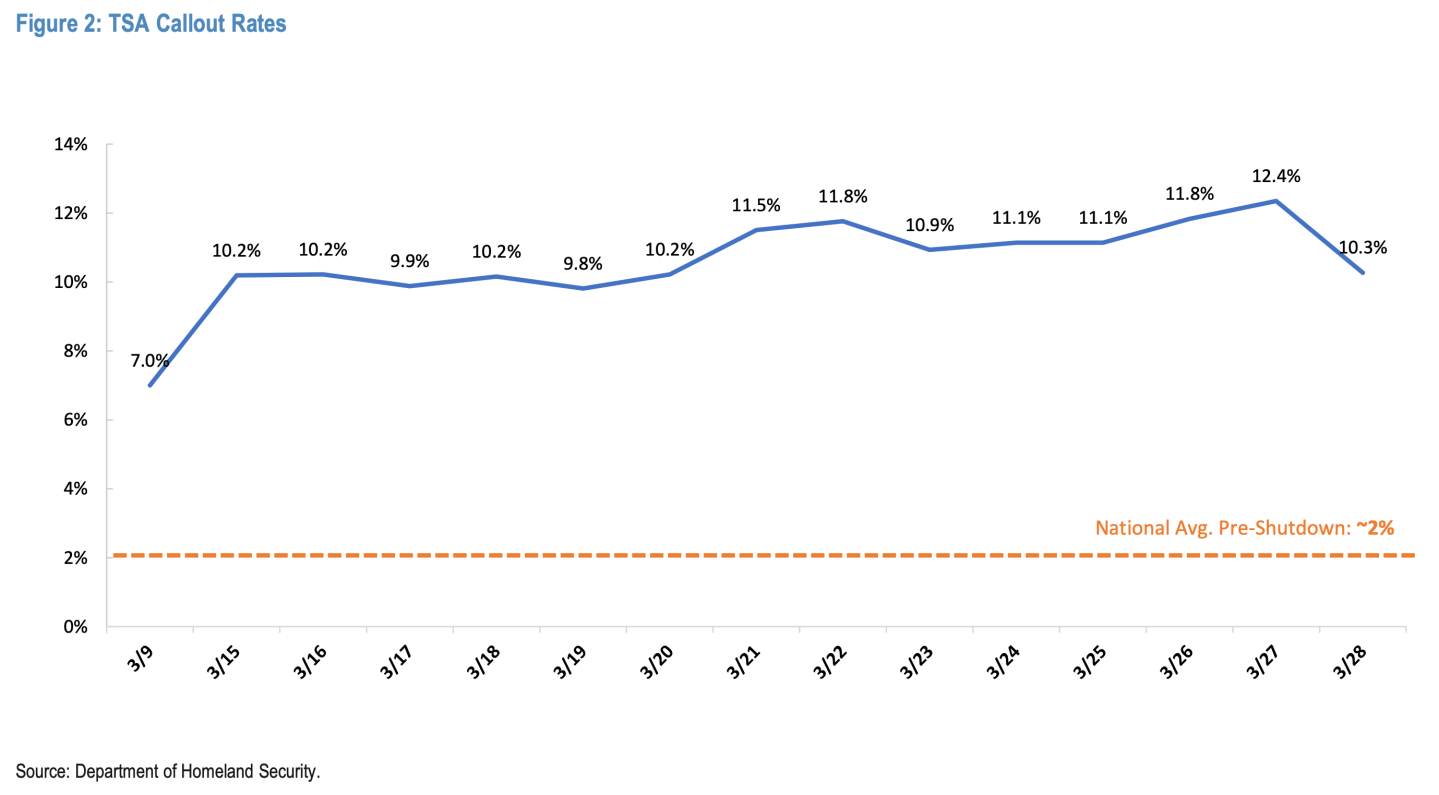
“There’s still no resolution to the partial government shutdown, but President Trump signed an executive order to pay TSA agents that should soon bring an end to the long airport security lines. TSA agent callout rates peaked at 12.4% on Friday, but moderated to 10.3% on Saturday and we expect them to continue trending downward with agent paychecks expected to start arriving as soon as Monday,” J.P. Morgan’s Cory A Carpenter and his colleagues said in a note seen by Fortune.
Callouts exceeded 25% or more at the airports serving Houston, Baltimore-Washington, New York’s JFK, Atlanta, New Orleans, and Philadelphia.
NUMBER OF THE DAY
60,000
The average of economists’ estimates for the number of new jobs created in the U.S. in March, according to Bloomberg’s survey. The real number of “non-farm payrolls”—as they are officially called—will be published on Friday. If it is below 60,000, that would indicate the American job market is weaker than expected.
MORE FROM FORTUNE
Meet the ex-Google CMO who quit with a seven-figure package by 28—he says getting promoted was easy because he just ‘disregarded all the rules’ – Orianna Rosa Royle
Dell’s CFO is using AI agents to run his finance team—and has helped the AI business go from $0 to $25 billion – Sheryl Estrada
Private equity is eying Asia’s healthcare funding gap as countries get wealthier and older – Angelica Ang
THE FRONT PAGES TODAY
Private capital: what are the risks? – FT
Russia welcomes arrival of oil tanker in Cuba after Trump softens approach to U.S. blockade – CNBC
What OpenAI’s erotica retreat really means – Axios
Iran’s Wealth Is Parked on London’s Billionaires’ Row – WSJ
The Oil Market Is Moving Into Demand Destruction Mode – Bloomberg
ONE MORE THING
More people stay silent on their savings
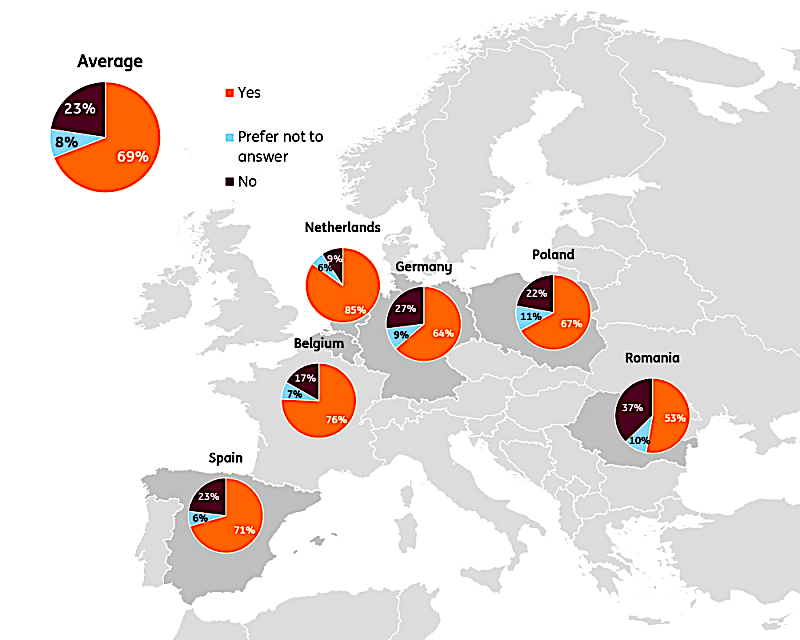
In what ING analyst Sebastian Franke interprets as an ominous sign, the percentage of consumers who refused to answer a question about whether their household had any savings rose to 8% across six countries surveyed in Europe. “The percentage that didn’t want to answer the question at all increased everywhere by between one and four percentage points,” he told clients.
The Dutch are Europe’s most ardent savers, ING’s survey says. Only 4% of Dutch people say they don’t earn enough to save. In bottom-of-the-ladder Romania, 21% say they cannot save.