Connect with us

Business

Walmart and Target are allegedly forcing employees to remove tags on apparel

Published

on


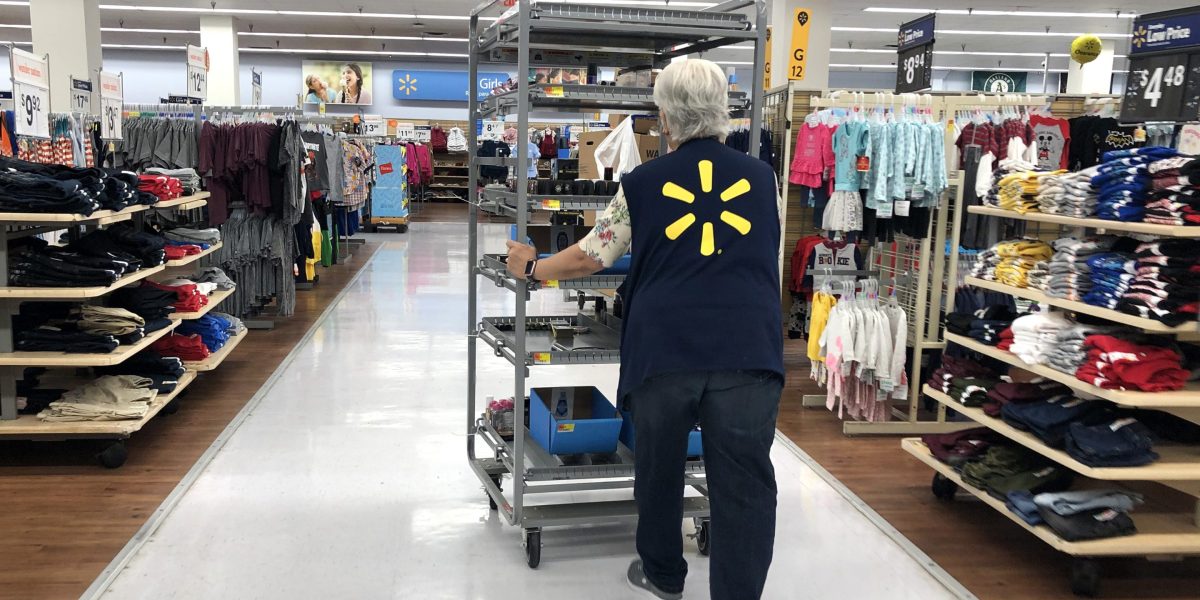
Walmart and Target have allegedly been directing employees to remove prices from tags on many in-store apparel items for several months, according to social media posts.

Posts across TikTok, Reddit, and Facebook from people claiming to be the retailers’ workers, as well as consumers, show workers removing the bottom portion of tags with prices and consumers discovering ripped tags in stores. Posts show whole displays of clothing for brands like Walmart’s Wonder Nation and Target’s Auden at stores across the country with altered tags.

Social media posts accusing both retailers of the practice began appearing online around the same time. These posters claim that removing price tags can allow the retailers to raise prices more easily, possibly in response to tariffs, and the moves have garnered criticism both from workers who say their shifts have been dedicated to the task and confused consumers who believe the retailers are attempting to conceal price increases.

Rag tag: In one TikTok from July 25, a poster claiming to be a Target employee bemoans “having to rip off EVERY individual price,” noting she spent “almost a whole 8-hour shift” performing the task. Another August 8 TikTok by someone saying they are a Target worker shows her tearing off the price tags on stacks of jeans, claiming that the retailer “can’t keep up with constant price changes.” Some Reddit users made similar assertions in a July 20 r/Target thread—claiming employees had to work past closing or come in at 4am to remove prices on tags.

@mykalamontalbano spent almost a whole 8 hour shift just doing this #democrat #tarrifs #work #target #fyp #foryou ♬ Vogue (Edit) – Madonna

A July 29 TikTok shows someone claiming to be a Walmart employee removing prices from apparel tagged with the Walmart-exclusive Child of Mine by Carter’s brand. “Processing/working freight takes longer just because of the tariffs and prices going up…I’m over it,” she said in the caption. Another post this week showed an apparent Walmart worker with a handful of ripped-off price tags.

@amandaleah2021 Can it just come in without prices already?!? Processing/ working freight takes longer just because of the tariffs and prices going up. . . I’m over it 😩😮‍💨😢 #walmart #teamlead #worklife #fyp ♬ Got Your Money (feat. Kelis) – Ol’ Dirty Bastard

Consumers have taken notice, posting their own videos, threads, and Facebook discussions questioning the torn-off price tags and whether they indicated inflated pricing, noting removed pricing deterred them from buying.

Retail Brew visited a New York City Target location on August 21 and 22 and found a significant number of removed prices across its private-label brands Auden, All in Motion, and A New Day. Many items weren’t re-stickered and had no indication of price. One item was not recognized by Target’s app when Retail Brew scanned its barcode.

At an Auden underwear display with most price tags removed, Retail Brew identified a handful of untouched tags whose scanned barcodes revealed prices $1–$2 higher than printed on the tag. Some products had been re-stickered with higher prices, with increases of $2–$5. Similarly, one TikTok filmed in a Walmart location shows stray unaltered tags with prices conflicting with higher on-rack pricing signs.

The price isn’t right: The tag changes at Walmart have come after the retailer enacted a new labeling process across all brands in its fashion department in May that led it to direct employees to remove select perforated price tags, using signs or stickers on the clothing displays to indicate the price, Walmart’s director of media relations, Jaeme Laczkowski, told Retail Brew. Some, not all, prices were changed as a result, but the company would not confirm if any were tariff-related changes. However, Walmart CEO Doug McMillon said last week in the retailer’s Q2 earnings call that “as we replenish inventory at post-tariff price levels, we’ve continued to see our costs increase each week.”

Walmart tags that differ from prices on the signs, as seen in TikToks, are a result of incorrect placement or a sign representing the highest price of items in the display, per Laczkowski. Walmart does not have in-store price check scanners, so consumers must use the Walmart app, ask an associate to scan the tags, or bring the tag to checkout to confirm the price for tags whose price has been removed.

Target did not respond to questions Retail Brew sent regarding the price tag removals.

When asked about tariff-related price increases on its Q2 earnings call last week, Richard H. Gomez, Target’s EVP and chief commercial officer, said the retailer will “take price as a last resort.” He noted the retailer will be “leaning into” its private-label brands to deliver value to customers.

The move by Target also comes just after the retailer ended its 10-year price-matching initiative in July that allowed consumers to receive a price match for items sold by Walmart and Amazon.

Ripped off: Jeff Sward, founding partner of retail merchandising consultancy Merchandising Metrics, and Liza Amlani, principal and founder of Retail Strategy Group, both told Retail Brew that price removal from tagged products is not a common practice.

Since retailers pay to label and price products, their subsequent removal is a “wasteful strategy,” Amlani wrote in an email, and Sward said doing so at such a high volume is a “highly inefficient, highly expensive process.”

The sole use of signs to indicate price for apparel at big box retailers can get “messy,” Sward said, and when there’s multiple styles on one fixture at different prices, or when products are moved to the wrong spot, it gets “messier and messier.”

“It’s just hard to believe that the big guys like Walmart and Target didn’t have a better mechanism for making this all happen,” he said. “Of course customers are going to get frustrated and maybe not buy stuff, [especially] if they think they’re in the process of being ripped off.”

This report was originally published by Retail Brew.

Fortune Global Forum returns Oct. 26–27, 2025 in Riyadh. CEOs and global leaders will gather for a dynamic, invitation-only event shaping the future of business. Apply for an invitation.


Source link

Continue Reading

Business

Khosla-backed Formulary raises oversubscribed $4.6 million seed round for its AI-powered private fund manager software

Published

on


Alfia Ilicheva came from the world of public markets, including four years at one of the world’s largest hedge funds, Bridgewater. But when she transitioned over to the private side, including serving as the CEO of an Apollo-backed investment platform, she realized the difficulty of fund administration for operations like private equity and venture capital. Instead of having access to real-time and accurate data like at Bridgewater, which can rely on publicly available information, this new world was filled with manually compiled and fragmented data subject to human error and inconsistent metrics.  “How could it be that hedge funds are so into the future and private capital markets are so backward,” she remembers thinking. 

As private markets explode and AI makes automation increasingly possible, Ilicheva saw an opportunity to build the next generation of fund administration software for everyone from venture capital outfits to PE giants like Apollo. After initially planning to bootstrap the project, which she named Formulary, Ilicheva was introduced to Hari Arul, a partner at Khosla Ventures, who immediately saw the appeal of the idea. Khosla is leading Formulary’s $4.6 million seed round, which Ilicheva says is three times oversubscribed, with participation from Human Ventures, Serena Williams’s venture firm, and others. 

In the red-hot field of private investments, buoyed by the rise of private credit and massively valued companies like SpaceX and OpenAI, fund administration may not be the most alluring area for innovation. But the ability to track investments, returns, and performance—and accurately convey the information to investors, or limited partners—is a necessary foundation. 

The existing options fall into two camps: the service side, or high-touch accounting companies, like SS&C and Citco, or the software side, like Carta. As Ilicheva interviewed general partners and former clients in her user research, she realized that nearly everyone was dissatisfied with the existing options to the point that most turned to shadow fund administration, where they would hire outside firms but keep their own books at the same time. “When you raise a fund, your dream is to generate alpha by investing capital, not redoing someone’s work,” Ilicheva said. 

Ilicheva planned to find a happy medium between the two models by leveraging AI to massively scale up the service approach, creating software for their own in-house accountants, which Ilicheva playfully calls bionic accountants. “They’re really focused on having a grip on the numbers and delivering service, but they’re not manually entering things in an Excel spreadsheet, which has been the industry’s burden for the past decades,” she said.  

The challenge in creating a tech-enabled services company, of course, is scale, with a pure SaaS model able to grow at a much faster clip. When I asked Khosla’s Arul how he thought about the approach, he said the key is to deliver the vast majority of the product through technology: “It’s important for any entrepreneur or any investor to look at an AI-enabled services business and say, the margin of how this business runs looks more like a technology company than a services company.” 

Arul said that while Khosla is not yet using Formulary, which is just now coming out of stealth, he’s optimistic for a future where tedious processes like ensuring data accuracy for LPs can be fully, reliably automated. Ilicheva mentioned one possible future use case for Formulary as drafting LP letters, which Arul wholeheartedly endorsed, along with a portal where investors could communicate directly with the system to understand the value of positions, fund deployment, and future capital calls. “[That] sounds pie in the sky relative to what the reality is today,” Arul said, “But it doesn’t feel out of reach.” 

Leo Schwartz
X:
 @leomschwartz
Email: leo.schwartz@fortune.com

Submit a deal for the Term Sheet newsletter here.

Joey Abrams curated the deals section of today’s newsletter. Subscribe here.

This story was originally featured on Fortune.com


Source link

Continue Reading

Business

Leaders at Davos are obsessing over how to use AI at scale

Published

on


  • In today’s CEO Daily: Fortune‘s AI editor Jeremy Kahn reports on the AI buzz at Davos
  • The big story: SCOTUS could upend Trump’s leverage to acquire Greenland.
  • The markets: Jolted by Trump’s renewed tariff threats.
  • Plus: All the news and watercooler chat from Fortune.

Good morning. I’m on the ground in Davos, Switzerland, for this year’s World Economic Forum. As Diane wrote yesterday, U.S. President Donald Trump’s arrival later this week along with a large delegation of U.S. officials eclipses pretty much every other discussion at Davos this year. But, when people here aren’t talking about Trump, they are talking about AI.

At Davos last year, the hype around AI agents was pierced by the shock of DeepSeek’s R1 model, which was released during the conference. We’ll see if a similar bit of news upends the AI narrative again this year. (There are rumors that DeepSeek is planning to drop another model.) But, barring that, business leaders seem to be less wowed by the hype around AI this year and more concerned with the nitty-gritty of how to implement the technology successfully at scale.

On Monday, Srini Tallapragada, Salesforce’s chief engineering and customer success officer, told me the company is using ‘forward deployed engineers’ to tighten feedback loops between customers and product teams. Salesforce is also offering pre-built agents, workflows, and playbooks to help customers re-engineer their businesses—and avoid getting stuck in “pilot purgatory.”

Meanwhile, at a side event in Davos called A Compass for Europe, that focused on how to restore the continent’s flagging competitiveness, AI was front-and-center. Christina Kosmowski, the CEO of LogicMonitor, told the assembled CEOs that to achieve AI success at scale, companies should take a “top down” approach, with the CEO and leadership identifying the highest value use cases and driving the whole organization to align around achieving them. Neeti Mehta Shukla, the cofounder and chief impact officer at Automation Anywhere, said it was critical to move beyond measuring automation’s impact only through the lens of labor savings. She gave specific customer examples where uplifting data quality, improving customer satisfaction, or moving more workers to new tasks, were better metrics than simply looking at cost per unit output. Finally, Lila Tretikov, head of AI strategy at NEA, said Europe has enough talent and funding to build world-beating AI companies—what it lacks is ambition and willingness to take big bets.

Later, I met with Bastian Nominacher, co-founder and co-CEO of process analytics software platform Celonis. He echoed some of these points, telling me that to achieve ROI with AI generally required three things: strong leadership commitment, the establishment of a center of excellence within the business (this led to an 8x higher return than for companies that didn’t do this!), and finally having enough live data connected to the AI platform.

For further AI insights from Davos, check out Fortune’s Eye on AI newsletter. Meanwhile, Fortune is hosting a number of events in Davos throughout the week. View that lineup here. And my colleagues will be providing more reporting from Davos to CEO Daily and fortune.com throughout the week.—Jeremy Kahn

Contact CEO Daily via Diane Brady at diane.brady@fortune.com

This is the web version of CEO Daily, a newsletter of must-read global insights from CEOs and industry leaders. Sign up to get it delivered free to your inbox.


Source link

Continue Reading

Business

Stock market today: Dow futures tumble 400 points on Trump’s tariffs over Greenland, Nobel prize

Published

on


U.S. stock futures dropped late Monday after global equities sold off as President Donald Trump launches a trade war against NATO allies over his Greenland ambitions.

Futures tied to the Dow Jones industrial average sank 401 points, or 0.81%. S&P 500 futures were down 0.91%, and Nasdaq futures sank 1.13%. 

Markets in the U.S. were closed in observance of the Martin Luther King Jr. Day holiday. Earlier, the dollar dropped as the safe haven status of U.S. assets was in doubt, while stocks in Europe and Asia largely retreated.

On Saturday, Trump said Denmark, Norway, Sweden, France, Germany, the United Kingdom, the Netherlands, and Finland will be hit with a 10% tariff starting on Feb. 1 that will rise to 25% on June 1, until a “Deal is reached for the Complete and Total purchase of Greenland.”

The announcement came after those countries sent troops to Greenland last week, ostensibly for training purposes, at the request of Denmark. But late Sunday, a message from Trump to European officials emerged that linked his insistence on taking over Greenland to his failure to be award the Nobel Peace Prize.

The geopolitical impact of Trump’s new tariffs against Europe could jeopardize the trans-Atlantic alliance and threaten Ukraine’s defense against Russia.

But Wall Street analysts were more optimistic on the near-term risk to financial markets, seeing Trump’s move as a negotiating tactic meant to extract concessions.

Michael Brown, senior research strategist at Pepperstone, described the gambit as “escalate to de-escalate” and pointed out that the timing of his tariff announcement ahead of his appearance at the Davos World Economic Forum this week is likely not a coincidence.

“I’ll leave others to question the merits of that approach, and potential longer-run geopolitical fallout from it, but for markets such a scenario likely means some near-term choppiness as headline noise becomes deafening, before a relief rally in due course when another ‘TACO’ moment arrives,” he said in a note on Monday, referring to the “Trump always chickens out” trade.

Similarly, Jonas Goltermann, deputy chief markets economist at Capital Economics, also said “cooler heads will prevail” and downplayed the odds that markets are headed for a repeat of last year’s tariff chaos.

In a note Monday, he said investors have learned to be skeptical about all of Trump’s threats, adding that the U.S. economy remains healthy and markets retain key risk buffers.

“Given their deep economic and financial ties, both the US and Europe have the ability to impose significant pain on each other, but only at great cost to themselves,” Goltermann added. “As such, the more likely outcome, in our view, is that both sides recognize that a major escalation would be a lose-lose proposition, and that compromise eventually prevails. That would be in line with the pattern around most previous Trump-driven diplomatic dramas.”


Source link

Continue Reading

Trending

Copyright © Miami Select.