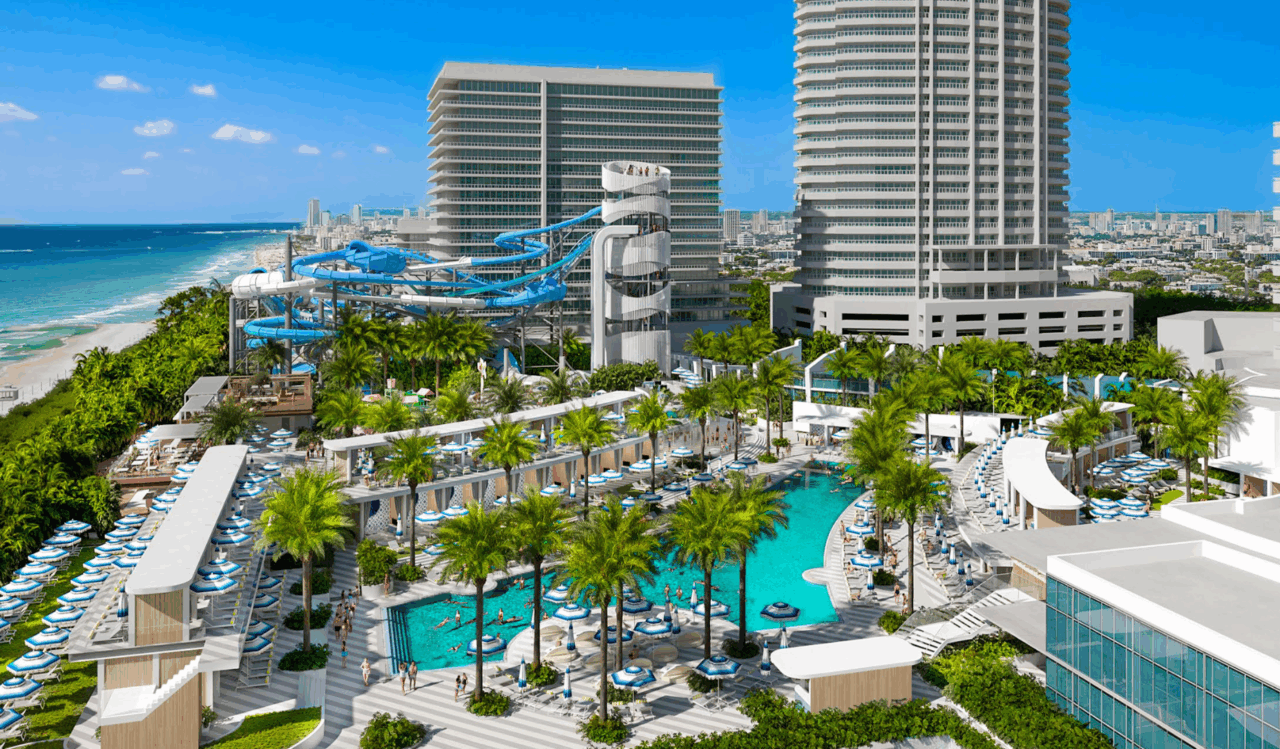
It’ll be at least another few months until residents and travelers know the future of an ambitious proposed pool deck renovation at the Fontainebleau Miami Beach.
A vote on the matter was supposed to happen Tuesday, but the firm behind the project — parent company Fontainebleau Development — pulled the item from the Miami Beach Historic Preservation Board agenda just before the meeting commenced.
The rescheduled vote will now take place in May or June.
Fontainebleau cited the absence of Board member Haskel Mayer, which left a potentially tie-making six votes on the dais, as a reason for requesting a deferral.
The company will pay a fee to reschedule consideration of the project and must re-advertise the pending late-Spring or early-Summer vote.
“The Fontainebleau proposal is about reinvesting in one of Miami Beach’s most iconic landmarks in a way that honors its history while preparing it for the future — all while maintaining the property’s existing footprint, and without increasing density or adding traffic,” Fontainebleau Development said in a statement.
“At today’s meeting, more than 100 Miami Beach residents, community members, and hospitality leaders were present in support, underscoring broad backing for a thoughtful plan focused solely on improving existing outdoor amenities.”
Dozens of opponents of the project attended the meeting too, many of them holding signs that read, “A waterpark is not compatible with Miami Beach.” Some shouted in disapproval after the deferral was announced.
The proposed redevelopment of the pool deck and surrounding outdoor areas at the Fontainebleau represents one of the most ambitious renovations at the resort in more than a decade, signaling a shift toward attracting families alongside its traditional luxury and nightlife clientele.
Image via Fontainebleau Development.
The plan centers on a sweeping reconfiguration of the hotel’s existing pool area, transforming it into a family-oriented water-park-style environment without expanding the resort’s overall footprint or altering its historic architecture.
At the heart of the proposal is a new water park featuring 11 slides — six designed for adults and teenagers, five for children — including a signature slide with an approximately 120-foot drop that would be among the largest in the country.
The project would also halve the number of pools on the main deck to five while adding two hot tubs and what developers describe as an “immersive kids play park” with interactive water features, sprinklers and a dedicated children’s pool and camp.
While the layout will change, developers said, the total surface area of the pools and deck will remain essentially the same. New cabanas with televisions and lockers would allow hotel guests to access amenities without booking overnight stays.
Fontainebleau Development, led by Chair and CEO Jeffrey Soffer, has owned the property since 2005. Company executives describe the project as a “thoughtful evolution” that repurposes existing outdoor space while preserving the Morris Lapidus–designed MiMo landmark, which is listed on the National Register of Historic Places.
Construction is planned to begin this year and continue into 2027, with the hotel remaining open in phases throughout the work.
Industry support for the project has been vocal. The Greater Miami and the Beaches Hotel Association and the Greater Miami Convention and Visitors Bureau have both urgedapproval, arguing that reinvestment is essential for Miami Beach to remain competitive with other global destinations and to diversify its visitor base.
Supporters note that the amenities are private, guest-focused improvements that will not increase density or materially affect surrounding neighborhoods. Opponents, meanwhile, have focused on concerns about preserving the Fontainebleau’s historic character, which stands as one of Lapidus’ signature designs in the city, and fears of increased traffic and commercialization.
Public opinion has appeared to lean in favor of the redevelopment. A January 2025 poll of likely Miami Beach voters found nearly 60% of Miami Beach voters support the plan, fewer than 30% oppose it. Nearly two-thirds of respondents said they were familiar with the proposal, a result developers cited as evidence of informed community backing as the project neared Tuesday’s Historic Preservation Board vote.