Connect with us

Fashion

Vogue US faces backlash over Guess ad featuring AI-generated model
Published

on


Translated by

Nazia BIBI KEENOO

Published


August 1, 2025

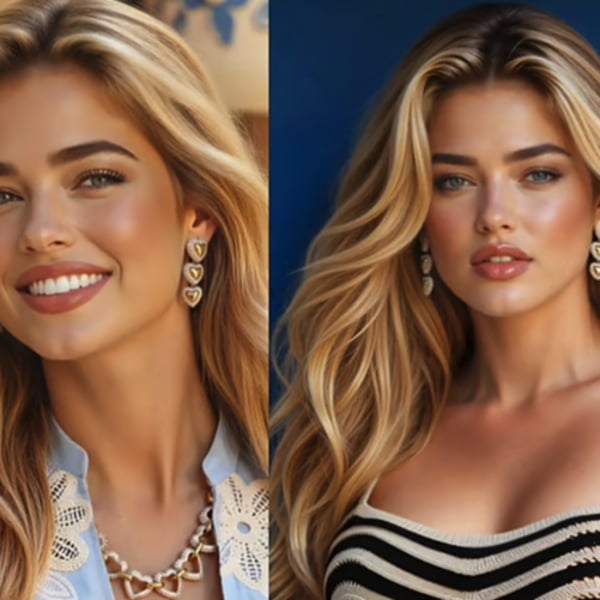
Vogue US sparked major debate when it ran a Guess ad featuring artificial intelligence–generated visuals in its August 2025 issue. The campaign stirred widespread backlash from readers, image professionals, and content creators, who see it as a warning sign for creative industries. The double-page spread showed a blonde model with light eyes and full lips wearing a sky-blue top and a black-and-white patterned dress. Vogue included a footnote confirming the images came from AI, but readers flooded the magazine’s social platforms with criticism.

The AI-created model in the Guess advertisement – Vogue US

Social media users and TikTok creators expressed frustration with the decision, citing Vogue’s legacy of groundbreaking photographers like Irving Penn, Lee Miller, and Erwin Blumenfeld. Critics argued that AI contradicted the magazine’s artistic foundation. Although Vogue stated that the ad came from its advertising department, not its editorial team, many readers still saw it as a symbolic turning point. The placement raised bigger questions about the industry’s reliance on human creativity.

Seraphinne Vallora created the AI visuals

Marketing agency Seraphinne Vallora designed the campaign. The company has promoted its synthetic models across Elle, Grazia, Harper’s Bazaar, the Financial Times, and the Wall Street Journal. On Instagram, the agency showcases its AI-generated visuals and promotes its ability to replicate real-life models through digital scans.

Brands like H&M have already used these AI body doubles, allowing real models to fulfill contracts without attending photo shoots. These avatars save time and reduce production costs.

U.S. laws such as the “right of publicity” protect personal features like a model’s face or voice. Companies must obtain consent before using AI likenesses. But disputes still occur. Scarlett Johansson, for instance, accused OpenAI of using her voice without permission—sparking another legal controversy.

Although the U.S., the UK, and the EU enforce laws to regulate AI-driven use of personal identity, industry professionals continue to raise concerns about the impact on makeup artists, stylists, photographers, and production crews.

Creative professionals push back

Many journalists and artists now use AI to streamline repetitive tasks, but this Guess campaign reignited fears that companies will use AI to replace—not support—creative professionals.

On Newstalk Tech’s TikTok account, correspondent Jess Kelly said, “This puts people out of work. And creatively, a photoshoot isn’t just about the model—it involves photographers, lighting crews, and an entire team working behind the scenes.”

Puma ad highlights how brands are embracing AI in advertising.
Puma ad highlights how brands are embracing AI in advertising. – Puma

Governments and unions act on copyright

To protect human-created work, unions and lawmakers are stepping in. The European Union adopted the AI Act in April 2024 to regulate synthetic media. This legislation, rolling out through 2027, requires companies to disclose AI-generated content, publish training datasets, and respect intellectual property—even when using open-source tools.

In journalism, the International Federation of Journalists (IFJ) published formal recommendations in January 2025. “AI cannot replace human journalists,” the report stated, “and its production should not be considered journalism unless it undergoes proper human oversight.”

INA, the French audiovisual institute, published a report outlining AI’s risks and benefits in the newsroom. It praised AI for boosting speed, format diversity, and translation—but warned that it also encourages content standardization, audience detachment, and unchecked data mining. The authors argued that publishers risk prioritizing cost over quality.

AI won’t affect every media role equally​

Despite industry anxiety, some roles may adapt instead of disappearing. A 2025 report by consulting firm BearingPoint examined how generative AI could impact broadcast journalism jobs. The study flagged roles like documentalists, subtitlers, motion designers, editors, and translators as highly automatable.

AI systems use the work of journalists and creatives to generate content.
AI systems use the work of journalists and creatives to generate content. – Shutterstock

But BearingPoint identified other roles—such as reporters, web editors, data journalists, and community managers—that could shift toward supervising AI output, managing quality control, or using AI as a creative partner.

In short, the firm believes that many image and information professionals can evolve with the technology rather than get replaced by it.

Still, the reaction to Vogue’s Guess ad shows that industry players view AI as a serious threat to creative labor. As Condé Nast navigates this backlash, it faces a critical choice: either establish clear rules for advertisers—or risk weakening the very ecosystem that defines its brand legacy.

This article is an automatic translation.
Click here to read the original article.

Copyright © 2025 FashionNetwork.com All rights reserved.


Source link

Continue Reading

Fashion

Brioni parts ways with design director Norbert Stumpfl

Published

on


Published


December 5, 2025

Another creative director departure at a major brand is shaking up the fashion industry. It is now the turn of Austrian designer Norbert Stumpfl to leave Brioni. The label has just confirmed the end of its collaboration with the designer in a statement. Stumpfl had designed Brioni’s collections for the past seven years.

Brioni – Spring-Summer 2026 – Menswear – Milan – ©Launchmetrics/spotlight

The fashion house founded in 1945, which in 1952 became the first menswear brand to stage a fashion show (in Florence’s legendary Sala Bianca), has expressed its “deep gratitude for the contribution he has made over the years. During his tenure at Brioni, Norbert interpreted with precision the concepts of lightness and discretion, contributing to the evolution of the men’s wardrobe with a modern approach that pays homage to tradition,” Brioni said.

Federico Arrigoni, CEO of Brioni, said, “Our journey continues, and the Maison will continue to consolidate its tradition- perfection of craftsmanship, exceptional materials, and innovation in tailoring techniques- to create true masterpieces, from formalwear to leisurewear and accessories. Brioni pursues its mission of defining the contemporary codes of Italian elegance, while elevating its mastery of high tailoring and bespoke craftsmanship for those who lead and accept nothing but the exceptional.”

Since 2011, Brioni has been part of the Paris-based French luxury group Kering. From 2018 until his departure, the brand’s collections were designed by Norbert Stumpfl, the acclaimed Austrian menswear couturier, celebrated for his blend of impeccable tailoring and cutting-edge fabrics- among his creations were dinner jackets woven with 24-carat gold threads and enzyme-treated silk-linen blends with a soft, distinctive handle. During his tenure, Brioni also expanded masterfully into womenswear, expressing discreet luxury with rare aplomb.

A pinnacle of Roman sartorial luxury, the Italian label marked its 80th anniversary in late November with an exhibition of its superb tailoring and a gala dinner at the Chiostro del Bramante in Rome.

This article is an automatic translation.
Click here to read the original article.

Copyright © 2025 FashionNetwork.com All rights reserved.


Source link

Continue Reading

Fashion

Another original Hermes Birkin bag sells for $2.86 million

Published

on


By

AFP

Published


December 5, 2025

An Hermes handbag that once belonged to Jane Birkin was sold for $2.86 million (2.45 million euros) at auction in Abu Dhabi on Friday, just months after the record-breaking sale of her first bag from the French brand, Sotheby’s said.

Jane Birkin with one of her signature Hermes bags – Sotheby’s

Hermes first created the design for the British singer and actress in 1984 and it has gone on to become a modern and highly prized classic, sought by fashionistas the world over. The first prototype was sold for 8.58 million euros ($10 million) at a Sotheby’s auction in Paris in July, smashing previous price records for a handbag.

The one sold on Friday was a ‘Birkin Voyageur,’ which was gifted to the former wife of French singing legend Serge Gainsbourg in 2003. The final sale price was around six times times higher than the estimated price range of $230,000-$430,000 given before the sale.

“Jane Birkin’s handbag legacy continues to captivate collectors,” Sotheby’s said in a statement sent to AFP, adding that bidding took place over 11 minutes between six collectors. The new owner was a phone buyer and has not been identified.

The handbag was one of four owned by the late celebrity, who used to sell them to raise money for charitable causes. It has a handwritten inscription in French inside from Birkin that reads: “My Birkin bag, my globetrotting companion.”

A third Hermes bag owned by Birkin is set to go under the hammer on December 15 at the Hotel Drouot auction house in Paris. It was entrusted by the late star to her friend and biographer Gabrielle Crawford, who is selling it to help fund the future Jane Birkin Foundation, Drouot said in a statement.

Produced in very limited numbers, the modern Birkin bag manufactured by Hermes has maintained an aura of exclusivity and is beloved by celebrities such as the Kardashians, Jennifer Lopez, and Victoria Beckham. The most expensive fashion item ever sold at auction was a pair of ruby red slippers worn by actor Judy Garland from The Wizard of Oz in 1939, which sold for $32.5 million in 2024 in Dallas, Texas, according to Sotheby’s.

Copyright © 2025 AFP. All rights reserved. All information displayed in this section (dispatches, photographs, logos) are protected by intellectual property rights owned by Agence France-Presse. As a consequence you may not copy, reproduce, modify, transmit, publish, display or in any way commercially exploit any of the contents of this section without the prior written consent of Agence France-Presses.


Source link

Continue Reading

Fashion

Mention Me launches AI tool to help brands reach consumers through generative AI search 

Published

on


Published


December 5, 2025

Artificial intelligence (AI) continues its march to transform businesses’/consumers’ lives with customer advocacy platform Mention Me launching ‘AI Discovery IQ’, a free-to-use tool that “helps brands reach target consumers in the new age of generative AI search”.   

Kirill KUDRYAVTSEV / AFP/Archives

It claims to allow brands to “instantly audit how discoverable they are within popular AI systems” such as ChatGPT, Claude, Gemini and Perplexity.  

According to Mention Me, 62% of UK consumers now turn to generative AI tools for product recommendations, brand discovery and comparisons, “bypassing traditional search engines entirely [so] businesses are under pressure to respond to this behaviour change,” said  the platform’s CEO Wojtek Kokoszka whose platform works with firms including Charlotte Tilbury, Huel and Puma, “helping marketing teams to boost consumer awareness and sales”.   

With AI, it says the modern customer journey, powered by natural language prompts instead of outdated keyword strings, means consumers are 4.4 times more likely to convert if they find a brand through a large language model (LLM). 

“The rise of ‘agent-mode’ assistants and AI-driven voice search has pushed brands into a new world of digital visibility. Despite this, most brands have little to no insight into how they appear in AI-generated answers”, said Kokoszka.  

AI Discoverability IQ claims to give brands an overall LLM discoverability score, specific details on areas such as technical website elements, content and structured data, and actionable recommendations to improve their AI discoverability.

Its tool generates “measurable, trackable outputs” like AI Visibility Score, brands’ prompt-based results, and a side-by-side comparisons with their competitive set. This means brands “can react quickly to improve their discoverability scores” with Mention Me’s wider suite of products and unique first-party data.  

It’s also “innovating and evolving” its platform to include more capabilities, such as the ability to benchmark against competitors, to drive further improvements for marketing leaders in the age of AI. 

Mention Me CMO Neha Mantri said: “AI Discoverability is not yet a named practice within most marketing teams; the same way SEO wasn’t in the early 2000s. But when up to 31% of consumers say they’re more likely to trust responses from generative AI than traditional search results, this needs to change. Mention Me is naming the problem and providing a solution at just the right time.”  

Copyright © 2025 FashionNetwork.com All rights reserved.


Source link

Continue Reading

Trending

Copyright © Miami Select.