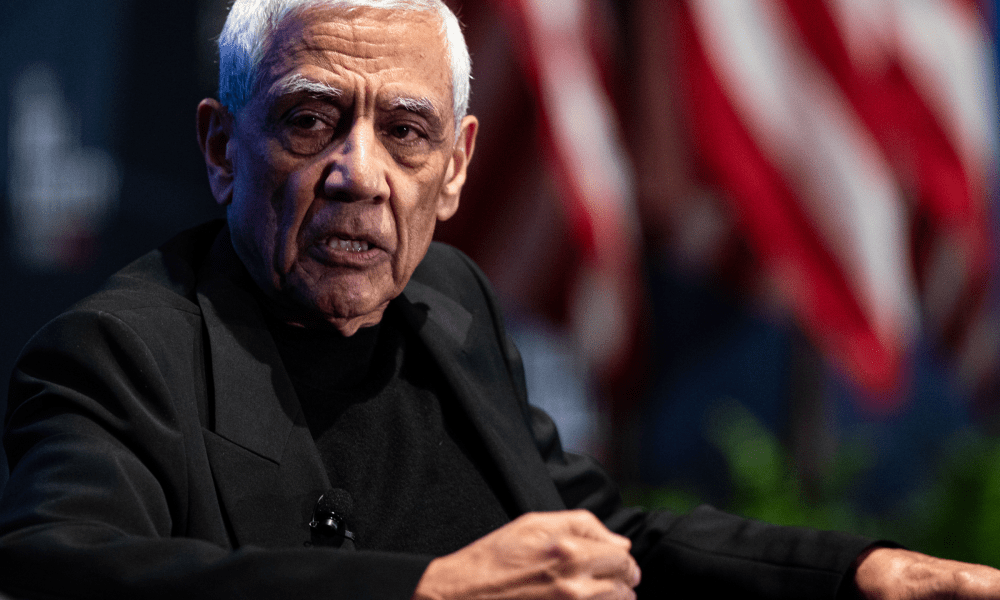
On a recent episode of Fortune’s Titans and Disruptors of Industry podcast, he opened up about his work-life philosophy: even at age 71—and with $12 billion to his name—he has no intention of slowing down.
“At age 71—health permitting—next 25 years, I’ll be doing exactly the same thing because I like working 80 hours a week learning,” he told Fortune Editor-in-Chief Alyson Shontell. “And nobody can take that away from me.”
But while Khosla has spent his career following his interests, he admits that the classic advice to “follow your passion” isn’t always practical today—especially for younger generations navigating a rapidly changing job market.
For many people, the expected path is still traditional: study hard, get into college, and land a stable job that can support a family.
Khosla believes artificial intelligence could soon upend that formula.
Khosla predicted that artificial intelligence will eventually be able to handle about 80% of today’s jobs, ranging from physicians and radiologists to accountants and sales professionals. As AI takes over much of this work, he said labor costs could effectively fall to near zero, dramatically lowering the prices of goods and services. In that scenario, Khosla suggested that the youngest generation may not need a college degree to build a livelihood—or even need traditional employment at all.
“Fifteen years from now, you will say—what is bad advice today or used to be … ‘Follow your passion,’” Khosla said. “‘Follow your passion’ comes second to surviving. I think that surviving part will go away, and you’ll tell every 5-year-old kid, ‘Follow your passion.’”
Khosla’s career, from software to AI
For Khosla, the freedom to pursue what interests him is something he admits he’s been unusually fortunate to have throughout his career—especially since he’s never written a resume, applied for a job, or even worked for a boss.
After earning his undergraduate degree from the Indian Institute of Technology, a master’s in biomedical engineering from Carnegie Mellon, and an MBA from Stanford, he jumped straight into following his fascination with tech. Khosla made his first fortune cofounding computer hardware firm Sun Microsystems, which helped shape the early internet era and gave him enough financial security to “never need money again.”
Today, Khosla’s long work weeks are dedicated to his passion—Khosla Ventures, the venture capital firm he founded in 2004. It has backed hundreds of companies in their early stages, including Square and DoorDash.
His interest in AI has also shaped his investment priorities. Khosla Ventures placed early bets on Radical Health, a company using AI to help patients navigate the cancer treatment process, and Replit, an AI-powered software development firm. It was also notably one of OpenAI’s first institutional investors in 2019.
For Khosla, prolonging his career is now less about finances—it’s about curiosity and the freedom his success has afforded him.
“I care about my freedom,” he told Fortune. “…I decided I would do what I want and say what I want, and I want to feel good about where I stand. I would say most people don’t have that luxury. It’s almost an indulgence to be able to do what I do.”
How AI is upending career advice
The existential question hovering over every college campus right now isn’t which major to choose — it’s whether the old rules of higher education still apply at all. Some of the most influential names in business have been sounding off on exactly that, and their answers might make younger generations reconsider a traditional path.
LinkedIn CEO Ryan Roslansky has told students point-blank that having a five-year career plan is “outdated” and “a little bit foolish” given how quickly AI is reshaping the workplace.
Not everyone is sounding the alarm. Sam Altman, the billionaire CEO of OpenAI, has said that if he were 22 and graduating today, he would “feel like the luckiest kid in all of history.”
Altman told video journalist Cleo Abram that by 2035, today’s college graduates “could very well be leaving on a mission to explore the solar system — in some completely new, exciting, super well-paid, super interesting job.” The caveat, of course, is that Altman added: “if they still go to college at all.”
Alexandr Wang—the 29-year-old Scale AI founder-turned-Meta chief AI officer—has perhaps the most specific and urgent advice for young people.
Speaking on the TBPN podcast and covered by Fortune, Wang told teens that “vibe coding” is today’s equivalent of 1980s teens spending their nights in a computer lab: “If you are 13 years old, you should spend all of your time vibe coding. That’s how you should live your life.”
Wang argued that 10,000 hours of deep, hands-on experimentation with AI tools now can become a “huge advantage.”
Khosla’s advice to Gen Z isn’t to panic, but to embrace the single skill that cannot be automated: the ability to learn rapidly and continuously.