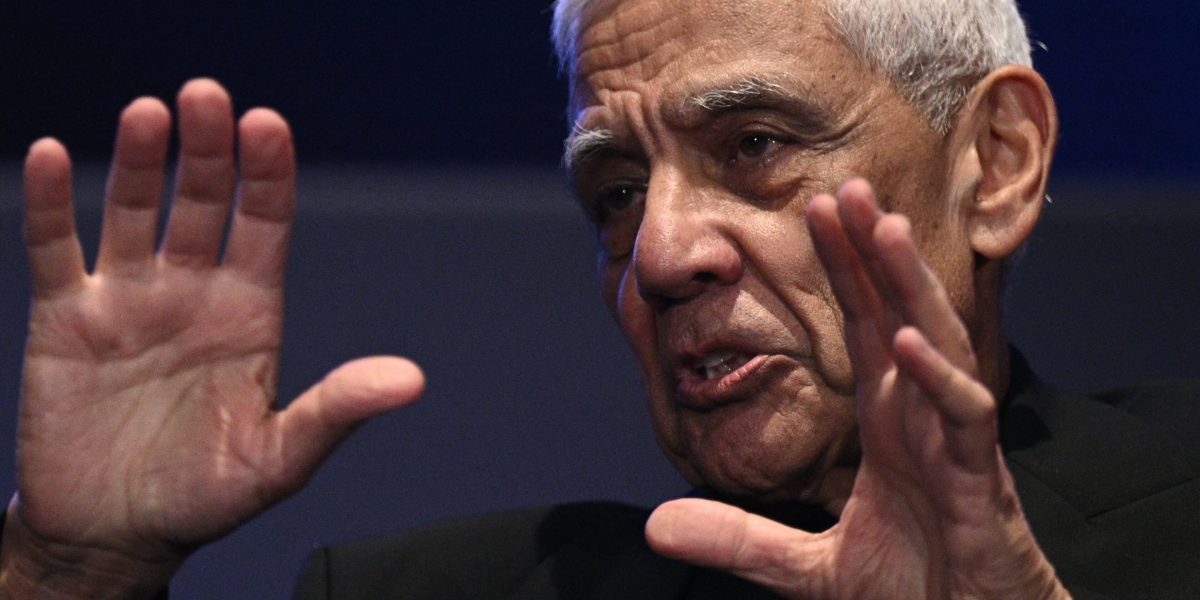
Venture capitalist Vinod Khosla has not been shy in criticizing Donald Trump’s policies on immigration, climate change and diplomacy. In 2024, he said the then presidential-candidate had “depraved values.”
But the billionaire Khosla, who acknowledges he is on the president’s “sh-tlist,” places himself in Trump’s corner on one key issue: AI policy and China.
“We are in a techno-economic war with China,” Khosla, who founded both Sun Microsystems and Khosla Ventures, said to Fortune editor-in-chief Alyson Shontell on the “Titans and Disruptors of Industry” podcast. He admitted he “mostly” agreed with Trump’s approach to AI, even as he disagreed with most of the administration’s other policies. “We have to win that race,” he said in the interview.
In 2019, Khosla was the first institutional investor in OpenAI, investing $50 million at a $1 billion valuation. OpenAI recently closed a $110 million round of financing that valued it at $780 billion.
The U.S. has steadily intensified its restrictions on China’s tech sector since late 2022, when the Biden administration imposed sweeping controls on the sale of advanced chips and chipmaking equipment to Chinese buyers. Those controls later expanded to include a ban on U.S. outward investment into Chinese firms working in strategic technologies, like advanced semiconductors, quantum information, and AI. Officials said these measures were necessary to maintain the U.S.’s edge over China in strategic technologies, and constrain China’s ability to develop its own AI tools.
The Trump administration’s approach to export controls has been more fluid. Officials, at times, tried to expand export controls to goods like chip design software, and add sanctions on more Chinese companies. Yet in recent months, as part of broader trade negotiations with Beijing, Trump has rolled back some restrictions and considered allowing Nvidia and other chipmakers to sell a limited number of AI processors to Chinese customers in exchange for a cut of revenue.
Khosla framed U.S.-China AI competition as a fight for geopolitical and economic dominance. “Whoever wins the AI race will win the economic race, and will win the race for economic power and influence globally, whether you’re talking about Southeast Asia, Latin America, Europe,” he told Shontell.
China’s push for self-reliance
Ironically, U.S. controls may have jump-started China’s push for tech self-reliance. The restrictions spurred Chinese chipmakers and tech giants to double down on local manufacturing investments, with companies like Huawei developing AI processors as partial substitutes for Nvidia’s top-end chips.
Chinese AI developers such as DeepSeek, Moonshot AI, and MiniMax have released large language models that approach the performance of leading U.S. systems. These open-source Chinese models often prioritize efficiency, offering strong results even on limited hardware. That has helped them gain traction with developers and enterprises worldwide. AirbnbCEO Brian Chesky has said the company’s customer-service chatbot runs on Alibaba’s Qwen model.
Khosla’s concerns about Chinese AI progress are echoed by other Silicon Valley leaders. OpenAI and Anthropic do not make their flagship GPT and Claude models available in mainland China, and Anthropic CEO Dario Amodei has repeatedly argued that export controls are needed to ensure “democratic nations remain at the forefront of AI development.”
Amodei and Anthropic are now locked in a high-profile clash with the Trump administration over the company’s refusal to weaken safety restrictions in Claude for military and intelligence use. Trump has ordered federal agencies to phase out Anthropic products over six months, after the Pentagon designated the company a “supply-chain risk” following a dispute over whether Claude could be used for mass surveillance and fully autonomous weapons systems.
The fight between Anthropic and the government—and the fight between Washington and Beijing—shows how the AI context is as much about political values as it is about technological development.
“I happen to like democracy over the Chinese system,” Khosla said on Fortune’s podcast.