Connect with us

Business

Venezuela’s new president steered $500,000 to Trump’s inauguration—in 2017

Published

on


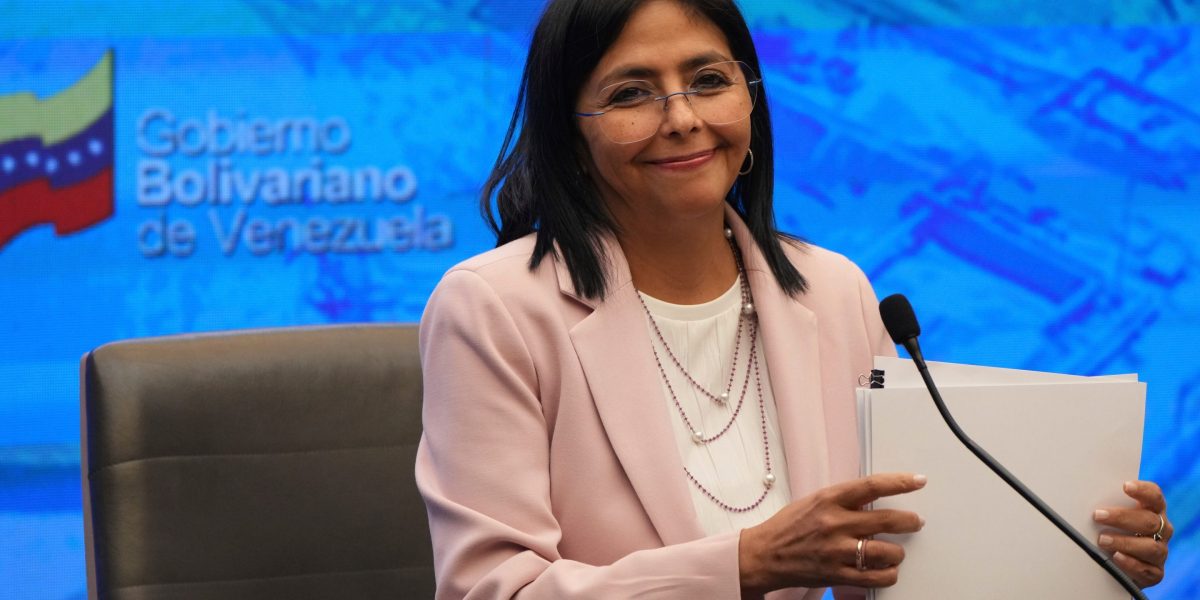
In 2017, as political outsider Donald Trump headed to Washington, Delcy Rodríguez spotted an opening.

Then Venezuela’s foreign minister, Rodríguez directed Citgo — a subsidiary of the state oil company — to make a $500,000 donation to the president’s inauguration. With the socialist administration of Nicolas Maduro struggling to feed Venezuela, Rodríguez gambled on a deal that would have opened the door to American investment. Around the same time, she saw that Trump’s ex-campaign manager was hired as a lobbyist for Citgo, courted Republicans in Congress and tried to secure a meeting with the head of Exxon.

The charm offensive flopped. Within weeks of taking office, Trump, urged by then-Sen. Marco Rubio, made restoring Venezuela’s democracy his driving focus in response to Maduro’s crackdown on opponents. But the outreach did bear fruit for Rodríguez, making her a prominent face in U.S. business and political circles and paving the way for her own rise.

“She’s an ideologue, but a practical one,” said Lee McClenny, a retired foreign service officer who was the top U.S. diplomat in Caracas during the period of Rodríguez’s outreach. “She knew that Venezuela needed to find a way to resuscitate a moribund oil economy and seemed willing to work with the Trump administration to do that.”

Nearly a decade later, as Venezuela’s interim president, Rodríguez’s message — that Venezuela is open for business — seems to have persuaded Trump. In the days since Maduro’s stunning capture Saturday, he’s alternately praised Rodríguez as a “gracious” American partner while threatening a similar fate as her former boss if she doesn’t keep the ruling party in check and provide the U.S. with “total access” to the country’s vast oil reserves. One thing neither has mentioned is elections, something the constitution mandates must take place within 30 days of the presidency being permanently vacated.

This account of Rodríguez’s political rise is drawn from interviews with 10 former U.S. and Venezuelan officials as well as businessmen from both countries who’ve had extensive dealings with Rodríguez and in some cases have known her since childhood. Most spoke on the condition of anonymity for fear of retaliation from someone who they almost universally described as bookishly smart, sometimes charming but above all a cutthroat operator who doesn’t tolerate dissent. Rodríguez didn’t respond to AP requests for an interview.

Father’s murder hardens leftist outlook

Rodríguez entered the leftist movement started by Hugo Chávez late — and on the coattails of her older brother, Jorge Rodríguez, who as head of the National Assembly swore her in as interim president Monday.

Tragedy during their childhood fed a hardened leftist outlook that would stick with the siblings throughout their lives. In 1976 — when, amid the Cold War, U.S. oil companies, American political spin doctors and Pentagon advisers exerted great influence in Venezuela — a little-known urban guerrilla group kidnapped a Midwestern businessman. Rodriguez’s father, a socialist leader, was picked up for questioning and died in custody.

McClenny remembers Rodríguez bringing up the murder in their meetings and bitterly blaming the U.S. for being left fatherless at the age of 7. The crime would radicalize another leftist of the era: Maduro.

Years later, while Jorge Rodríguez was a top electoral official under Chávez, he secured for his sister a position in the president’s office.

But she advanced slowly at first and clashed with colleagues who viewed her as a haughty know-it-all.

In 2006, on a whirlwind international tour, Chávez booted her from the presidential plane and ordered her to fly home from Moscow on her own, according to two former officials who were on the trip. Chávez was upset because the delegation’s schedule of meetings had fallen apart and that triggered a feud with Rodriguez, who was responsible for the agenda.

“It was painful to watch how Chávez talked about her,” said one of the former officials. “He would never say a bad thing about women but the whole flight home he kept saying she was conceited, arrogant, incompetent.”

Days later, she was fired and never occupied another high-profile role with Chávez.

Political revival and soaring power under Maduro

Years later, in 2013, Maduro revived Rodríguez’s career after Chávez died of cancer and he took over.

A lawyer educated in Britain and France, Rodríguez speaks English and spent large amounts of time in the United States. That gave her an edge in the internal power struggles among Chavismo — the movement started by Chávez, whose many factions include democratic socialists, military hardliners who Chávez led in a 1992 coup attempt and corrupt actors, some with ties to drug trafficking.

Her more worldly outlook, and refined tastes, also made Rodríguez a favorite of the so-called “boligarchs” — a new elite that made fortunes during Chávez’s Bolivarian revolution. One of those insiders, media tycoon Raul Gorrín, worked hand-in-glove with Rodríguez’s back-channel efforts to mend relations with the first Trump administration and helped organize a secret visit by Rep. Pete Sessions, a Texas Republican, to Caracas in April 2018 for a meeting with Maduro. A few months later, U.S. federal prosecutors unsealed the first of two money laundering indictments against Gorrin.

After Maduro promoted Rodríguez to vice president in 2018, she gained control over large swaths of Venezuela’s oil economy. To help manage the petro-state, she brought in foreign advisers with experience in global markets. Among them were two former finance ministers in Ecuador who helped run a dollarized, export-driven economy under fellow leftist Rafael Correa. Another key associate is French lawyer David Syed, who for years has been trying to renegotiate Venezuela’s foreign debt in the face of crippling U.S. sanctions that make it impossible for Wall Street investors to get repaid.

“She sacrificed her personal life for her political career,” said one former friend.

As she amassed more power, she crushed internal rivals. Among them: once powerful Oil Minister Tareck El Aissami, who was jailed in 2024 as part of an anti-corruption crackdown spearheaded by Rodríguez.

In her de-facto role as Venezuela’s chief operating officer, Rodríguez proved a more flexible, trustworthy partner than Maduro. Some have likened her to a sort of Venezuelan Deng Xiaoping — the architect of modern China.

Hans Humes, chief executive of Greylock Capital Management, said that experience will serve her well as she tries to jump-start the economy, unite Chavismo and shield Venezuela from stricter terms dictated by Trump. Imposing an opposition-led government right now, he said, could trigger bloodshed of the sort that ripped apart Iraq after U.S. forces toppled Saddam Hussein and formed a provisional government including many leaders who had been exiled for years.

“We’ve seen how expats who have been outside of the country for too long think things should be the way it was before they left,” said Humes, who has met with Maduro as well as Rodríguez on several occasions. “You need people who know how to work with how things are not how they were.”

Democracy deferred?

Where Rodríguez’s more pragmatic leadership style leaves Venezuela’s democracy is uncertain.

Trump, in remarks after Maduro’s capture, said Nobel Peace Prize winner Maria Corina Machado lacks the “respect” to govern Venezuela despite her handpicked candidate winning what the U.S. and other governments consider a landslide victory in 2024 presidential elections stolen by Maduro.

Elliott Abrams, who served as special envoy to Venezuela during the first Trump administration, said it is impossible for the president to fulfill his goal of banishing criminal gangs, drug traffickers and Middle Eastern terrorists from the Western Hemisphere with the various factions of Chavismo sharing power.

“Nothing that Trump has said suggests his administration is contemplating a quick transition away from Delcy. No one is talking about elections,” said Abrams. “If they think Delcy is running things, they are completely wrong.”


Source link

Continue Reading

Business

No, Trump can’t use example of fraud in Minnesota to block childcare subisidies to 5 blue states, judge says

Published

on


A federal judge ruled Friday that President Donald Trump’s administration cannot block federal money for child care subsidies and other programs aimed at supporting low-income families with children from flowing to five Democratic-led states for now.

The states of California, Colorado, Illinois, Minnesota and New York argued that a policy announced Tuesday to freeze billions of dollars in funds for three grant programs is having an immediate impact on them and creating “operational chaos.” In court filings and a hearing earlier Friday, the states contended that the government did not have a legal reason for withholding the money from them.

The U.S. Department of Health and Human Services said it was pausing the funding because it had “reason to believe” the states were granting benefits to people in the country illegally, though it did not provide evidence or explain why it was targeting those states and not others.

U.S. District Judge Arun Subramanian, who was nominated to the bench by President Joe Biden, did not rule on the legality of the funding freeze but said the five states met a legal threshold “to protect the status quo” for at least 14 days while arguments are made in court.

Health department officials did not immediately respond to a request for comment.

The affected programs are the Child Care and Development Fund, which subsidizes child care for 1.3 million children from low-income families; the Temporary Assistance for Needy Families program, which provides cash assistance and job training; and the Social Services Block Grant, a smaller fund that provides money for a variety of programs.

The five states say they receive a total of more than $10 billion a year from the programs.

New York Attorney General Letitia James, who is leading the lawsuit, called the ruling a “critical victory for families whose lives have been upended by this administration’s cruelty.”

The government had requested reams of data from the five states, including the names and Social Security numbers of everyone who received benefits from some of the programs since 2022.

The states argue that the effort is unconstitutional and is intended to go after Trump’s political adversaries rather than to stamp out fraud in government programs — something the states say they already do.

Jessica Ranucci, a lawyer in James’ office, said during the Friday hearing that at least four of the states had already had money delayed after requesting it. She said that if the states can’t get child care funds, there will be immediate uncertainty for providers and families who rely on the programs.

A lawyer for the federal government, Kamika Shaw, said it was her understanding that the money had not stopped flowing to states.

The other 45 states face a new requirement to check attendance at child care centers and submit “strong justification for the use of funds” that aligns with the program’s purpose.

At about the same time the judge stopped the freeze on the child care subsidies, Agriculture Secretary Brooke Rollins announced that the administration would freeze about $130 million a year in funding from her agency to Minnesota.

Rollins said the state’s inability to stop fraud schemes led to the decision. Seventy-eight people have been charged since 2022 — and 57 convicted — after federal prosecutors said the Minnesota nonprofit group Feeding Our Future stole $250 million from a program meant to feed children in need during the COVID-19 pandemic.

Minnesota Gov. Tim Walz’s office did not immediately have a comment Friday evening. The state’s attorney general, Keith Ellison, said he’d fight the new freeze of funds in court.

In a letter to Walz that Rollins shared on social media, she suggested the state could restore its access to the funding by providing justification for how it spent federal dollars over the past year. All the state’s future transactions involving money from the agency will require the same justification, she said.

Walz and Minnesota have become a main target of the administration in Trump’s second term.

Last month the president called the state’s Somali population “garbage” in the wake of the Feeding Our Futures investigation and other fraud cases involving Somali defendants.

And this week the administration launched the largest immigration enforcement operation in history in Minneapolis, leading to a fatal shooting of a woman by an Immigration and Customs Enforcement agent.


Source link

Continue Reading

Business

Down Arrow Button Icon

Published

on


If the current frenzy over artificial intelligence feels familiar to Peter Cappelli, the George W. Taylor professor of management at the Wharton School, it’s because he’s seen this movie before. He points to the period between 2015 and 2017, when major consultancies and the World Economic Forum confidently predicted that driverless trucks would eliminate truck drivers within a few years.

“You didn’t have to think very long to realize that just wasn’t going to make sense in practice,” Cappelli told Fortune on Zoom from his home in Philadelphia.

“You didn’t have to think very long about driverless trucks to think about, okay, what happens when they need gas? You know? Or what happens if they have to stop and make a delivery? And if they have to have an employee sitting with them, of course it defeats the purpose, right?”

Cappelli, who recently partnered with Accenture on a series of podcasts to get to the bottom of what AI is actually doing to jobs, warned against listening too closely to the companies that are talking their book, or trying to sell you on their new products.

“If you’re listening to the people who make the technology, they’re telling you what’s possible, and they’re not thinking about what is practical.”

Over the course of a wide-ranging conversation with Fortune, Cappelli tackled what AI is really doing to work, much like he talked to Fortune previously about how remote work is, actually, quite bad for most organizations.

“I mean, people say I’m a contrarian,” Cappelli said, “but I don’t think so, so much as I just am skeptical about stuff, you know?”

When pointed out this was an inherently contrarian position, Cappelli laughed, before returning to the main point. “I just get nervous with hype.”

He talked to Fortune about how his research fits into the wider picture that defined the back half of 2025, after the influential MIT study that caught the eye on 95% of generative AI pilots failing to generate any meaningful return. His favorite example was a particular case study on a company that actually made AI work, both cutting headcount and boosting productivity. It still didn’t fit neatly with predictions (say, from Elon Musk or Anthropic’s Dario Amodei, that work will soon be optional, or even a hobby). “It’s hugely expensive to do this,” Cappelli said about his findings. “And this was a success.”

Three times the cost

Cappelli detailed the findings of a case study that he participated in, published in the Harvard Business Review, on Ricoh, an insurance claims processor: the exact type of low-level administrative work that AI is supposed to automate easily. The reality of adoption, however, was a financial shock. While the company eventually achieved three times the performance, the transition was anything but cheap. The firm spent a year with a team of six, three of whom were expensive outside consultants, just to get the system running.

“The first thing they discovered,” Capelli said, “is large language models could do this pretty well — at three times the cost of their employees doing it [manually]. Okay, so that’s not going to work.” Cappelli pointed out that the costs included Ricoh paying roughly $500,000 in fees to outside consultants.

Even after optimizing the process, Ricoh was still spending about $200,000 a month on AI fees—more than their total payroll for the task had been. They were able to cut their headcount from 44 to 39, he added, showing just how far from being a massive job killer AI is in practice. His explanation recalls his self-driving truck example.

“The reason they still need employees is that lots of problems have to be chased down, and they’re harder to chase down if they come off of AI,” he said. The good news, he added, is that this Ricoh division will ultimately be three times as productive.

“So that’s the payoff, but it’s not cheap [and] it took a hell of a long time to do.”

Ashok Shenoy, VP of Ricoh USA, told Fortune that, after starting to use AI for “very routine, repetitive, high-volume tasks,” work for humans didn’t disappear, but “shifted toward areas where human judgment and experience add the most value.” In the year or so since the case study was conducted, he noted that Ricoh has successfully applied AI to mid-level, repetitive, time-consuming tasks at scale, and expects to use AI agents to achieve partial or full workflow automation within the next six to 12 months, “with a human-in-the-loop to resolve missing or unclear information and ensure quality.”

While acknowledging the big-ticket costs highlighted by Cappelli, Shenoy noted that this project reached break-even in less than a year, and it’s $200,000 monthly costs are less expensive than the previous operating model. “The shift to AI delivered an estimated 15% total cost reduction, even though it did not rely on significant labor cuts.” Regarding headcount, he said “this exercise was not driven by cost or headcount reduction,” and AI implementation requires creating new roles, redesigning existing ones, and repurposing team members toward higher-value work. He said there haven’t been further job cuts, either, with staffing levels largely stabilizing as productivity increased and volumes grew. “The bigger change was in how people spent their time. They are doing less repetitive work and are more focused on resolving exceptions, maintaining quality and serving customers.”

Performative AI shame in the boardroom

Cappelli said he found similar dynamics in his partnership with Accenture, which looked at Mastercard, Royal Bank of Scotland, and Jabil. “These are all success stories,” he said, and in the long run, they will see productivity will go up. Companies will be able to do more with fewer people but “it’ll take a long while to get there.” He argued that something crucial is being underestimated. “The key thing, though, is just how much work is involved in doing it.”

Also, regarding headcount reductions, Cappelli said that at least in the areas that he researched, which were specific units within each company, he didn’t see any job cuts whatsoever. When contacted for comment by Fortune, Accenture said it largely agrees with Cappelli’s conclusions, and referred back to CEO Julie Sweet’s recent interview with Fortune Editor-in-Chief Alyson Shontell.

According to Cappelli, so much of the noise around AI—and the distance between what’s possible and what’s practical—is driven by what other commentators have called “AI shame.”

Cappelli wasn’t familiar with the “AI shame” phrase, but told Fortune it was “absolutely right” in describing what he’s seen. “They’re pretending so they can say they’re doing something, right?” he said. “So the pressure is just enormous on them to try to make this stuff work, because the investors love the idea.”

The professor cited the Harris Poll’s finding in early 2025 that 74% of CEOs globally felt they’d lose their job in two years if they couldn’t demonstrate AI success, and roughly a third said they were performatively adopting AI without really understanding what it would entail. As The Harris Poll put it: “CEOs estimate that over a third (35%) of their AI initiatives amount to mere ‘AI washing’ for optics and reputation, but offering little to no real business value at all.”

Cappelli described how markets typically celebrate news of layoffs, and even cited research that “phantom layoffs” get announced by companies that never actually occur, because companies are arbitraging the positive stock-market reaction to the news of a potential layoff.

Cappelli predicted a “slow learning curve” will take place, in which CFOs will start realizing “this is super-expensive stuff to put in place.” The problem, according to Cappelli, is that U.S. management has become “spoiled” and increasingly averse to the hard work of organizational change.

“[Employers] think it should be free. It should be cheap. You should just be able to hang a shingle out, and the right people will just show up,” he says. Real AI success, in his opinion, will require “old-fashioned human resources” work: mapping workflows, breaking down jobs into tasks, and having employees work alongside AI “agents” to refine prompts.

“You can’t do it over the top of employees, because the employees really do know how their job is done,” Cappelli said. The professor was withering about what he sees happening in most C-suites, saying they are largely “ducking” the problem of really grappling with this technology.

“They’re not seeing it as an organization change problem and a big one,” he said. “They’re just stressing everybody out and, you know, hoping that it somehow works itself out.”


Source link

Continue Reading

Business

Netflix’s $82.7 billion rags-to-riches story: How the a DVD-by-mail company swallowed Hollywood

Published

on


It’s a story so good  it could have been a screenplay. In 2000, Reed Hastings and Marc Randolph sat down across from John Antioco, then CEO of video rental giant Blockbuster, and pitched him on acquiring their still unprofitable DVD-by-mail startup, Netflix, which at the time had around 300,000 subscribers. But when they told him their price—$50 million and the chance to develop and run Blockbuster’s online rental business—Antioco balked. It was a famously shortsighted business decision: By 2010, Blockbuster had filed for bankruptcy, and Netflix had stormed Hollywood with its entertainment streaming service

Now Netflix—a behemoth that has moved far beyond streaming others’ films and shows, with an estimated $18 billion content spend for 2025—is writing the sequel, following the same underdog-towinner trope. It announced in early December an $82.7 billion deal to become the new owner of the storied Warner Bros. film and television studios, plus cable crown jewel HBO and streamer HBO Max. The deal comes some 15 years after an executive who previously oversaw those very assets dismissed the notion of Netflix being a threat to Hollywood’s power structures: Jeff Bewkes, then CEO of Warner Bros. parent Time Warner, described that scenario in 2010 as “a little bit like, is the Albanian army going to take over the world?” 

To be sure, Netflix has never before attempted a deal of this size. And with rival Paramount making a play for the entire Warner Bros. Discovery business through a hostile bid, a Netflix–Warner Bros. tie-up is still far from a sure thing. But even if the deal never actually materializes, Netflix has demonstrated how to not just disrupt an industry but swallow it. 

It’s a trajectory that’s all the more impressive given the company’s scrappy, dotcom-era start. “Netflix should have never existed,” says Peter Supino, who analyzes the media and entertainment industries as managing director at Wolfe Research. “Their path relied on a bunch of strategic decisions that were risky and uncertain at times and the body of which proved out to be smashingly correct.” 

To dominate streaming today, of course, is to dominate all of entertainment. And Netflix now has a market cap—almost $400 billion currently— that exceeds the combined value of legacy competitors Disney, Warner Bros. Discovery, Fox Corp., Paramount, and Lionsgate. 

So just how did Netflix do it? The company has built a culture that fosters flexibility and daring, and has repeatedly shown its adeptness at taking calculated risks—including a series of strategic U-turns. Netflix was never going to make original television shows and movies—until it ponied up an unprecedented $100 million for two seasons of House of Cards from executive producer David Fincher in 2011, sight-unseen without a pilot. Netflix didn’t care about password sharing—until it began vigorously enforcing a “one household” rule in 2023. Netflix was never going to introduce livestreaming or advertising—until it added both within a few months in 2022 and 2023, then struck its first major sports rights deal, another one-time no-go, in 2024.

“When one of your people does something dumb, don’t blame them. Instead ask yourself what context you failed to set. Are you articulate and inspiring enough in expressing your goals and strategy? Have you clearly explained all the assumptions and risks that will help your team to make good decisions?”


Reed Hastings on leading with “context, not control.”
From No Rules Rules: Netflix and the Culture of Reinvention, by Reed Hastings and Erin Meyer

And Netflix was never going to go all in on theatrical releases—until it decided to buy Warner Bros. and pledged to distribute its films to movie theaters. “We’ve built a great business, and to do that, we’ve had to be bold and continue to evolve,” co-CEO Ted Sarandos told investors on the call announcing the deal. “We can’t stand still. We need to keep innovating and investing in stories that matter most to audiences.”

Call it “innovating,” or call it misleading the competition, most people agree that Netflix has offered a master class in audacious strategy. In his business tome, No Rules Rules: Netflix and the Culture of Reinvention, Hastings offers guidelines for strategic pivots, pointing out: “The vast majority of firms fail when their industry shifts.” The former CEO, who kicked himself upstairs to chairman in 2023, attributes the company’s success to a culture that prioritizes innovation, motivates top performers, and has few controls, allowing Netflix “to continually grow and change as the world, and our members’ needs, have likewise morphed around us.” 

This is antithetical to how business is usually done in Hollywood, where studio executives would rather bet on proven IP with sequels, spinoffs, reboots, and copycats than stick their neck out for new, untested ideas. 

Netflix cofounder and ex-CEO Reed Hastings (left) with his successor, co-CEO Ted Sarandos.

Kevin Dietsch—Getty Images

A bolder approach has given Netflix the upper hand. “We were willing to take the risk that these other companies weren’t willing to take because they were so stuck on what made them successful in the first place,” says Jessica Neal, former chief talent officer at Netflix. This approach means also accepting what Neal calls “the tax” of sometimes disappointing customers in the short term, in service of a bigger goal. Case in point: Netflix’s short-lived plan to split its DVD-by-mail operations into a separate unit called Qwikster in 2011, while arguably necessary to maintain the focus on streaming growth, annoyed customers, and its execution was seen as a rare blunder for the company

“Companies do [themselves] a massive disservice because they look at mistakes as failures, and we looked at mistakes as learning,” says Neal, who worked almost 12 years in talent-focused roles during two stints at Netflix. “But you have to teach people how to do it, and we did. And you also have to hire people that have the appetite to do it.” 

That once-scrappy DVD-by-mail company now employs around 14,000 people worldwide. And after nearly 30 years of strategic pivots, little of Netflix’s original business model remains in place. Yet remarkably, the company’s internal corporate culture remains relatively unchanged. It’s that work
environment—and what Supino calls an “unsentimental culture”—that just might be its secret weapon. 

Thousand-fold growth

Blockbuster turned down the opportunity to buy Netflix in 2000.

~300,000


Approximate number of subscribers to Netflix’s DCD-by-mail service in 2000

>300 million

Netflix’s 2025 streaming subscribers, in over 190 countries
Sources: Netflix, Media Reports

In 2009, Netflix published a 125-slide culture deck on how it has become such a high-functioning workplace. The memo has been updated several times, but it continues to emphasize a handful of unique concepts, including freedom over processes, leading with “context, not control,” and a commitment to candor, even (or especially) when it’s uncomfortable. 

As Hastings’s book acknowledges, Netflix’s culture is weird. The company doesn’t keep track of vacation or expenses. It champions internal transparency around performance data and executive salaries. And to ensure it’s only employing people at the top of their game, the company famously applies a “keeper test”—essentially an employee review where bosses ask themselves, “If X wanted to leave, would I fight to keep them?”—to decide who is delivering real results and who should be let go. Some very senior executives have exited the company in accordance with these principles, including Patty McCord, the company’s original chief talent officer and one of the architects of its corporate culture. 

“We were very focused on feedback and having tough conversations that people don’t want to have,” says Neal. “And we believed that telling the truth to somebody was actually caring, and it was uncaring to do the opposite.” This helps teams communicate during rough patches, she says: “We actually were able to navigate those things much more effectively because we were able to talk about the tough stuff.”

Take the moment, all those years ago, when Time Warner’s CEO shrugged Netflix off as the “Albanian army.” In what could be a scene straight out of the official Netflix movie, a comment intended as an insult instead galvanized the troops. Hastings reportedly gifted top executives camouflage berets featuring the double-headed eagle from the flag of Albania, and Neal remembers staff wearing Albanian army dog tags “with pride.” 

Even back then, they knew they’d eventually get their Hollywood ending.

This article appears in the February/March issue of Fortune with the headline “How Netflix swallowed Hollywood.”


Source link

Continue Reading

Trending

Copyright © Miami Select.