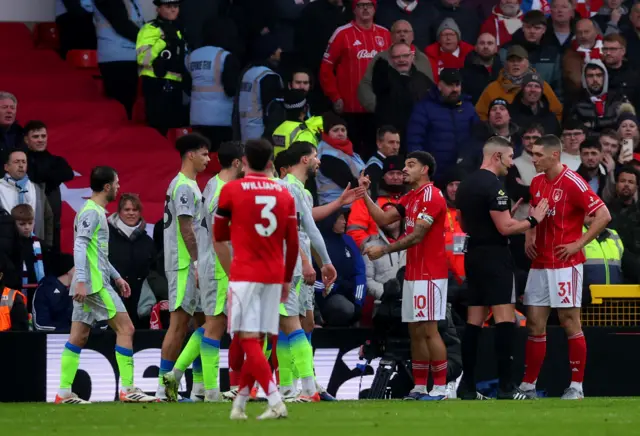
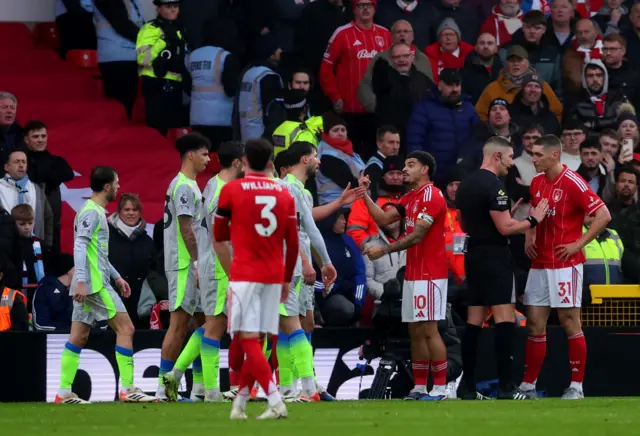
Nottingham Forest were left furious after a series of controversial refereeing decisions overshadowed their late 2–1 defeat to Manchester City, with key moments prompting major questions over VAR and on-field judgement at the City Ground.
Forest appeared set to earn a vital point before Rayan Cherki’s 83rd-minute winner, a goal that sparked immediate protests from players and staff who believed a clear foul had been ignored in the build-up.
VAR Scrutiny After “Obvious” Foul Ignored
The decisive moment came when Morgan Gibbs-White was knocked to the floor just seconds before Cherki struck from the edge of the box. Forest argued the midfielder was illegally pushed, preventing him from blocking the shot.
“Morgan Gibbs-White quite clearly gets pushed to the floor and the same player is involved in blocking the ball,” Forest manager Sean Dyche said. “But he can’t block it because as he jumps up, it goes through the bit of his body which he would have blocked it with. Whichever way you look at it it’s a foul.”
Despite a VAR check, referee Rob Jones allowed the goal to stand, a decision that left Forest incredulous.
“Such an easy game to referee, in my opinion, such an easy decision for VAR,” Dyche said.
“When you played so well, to come in and have to talk about officials affecting the game, but they clearly did. Everyone in the stadium and everyone watching at home could see that.”
Dyche also questioned the interpretation used to justify the goal.
“They’ll say, ‘Yeah, the ball wasn’t there’. And you go, ‘OK, so if the ball’s not near the keeper and you push the keeper to the floor, is that going to be a foul then?’
“We all know it is. I can’t work it out. And then they score from it, which is the double whammy.
“I’m a big fan of VAR – I can’t work out how you can’t get that right.”
Second Yellow Card Overlooked in Another Flashpoint
Forest’s anger deepened earlier in the second half when Ruben Dias, already booked for dissent, brought down Igor Jesus as the Forest forward broke into space.
Jones awarded a free-kick but declined to show a second yellow card: a call that could have left City playing with ten men for over 40 minutes.
“They say it’s an accident. If that’s an accident when he’s running through on goal we all know what happens. You get a red card,” Dyche said.
“So why is it an accident and he isn’t yellow carded then?
“I just find it bizarre, I really do. And I think these are easy things. Just give him a second yellow, that’s it. ‘Off you go’. I’m absolutely stunned.”
Big Calls, Big Consequences
With Forest hovering just above the Premier League relegation zone, the impact of such decisions is magnified. A point against an in-form City side would have offered breathing space, but instead the focus has fallen on officiating errors that Forest believe directly influenced the outcome.
In a match where fine margins mattered, Forest were left feeling those margins were decided not by football, but by refereeing calls that failed them when it mattered most.
While the AP News report confirms their marriage and Preti’s background as a Danish‑born Italian model and actor, the couple has kept the earliest details of their meeting private. What is known is that their relationship grew steadily over the past several years, with Preti becoming a consistent presence at Williams’ public appearances and tennis events. His support was especially visible during Williams’ return to competition in 2025, where he was often seen courtside cheering her on. Their connection deepened through shared interests in fashion, travel, and creative pursuits, forming the foundation of a partnership that friends describe as grounded, warm, and deeply supportive.
A Relationship Built on Support and Shared Passions
Williams publicly thanked Preti earlier in 2025 after becoming the second‑oldest woman to win a tour‑level singles match, noting that he was in the stands during her emotional victory at the DC Open. Their relationship has been marked by mutual encouragement — Williams continuing her legendary tennis career and Preti expanding his work in modeling and acting. The pair has appeared together at major fashion events, including the CFDA Fashion Awards in New York, signaling a shared comfort in both the sports and entertainment worlds.
A Five‑Day Wedding Celebration Filled With Style and Star Power
The couple married in Palm Beach, Florida, during a five‑day celebration surrounded by family, friends, and fellow athletes. While AP News does not list specific celebrity attendees, Williams’ long‑standing ties to the tennis world, fashion industry, and entertainment community suggest a guest list filled with notable figures. The event reportedly blended elegance with personal touches, reflecting Williams’ signature style and Preti’s European creative background. The celebration marked a joyful milestone for the seven‑time Grand Slam singles champion as she enters her 33rd season on the WTA Tour in 2026.
What’s Next for Venus and Andrea in 2026
Professionally, Williams is set to begin her 33rd straight season on tour, starting in Auckland in January. Her focus remains on competing at the highest level while continuing her work in fashion, business, and philanthropy. Preti, meanwhile, is expected to continue expanding his acting and modeling career, leveraging the visibility and momentum of this new chapter. Together, the newlyweds enter 2026 as a power couple balancing global careers, creative ambitions, and a shared life built on partnership and purpose.
IOC Pushes for Olympic Truce Ahead of Milan Cortina 2026
The International Olympic Committee is once again calling for a pause in global conflict, urging a temporary truce in the ongoing wars in Gaza and Ukraine ahead of the Milan Cortina 2026 Olympic and Paralympic Winter Games.
The proposed truces would last roughly two months, covering the full Olympic and Paralympic window. While the IOC’s effort is unlikely to bring warring parties to the negotiating table, it has received formal backing from the international community through the United Nations.
United Nations Adopts Olympic Truce Resolution
The Olympic Truce Resolution was adopted during the 80th Session of the United Nations General Assembly. The resolution calls on all UN Member States to observe the Olympic Truce for the Milan Cortina 2026 Games, reinforcing the long standing connection between sport and peace.
In its official statement, the United Nations emphasized the Olympic ideal, stating the resolution aims at “building a peaceful and better world through sport and the Olympic ideal.”
The truce period is defined as beginning seven days before the opening ceremony of the Olympic Winter Games on February 6 and extending through seven days after the conclusion of the Paralympic Winter Games on March 15.
Safe Passage for Athletes and Officials
At its core, the Olympic Truce resolution focuses on ensuring the safe passage and participation of athletes, coaches, officials, and delegations traveling to and from the Games.
The tradition dates back to Ancient Greece in the ninth century BC, when warring city states agreed to lay down their arms so competitors could safely travel to ancient Olympia. The agreement allowed sport to exist above conflict, even if only temporarily.
The IOC formally revived the concept in the 1990s, viewing the Olympic Truce as a way to protect athletes and use sport as a platform for dialogue, reconciliation, and peace.
A History That Rarely Holds
Despite its symbolic value, the Olympic Truce has often failed on the modern world stage. Most notably, Russia launched its invasion of Ukraine during the 2022 Beijing Winter Olympics, directly violating the spirit of the truce.
History shows the limits of the Olympic ideal during global conflict. The 1916 Olympic Games were cancelled due to World War I, while the 1940 and 1944 Summer and Winter Olympics were cancelled because of World War II.
Symbolism Over Substance
While the Olympic Truce carries deep historical and moral significance, its real world impact remains limited. On the global stage, symbolic gestures rarely outweigh political and military realities.
Still, the IOC continues to push the message, believing that even a brief pause in violence is worth pursuing, if only to protect the athletes and preserve the ideals upon which the Olympic movement was built.
Does Major League Soccer Have a Vancouver Problem?
The answer appears to be yes. However, there may also be a clear solution. That solution is a stadium village built around a modern soccer specific venue. The Vancouver City Council and the ownership group of the Vancouver Whitecaps have signed a memorandum of understanding. The agreement allows both sides to explore a new stadium and surrounding entertainment district. The proposed site sits on a recently closed city owned racetrack.
Stadium Revenue at the Center of the Issue
According to MLS Commissioner Don Garber, the Whitecaps ownership is not generating enough stadium revenue at its current home. The team does not control food and beverage sales. That limits one of the most important income streams for modern sports franchises.
There are also scheduling problems. The venue hosts other events that block access for the Whitecaps. In 2024, the issue reached a breaking point. An MLS playoff match could not be played in Vancouver due to a conflict. The match against Portland had to be moved to Portland.
Those problems hurt revenue and competitive balance. They also weaken the long term stability of the franchise.
Political Pressure and Relocation Concerns
Vancouver Mayor Ken Sim did not mince words when discussing the situation. He acknowledged that there are interested parties who would like to buy the Whitecaps. Some of those groups would consider moving the team if a new stadium deal is not reached.
Sim made it clear that ownership control matters. Without a stadium and control over concessions, the economics do not work. He stated that there may be no realistic path for the Whitecaps to remain in Vancouver without the memorandum of understanding.
That statement raised alarms across the city and within MLS.
World Cup Venue But Still a Problem
The current Vancouver stadium is 42 years old. It is also undergoing another renovation. The building will host seven FIFA Men’s World Cup matches in 2026.
That alone confirms the venue is not obsolete. FIFA does not select broken or outdated facilities for its premier events. Still, World Cup suitability does not solve MLS business issues.
A multipurpose stadium rarely maximizes revenue for a single tenant. That reality drives league wide pressure for soccer specific venues.
Garber Gets the Result He Wanted
Garber’s role is to advocate for MLS owners. That includes pushing for better venues and stronger lease terms. The memorandum of understanding suggests progress.
A stadium village would give the Whitecaps control. It would also anchor development around the club. That model has worked across North America.
MLS may have had a Vancouver problem. It now appears to have a Vancouver opportunity.