By- Jim Williams Senior Columnist – Capital Sports Network
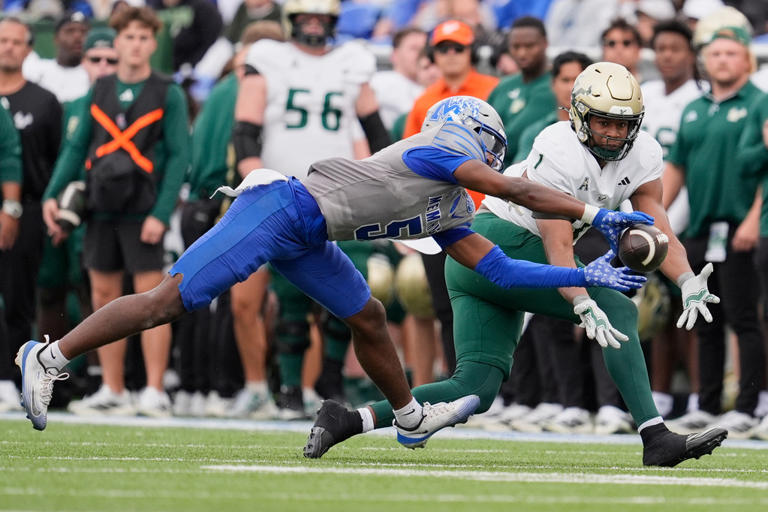
In a high-stakes battle for supremacy atop the American Conference, No. 18 USF Bulls fell to Memphis 34–31 in a dramatic finish at Simmons Bank Liberty Stadium. The showdown carried major implications for the AAC title race and potential College Football Playoff positioning. With both teams entering at 6–1, the game was billed as a defining moment in the 2025 season—and it delivered.
USF Bulls led 31–17 entering the final quarter, but Memphis mounted a furious comeback. Greg Desrosiers Jr. sparked the rally with a 13-yard touchdown run, followed by a Gianni Spetic 28-yard field goal to cut the deficit to 31–26. With just over a minute left, Brendon Lewis connected with Cortez Braham Jr. on a 10-yard fade for the go-ahead score. Lewis finished with 307 passing yards and the game-winning two-point conversion.
USF quarterback Byrum Brown was electric, accounting for 390 total yards—269 passing and 121 rushing—with three touchdowns. His 73-yard scoring run in the third quarter gave the Bulls a two-score cushion, but the offense stalled in the fourth.
USF Bulls Gramatica’s Miss Seals Memphis Win
With two seconds remaining, USF kicker Nico Gramatica lined up for a 52-yard field goal to force overtime. The attempt sailed wide right, ending the Bulls’ hopes and handing Memphis a crucial conference win.
Despite the loss, he USF Bulls (6–2, 3–1 AAC) remains in contention. Head coach Alex Golesh emphasized postgame, “We control what we can. If we win out, we’ll be right there. This team has heart, and we’re not done yet.”
USF’s remaining schedule includes:
Nov. 6th home to UTSA
Nov. 15th at Navy
Nov. 22nd at UAB
Nov. 29th home to Rice
Memphis schedule
Oct. 31 at Rice
Nov. 7th home to Tulane
Nov. 15th at East Carolina
Nov. 27th Navy come to Memphis
If USF wins out and Memphis drops one more, the Bulls could reclaim the top spot and earn a berth in the AAC Championship Game. With a strong finish and a title win, USF could re-enter the CFP conversation.
Lane Kiffin’s 31–24 win over Florida Saturday night kept Ole Miss alive in the SEC title race and the College Football Playoff hunt. But the real story? Where will Kiffin coach next season—Oxford or Gainesville? LSU is not in the mix. According to reports from a number of media outlets including USA Today, ESPN, and CBS Sports, Kiffin’s focus is squarely on Ole Miss and Florida.
Lane Kiffin reportedly views this next move as his final stop. Whether he stays at Ole Miss or takes the Florida job, he wants full control, long-term security, and a shot at a national championship. He’s inspired by Urban Meyer and Steve Spurrier, both of whom won titles at Florida with full autonomy.
Florida’s Pitch vs. Ole Miss’ Loyalty
Florida offers:
Elite facilities
Fertile recruiting ground
A massive salary package (reportedly $10M+)
Ole Miss counters with:
A top-10 salary ($9M)
Strong administrative support
A loyal fan base and winning culture
Sources from the Gainesville Sun, Florida Times-Union, and Clarion Ledger confirm both schools are actively pursuing Kiffin.
Lane Kiffin Represented By Jimmy Sexton: Leverage and SEC Loyalty
Kiffin’s agent, Jimmy Sexton, is reportedly in touch with both programs. Ole Miss has already placed a new offer on Kiffin’s desk. Either way, Sexton will ensure Lane Kiffin gets everything he wants.
Kiffin wants to stay in the SEC and compete for national titles. Florida may be hard to turn down, but Ole Miss has been good to him. The decision will shape the SEC for years to come.
Does Major League Soccer Have a Vancouver Problem?
Does the MLS have a Vancouver problem? Increasingly, the answer appears to be yes.
The Vancouver Whitecaps ownership group’s lease with PayCo, a British Columbia provincial Crown corporation, expires at the end of December, and Major League Soccer Commissioner Don Garber is publicly pressuring PayCo to improve the terms. According to Garber, the Whitecaps’ owners are not getting anywhere near the stadium revenue needed to operate competitively or sustainably in today’s MLS landscape.
Garber did not mince words. “The club isn’t sustainable in a situation where they’re in a building which they have no control over, they have minimal participation with revenue. The biggest issue is the lack of schedule flexibility,” he said. The Whitecaps are missing out on essential revenue from concessions, and the team regularly loses access to needed dates because of other events. In 2024, an MLS playoff game that was slated to be played in Vancouver had to be moved entirely because the venue was already booked—forcing the Vancouver-Portland matchup to be relocated to Portland.
Ownership Pressures and Stadium Challenges
PayCo responded by insisting they want to keep Whitecaps games in the stadium, issuing a statement describing “productive discussions” with club ownership. But the story behind the scenes is more complicated. The Whitecaps ownership quietly put the franchise up for sale nearly a year ago, signaling deeper concerns about long-term stability. At the same time, the ownership group began speaking with Vancouver city officials about the possibility of constructing a soccer-specific stadium—something MLS has favored for decades.
BC Place, Vancouver’s existing stadium, seats 55,000 people and is 42 years old. It is currently undergoing yet another renovation, in part because the venue will host seven FIFA Men’s World Cup games in 2026. Since FIFA does not choose outdated or poorly maintained venues for its marquee events, the upgrades are substantial. A new “premium hospitality” area is expected to generate a fresh revenue stream, raising questions about whether improved financial terms might now be possible for the Whitecaps.
Garber’s Mission: Better Venues and Better Deals
A commissioner’s job is to advocate for stronger venues and better lease agreements for every franchise, and Garber has made that clear in Vancouver’s case. With MLS growing rapidly and club valuations climbing, teams need full access to stadium revenues to keep pace. Whether that happens at BC Place—or in a new stadium altogether—may determine the future of the Whitecaps in Vancouver.
ESPN Makes News with NFL deal along with new streaming app coning soon
The Tenure of Paul Tagliabue Defined by Stability, Strategy, and Big Money
Paul Tagliabue did what needed to be done to be a successful sports league commissioner. Tagliabue, who recently passed away at the age of 84, stepped into one of the most challenging roles in American sports when he replaced the legendary Pete Rozelle. Following Rozelle was no easy act, but Tagliabue understood the essential truth of the job: make the owners money, protect the league’s interests, and keep the machine running smoothly. By that metric—and many others—Tagliabue excelled.
One of the biggest turning points of his tenure came in 1993, when Rupert Murdoch’s FOX network was struggling to stay alive and searching desperately for a programming identity. Murdoch needed a major sports property to legitimize his young network, and he shocked the industry by outbidding CBS for the National Football Conference television package. Murdoch made a massive gamble. Tagliabue took the money, and the NFL walked away with a financial windfall. FOX, in turn, took over a series of CBS affiliates and reshaped American television, giving those stations shows like The Simpsons and Married With Children while CBS lost 60 Minutes in several major markets.
Labor Peace and Legal Battles Shaped the League’s Growth
Tagliabue’s relationship with the National Football League Players Association Executive Director Gene Upshaw also became a defining factor of his era. While the two never publicly detailed the mechanics of their working relationship, it was clear they had an understanding that benefitted both sides. The NFL enjoyed unprecedented labor peace, despite a series of complex legal rulings—most notably a court-ordered form of free agency—that changed the business structure of the league. Instead of chaos, the NFL kept moving forward, stabilizing its economic structure and keeping players and owners aligned enough to avoid major disruptions.
Expansion, Relocation, and an Evolving NFL Landscape
The 1990s also became an era of franchise movement and expansion under Tagliabue. In 1995, Al Davis took the Los Angeles Raiders franchise back to Oakland. That same year, Georgia Frontiere moved her Los Angeles Rams to St. Louis. Not long after, Art Modell uprooted the Cleveland Browns franchise for Baltimore in 1996. In 1997, Bud Adams relocated the Houston Oilers to Tennessee.
The moves triggered political battles as well. The city of Cleveland sued the NFL, ultimately forcing the league to promise a return to the city—leading to a 1999 expansion team. Earlier in the decade, the league added franchises in Charlotte and Jacksonville, continuing its push into new markets.
By 1999, the NFL sought a 32nd team and hoped desperately to reenter Los Angeles. With no stadium deal available, the league instead awarded the franchise to Houston.
A Commissioner Who Delivered
Tagliabue retired in 2006, leaving behind a league richer, more stable, and more nationally dominant than when he arrived. Above all else, he made the NFL owners money—and in their eyes, that made him a success.