Connect with us

Business

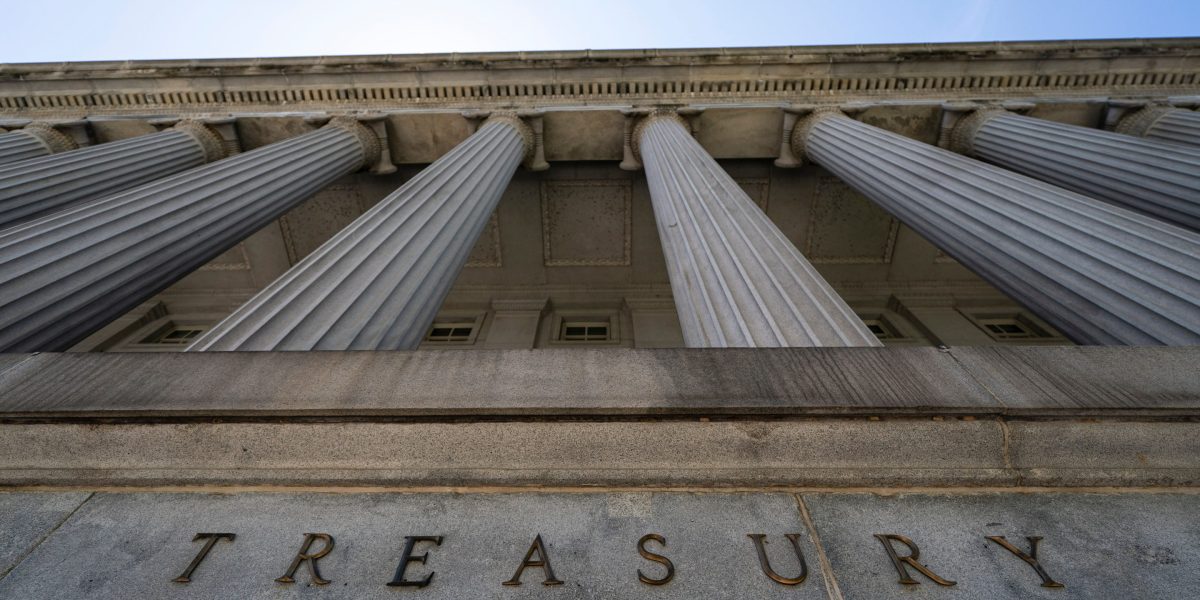
US, UK, France bond yields tip higher amid national debt concerns

Published

on


As traders head into the final leg of 2025 they are not doing so with overconfidence. In fact, if this week’s bond market is anything to go by, they’re nervous.

U.S. 30-year Treasuries will open a breath away from 5% today, one of their highest levels this year, following a sharp uptick since the end of last month. While yields pushing higher is one sign of a selloff, another is trading activity. That too has ticked up, increasing approximately 19% year-on-year at the end of August according to securities experts Sifma.

But the upset isn’t confined to America alone. In Europe, French government bonds—Obligations Assimilables du Trésor or OATs—similarly spiked toward a 5% yield and sit at 4.49% at the time of writing, marking its highest run since 2009.

The U.K. is arguably feeling the sharpest end of the issue, with 30-year gilts pushing above 5.7%, their highest level since the spring of 1998.

Meanwhile, gold, the safe haven asset in times of economic upheaval, has hit a record price of $3,537.

One reason investors are drawing back from government debt is concerns over its sustainability. For years economists have been nervously watching the debt-to-GDP ratios of developed economies tip further out of balance, meaning nations aren’t generating the growth to keep up with the borrowing they have financed.

If that ratio tips too far out of balance, or if investors see no signs of governments addressing the issue, experts fear there will be a flight from government securities as buyers demand higher yield premiums in return for their debt purchases. This could prompt a range of outcomes, with either central banks forced to step in to ease money supply or political pressure mounting to the point of significant cost cutting.

Investors won’t be cajoled by pressure from the Oval Office to continue buying either, said Desmond Lachman, a senior fellow at the American Enterprise Institute. He told Fortune in an exclusive interview last month: “A comment I think is great is: One thing about the bond markets is that they can’t be primaried. In bond markets, the money’s gonna move. People just want to protect their cash; they’re not afraid of being bullied by Trump if the numbers don’t add up.”

Deutsche Bank noted to clients this morning that the French deficit running at 5.6–5.8% of GDP in 2025, above the official 5.4% target, which is fueling concerns around debt sustainability. Likewise in the U.K., Deutsche’s Jim Reid noted that the government has a £20–£25 billion budget gap to fill by November, compounding questions about how seriously global governments are taking their spending.

The Fed question

The picture in the U.S. is slightly more complicated, but boils down to confidence in the fundamentals of America’s economy. As Reid notes: “Concerns around Fed independence also contributed to the bond market moves. A second court hearing began yesterday on whether President Trump can be temporarily barred from dismissing Fed Governor Lisa Cook … Earlier, nearly 600 economists signed an open letter in Cook’s defence, while FHFA Director Bill Pulte kept up accusations of mortgage fraud.”

“Meanwhile, Treasury Secretary Scott Bessent confirmed the search for Powell’s successor as Fed Chair is already underway … In comments to Reuters, he stressed that the Fed ‘should remain independent,’ though he was quick to add that it has also ‘made a lot of mistakes.’”

With Bessent and Trump continuing to pressure the Fed for lower interest rates—and with economic data suggesting this may soon be appropriate—treasury yields on the shorter end are lowering in anticipation of cheaper borrowing.

5 year yields, for example, are at 3.74% down significantly from earlier this year when they sat at more than 4.6%.

Goldman Sachs noted the widening of the gap between short and long term yields, writing to clients Friday: “Despite relative stability at the very front-end of the U.S. curve, cut pricing in 2026 has continued to build alongside a rise in risk premium at the long-end.”

Oxford Economics’s John Canavan echoed in a note yesterday: “Supply pressures also argue for continued upward pressure on term premiums. Treasury Secretary Scott Bessent has suggested the Treasury avoid increasing the size of long-end Treasury issuance unless rates move lower, but the Treasury still needs to raise much more than is maturing for the 10-year and bond auction cycles each month, even if the auction sizes remain steady.

“Market participants might be taking some comfort in a recent Congressional Budget Office forecast that the increase in tariffs will reduce deficits over the next 10 years by a total of around $4tn, but we think the effective tariff rate will be lower than that assumed by the CBO, which means the impact on deficits will be smaller. If deficits are larger than expected, the upward pressure on the term premium is likely to increase regardless of the specific monthly 10-year and bond auction sizes.”

Fortune Global Forum returns Oct. 26–27, 2025 in Riyadh. CEOs and global leaders will gather for a dynamic, invitation-only event shaping the future of business. Apply for an invitation.


Source link

Continue Reading

Business

U.S. consumers are so strained they put more than $1B on BNPL during Black Friday and Cyber Monday

Published

on


Financially strained and cautious customers leaned heavily on buy now, pay later (BNPL) services over the holiday weekend.

Cyber Monday alone generated $1.03 billion (a 4.2% increase YoY) in online BNPL sales with most transactions happening on mobile devices, per Adobe Analytics. Overall, consumers spent $14.25 billion online on Cyber Monday. To put that into perspective, BNPL made up for more than 7.2% of total online sales on that day.

As for Black Friday, eMarketer reported $747.5 million in online sales using BNPL services with platforms like PayPal finding a 23% uptick in BNPL transactions.

Likewise, digital financial services company Zip reported 1.6 million transactions throughout 280,000 of its locations over the Black Friday and Cyber Monday weekend. Millennials (51%) accounted for a chunk of the sizable BNPL purchases, followed by Gen Z, Gen X, and baby boomers, per Zip.

The Adobe data showed that people using BNPL were most likely to spend on categories such as electronics, apparel, toys, and furniture, which is consistent with previous years. This trend also tracks with Zip’s findings that shoppers were primarily investing in tech, electronics, and fashion when using its services.

And while some may be surprised that shoppers are taking on more debt via BNPL (in this economy?!), analysts had already projected a strong shopping weekend. A Deloitte survey forecast that consumers would spend about $650 million over the Black Friday–Cyber Monday stretch—a 15% jump from 2023.

“US retailers leaned heavily on discounts this holiday season to drive online demand,” Vivek Pandya, lead analyst at Adobe Digital Insights, said in a statement. “Competitive and persistent deals throughout Cyber Week pushed consumers to shop earlier, creating an environment where Black Friday now challenges the dominance of Cyber Monday.”

This report was originally published by Retail Brew.


Source link

Continue Reading

Business

AI labs like Meta, Deepseek, and Xai earned worst grades possible on an existential safety index

Published

on


A recent report card from an AI safety watchdog isn’t one that tech companies will want to stick on the fridge.

The Future of Life Institute’s latest AI safety index found that major AI labs fell short on most measures of AI responsibility, with few letter grades rising above a C. The org graded eight companies across categories like safety frameworks, risk assessment, and current harms.

Perhaps most glaring was the “existential safety” line, where companies scored Ds and Fs across the board. While many of these companies are explicitly chasing superintelligence, they lack a plan for safely managing it, according to Max Tegmark, MIT professor and president of the Future of Life Institute.

“Reviewers found this kind of jarring,” Tegmark told us.

The reviewers in question were a panel of AI academics and governance experts who examined publicly available material as well as survey responses submitted by five of the eight companies.

Anthropic, OpenAI, and GoogleDeepMind took the top three spots with an overall grade of C+ or C. Then came, in order, Elon Musk’s Xai, Z.ai, Meta, DeepSeek, and Alibaba, all of which got Ds or a D-.

Tegmark blames a lack of regulation that has meant the cutthroat competition of the AI race trumps safety precautions. California recently passed the first law that requires frontier AI companies to disclose safety information around catastrophic risks, and New York is currently within spitting distance as well. Hopes for federal legislation are dim, however.

“Companies have an incentive, even if they have the best intentions, to always rush out new products before the competitor does, as opposed to necessarily putting in a lot of time to make it safe,” Tegmark said.

In lieu of government-mandated standards, Tegmark said the industry has begun to take the group’s regularly released safety indexes more seriously; four of the five American companies now respond to its survey (Meta is the only holdout.) And companies have made some improvements over time, Tegmark said, mentioning Google’s transparency around its whistleblower policy as an example.

But real-life harms reported around issues like teen suicides that chatbots allegedly encouraged, inappropriate interactions with minors, and major cyberattacks have also raised the stakes of the discussion, he said.

“[They] have really made a lot of people realize that this isn’t the future we’re talking about—it’s now,” Tegmark said.

The Future of Life Institute recently enlisted public figures as diverse as Prince Harry and Meghan Markle, former Trump aide Steve Bannon, Apple co-founder Steve Wozniak, and rapper Will.i.am to sign a statement opposing work that could lead to superintelligence.

Tegmark said he would like to see something like “an FDA for AI where companies first have to convince experts that their models are safe before they can sell them.

“The AI industry is quite unique in that it’s the only industry in the US making powerful technology that’s less regulated than sandwiches—basically not regulated at all,” Tegmark said. “If someone says, ‘I want to open a new sandwich shop near Times Square,’ before you can sell the first sandwich, you need a health inspector to check your kitchen and make sure it’s not full of rats…If you instead say, ‘Oh no, I’m not going to sell any sandwiches. I’m just going to release superintelligence.’ OK! No need for any inspectors, no need to get any approvals for anything.”

“So the solution to this is very obvious,” Tegmark added. “You just stop this corporate welfare of giving AI companies exemptions that no other companies get.”

This report was originally published by Tech Brew.


Source link

Continue Reading

Business

Hollywood writers say Warner takeover ‘must be blocked’

Published

on


Hollywood writers, producers, directors and theater owners voiced skepticism over Netflix Inc.’s proposed $82.7 billion takeover of Warner Bros. Discovery Inc.’s studio and streaming businesses, saying it threatens to undermine their interests.

The Writers Guild of America, which announced in October it would oppose any sale of Warner Bros., reiterated that view on Friday, saying the purchase by Netflix “must be blocked.”

“The world’s largest streaming company swallowing one of its biggest competitors is what antitrust laws were designed to prevent,” the guild said in an emailed statement. “The outcome would eliminate jobs, push down wages, worsen conditions for all entertainment workers, raise prices for consumers, and reduce the volume and diversity of content for all viewers.”

The worries raised by the movie and TV industry’s biggest trade groups come against the backdrop of falling movie and TV production, slack ticket sales and steep job cuts in Hollywood. Another legacy studio, Paramount, was sold earlier this year.

Warner Bros. accounts for about a fourth of North American ticket sales — roughly $2 billion — and is being acquired by a company that has long shunned theatrical releases for its feature films. As part of the deal, Netflix co-CEO Ted Sarandos has promised Warner Bros. will continue to release moves in theaters.

“The proposed acquisition of Warner Bros. by Netflix poses an unprecedented threat to the global exhibition business,” Michael O’Leary, chief executive officer of the theatrical trade group Cinema United, said in en emailed statement Friday. “The negative impact of this acquisition will impact theaters from the biggest circuits to one-screen independents.”

The buyout of Warner Bros. by Netflix “would be a disaster,” James Cameron, the director of some of Hollywood’s highest-grossing films in history including Titanic and Avatar, said in late November on The Town, an industry-focused podcast. “Sorry Ted, but jeez. Sarandos has gone on record saying theatrical films are dead.”

On a conference call with investors Friday, Sarandos said that his company’s resistance to releasing films in cinemas was mostly tied to “the long exclusive windows, which we don’t really think are that consumer friendly.”

The company said Friday it would “maintain Warner Bros.’ current operations and build on its strengths, including theatrical releases for films.”

On the call, Sarandos reiterated that view, saying that, “right now, you should count on everything that is planned on going to the theater through Warner Bros. will continue to go to the theaters through Warner Bros.” 

Competition from online outfits like YouTube and Netflix has forced a reckoning in Hollywood, opening the door for takeovers like the Warner Bros. deal announced Friday. Media giants including Comcast Corp., parent of NBCUniversal, are unloading cable-TV networks like MS Now and USA, and steering resources into streaming. 

In an emailed note to Warner Bros. employees on Friday, Chief Executive Officer David Zaslav said the board’s decision to sell the company “reflects the realities of an industry undergoing generational change in how stories are financed, produced, distributed, and discovered.”

The Producers Guild of America said Friday its members are “rightfully concerned about Netflix’s intended acquisition of one of our industry’s most storied and meaningful studios,” while a spokesperson for the Directors Guild of America raised concerns about future pay at Warner Bros.

“We will be meeting with Netflix to outline our concerns and better understand their vision for the future of the company,” the Directors Guild said.

In September, the DGA appointed director Christopher Nolan as its president. Nolan has previously criticized Netflix’s model of releasing films exclusively online, or simultaneously in a small number of cinemas, and has said he won’t make movies for the company.

The Screen Actors Guild said Friday that the transaction “raises many serious questions about its impact on the future of the entertainment industry, and especially the human creative talent whose livelihoods and careers depend on it.”

Oscar winner Jane Fonda spoke out on Thursday before the deal was announced. 

“Consolidation at this scale would be catastrophic for an industry built on free expression, for the creative workers who power it, and for consumers who depend on a free, independent media ecosystem to understand the world,” the star of the Netflix series Grace and Frankie wrote on the Ankler industry news website.

Netflix and Warner Bros. obviously don’t see it that way. In his statement to employees, Zaslav said “the proposed combination of Warner Bros. and Netflix reflects complementary strengths, more choice and value for consumers, a stronger entertainment industry, increased opportunity for creative talent, and long-term value creation for shareholders.”


Source link

Continue Reading

Trending

Copyright © Miami Select.