In October, Swiss watch exports were again hit by the 39% tariffs imposed by the US, but a proposed agreement between Bern and Washington to cut them to 15% should give watchmakers some much-needed breathing space.
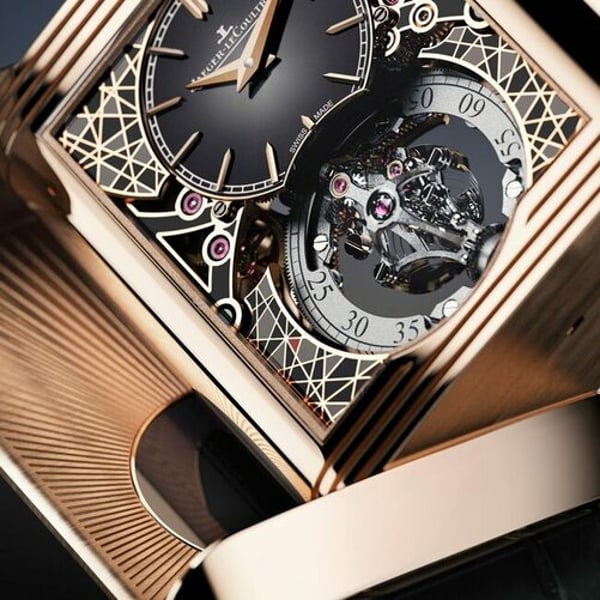
Swiss brands hope for a new agreement between Bern and Washington – Jaeger Lecoultre
In October, Swiss watch exports to the United States fell by a further 46.8% compared with the same period a year earlier, following a 55.6% drop in September and a 23.9% decline in August, according to data from the watchmaking federation published on Thursday.
In August, Washington imposed 39% tariffs on imports from Switzerland, raising serious concerns for the watch industry, since watches must be made in the country to bear the “Swiss Made” label, widely regarded as a symbol of Swiss watchmaking tradition.
However, after three trips to Washington, Economy Minister Guy Parmelin returned to Bern at the end of last week with a draft agreement to reduce these duties to 15%, although certain details still need to be finalised, particularly for the watch industry.
Since then, Manuel Emch, CEO of watchmaker Louis Erard, has been inundated with calls. In less than 24 hours, “all my retailers without exception have placed orders,” the head of the brand, which generates around a quarter of its sales in the US, told AFP.
“And now we need to put an entire production and logistics plan in place to ramp up output,” he added, because “we’re in the home straight before Christmas,” with “a very short window of opportunity to satisfy a very sudden demand.” Unlike some of its competitors, the brand, which produces in small quantities, had not been able to build up stock in the US.
Relief
The US is the leading foreign market for Swiss watchmaking, accounting for almost 17% of exports. Anticipating an increase in tariffs, many watchmakers rushed to build up stock there, sending exports to the US up by 149.2% in April and 45% in July. These exports collapsed in August in the wake of the announcement of the US tariff hike.
“I’m relieved that we’re back to a less punitive tariff,” Elie Bernheim, CEO of Geneva-based Raymond Weil, told AFP, adding that “this will greatly improve Swiss exports to the US in the coming weeks.”
For Edouard Meylan, head of luxury brand H. Moser, “going from 39% to 15% clearly eases the pressure,” even if “it doesn’t make the other challenges disappear… but it does provide more breathing space,” which “allows us to look at this strategic market with greater clarity.”
In a study published at the beginning of October, the auditing and consulting firm Deloitte noted that the sector is currently going through “one of the most complex periods in its recent history,” amid weak demand in China, surging gold prices and a strong Swiss franc, as well as US tariffs.
According to Jean-Philippe Bertschy, analyst at Vontobel, this easing of tariffs will therefore give “a little breathing space” to watch manufacturers and their suppliers, he told AFP. But “pressure will remain high over the coming quarters, with an improvement expected in the second half of 2026,” he said.
Across all markets, Swiss watch exports contracted by 4.4% in October, to 2.2 billion Swiss francs (2.3 billion euros), according to the watchmaking federation. In China, they recovered for the second consecutive month, rising by 12.6% in October. They also increased by 2.4% in Hong Kong but fell by 5.6% in Japan. The picture was more mixed in Europe, with the UK down 7.4%, France up 10.8%, and Germany up 3.9%.
This article is an automatic translation. Click here to read the original article.
The demerger of Unilever‘s ice cream division, to be named ‘The Magnum Ice Cream Company,’ which had been delayed in recent months by the US government shutdown, will finally go ahead on Saturday, the British group announced.
Reuters
Unilever said in a statement on Friday that the admission of the new entity’s shares to listing and trading in Amsterdam, London, and New York, as well as the commencement of trading… is expected to take place on Monday, December 8.
The longest federal government shutdown in US history, from October 1 to November 12, fully or partially affected many parts of the federal government, including the securities regulator, after weeks without an agreement between Donald Trump‘s Republicans and the Democratic opposition.
Unilever, which had previously aimed to complete the demerger by mid-November, warned in October that the US securities regulator (SEC) was “not in a position to declare effective” the registration of the new company’s shares. However, the group said it was “determined to implement in 2025” the separation of a division that also includes the Ben & Jerry’s and Cornetto brands, and which will have its primary listing in Amsterdam.
“The registration statement” for the shares in the US “became effective on Thursday, December 4,” Unilever said in its statement. Known for Dove soaps, Axe deodorants and Knorr soups, the group reported a slight decline in third-quarter sales at the end of October, but beat market expectations.
Under pressure from investors, including the activist fund Trian of US billionaire Nelson Peltz, to improve performance, the group last year unveiled a strategic plan to focus on 30 power brands. It then announced the demerger of its ice cream division and, to boost margins, launched a cost-saving plan involving 7,500 job cuts, nearly 6% of the workforce. Unilever’s shares on the London Stock Exchange were steady on Friday shortly after the market opened, at 4,429 pence.
This article is an automatic translation. Click here to read the original article.
Burberry has named a new chief operating and supply chain officer as well as a new chief customer officer. They’re both key roles at the recovering luxury giant and both are being promoted from within.
Matteo Calonaci becomes chief operating and supply chain officer, moving from his role as senior vice-president of strategy and transformation at the firm.
In his new role, he’ll be oversee supply chain and planning, strategy and transformation, and data and analytics. He succeeds Klaus Bierbrauer, who’s currently Burberry supply chain and industrial officer. Bierbrauer will be leaving the company following its winter show and a transition period.
Matteo Calonaci – Burberry
Meanwhile, Johnattan Leon steps up as chief customer officer. He’s currently currently Burberry’s senior vice-president of commercial and chief of staff. In his new role he’ll be leading Burberry’s customer, client engagement, customer service and retail excellence teams, while also overseeing its digital, outlet and commercial operations.
Both Calonaci and Leon will join the executive committee, reporting to Company CEO Joshua Schulman.
JohnattanLeon – Burberry
Schulman said of the two execs that the appointments “reflect the exceptional talent and leadership we have at Burberry. Both Matteo and Johnattan have been instrumental in strengthening our focus on executional excellence and elevating our customer experience. Their deep understanding of our business, our people, and our customers gives me full confidence that their leadership will help drive [our strategy] Burberry Forward”.
Traditional and occasion wear designer Puneet Gupta has stepped into the world of fine jewellery with the launch of ‘Deco Luméaura,’ a collection designed to blend heritage and contemporary aesthetics while taking inspiration from the dramatic landscapes of Ladakh.
Hints of Ladakh’s heritage can be seen in this sculptural evening bag – Puneet Gupta
“For me, Deco Luméaura is an exploration of transformation- of material, of story, of self,” said Puneet Gupta in a press release. “True luxury isn’t perfect; it is intentional. Every piece is crafted to be lived with and passed on.”
The jewellery collection features cocktail rings, bangles, chokers, necklaces, and statement evening bags made in recycled brass and finished with 24 carat gold. The stones used have been kept natural to highlight their imperfect and unique forms and each piece in the collection has been hammered, polished, and engraved by hand.
An eclectic mix of jewels from the collection – Puneet Gupta
Designed to function as wearable art pieces, the colourful jewellery echoes the geometry of Art Deco while incorporating distinctly South Asian imagery such as camels, butterflies, and tassels. Gupta divides his time between his stores in Hyderabad and Delhi and aims to bring Indian artistry to a global audience while crafting a dialogue between designer and artisan.