Despite fears the trans-Atlantic alliance would break up over President Donald Trump’s desire to take over Greenland, the U.S. and Europe are too intertwined militarily and economically to split, according to Dan Alamariu, chief geopolitical strategist at Alpine Macro.
Indeed, U.S. geopolitical dominance actually depends on European allies, he said in a note earlier this month, even as NATO members scramble to boost military spending to shore up capability gaps. Meanwhile, Europe can’t pivot to China or Russia.
“The plausible and likely path is messy coexistence: periodic trade clashes, louder rhetoric, and gradual European autonomy at the margins, alongside continued alignment on Russia, nuclear deterrence, intelligence, and China policy,” Alamariu wrote.
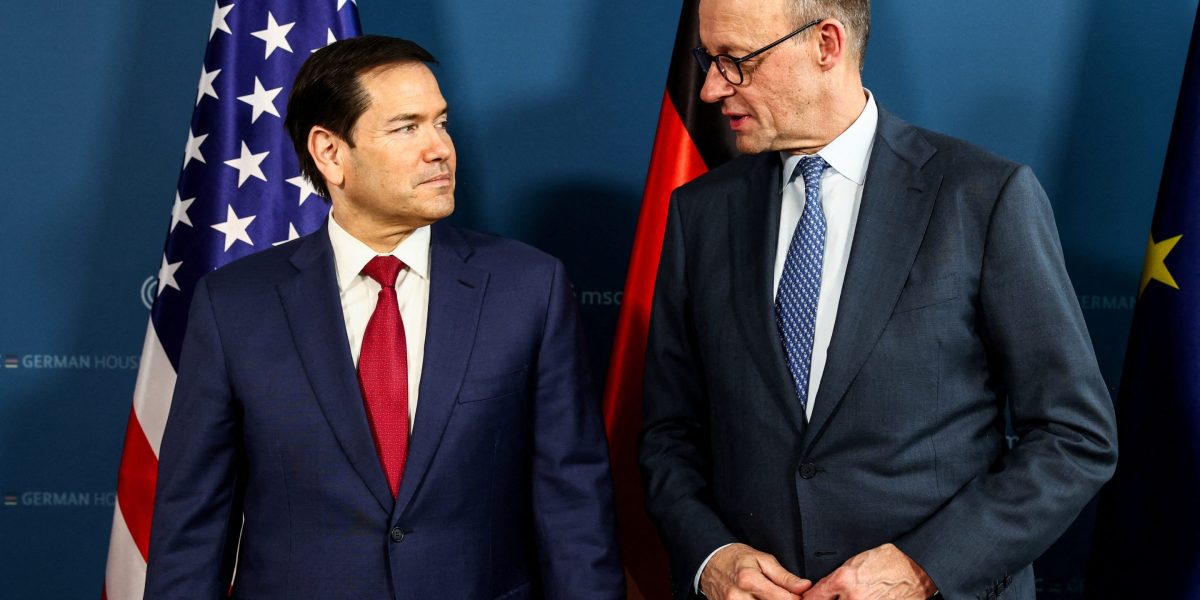
The strained ties were on display over the weekend during the Munich Security Conference. Secretary of State Marco Rubio vowed to remain involved in Europe and pointed to shared sacrifices on the battlefield, but reaffirmed the Trump administration’s goal to reshape the alliance.
Rubio also pulled out of a high-level meeting on Ukraine at the last minute, prompting one European official to call the move “insane” amid efforts to end Russia’s war there.
But for now, Europe can’t break free of its dependence on the U.S. military, especially for high-end deterrence and warfighting enablers, Alamariu said. While the European Union is boosting defense spending, it’s not enough to achieve strategic autonomy anytime soon.
“Even if politics sours, Euro-Atlantic defense runs through U.S.-centered institutions,” he added. “Bottom line: Without a common EU military and budget, the EU won’t become autonomous from the U.S., much less split off.”
On the economic side, the two partners have extremely complex ties that cover supply chains, services, foreign direct investment and financial flows, representing the world’s deepest bilateral relationship, Alamariu explained.
This dependence goes both ways and extends to military power. If NATO were to break up, the value of having the U.S. as an ally would be greatly diminished in Japan and South Korea, he said.
“Without NATO and its major allies, the U.S. would struggle to maintain its globally dominant role,” Alamariu warned. “This would have dire implications for the USD’s global role and its weak fiscal outlook. The U.S. literally cannot afford not to be a superpower, lest its bills come due.”
In fact, the U.S. fiscal picture has deteriorated sharply in recent years. And despite soaring deficits, Trump has vowed to increase defense spending by 50% to $1.5 trillion.
Helping finance U.S. budget shortfalls is Europe, which remains a top buyer of Treasury debt. Alamariu said there’s no broad evidence of European liquidation of U.S. assets and predicted it’s unlikely. At the same time, the American economy continues to outperform, making it attractive to investors, while Europe lacks a viable alternative to Treasuries.
EU foreign policy chief Kaja Kallas also highlighted U.S.-Europe codependence at the Munich Security Conference.
“When, for example, Russia goes to war, they go alone because they don’t have allies,” she said. “When America goes to wars, a lot of us go with you, and we lose our people along the way. So that means that you also need us to be this superpower. Because if you look at the bigger picture in terms of economic might, China is a very, very powerful country.”
To be sure, China is an economic threat to Europe, as a flood of cheap imports puts the continent’s industrial base at risk, Alamariu pointed out.
China also is a critical enabler of Russia’s war on Ukraine, and has reportedly deepened its cooperation with Moscow, particularly for dual-use components and critical minerals used in Russian drone production.
As long as Russia remains a threat, Europe has an incentivize to manage its tensions with the U.S. rather than seek a full-blown rupture, Alamariu said, adding that it will still accelerate “selective autonomy” in areas like defense investment and economic security.
“Yet, collaboration with the U.S. will likely persist despite sky-high headline risks and mutual fear and loathing,” he said. “Our argument: the two are stuck with each other, in an increasingly loveless, if still convenient, marriage.”