Uniform-Shoes, the Portuguese specialist in professional footwear, founded in 2014 — under the umbrella of Cool Gray Lda., headquartered in Oliveira de Azeméis — is enjoying strong commercial momentum and, consequently, consolidating its international presence.
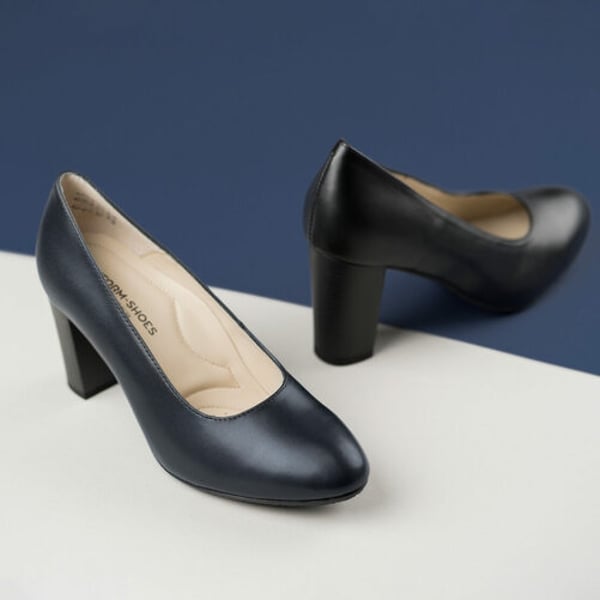
Pair of shoes created in 2023 by Uniform-Shoes for the hospitality and management teams at the Château de Versailles – @uniformshoes / Instagram
Having outfitted the hospitality and management teams at the Château de Versailles in 2023, in 2025 the Portuguese brand will renew its contract with the emblematic French palace, located on the outskirts of Paris and a symbol of the absolutist monarchy of King Louis XIV, who remodelled and decorated it in the Baroque style.
The Versailles contract with Uniform-Shoes will be extended for a further two years, reaffirming this prestigious collaboration, alongside many others currently underway, including the “start of a new project with Lufthansa Group, confirming the brand’s growing recognition among leading international clients,” said APICCAPS — the Portuguese Footwear, Components and Leather Goods Manufacturers’ Association.
With the Middle East and Europe as its main markets, in 2026 it “projects a phase of strong expansion in the United States, the consolidation of operations in the Middle East and the implementation of new large-scale projects in various European markets”, added APICCAPS, highlighting Portugal’s special role as a platform for industrial development and innovation. Nevertheless, this technical footwear also reaches destinations such as Madagascar, Cameroon and Morocco, to name a few of the most distinctive and distant markets.
“Uniform-Shoes has been consolidating its commercial presence across multiple geographies, supplying technical and customised footwear solutions to luxury tourism projects in Portugal and abroad, which rely on the brand to equip their teams,” the statement continued. “Its clients include leading names such as the Hilton Group, Rolls-Royce and Austrian Airlines.”
Alongside this specialisation, Uniform-Shoes also supplies international luxury retail operations with “uniform footwear for their sales teams, under confidentiality agreements that attest to the level of trust and rigour in this segment, and has been invited to submit proposals in international tenders, especially in the Middle East, where its network of local partners ensures direct service capacity and technical support in the region’s main markets,” said the Portuguese footwear association.
In short: Uniform-Shoes “combines tradition and innovation to meet the technical and aesthetic demands of professionals in the aviation, hospitality, retail and corporate services sectors”, benefiting from in-house manufacturing that is 100% Made in Portugal.
“ISO 14001 certification (sustainability), SEDEX membership (good management practices) and exports to more than 50 countries attest to the excellence of its production,” APICCAPS also said, highlighting the combination of technical design with “certified comfort and ethical responsibility in a project that is consolidating its position as one of the most promising in the sector,” it concluded.
Paon-Paon is still little-known but is already making its presence felt. The fledgling French artisanal maison is setting up a snug nest at 11 rue du Dragon in Paris, where it will open on January 30. The store is the brainchild of CEO Emmanuel Gavache, who co-founded Paon-Paon with Aurélie Introzzi, the maison’s creative director.
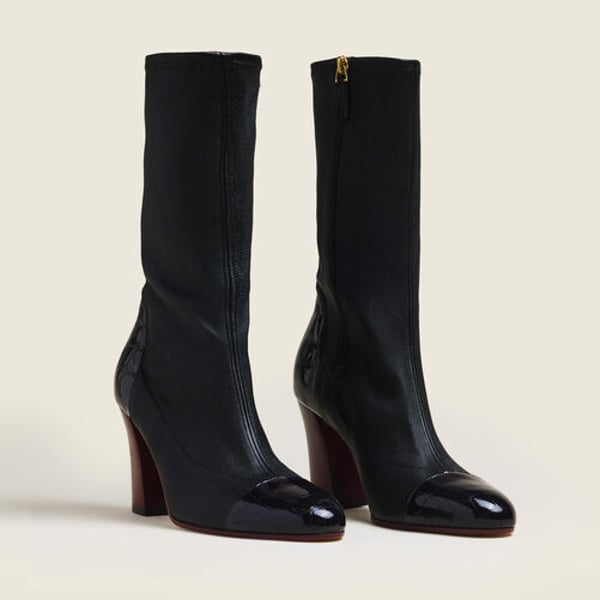
Paon-Paon’s first collection is big on cowhide leather – Paon-Paon
Paon-Paon was founded in December 2025, entering the market with a range of women’s footwear featuring sandals, mules, pumps and booties, some of them characterised by curved shapes, others more sharply defined. The models come in a wide variety of colours and materials, from pink or white cowhide to black or gold metal-effect leather, black or blue cashmere uppers, and more. Paon-Paon’s shoes are priced between €500 and €700, hoping to attract Parisian women with an eye for detail and luxury.
A touch of extravagance and “groundbreaking” sourcing
Introzzi, the creative mind behind the brand, said that “I design shoes because I’m profoundly convinced that footwear can do much more than change a look. Shoes influence posture, and posture can transform one’s attitude and confidence, the way one enters a room and inhabits the world.” Introzzi’s aim is to add a touch of extravagance to luxury.
Barely three months old, Paon-Paon will open its first store in Paris at the end of January – Paon-Paon
Paon-Paon shoes are made in Milan by a single manufacturer, following the “groundbreaking” sourcing strategy devised by Gavache, who is well aware of future requirements for manufacturing transparency. For example, the shoes’ leather comes from calves raised close to the tanneries that treat the material. Gavache is keen to showcase Paon-Paon’s traceable sourcing practices, and said he can organise visits to the brand’s manufacturing partners.
“Self-styled” luxury is meaningless
While Paon-Paon’s artisanal products are currently all made in Italy, Gavache is hoping to eventually produce in France, though he laments the harsh climate making it difficult to set up in business in the country. Paon-Paon is looking to expand its range, and is planning to gradually introduce leather goods and ready-to-wear within the next two years. However, Gavache prefers to describe Paon-Paon as an “artisanal maison” rather than a luxury label. “Before being deservedly labelled as ‘luxury’, [a brand] needs to be truly well-established to be identified as such. I don’t think one can self-style one’s brand as a luxury one,” he said.
Paon-Paon shoes are all made in Italy, near Milan – Paon-Paon
The same quest for the meaning of the word ‘luxury’ is mirrored in Introzzi’s words. “Having spent 12 years creating and perfecting comfortable footwear – an obsession that’s always stayed with me – working alongside top-notch artisans in Italy, I developed a desire to go a step further, travelling the extra mile and returning to what truly drives me: human nature, the environment, materials, colours, the lived experience,” she said.
Pivotal first year for Paon-Paon
The third name in Paon-Paon’s executive triumvirate is Catherine Teurquetil, who started her career in fashion and advertising before founding a children’s stationery and home decoration brand, and later taking charge of the family’s wine estate. Her business experience now enables her to actively shape “[Paon-Paon’s] vision and main strategies,” she said. According to Teurquetil, the maison’s challenge in its first year is to develop a powerful image and the vision of an established brand.
Paon-Paon is keen to become a recognised player in the French luxury sector – Paon-Paon
Teurquetil also cast light on what drove her to take part in the Paon-Paon venture: “I was immediately attracted by its creative freedom and artistic vision, as both chime perfectly with my sense for luxury and fashion.” She added that “the team’s quality, my clear desire to link up again with a demanding creative environment, and the very strong prospect of future success, made it a no-brainer.”
“Tightly controlled” distribution
After a year of preparation and barely out of the trap, Paon-Paon is already available at Printemps in New York. A “symbolically strong” presence according to Gavache, who is working on a “tightly controlled” distribution footprint. In parallel, Paon-Paon launched online and at Parisian accessories store 58M, and is hoping to work with Le Bon Marché in the capital, and with Galeries Lafayette in other French cities.
Paon-Paon shoes are equipped with removable soles, which can be replaced in Italy – Paon-Paon
For now, Paon-Paon’s priority project is its Parisian store. It extends over 70 square metres, 40 of which are devoted to the retail area and 30 to a space for product alterations and personalisation. The latter service is set to be provided by French artisans. Paon-Paon shoes, with the goal of extending their useful life, are equipped with removable soles that can be replaced in the producer’s workshop in Italy.
A “groundbreaking” sourcing approach, longer-lasting products and luxury designs don’t seem to be enough for Gavache. He has a history of investing in new technology, and is planning to bring his experience in the sector to bear. For example, he is keen to use a LiDAR scanner with volunteer customers to adapt Paon-Paon shoes to their actual foot shapes. Because, while the maison is taking flight, it might as well spread its wings in avant-garde fashion.
After ending 2024 down 2.1%, Italy’s childrenswear sector is expected to end 2025 with turnover of just over 3 billion euros, a decline of 3.2%, according to preliminary estimates by Confindustria Moda‘s Economic and Statistical Research Office. The value of production is expected to fall by 4.8% year on year.
In foreign trade, childrenswear exports are forecast to decline by 3.2%, bringing the total value of overseas sales to 1.5 billion euros and accounting for 48.9% of sector turnover. By contrast, imports are expected to grow by 1.8%, taking the total to almost 2.6 billion euros.
With regard to foreign markets, the analysis can be limited to babywear, which, according to Istat, fell by 3.9% in the first nine months of 2025 to 112.7 million euros. This negative trend affected both EU (-1.2%) and non-EU (-5.9%) markets.
During the period under review, the United Arab Emirates confirmed its position as the leading destination for babywear, posting growth of 18.1% to 10.3 million euros, equivalent to 9.2% of total exports. Despite a 2.3% contraction, Spain climbs to second place and accounts for 9.1%, while France takes third place with growth of 1.3%. The US, a strategic market for babywear, slips to fourth following a marked 17.0% decline, to 8.6 million euros and a 7.6% share. The UK and Germany, the fifth and sixth destination markets respectively, also contracted, but at very different rates: the UK recorded a modest 3.6% decline, with a value of 6.8 million euros, while Germany suffered a more pronounced 16% loss, with turnover of 4.8 million euros, corresponding to 4.3% of total exports for the segment.
Conversely, China, in seventh place, shows moderate growth (+4.5%) to 4.6 million euros, followed by Russia and Poland, with particularly strong increases of 35.3% and 63% respectively. Sales to Israel also rose sharply, up 131.2% to 3.9 million euros, taking its share to 3.5%.
Among other European markets, Portugal and Bulgaria, the eleventh and twelfth, both show increases of 1.9% and 0.3% respectively; while Greece and the Netherlands, in fourteenth and fifteenth positions, show declines of 12.3% and 14.5%, respectively. In the Middle East, in addition to the aforementioned Emirates, Qatar (2.9 million euros, +8.9%) and Saudi Arabia (2.2 million euros, +25.6%) stand out, strengthening their overall contribution.
Finally, with shares of less than 2%, Belgium and Romania show significant growth, with increases of 52.3% and 12.6%, respectively, while Croatia and Japan register smaller negative changes of 7.8% and 0.5%, respectively.
This article is an automatic translation. Click here to read the original article.
Monica Vinader has chosen English singer/songwriter Sienna Spiro as the face of the aspirational, ambitious premium jewellery brand.
Sienna Spiro
The “meaningful collaboration” links the jewellery brand “known for its design integrity and exceptional quality” to “one of music’s most compelling emerging voices… with her lyrics rooted in feeling and intention, qualities that closely align with Monica Vinader’s approach to design”, we’re told.
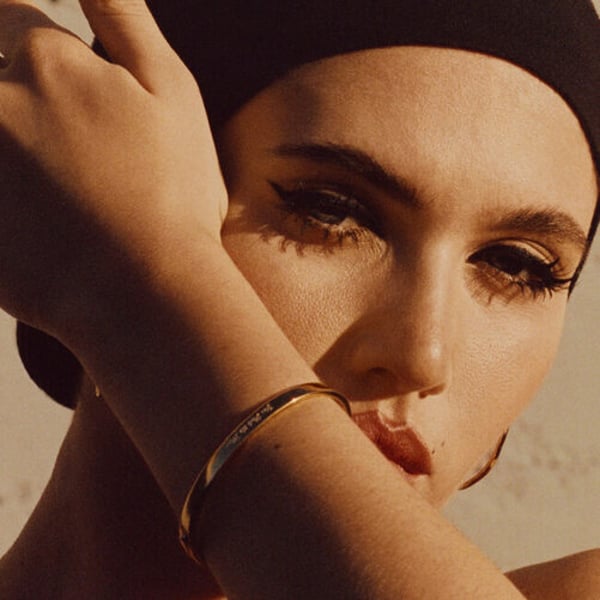
Throughout the campaign, Spiro wears the new Infinity collections as well as Monica Vinader pieces engraved with lyrics from her song ‘You Stole the Show’.
The engravings spotlight the brand’s personalisation services, “transforming jewellery into objects of meaning, from song lyrics and private messages to personal mantras”, the retailer said.
The brand, which has several stores in London, plus stores at Liverpool One, in Manchester and Edinburgh, appointed a new CEO in November. Sebastian Picardo now heads the previously family-run brand founded by siblings Monica (artistic director) and Gabriela (non-exec director) in 2008.
At the time of his appointment, the sisters said Picardo is “perfectly placed to guide our next phase of growth” and will work to accelerate the business’s global reach, “scaling innovation, inspiring existing and new audiences, and setting new standards for modern luxury jewellery”.