British supermarket group Sainsbury’s said on Sunday it has terminated talks with Chinese e-commerce giant JD.com over selling the Argos general merchandise retailer, a day after confirming discussions were underway.
Reuters
“JD.com has communicated that it would now only be prepared to engage on a materially revised set of terms and commitments, which are not in the best interests of Sainsbury’s shareholders, colleagues and broader stakeholders” the company said in a statement.
The company repeated its forecast for retail underlying operating profit of around 1 billion pounds ($1.36 billion) for the 2025–2026 financial year.
JD.com declined to comment.
Sainsbury’s, which has been focusing more on food since Simon Roberts became CEO in 2020, had on Saturday confirmed it was in talks with JD.com for the sale of Argos.
Argos, which Sainsbury’s bought in 2016 for 1.1 billion pounds, is Britain’s second-largest general merchandise retailer, with the third most-visited retail website in the country and more than 1,100 collection points.
Britain’s second-largest supermarket group, trailing only Tesco, said on Sunday that it is committed to driving improvements at Argos after the business traded in line with expectations over the summer, helped by good weather.
“We are taking focused action to extend range, enhance digital capabilities and improve relevance to grow frequency and spend in Argos,” Sainsbury’s said in its statement.
London-listed Sainsbury’s is valued at 7.05 billion pounds ($9.56 billion), while Hong Kong-listed JD.com has a market capitalisation of HK$418.76 billion ($53.82 billion), according to LSEG data. Sainsbury’s in July sold off its Sainsbury’s Bank’s travel money business to Fexco Group.
This has followed last year’s sale of Sainsbury’s Bank’s personal loan, credit card and retail deposit portfolios to NatWest Group the disposal of its cash machines business to NoteMachine and the sale of the Argos Financial Services cards portfolio to NewDay Group.
US and Indian trade negotiators begin two days of talks Wednesday as they try to reach a deal amid geopolitical turbulence after Washington hit New Delhi with huge tariffs over its purchases of Russian oil.
The gem and jewellery industry hopes an improved tariff rate will turn around export rates to the US – GJEPC – India- Facebook
The 50% levies on most goods was imposed in August, with US officials arguing the imports of discounted Russian crude effectively bankroll Moscow’s war in Ukraine. Deputy US Trade Representative Rick Switzer’s visit comes a week after Prime Minister Narendra Modi embraced Russian President Vladimir Putin in New Delhi.
India’s foreign ministry described Switzer’s meetings as a “familiarisation” trip. India was among the first countries to begin trade talks after President Donald Trump unveiled sweeping tariffs on most US trade partners in April. But it is one of the few major economies still without an agreement, raising risks for jobs, economic growth, and markets.
India is the world’s fastest-growing major economy and recorded a $45.8 billion goods trade deficit with the US in 2024. Large export categories such as smartphones and generic drugs are exempt from Trump’s tariffs, but many labour-intensive industries are not.
That’s a serious blow for a country already struggling to generate well-paid jobs for millions of young graduates, and the turmoil threatens Modi’s ambition to lift the country into high-income status. Exports fell nearly 12% year-on-year in October, driven by a plunge in US-bound shipments.
The Global Trade Research Initiative (GTRI) estimates that labour-heavy sectors- gems and jewellery, textiles and seafood- saw export drops of 37-60% between May and September. Foreign investors have dumped more than $16 billion in Indian equities this year, helping push the rupee to a record low past 90 per dollar.
The International Monetary Fund has also cut India’s 2026-27 growth forecast from 6.4% to 6.2%, assuming “prolonged 50% US tariffs”. Exports could shrink to about $49.6 billion this fiscal year, from $86.5 billion last year, potentially knocking up to 80 basis points off growth, according to the GTRI.
India enthusiastically bought discounted Russian crude after the 2022 invasion of Ukraine as Moscow was hammered with severe sanctions including on its sale of oil. But Trump’s decision to link trade policy to geopolitics upended US-India relations in August, with roughly half of the tariff burden stemming from Washington’s attempt to penalise those purchases.
The US president has repeatedly claimed India either plans to stop, or has already mostly stopped, buying Russian oil- a claim New Delhi has neither confirmed nor denied. But when in the Indian capital, Putin offered to “continue uninterrupted shipments of fuel.” Modi did not comment directly on oil flows.
However, top buyer Reliance Industries said in November it stopped importing Russian oil for its export-focused refinery, while smaller refiners like HPCL-Mittal Energy have said they have stopped entirely.
Analysts at trade intelligence platform Kpler expect a “notable dip” in India’s December-January imports. Whether that decline will sway Washington is unclear.
Negotiating a trade pact is complicated by the need to address Trump’s so-called reciprocal tariffs, though both tracks are linked, officials say.
“These are two separate, parallel negotiations that are going on, but one will feed into another,” Commerce Secretary Rajesh Agrawal told an industry event last week.
Relations have improved since August, with several smaller deals advancing. That includes US approval in November for two arms sales worth nearly $93 million, and New Delhi’s “significant” deal for the US to supply nearly 10 percent of its liquefied petroleum gas (LPG) imports.
Energy commitments have anchored past US trade deals, and experts say the LPG contract may help convince Washington that India is reducing its reliance on Russia.
Chanel will stage its next cruise show in Biarritz on April 28, 2026, the Paris based fashion house revealed on Wednesday.
Chanel – Courtesy
The brand will present what will be its Cruise 2026/27 collection with a runway show in Biarritz, an historic seaside resort on France’s Atlantic coast.
“Biarritz plays a fundamental role in the history of Chanel,” commented Bruno Pavlovsky, president of Chanel Fashion, in a release.
“We are delighted that Matthieu Blazy has chosen this destination, so dear to the house, to present his first vision of the Cruise collection,” he added.
The news comes just one week after Chanel’s creative director Blazy staged a highly acclaimed Métiers d’Art show in a disused New York subway station in lower Manhattan.
In 1915, buoyed by the success of her boutique in Deauville, Gabrielle Chanel set up her first couture house in the Villa de Larralde, an elegant neo feudal mansion in Biarritz. It comprised a boutique and an atelier of some 60 petites mains, or skilled artisans, where she presented her collections.
The free-spirited and sporty atmosphere of this iconic seaside resort in south-western France helped forge her vision of fashion and design, making Biarritz an essential chapter in the construction of her style, the house noted.
Outlet destinations have been among the most buoyant retail centres in recent years and on Wednesday, retail property giant Landsec provided yet more evidence of that trend.
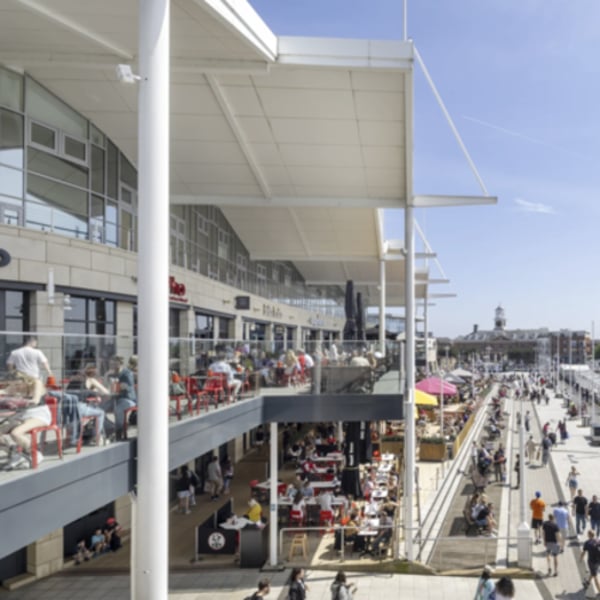
Gunwharf Quays
It said it recorded 8.1% year-on-year sales growth across its outlets during Black Friday week, continuing a year of sustained growth across its outlet portfolio, which also reported a record-breaking year in 2024.
Its outlet trio, Gunwharf Quays, Braintree Village and Clarks Village, generated a combined spend of £16.3 million across the week, with footfall up 8.6% year on year, “demonstrating the continued strength of in-person retail during key calendar moments”. But it also demonstrated just how much consumers are focused on discounts given that they visited destinations already offering discounts for the even greater markdowns available during that week.
Landsec said this “builds on a consistently strong trading performance across the outlet portfolio and follows a record-breaking year for spend across major Landsec retail destinations during the last financial year”.
Braintree Village enjoyed a record-breaking week, with Saturday seeing its highest single day of footfall since the pandemic. Clarks Village recorded its highest-ever sales day. And Gunwharf Quays saw its biggest-ever sales week, building on last year’s record. The outlet also recorded its highest-ever single-day revenue and footfall up 9.8% year on year.
The landlord added that individual store success was strong, with 25 brands achieving record sales weeks at Gunwharf Quays alone, while a further nine brands set new records on Saturday.
And what were consumers buying? Across the outlet portfolio, shoppers spent the most on health & beauty (+46% week on week), gifts, cards, toys and books (+43%), and accessories (+40%). These categories have continued to show strong momentum in 2025 across Landsec’s outlet destinations.







 Politics8 years ago