Connect with us

Business

UK treasury chief says ‘harsh global headwinds’ from wars and tariffs are harming the country’s economic outlook

Published

on


Britain’s Treasury chief warned Monday that “harsh global headwinds” from wars in Ukraine and the Middle East and U.S. President Donald Trump’s tariffs have worsened the U.K.’s economic outlook since the governing Labour Party won power last year.

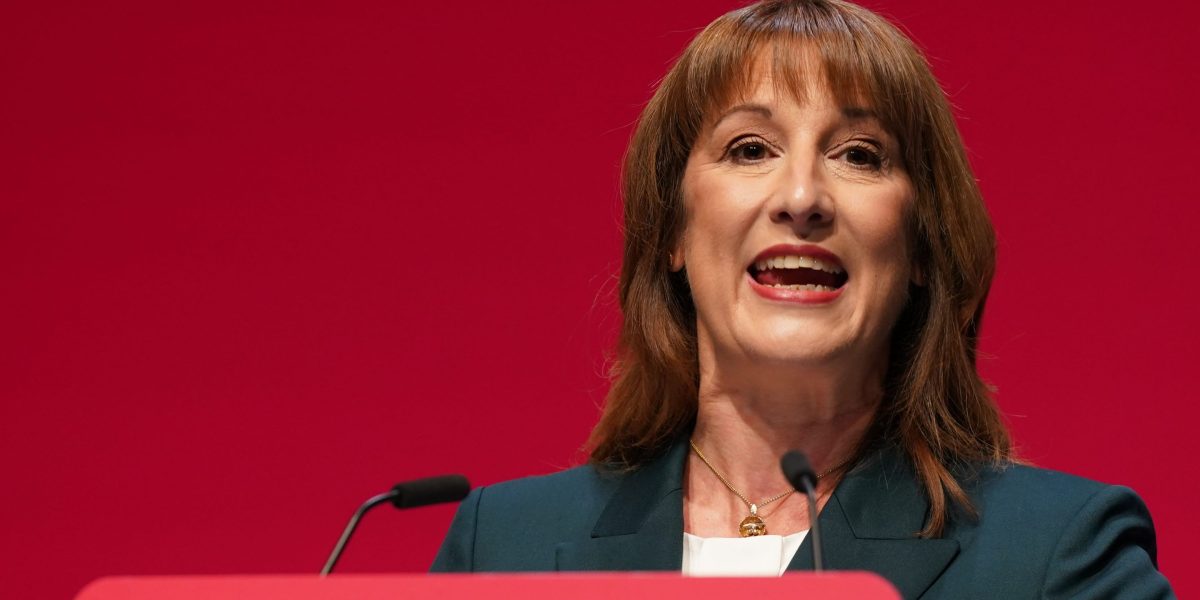
Chancellor of the Exchequer Rachel Reeves told Labour’s annual conference that her economic plans must be “fit for an uncertain world,” a hint she will raise taxes in her autumn budget on Nov. 26.

“In the last year the world has changed, and we are not immune to that change,” she told the BBC before the speech. “Whether it is wars in Europe and the Middle East, whether it is increased barriers to trade because of tariffs coming from the United States, whether it is the global cost of borrowing, we’re not immune to any of those things.”

Since ending 14 years of Conservative rule in July 2024, Labour has struggled to deliver the economic growth it promised. Inflation remains stubbornly high and the economic outlook subdued, frustrating efforts to repair tattered public services and ease the cost of living.

Labour pledged during the election not to raise taxes on working people, but has since hiked levies on employers.

Reeves told the BBC she was “determined not to increase those key taxes that working people pay,” stopping short of ruling out any hikes at all.

In her speech, interrupted by repeated standing ovations from hundreds of Labour members — and by a lone pro-Palestinian protester — Reeves leavened her sober assessment of the country’s finances with a touch of optimism. She outlined the government’s investments in defense, transport, energy and education, claiming they were making a difference to millions of people.

She pledged to end long-term youth unemployment, saying everyone under 25 who has been unemployed for 18 months will be offered guaranteed paid work. One in eight 16–24-year-olds in Britain — about 1 million people — is currently not in education, work, or training.

Reeves also said the government was working on an “ambitious agreement on youth mobility” with the 27-nation European Union. British citizens lost the right to move and work freely in the EU when the country left the bloc in 2020.

Thousands of Labour members are in Liverpool, northwest England, for the party conference -– a mix of policy forum and pep rally that this year is lacking in pizazz.

The hard right is a key concern

Labour lags behind Nigel Farage ’s hard-right Reform UK party in opinion polls, and some party members are losing faith in Prime Minister Keir Starmer, even though there may be four years until the next election.

Many are rallying around Andy Burnham, the ambitious Labour mayor of Manchester, who said Sunday that the party is in “peril” and needs to change direction.

Reeves took aim at those in Labour, such as Burnham, who argue the government should borrow more to spend more on public services. She cited former Conservative Prime Minister Liz Truss’ disastrous 2022 plan for unfunded tax cuts, which sent the value of the pound plunging and the cost of government borrowing soaring.

“When spending gets out of control, when market confidence is lost … it is felt immediately in the growing cost of essentials, and rising interest rates,” Reeves said.

The threat posed by Reform is top issue among Labour delegates at the four-day conference, which ends Wednesday. Farage’s party has only five lawmakers in the 650 seat House of Commons, and Labour has more than 400. Nonetheless, Starmer said Reform is now Labour’s chief opponent, not the main opposition Conservatives.

Starmer has described the fight between Labour and Reform as “a battle for the soul of this country.” On Sunday he accused Farage of sowing division with plans by Reform to deport immigrants who are in the U.K. legally. Starmer said such a policy would be “racist” and “immoral.”

The U.K. government has toughened its own language about immigration, though. Home Secretary Shabana Mahmood told the conference the government must question some of “the assumptions and legal constraints” around migration.

She said she plans to raise the bar immigrants must meet to gain permanent residency. Under the proposals, people will have to have a “high standard” of English, no criminal record and give back to their communities to get the right to settle in the U.K.

“Unless we have control of our borders, and until we can decide who comes in and who must leave, we will never be the open, tolerant and generous country that I know we all believe in,” she said.

Fortune Global Forum returns Oct. 26–27, 2025 in Riyadh. CEOs and global leaders will gather for a dynamic, invitation-only event shaping the future of business. Apply for an invitation.


Source link

Continue Reading

Business

Why Jollibee is turning to a U.S. IPO to fuel global growth

Published

on


Good morning. Chickenjoy—its crispy, juicy fried chicken—and Jolly Spaghetti are signature menu items at Jollibee, a Filipino fast-food chain that is building a growing fan base in the U.S. Now, the company is setting its sights on Wall Street. 

The Philippines-based Jollibee Foods Corporation (JFC), the restaurant’s parent company, disclosed earlier this month that it plans to spin off its international operations and pursue a U.S. initial public offering for that business. The contemplated spin-off and listing are targeted for late 2027, leaving “quite a bit of time ahead of us for the work to be done,” Jollibee Global CFO Richard Shin said during a Jan. 14 media roundtable.

JFC, which includes restaurant brands such as Smashburger and The Coffee Bean & Tea Leaf, is currently traded as a single group on the Philippine Stock Exchange and operates in 33 countries. Over the past 15 quarters, JFC’s international network has posted a 26.7% compound annual growth rate, outpacing the group’s overall 15.1% rate of expansion. The separation reflects increasingly distinct strategic profiles for the domestic and international businesses, Shin said.

In March 2025, Jollibee launched its first U.S. franchising program. After opening its first North American location in 1998 in Daly City, California, the brand has since expanded to more than 100 locations across the U.S. and Canada as of early 2026.

Why go the route of a U.S. IPO? “I think there’s a fact that we can all agree on: the U.S. capital markets have deep investor-based experience in valuing global consumer and restaurant growth companies,” Shin said on the call.

Many such companies are still growing into their potential yet are often rewarded with higher multiples and valuations, he said. While that outcome is not guaranteed for JFC, a U.S. listing offers greater capital depth, liquidity, and broader analyst coverage, with any final decision subject to valuation and required approvals, he added.

The IPO market in the U.S. is heating up again, Fortune’s Jeff John Roberts writes in a new feature article. “While 2026 will almost certainly not match the banner year of 1999, which saw 476 companies go public, investors should have far more choices than they did four years ago, when just 38 firms held an IPO,” he writes.

Shin also framed the separation of JFC in terms of simplifying how investors assess the corporation, noting the group includes businesses at different stages of their life cycles, with varying returns and opportunities. Distinct domestic and international entities, he suggested, could offer investors clearer, more targeted investment options as the strategic profiles of the two segments continue to diverge.

Reasons for pursuing the separation include improved transparency, discipline in capital allocation, execution against the growth strategy, and the ability to attract an investor base aligned with the risk–return profile of each business rather than being judged solely on short-term financial metrics, he said.

“The transaction is aligned with the Jollibee Group’s long-term value creation strategy,” Shin said.

With its eyes on Wall Street, Jollibee is betting that global taste and investor appetite, will be on its side.

Sheryl Estrada
sheryl.estrada@fortune.com

Leaderboard

Helen Cai was appointed senior executive vice president and CFO of Barrick Mining Corporation (NYSE: B), effective March 1, following the departure of long-serving finance chief Graham Shuttleworth, who will be leaving the company after its year-end results. Cai has served on Barrick’s board since November 2021 and brings more than 20 years of experience in equity research, corporate finance, capital markets, and M&A at firms across the mining, industrial, and technology sectors, primarily with Goldman Sachs and China International Capital Corporation.

Meredith Peck was named CFO of Zekelman Industries, the largest independent steel pipe and tube manufacturer in North America. Peck succeeds Mike Graham, who will retire on May 15 following a planned transition period. She brings more than 20 years of financial leadership experience to Zekelman Industries and most recently served as CFO for COTSWORKS, Inc., after earlier roles as the company’s controller and then vice president of finance and administration. Earlier in her career, Peck held senior leadership roles at KeyBank and began her career in public accounting at PwC, and she is also a former U.S. Coast Guard officer.

Big Deal

In a blog post on Sunday, OpenAI CFO Sarah Friar provided an update on the tech giant, including its revenue. In 2023, revenue reached $2 billion in annual recurring revenue; it rose to $6 billion in 2024 and jumped to more than $20 billion in 2025.​

This revenue growth closely tracked an expansion in computing capacity. OpenAI’s computing capacity rose from 0.2 gigawatts (GW) in 2023 to 0.6 GW in 2024 and about 1.9 GW in 2025.​

Friar writes: “Compute is the scarcest resource in AI. Three years ago, we relied on a single compute provider. Today, we are working with providers across a diversified ecosystem. That shift gives us resilience and, critically, compute certainty.”​

In an accompanying LinkedIn post, Friar said that from a finance perspective, demand is real and growing at rates never seen by any company previously, and that customers are paying in proportion to the value delivered. She added that capital is being deployed deliberately into the constraints that actually matter, especially compute. 

Going deeper

ACCA (the Association of Chartered Certified Accountants) and IMA (Institute of Management Accountants) have published a Global Economic Conditions Survey, based on the results of their Q4 2025 poll. Members from around the world share their views on the macroeconomic environment. 

Confidence among CFOs improved somewhat, but remained below its historic average, and the key indicators point to caution at their firms, according to the findings. Accountants flagged economic pressure, cyber disruption, and geopolitical uncertainty as the top risk priorities, underscoring that risks are increasingly complex and interlinked. 

“Accountants remain cautious entering 2026, amid a highly uncertain global backdrop,” Jonathan Ashworth, chief economist of ACCA, said in a statement. “The global economy performed better than expected in 2025 and looks set to remain resilient in 2026 amid recent monetary easing by central banks, stock market gains, supportive fiscal policies in key countries, and the ongoing global AI boom.” However, there remains significant uncertainty, amid a wide range of risks, “not least on the geopolitical front, which are more heavily skewed to the downside,” he said.

Overheard

“We are entering an IPO ‘mega‑cycle’ that we expect will be defined by unprecedented deal volume and IPO sizes.” 

—Goldman Sachs’ global co-head of investment banking, Kim Posnett, recently told Fortune. Posnett discussed how she sees the current business environment and the most significant developments in 2026 in terms of AI, the IPO market, and M&A activity. Posnett, named among the leaders on Fortune’s Most Powerful Women list, is one of the bank’s top dealmakers and also serves as vice chair of the Firmwide Client Franchise Committee and as a member of the Management Committee.


Source link

Continue Reading

Business

Khosla-backed Formulary raises oversubscribed $4.6 million seed round for its AI-powered private fund manager software

Published

on


Alfia Ilicheva came from the world of public markets, including four years at one of the world’s largest hedge funds, Bridgewater. But when she transitioned over to the private side, including serving as the CEO of an Apollo-backed investment platform, she realized the difficulty of fund administration for operations like private equity and venture capital. Instead of having access to real-time and accurate data like at Bridgewater, which can rely on publicly available information, this new world was filled with manually compiled and fragmented data subject to human error and inconsistent metrics.  “How could it be that hedge funds are so into the future and private capital markets are so backward,” she remembers thinking. 

As private markets explode and AI makes automation increasingly possible, Ilicheva saw an opportunity to build the next generation of fund administration software for everyone from venture capital outfits to PE giants like Apollo. After initially planning to bootstrap the project, which she named Formulary, Ilicheva was introduced to Hari Arul, a partner at Khosla Ventures, who immediately saw the appeal of the idea. Khosla is leading Formulary’s $4.6 million seed round, which Ilicheva says is three times oversubscribed, with participation from Human Ventures, Serena Williams’s venture firm, and others. 

In the red-hot field of private investments, buoyed by the rise of private credit and massively valued companies like SpaceX and OpenAI, fund administration may not be the most alluring area for innovation. But the ability to track investments, returns, and performance—and accurately convey the information to investors, or limited partners—is a necessary foundation. 

The existing options fall into two camps: the service side, or high-touch accounting companies, like SS&C and Citco, or the software side, like Carta. As Ilicheva interviewed general partners and former clients in her user research, she realized that nearly everyone was dissatisfied with the existing options to the point that most turned to shadow fund administration, where they would hire outside firms but keep their own books at the same time. “When you raise a fund, your dream is to generate alpha by investing capital, not redoing someone’s work,” Ilicheva said. 

Ilicheva planned to find a happy medium between the two models by leveraging AI to massively scale up the service approach, creating software for their own in-house accountants, which Ilicheva playfully calls bionic accountants. “They’re really focused on having a grip on the numbers and delivering service, but they’re not manually entering things in an Excel spreadsheet, which has been the industry’s burden for the past decades,” she said.  

The challenge in creating a tech-enabled services company, of course, is scale, with a pure SaaS model able to grow at a much faster clip. When I asked Khosla’s Arul how he thought about the approach, he said the key is to deliver the vast majority of the product through technology: “It’s important for any entrepreneur or any investor to look at an AI-enabled services business and say, the margin of how this business runs looks more like a technology company than a services company.” 

Arul said that while Khosla is not yet using Formulary, which is just now coming out of stealth, he’s optimistic for a future where tedious processes like ensuring data accuracy for LPs can be fully, reliably automated. Ilicheva mentioned one possible future use case for Formulary as drafting LP letters, which Arul wholeheartedly endorsed, along with a portal where investors could communicate directly with the system to understand the value of positions, fund deployment, and future capital calls. “[That] sounds pie in the sky relative to what the reality is today,” Arul said, “But it doesn’t feel out of reach.” 

Leo Schwartz
X:
 @leomschwartz
Email: leo.schwartz@fortune.com

Submit a deal for the Term Sheet newsletter here.

Joey Abrams curated the deals section of today’s newsletter. Subscribe here.

This story was originally featured on Fortune.com


Source link

Continue Reading

Business

Leaders at Davos are obsessing over how to use AI at scale

Published

on


  • In today’s CEO Daily: Fortune‘s AI editor Jeremy Kahn reports on the AI buzz at Davos
  • The big story: SCOTUS could upend Trump’s leverage to acquire Greenland.
  • The markets: Jolted by Trump’s renewed tariff threats.
  • Plus: All the news and watercooler chat from Fortune.

Good morning. I’m on the ground in Davos, Switzerland, for this year’s World Economic Forum. As Diane wrote yesterday, U.S. President Donald Trump’s arrival later this week along with a large delegation of U.S. officials eclipses pretty much every other discussion at Davos this year. But, when people here aren’t talking about Trump, they are talking about AI.

At Davos last year, the hype around AI agents was pierced by the shock of DeepSeek’s R1 model, which was released during the conference. We’ll see if a similar bit of news upends the AI narrative again this year. (There are rumors that DeepSeek is planning to drop another model.) But, barring that, business leaders seem to be less wowed by the hype around AI this year and more concerned with the nitty-gritty of how to implement the technology successfully at scale.

On Monday, Srini Tallapragada, Salesforce’s chief engineering and customer success officer, told me the company is using ‘forward deployed engineers’ to tighten feedback loops between customers and product teams. Salesforce is also offering pre-built agents, workflows, and playbooks to help customers re-engineer their businesses—and avoid getting stuck in “pilot purgatory.”

Meanwhile, at a side event in Davos called A Compass for Europe, that focused on how to restore the continent’s flagging competitiveness, AI was front-and-center. Christina Kosmowski, the CEO of LogicMonitor, told the assembled CEOs that to achieve AI success at scale, companies should take a “top down” approach, with the CEO and leadership identifying the highest value use cases and driving the whole organization to align around achieving them. Neeti Mehta Shukla, the cofounder and chief impact officer at Automation Anywhere, said it was critical to move beyond measuring automation’s impact only through the lens of labor savings. She gave specific customer examples where uplifting data quality, improving customer satisfaction, or moving more workers to new tasks, were better metrics than simply looking at cost per unit output. Finally, Lila Tretikov, head of AI strategy at NEA, said Europe has enough talent and funding to build world-beating AI companies—what it lacks is ambition and willingness to take big bets.

Later, I met with Bastian Nominacher, co-founder and co-CEO of process analytics software platform Celonis. He echoed some of these points, telling me that to achieve ROI with AI generally required three things: strong leadership commitment, the establishment of a center of excellence within the business (this led to an 8x higher return than for companies that didn’t do this!), and finally having enough live data connected to the AI platform.

For further AI insights from Davos, check out Fortune’s Eye on AI newsletter. Meanwhile, Fortune is hosting a number of events in Davos throughout the week. View that lineup here. And my colleagues will be providing more reporting from Davos to CEO Daily and fortune.com throughout the week.—Jeremy Kahn

Contact CEO Daily via Diane Brady at diane.brady@fortune.com

This is the web version of CEO Daily, a newsletter of must-read global insights from CEOs and industry leaders. Sign up to get it delivered free to your inbox.


Source link

Continue Reading

Trending

Copyright © Miami Select.