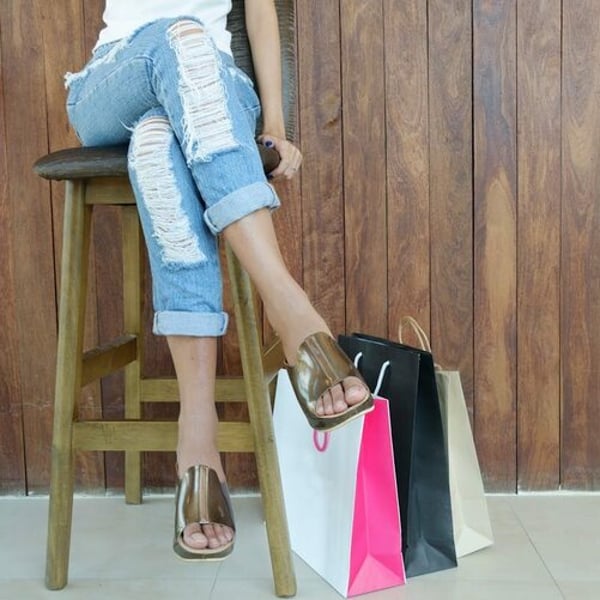
Buying the latest trainers or undertaking a major wardrobe refresh remains a favourite pastime for UK consumers. But just how much are Britons spending on fashion?
Photo: Pexels
Collectively, UK consumers spend over £162 billion on clothing each year and, individually, the average spend is £250 a month on clothes, totalling £3,000 annually, according to a new survey of 2,000 UK adults by credit specialist Aqua.
The study also reveals 25-34-year-olds are the biggest spenders on fashion (£524 a month), followed by 35-44-year-olds (£322 a month).
Unsurprisingly, women spend £459 a month on clothes compared to £150 for men. Meanwhile, Londoners spend the most on fashion compared to other UK cities, averaging £555 a month.
Also, 35% of Britons have bought fashion items in the past 12 months.
Other lifestyle spending
The report also reveals that 80% of Britons agree their lifestyle spending reflects their personal values or identity and “the powerful role of social media in driving financial decisions, and how many of these purchases ultimately lead to regret”.
While eating out tops the list of lifestyle spending categories (56%), beauty (39%) is also ranked highly, “reflecting a growing appetite for convenience and self-care”, while physical self-care services (38%), such as hairdressers and manicures, “further suggest the importance placed on personal presentation and wellness”.
Fashion and beauty combined see a monthly average spend of £399, surpassing food and drink (£251) and technology (£246), “indicating that personal style and aesthetics are still high on the priority list, even amid rising costs”.
Sharvan Selvam, commercial director at Aqua, said: “The data paints a clear picture of where the real financial pressures lie in 2025. While categories like travel and entertainment remain popular, it’s lifestyle-led spending on fashion, tech, and personal development that’s quietly eating up the biggest share of monthly budgets. For households trying to manage their budgets, understanding where the largest chunks of money are really going is the first step to taking back control of their spending.”
Meanwhile, over 70% of adults admit that social media has influenced their lifestyle spending, demonstrating the impact digital platforms have in driving purchasing decisions.
Facebook (49%) emerges as the single most influential platform, followed closely by Instagram (47%) and TikTok (42%), revealing that a clear dominance of visually led, trend-driven content is what fuels spending habits.
However, YouTube (37%) continues to hold a strong position in product discovery and research, while platforms like X (14%), Pinterest (12%), and Snapchat (9%) seemingly influences more niche audiences.
Facebook drives spending for over 35’s, but unsurprisingly, TikTok dominates Gen Z, with 78% of 16-24-year-olds saying they’ve been influenced to shop by what they see on the platform. Among those aged 25 to 34, Instagram takes the lead, swaying 61% of this age group.
But this influence comes at a cost. Some 61% of adult Britons, an estimated 34 million people, admit they’ve regretted purchases made as a result of social media, trends, or peer pressure. This figure highlights the emotional and financial fallout of lifestyle spending, where the desire to keep up with online trends often outweighs practical considerations such as value or long-term usage.
The demerger of Unilever‘s ice cream division, to be named ‘The Magnum Ice Cream Company,’ which had been delayed in recent months by the US government shutdown, will finally go ahead on Saturday, the British group announced.
Reuters
Unilever said in a statement on Friday that the admission of the new entity’s shares to listing and trading in Amsterdam, London, and New York, as well as the commencement of trading… is expected to take place on Monday, December 8.
The longest federal government shutdown in US history, from October 1 to November 12, fully or partially affected many parts of the federal government, including the securities regulator, after weeks without an agreement between Donald Trump‘s Republicans and the Democratic opposition.
Unilever, which had previously aimed to complete the demerger by mid-November, warned in October that the US securities regulator (SEC) was “not in a position to declare effective” the registration of the new company’s shares. However, the group said it was “determined to implement in 2025” the separation of a division that also includes the Ben & Jerry’s and Cornetto brands, and which will have its primary listing in Amsterdam.
“The registration statement” for the shares in the US “became effective on Thursday, December 4,” Unilever said in its statement. Known for Dove soaps, Axe deodorants and Knorr soups, the group reported a slight decline in third-quarter sales at the end of October, but beat market expectations.
Under pressure from investors, including the activist fund Trian of US billionaire Nelson Peltz, to improve performance, the group last year unveiled a strategic plan to focus on 30 power brands. It then announced the demerger of its ice cream division and, to boost margins, launched a cost-saving plan involving 7,500 job cuts, nearly 6% of the workforce. Unilever’s shares on the London Stock Exchange were steady on Friday shortly after the market opened, at 4,429 pence.
This article is an automatic translation. Click here to read the original article.
Burberry has named a new chief operating and supply chain officer as well as a new chief customer officer. They’re both key roles at the recovering luxury giant and both are being promoted from within.
Matteo Calonaci becomes chief operating and supply chain officer, moving from his role as senior vice-president of strategy and transformation at the firm.
In his new role, he’ll be oversee supply chain and planning, strategy and transformation, and data and analytics. He succeeds Klaus Bierbrauer, who’s currently Burberry supply chain and industrial officer. Bierbrauer will be leaving the company following its winter show and a transition period.
Matteo Calonaci – Burberry
Meanwhile, Johnattan Leon steps up as chief customer officer. He’s currently currently Burberry’s senior vice-president of commercial and chief of staff. In his new role he’ll be leading Burberry’s customer, client engagement, customer service and retail excellence teams, while also overseeing its digital, outlet and commercial operations.
Both Calonaci and Leon will join the executive committee, reporting to Company CEO Joshua Schulman.
JohnattanLeon – Burberry
Schulman said of the two execs that the appointments “reflect the exceptional talent and leadership we have at Burberry. Both Matteo and Johnattan have been instrumental in strengthening our focus on executional excellence and elevating our customer experience. Their deep understanding of our business, our people, and our customers gives me full confidence that their leadership will help drive [our strategy] Burberry Forward”.
Traditional and occasion wear designer Puneet Gupta has stepped into the world of fine jewellery with the launch of ‘Deco Luméaura,’ a collection designed to blend heritage and contemporary aesthetics while taking inspiration from the dramatic landscapes of Ladakh.
Hints of Ladakh’s heritage can be seen in this sculptural evening bag – Puneet Gupta
“For me, Deco Luméaura is an exploration of transformation- of material, of story, of self,” said Puneet Gupta in a press release. “True luxury isn’t perfect; it is intentional. Every piece is crafted to be lived with and passed on.”
The jewellery collection features cocktail rings, bangles, chokers, necklaces, and statement evening bags made in recycled brass and finished with 24 carat gold. The stones used have been kept natural to highlight their imperfect and unique forms and each piece in the collection has been hammered, polished, and engraved by hand.
An eclectic mix of jewels from the collection – Puneet Gupta
Designed to function as wearable art pieces, the colourful jewellery echoes the geometry of Art Deco while incorporating distinctly South Asian imagery such as camels, butterflies, and tassels. Gupta divides his time between his stores in Hyderabad and Delhi and aims to bring Indian artistry to a global audience while crafting a dialogue between designer and artisan.