British retailers have welcomed the government’s decision to start charging customs duties on low-value e-commerce parcels but said a March 2029 timeline is too late and risks making the country an international outlier.
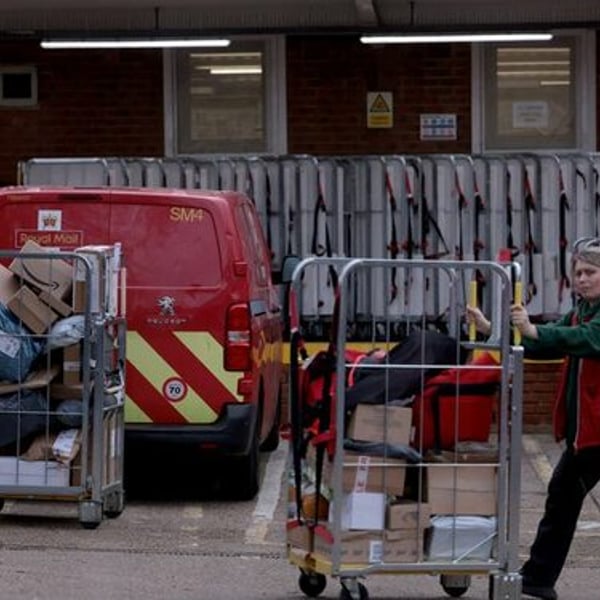
A Royal Mail worker pushes a trolley of parcels at the Streatham delivery office as the UK government clear a 3.57 billion pound takeover offer by Czech billionaire Daniel Kretinsky in London, Britain, December 16, 2024 – REUTERS/Hannah McKay/File Photo
UK retailers have been squeezed by rapidly growing ultra-low-cost platforms like AliExpress, Shein, Temu, and more recently Amazon Haul, which send packages directly from factories in China to shoppers’ doorsteps, benefiting from a customs waiver on parcels worth less than 135 pounds ($179).
“I will stop overseas online firms from undercutting our high street” by applying customs duty on parcels of any value, Reeves told parliament in her budget speech on Wednesday. But the finance ministry said the change would be made in March 2029 “at the latest”, with a consultation on the policy to run until March next year.
Helen Dickinson, chief executive of the British Retail Consortium trade body, said the proposed time frame is “simply too long”, citing government figures that 1.6 million parcels are taking advantage of the exemption every day, twice as many as last year. “Businesses cannot afford any delay,” she said.
The US, the biggest market for Shein and Temu, has already ended its customs waiver, dubbed “de minimis,” on parcels worth less than $800, scrapping it for imports from China and Hong Kong in May before removing it across the board in August. The US initially tried to remove the waiver in February with just 48 hours’ notice, but was forced to row back after more than a million packages piled up at New York’s John F. Kennedy International Airport.
The 2029 timeline also puts Britain well behind the European Union, which two weeks ago brought forward a plan to scrap its equivalent customs waiver, on packages under 150 euros, to 2026 from 2028. Last year South Africa began charging value added tax on low-value parcels, while Brazil introduced a 20% tax on international purchases of up to $50.
Removing de minimis adds to costs for online retailers sending direct to consumers, denting their competitiveness compared to traditional retailers who pay duties on products imported in bulk. “The gap between online and high street prices will shrink, potentially encouraging shoppers to return to UK retailers,” said Andrew Thurston, customs duty senior manager at accountancy firm MHA.
Dan Finley, CEO of Debenhams Group, which owns online fast-fashion retailer Boohoo, said delaying implementation until 2029 “means lost revenue for the UK and continued unfairness in the market.” Boohoo sales have declined significantly as Shein has grown.
Sainsbury’s, owner of Argos which offers an array of products similar to Amazon and Temu, also said it was disappointed by the proposed timeline and there is a risk the UK becomes an international outlier.
Puma is continuing its fruitful fashion-meets-sport collab with UK streetwear brand Represent, this time “rewriting the playbook of basketball-inspired staples”.
Puma x Represent
Fusing “Heritage Hoops Energy with Modern Streetwear”, it brings the two brands neatly together with a campaign fronted by German NBA star Dennis Schröder who “embodies the collection’s balanced fusion of court performance and off-court style”.
The “simple yet elevated collection” spans footwear and apparel that’s “highlighted by expressive and detailed cut-and-sew designs”, as well as a fresh interpretation of Puma’s All-Pro Nitro 2 sneaker.
Its “court-ready” Jersey and Shorts debut comes with a newly designed Puma x Represent graphic, featuring mesh construction and contrasting trim “that nods to retro game-day uniforms”.
The range is, of course, accompanied by “courtside essentials” including a Graphic T-Shirt and Hoodie, “pieces that bring bold visual detailing to the championship collaboration”.
A Coach Jacket and accompanying Pants also “comprise comfortable warm-up layers with everyday wearability”.
For footwear, Puma x Represent presents a re-envision All-Pro Nitro 2, a performance design underpinned by “explosive Nitro cushioning and a lightweight Ultraweave upper”. The black and white two-tone colourway is punctuated by subtle logo hits on the heel and tongue.
Complementing one of Puma’s “most modern examples of basketball performance technology”, the collection brings “a touch of ‘80s flair with the low-top Majesty”.
Spanish label Toni Pons continues to expand its global retail network and has opened a new store in the US. The Catalan espadrille brand has opened in Miami Beach, Florida, at 1656 Lenox Ave. It is the brand’s second store in the state, following its opening at the end of 2024 in Boca Raton.
Interior of the new Toni Pons store in Miami – Toni Pons
The Spanish footwear brand, which will celebrate its 80th anniversary in 2026, announced the opening via its profile on the professional networking platform LinkedIn and described it as “a new chapter in its international journey.”
Based in Girona, the footwear brand was founded in 1946 and currently operates more than 50 company-owned stores in Spain and abroad. The online channel is also a key pillar of its business, and the brand is available at around 4,000 multi-brand points of sale across nearly 90 markets. In financial terms, the brand records annual turnover of approximately €32 million.
This article is an automatic translation. Click here to read the original article.
In another change to Kering’s organisational structure: the group has announced that Bartolomeo Rongone, CEO of Bottega Veneta, will leave the group on March 31, 2026 to pursue new career opportunities.
Bartolomeo Rongone and Remo Ruffini – Moncler
The executive will step down from his role at Bottega Veneta on March 31, 2026, and will be appointed CEO of the Moncler Group with effect from April 1, 2026.
Under the Moncler Group’s new organisational set-up, Remo Ruffini will serve as executive chairman, retaining responsibility for creative direction and continuing to play a central role in governance and in shaping the group’s strategic direction.
This article is an automatic translation. Click here to read the original article.